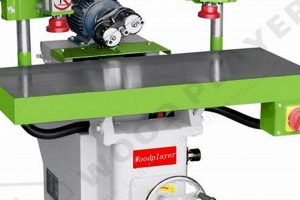
Pneumatically powered automation solutions tailored for the woodworking industry are a core offering from Festo. These systems encompass a range of devices, from air-driven clamps and positioners to sophisticated control units, designed to enhance the precision and efficiency of wood processing tasks. For example, an automated sanding line might utilize these pneumatic components to ensure consistent pressure and motion across the workpiece surface.
The incorporation of such automated systems into woodworking operations provides significant advantages. Production times are often reduced, while the consistency and quality of the finished product are improved. Historically, the integration of automation into woodworking has allowed for greater output with less manual labor, leading to increased profitability and competitiveness in the market.
The following sections will delve into specific applications, benefits regarding precision and efficiency, safety features, and integration strategies within the woodworking sector.
Optimizing Woodworking Processes
The subsequent tips aim to improve the utilization and effectiveness of automated pneumatic systems in woodworking, contributing to enhanced operational performance.
Tip 1: Precise Component Selection: Select pneumatic cylinders and valves with stroke lengths and flow rates that are specifically tailored to the requirements of each woodworking application. This ensures optimal speed and force, preventing inefficiencies and potential damage to materials.
Tip 2: Implement Centralized Air Distribution: Design a centralized air distribution system with adequately sized piping and filters. This maintains consistent air pressure throughout the woodworking facility, minimizing pressure drops that can impact the performance of automated tools.
Tip 3: Prioritize Regular Maintenance: Establish a routine maintenance schedule for pneumatic equipment, including the lubrication of cylinders, cleaning of filters, and inspection of hoses and fittings. This proactive approach extends the lifespan of equipment and prevents costly downtime.
Tip 4: Optimize Control System Programming: Refine the programmable logic controller (PLC) programming to streamline the sequencing of pneumatic actions. Precise control algorithms minimize unnecessary movements and optimize cycle times for each woodworking process.
Tip 5: Employ Energy-Efficient Components: Integrate energy-efficient valves and cylinders that minimize compressed air consumption. This reduces operational costs and promotes environmentally responsible practices within the woodworking facility.
Tip 6: Conduct Thorough Risk Assessments: Perform comprehensive risk assessments to identify potential hazards associated with automated pneumatic systems. Implement appropriate safety measures, such as safety light curtains and emergency stop buttons, to protect personnel from injury.
Tip 7: Provide Comprehensive Training: Ensure that all personnel operating and maintaining automated pneumatic systems receive thorough training. This minimizes the risk of human error and maximizes the efficiency of woodworking processes.
Implementing these practices allows for maximized productivity, improved accuracy, and enhanced safety protocols, leading to a more efficient and cost-effective woodworking operation.
The concluding section will provide a summary of key considerations for those looking to incorporate advanced solutions into their woodworking processes.
1. Pneumatic Precision
Pneumatic precision, characterized by the accuracy and repeatability of air-powered actions, is paramount in woodworking processes involving automated systems. The reliable operation of components dictates the quality and efficiency achieved in tasks such as cutting, shaping, and assembling wood products. This attribute is particularly relevant when considering integrated solutions.
- Consistent Clamping Force
The capacity to apply uniform clamping force is critical in assembly and bonding operations. Pneumatic cylinders, when properly regulated, exert repeatable pressure, ensuring consistent adhesion and joint integrity. Deviation in clamping force can lead to misalignment, weak bonds, and compromised structural integrity of the final product. Festo components, calibrated for precise pressure control, minimize such inconsistencies.
- Accurate Positioning Systems
Automated cutting and routing require precise positioning of the workpiece relative to the cutting tool. Pneumatic actuators drive positioning systems, ensuring accurate movements and alignment. Imprecise positioning results in dimensional errors, material waste, and potential damage to tooling. Festos servo-pneumatic positioning systems provide enhanced accuracy and responsiveness, addressing these challenges.
- Controlled Motion Profiles
The smoothness and consistency of motion profiles are important in processes such as sanding and finishing. Pneumatic drives, when coupled with sophisticated control algorithms, deliver controlled acceleration and deceleration, preventing abrupt movements that can mar the surface finish. Jerky or uneven motion compromises the quality of the finish, necessitating rework or rejection. Festo’s motion control solutions allow for fine-tuning of pneumatic drive parameters to achieve optimal surface quality.
- Repeatable Tool Actuation
The precise timing and duration of tool actuation are crucial in operations like drilling and fastening. Pneumatic valves, when integrated with programmable controllers, enable repeatable and synchronized tool movements, ensuring consistent hole placement and fastener installation. Variability in actuation timing can lead to misaligned holes, loose fasteners, and reduced structural integrity. Festos valve terminals offer rapid response times and precise control, minimizing such variations.
The interplay of clamping force, positioning systems, motion profiles, and tool actuation highlights the importance of pneumatic precision within the automated woodworking domain. The ability to manage these facets consistently contributes directly to enhanced product quality, reduced waste, and improved overall efficiency in Festo-driven woodworking applications.
2. Automation Efficiency
Automation efficiency, referring to the maximization of output with minimal resource expenditure, is critically linked to the implementation of advanced pneumatic systems. Within the woodworking sector, systems are strategically designed to optimize operational workflows, reduce manual intervention, and consequently, lower production costs.
- Reduced Cycle Times
Pneumatically driven machines enable accelerated production cycles by automating repetitive tasks. For example, automated clamping mechanisms secure workpieces more rapidly and consistently than manual alternatives. The resulting reduction in cycle times directly translates to increased throughput and overall production efficiency.
- Minimized Material Waste
Precise control over cutting, shaping, and routing processes minimizes material waste. Automated systems, guided by pre-programmed parameters, consistently execute cuts and contours, eliminating human error and reducing the likelihood of defects. Waste reduction not only lowers material costs but also contributes to sustainable manufacturing practices.
- Optimized Labor Allocation
Automation frees human labor from physically demanding or monotonous tasks, allowing for the reallocation of personnel to higher-value activities such as design, quality control, and system maintenance. This optimization of labor allocation maximizes productivity and improves workforce satisfaction.
- Enhanced Production Consistency
Automated systems ensure consistent product quality by eliminating variations in manual operations. Pneumatic controls guarantee uniform pressure, speed, and alignment across all products, resulting in standardized outputs and reduced rejection rates. This heightened consistency bolsters brand reputation and customer satisfaction.
The integration of optimized pneumatic systems yields significant gains in throughput, material utilization, labor allocation, and product quality. By embracing these advancements, woodworking facilities can achieve a competitive edge, reduce operational expenses, and foster a more sustainable manufacturing environment.
3. Component Durability

Component durability, defined as the ability of system components to withstand wear, stress, and environmental factors over an extended operational lifespan, is fundamentally important to the reliable performance of pneumatic solutions within the woodworking industry.
- Material Selection for Harsh Environments
The woodworking environment frequently exposes machinery to dust, wood particles, and varying humidity levels. Components resistant to abrasion and corrosion, such as pneumatic cylinders constructed from hardened steel or valves with protective coatings, are essential. The use of unsuitable materials leads to premature failure, necessitating frequent replacements and disrupting production schedules.
- Sealing Technologies and Contamination Resistance
Effective sealing mechanisms protect internal components from the ingress of contaminants. High-quality seals, specifically designed to withstand exposure to abrasive particles, are critical for maintaining pneumatic cylinder performance and preventing leaks. Seal failure causes pressure loss, reduced efficiency, and potential damage to sensitive components.
- Lifecycle Testing and Validation
Rigorous lifecycle testing simulates extended operational periods and exposes components to accelerated wear conditions. Valves, actuators, and control units must undergo stringent testing protocols to validate their long-term reliability. Failure to conduct thorough testing results in unforeseen equipment breakdowns and increased maintenance costs.
- Maintenance and Serviceability Considerations
Durable components are designed to facilitate ease of maintenance and repair. Modular designs, accessible service points, and readily available spare parts minimize downtime during maintenance procedures. Components that are difficult to access or require specialized tools for repair increase labor costs and extend production interruptions.
The emphasis on material selection, sealing technologies, lifecycle testing, and serviceability translates directly into improved operational efficiency and reduced total cost of ownership. Systems incorporating robust and well-maintained components withstand the rigors of the woodworking environment, resulting in sustained performance and a greater return on investment.
4. Operational safety

Operational safety is a non-negotiable element within the context of Festo’s pneumatic systems for woodworking. The high-speed, high-force actions inherent in automated woodworking processes pose significant risks to personnel and equipment if proper safety measures are not implemented. Fail-safe mechanisms, emergency stop systems, and comprehensive risk assessments become integral components of the overall Festo solution. A malfunction in a pneumatically powered saw, for example, could result in serious injury if not mitigated by redundant safety circuits and protective barriers. Therefore, the integration of safety features is not merely an add-on but a foundational design principle in Festo’s woodworking machinery.
Festo contributes to operational safety through several key engineering approaches. The implementation of dual-channel safety circuits ensures that a single point of failure does not compromise the system’s safety functions. Light curtains and laser scanners create protected zones around hazardous areas, immediately halting machine operation when a breach is detected. Furthermore, Festo’s diagnostic tools enable proactive monitoring of system health, allowing for the early detection of potential safety risks before they escalate into incidents. An example is the detection of degrading seals in a pneumatic cylinder, preventing a sudden and uncontrolled movement that could cause damage or injury.
The significance of operational safety extends beyond immediate accident prevention. A safe working environment fosters increased employee confidence and productivity. Adherence to rigorous safety standards, facilitated by integrated solutions, also reduces the risk of legal liabilities and regulatory penalties. Ultimately, the prioritization of operational safety, underpinned by robust engineering and proactive risk management, ensures the long-term sustainability and ethical responsibility of woodworking operations utilizing Festo pneumatic systems.
5. System integration

System integration represents a critical element in the effective utilization of Festo solutions within woodworking environments. The seamless connectivity and coordinated function of diverse components dictate the overall performance and efficiency of automated woodworking lines. An isolated, high-performance pneumatic cylinder, for instance, provides limited benefit if not properly integrated within a larger control system that governs its motion and synchronization with other machinery.
The implications of poor system integration are significant. Miscommunication between sensors and actuators can lead to inaccurate cuts, misaligned joints, and material waste. Lack of synchronization between different stations within a production line results in bottlenecks, reduced throughput, and increased operational costs. Proper integration necessitates careful consideration of communication protocols, control architectures, and the compatibility of individual Festo components with existing or planned machinery. For example, integrating Festo valve terminals with a specific PLC requires adherence to established communication standards (e.g., Ethernet/IP, PROFINET) and careful configuration of the PLC program to ensure accurate control and feedback.
Conversely, effective system integration unlocks the full potential of Festo’s pneumatic automation. Enhanced communication and control allow for dynamic adjustments to process parameters, optimizing performance in response to varying material properties or production demands. Real-time monitoring and diagnostics enable proactive maintenance, minimizing downtime and extending the lifespan of equipment. Ultimately, a holistic approach to system integration, prioritizing compatibility, communication, and control, is essential for maximizing the return on investment in Festo woodworking machines and achieving sustained operational success.
Frequently Asked Questions
The following section addresses common inquiries regarding the application, operation, and maintenance of automated pneumatic systems within the woodworking industry.
Question 1: What are the primary benefits of integrating pneumatic automation into woodworking processes?
The integration of pneumatic automation can result in increased production speeds, improved product consistency, reduced material waste, and enhanced worker safety. These benefits contribute to overall operational efficiency and profitability.
Question 2: What types of woodworking operations are suitable for pneumatic automation?
Pneumatic systems are applicable to a wide range of woodworking operations, including clamping, positioning, cutting, sanding, and assembly. The specific suitability depends on the scale and complexity of the operation.
Question 3: What factors should be considered when selecting pneumatic components for a woodworking application?
Factors to consider include the required force and speed of the actuators, the environmental conditions (e.g., dust, humidity), the control system integration requirements, and the component’s durability and maintenance needs.
Question 4: How can the accuracy and repeatability of pneumatically driven woodworking machines be ensured?
Accuracy and repeatability are achieved through the use of precision components, proper system calibration, and robust control algorithms. Regular maintenance and monitoring are also crucial for maintaining performance over time.
Question 5: What safety precautions should be observed when operating automated pneumatic woodworking machinery?
Safety precautions include the use of emergency stop systems, safety light curtains, proper guarding of moving parts, and thorough operator training. Adherence to relevant safety standards is paramount.
Question 6: How frequently should automated pneumatic systems in woodworking applications be serviced?
Service intervals depend on the intensity of use and the environmental conditions. However, a regular maintenance schedule that includes lubrication, filter replacement, and inspection of hoses and fittings is recommended to prevent equipment failures and ensure optimal performance.
These frequently asked questions provide a foundation for understanding the benefits and considerations associated with pneumatic automation in woodworking. Further investigation and consultation with experts are recommended for specific applications.
The next section will focus on real-world applications and case studies.
Conclusion
This exploration has illuminated the significance of Festo woodworking machines in modern woodworking operations. The discussion has encompassed the core benefits of automation, including enhanced precision, improved efficiency, component durability, and elevated operational safety standards. Furthermore, the importance of seamless system integration for maximizing the potential of these machines has been emphasized.
The continued advancement and strategic implementation of Festo woodworking machines represent a pathway towards enhanced productivity, profitability, and safety within the woodworking sector. A thorough understanding of the principles outlined herein is essential for businesses seeking to leverage the benefits of automation in a competitive marketplace. Further research and careful planning remain crucial for successful adoption and sustained operational excellence.