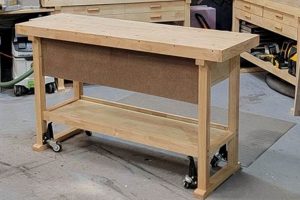
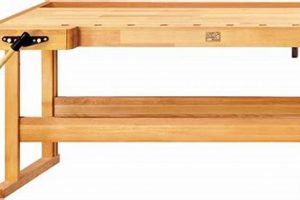
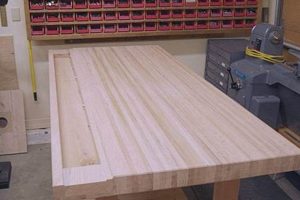
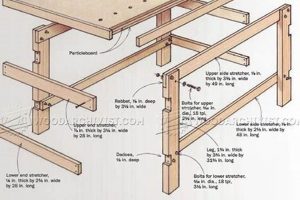
A sturdy and reliable surface designed for woodworking tasks, constructed primarily by manual labor rather than automated processes, provides a dedicated space for cutting, shaping, and assembling wood. Such a workbench often features vises, dog holes, and other integrated elements tailored to secure workpieces and facilitate various woodworking operations. Examples include benches crafted from hardwoods like maple or beech, featuring hand-cut joinery and customized storage solutions.
The advantages of a meticulously constructed work surface are multifaceted. The inherent stability and rigidity provided by solid wood construction enhance precision and safety during intricate tasks. Furthermore, carefully considered design elements contribute to ergonomic efficiency, reducing strain and improving workflow. Historically, these work surfaces were integral to craftsmanship, passed down through generations and embodying the skill and dedication of the maker.
The subsequent sections will delve into the selection of appropriate materials, the essential joinery techniques, and the critical design considerations involved in building a robust and functional workstation for woodworking pursuits. Attention will be given to the construction of various bench features as well.
Considerations for a Quality Woodworking Surface
The creation of a durable and efficient workstation necessitates careful planning and precise execution. Several factors significantly impact its overall functionality and longevity. The following provides guidelines to optimize the construction process.
Tip 1: Material Selection: Hardwoods such as maple, beech, or ash are preferable due to their density and resistance to wear. Softwoods may dent or warp more easily under the demands of woodworking.
Tip 2: Benchtop Thickness: A substantial benchtop, typically ranging from 3 to 4 inches thick, provides the necessary mass to dampen vibrations and resist movement during forceful operations.
Tip 3: Joinery Integrity: Mortise and tenon joints, dovetail joints, and properly executed rabbets ensure structural stability. Screws and glue alone may not provide sufficient long-term strength.
Tip 4: Vise Placement and Quality: The placement and type of vises significantly impact the surface’s versatility. Consider both face and tail vises, selecting models constructed from durable materials like cast iron or steel.
Tip 5: Dog Hole Alignment: Precisely aligned dog holes, often in a grid pattern, allow for secure workpiece clamping in conjunction with bench dogs or holdfasts.
Tip 6: Leg Stability: Sturdy legs, often connected by stretchers, prevent racking and ensure a stable work platform. Consider splayed legs for increased resistance to tipping.
Tip 7: Surface Finish: A durable finish, such as a penetrating oil or varnish, protects the surface from moisture and wear without compromising its ability to grip workpieces.
Tip 8: Consider Integrated Storage: Adding drawers, shelves, or cabinets underneath the benchtop will increases effiency.
These factors collectively contribute to a robust and functional woodworking aid. Adherence to these principles will ensure a reliable and efficient work surface.
The final section will discuss maintenance procedures and long-term care strategies for preserving the integrity and utility of woodworking equipment.
1. Material Durability

Material durability directly impacts the lifespan and functionality of a woodworking surface. A robust structure, constructed from materials resistant to wear, deformation, and moisture, ensures sustained performance under the demands of woodworking tasks. For example, a surface constructed from kiln-dried maple exhibits superior resistance to denting and warping compared to one built from pine, thereby maintaining its flatness and stability over extended use. This selection is a crucial determinant of the bench’s capacity to withstand repeated impact and pressure from various tools and workpieces, a fundamental requirement for precision and safety.
The choice of materials extends beyond the benchtop itself. The legs, stretchers, and vise components also contribute to the overall durability of the woodworking surface. Employing hardwoods or steel for these elements ensures resistance to racking, bending, and premature failure. Consider the example of a traditional joiner’s bench, often featuring legs and stretchers constructed from oak and fitted with heavy-duty cast iron vises, which is designed to withstand decades of rigorous use. Furthermore, surface coatings, such as oil-based finishes or epoxy resins, provide a protective barrier against moisture absorption and abrasion, thereby preserving the integrity of the wood and extending the lifespan of the woodworking station.
In summary, material durability is a cornerstone of quality in any woodworking structure. The investment in appropriate materials translates directly into a workstation capable of withstanding the rigors of demanding tasks, minimizing the need for frequent repairs or replacements. Understanding the properties of different materials and their suitability for various components is essential for creating a lasting and reliable woodworking asset. The selection of inferior materials compromises the stability and accuracy of the bench, potentially leading to unsafe working conditions and inaccurate project outcomes.
2. Structural Integrity

Structural integrity is paramount in a woodworking station. It ensures the tool withstands the dynamic forces generated during various woodworking operations. This foundation of stability is essential for precision, safety, and the longevity of the tool itself.
- Joinery Methods
Robust joinery methods, such as mortise and tenon, dovetail, or lap joints, are critical for distributing stress and preventing racking. The selection and execution of these joints determine the overall strength and rigidity of the frame. For example, properly fitted mortise and tenon joints, reinforced with glue, create a mechanical bond that resists separation under load, a necessary attribute when planing or chopping.
- Material Selection and Grain Orientation
The choice of wood species and the orientation of the wood grain significantly affect structural integrity. Dense hardwoods, such as maple or beech, offer greater resistance to bending and compression. Orienting the wood grain vertically in the legs and horizontally in the benchtop maximizes strength in the directions of greatest stress. Failure to consider grain orientation can lead to warping, splitting, or joint failure over time.
- Component Dimensions and Proportions
The dimensions and proportions of the individual components must be carefully considered to ensure adequate load-bearing capacity. Thicker legs, a wider benchtop, and properly sized stretchers contribute to overall stability. Components that are too slender or improperly scaled will compromise the workstation’s ability to withstand heavy use and dynamic forces. A poorly proportioned bench may wobble or deflect excessively, hindering precision and increasing the risk of accidents.
- Fasteners and Reinforcement
While traditional joinery is the foundation of structural integrity, fasteners and reinforcement can enhance the strength and durability of the structure. Screws, bolts, and metal reinforcement plates can be strategically employed to strengthen joints or prevent movement in areas subject to high stress. However, fasteners should complement, not replace, well-executed joinery. Over-reliance on fasteners can indicate a weakness in the underlying design or execution, ultimately undermining the bench’s structural integrity.
These facets of structural integrity work in concert to create a woodworking station capable of withstanding the demands of its intended purpose. A structure lacking in any one of these areas will be prone to failure, compromising its utility, safety, and lifespan. The implementation of proper design and construction techniques is essential to maximize structural integrity, resulting in a robust and durable piece of equipment that supports precise and efficient woodworking for years to come.
3. Surface Stability

Surface stability, defined as the resistance to movement or deflection under load, is a critical attribute of a functional woodworking bench. The connection between surface stability and the usability of a work surface is direct and consequential. A stable surface provides a reliable platform for precise cuts, secure clamping, and consistent results. Conversely, an unstable surface compromises accuracy, increases the risk of errors, and can lead to unsafe working conditions. For instance, attempting to hand-plane a large board on an unstable surface results in inconsistent thicknesses and uneven surfaces, rendering the workpiece unsuitable for its intended purpose. The cause of instability often stems from inadequate material thickness, insufficient support structure, or improperly executed joinery. The effect of this instability manifests as vibrations, wobbling, or deflection under pressure, all of which hinder the ability to perform precise woodworking operations.
The practical significance of surface stability extends beyond individual tasks. It affects the overall efficiency and quality of work produced in a woodworking environment. When workpieces are securely supported, measurements are more accurate, and tools operate as intended. A stable work area also minimizes fatigue, as the user expends less energy compensating for unwanted movement or vibrations. Consider the example of a craftsman building a fine cabinet. Accurate measurements and precise joinery are essential for a successful outcome. A stable woodworking table provides the necessary foundation for these processes, ensuring that the cabinet components align correctly and function smoothly. Furthermore, surface stability allows for the safe use of power tools, reducing the risk of kickback or loss of control. For example, using a router on an unstable surface increases the likelihood of the tool skipping or veering off course, potentially damaging the workpiece or causing injury.
In summary, surface stability is an indispensable characteristic of a functioning station for woodworking. It is a direct consequence of thoughtful design and careful construction, where material selection, joinery techniques, and overall structural integrity contribute to a solid and reliable work platform. The challenges in achieving a stable surface often involve balancing cost considerations with performance requirements and selecting appropriate construction methods. Understanding the principles of surface stability and applying them in practice is essential for any woodworker seeking to create a safe, efficient, and productive workspace.
4. Vise Functionality
Vise functionality, defined as the ability to securely hold workpieces during woodworking operations, is an integral component of a work surface. The vise is a primary interface between the woodworker and the material, enabling precise cutting, shaping, and assembly. The effectiveness of a vise directly influences the accuracy and efficiency of woodworking tasks, consequently shaping the overall quality of the finished product. For example, a robust vise with parallel clamping action allows for the secure fastening of large panels, which is essential for tasks such as joinery or edge-banding. In contrast, a poorly functioning vise, exhibiting excessive play or insufficient clamping force, compromises precision and increases the risk of workpiece slippage, leading to errors and potential injury.
Different types of vises, including face vises, tail vises, and leg vises, serve distinct purposes and cater to varied woodworking needs. The selection and proper installation of vises are critical to maximizing the versatility and usability of the station. For instance, a face vise with a quick-release mechanism facilitates rapid adjustments and allows for efficient workpiece positioning, while a tail vise, integrated with bench dogs, provides a secure clamping system for long workpieces. A leg vise, attached to a leg, offers substantial clamping force, especially suited for holding boards upright, such as when cutting dovetails. Furthermore, the quality of the vise components, such as the screw mechanism, jaws, and guide bars, directly affects its performance and longevity. Precision-machined components ensure smooth operation, minimal backlash, and consistent clamping force, resulting in a reliable and durable tool. An example would be the use of cast iron vise with precise jaw that can hold work piece safely for a long time.
In conclusion, vise functionality is not merely an accessory but an essential element that dictates the capacity to perform woodworking operations. The careful selection, installation, and maintenance of vises are crucial for achieving a stable, accurate, and efficient woodworking environment. Improper vise function will inevitably impede workflow, compromise the quality of work, and potentially create hazardous working conditions. The challenges in optimizing vise functionality involve balancing cost considerations with performance requirements and understanding the specific needs of the woodworker. By prioritizing vise functionality, a woodworker invests in a fundamental tool that significantly enhances their ability to create high-quality and precise woodwork.
5. Ergonomic Design

Ergonomic design, when applied to a woodworking surface, centers on optimizing the interaction between the woodworker and their workspace. Prioritizing human factors in this design leads to increased efficiency, reduced strain, and enhanced safety, all contributing to improved working conditions and higher-quality craftsmanship.
- Bench Height Optimization
Appropriate bench height minimizes back strain and promotes proper posture during prolonged work sessions. A bench that is too low requires excessive bending, while a bench that is too high necessitates reaching and shoulder strain. Ideally, the height should be customized to the individual, typically measured to allow for comfortable planing with a slightly bent elbow. Historical examples demonstrate a range of preferred heights, often reflecting the typical stature of workers in a given region. Bench height is a primary point of focus and will vary according to the tasks most frequently carried out.
- Work Surface Accessibility
Easy access to tools and materials reduces unnecessary movement and disruption. Integrated storage solutions, such as drawers, shelves, and tool racks, should be strategically positioned to keep frequently used items within reach. A clear and organized work surface minimizes clutter and prevents tripping hazards. An effective bench layout allows for a seamless workflow, minimizing physical exertion and maximizing productivity.
- Vise Placement and Operation
The placement and operation of vises influence posture and efficiency. Vises should be positioned to allow for comfortable clamping and unclamping, without requiring excessive reaching or twisting. Quick-release mechanisms and smooth-operating screws reduce the physical effort required to secure workpieces. Furthermore, the jaws of the vises should align properly to ensure even clamping pressure, preventing damage to the material and enhancing stability.
- Edge Treatment and User Interface
Rounded edges and smooth surfaces minimize pressure points and reduce the risk of injury. Sharp edges can cause discomfort and fatigue during prolonged contact, while rough surfaces can snag clothing and tools. Thoughtful edge treatment contributes to a more comfortable and user-friendly work environment. A well-designed bench will prioritize tactile and visual aspects, ensuring ease of use and minimizing potential hazards.
Collectively, these ergonomic considerations transform a standard woodworking station into a personalized and efficient workspace. The attention to height, accessibility, vise functionality, and edge treatment creates a woodworking table that minimizes physical strain, reduces the risk of injury, and enhances the overall quality of craftsmanship. Implementing these principles requires a thoughtful approach to design and construction, resulting in a lasting investment in the woodworker’s health and productivity.
Frequently Asked Questions
This section addresses common inquiries regarding the selection, construction, and maintenance of a constructed woodworking surface.
Question 1: What distinguishes a structure constructed by hand from a commercially produced alternative?
The primary distinction lies in the construction methods and the level of customization. A structure made by hand often features joinery techniques and tailored dimensions specific to the user’s needs, whereas a commercial bench typically adheres to standardized designs and mass-production methods.
Question 2: What are the key considerations when choosing the materials?
Material selection should prioritize durability, stability, and resistance to wear. Hardwoods, such as maple or beech, are generally preferred over softwoods due to their superior density and ability to withstand the rigors of woodworking tasks.
Question 3: How does the design affect its overall functionality?
The design directly influences the usability and efficiency of the workstation. Factors such as bench height, vise placement, and the inclusion of integrated storage solutions contribute to a more ergonomic and productive workspace.
Question 4: What are the essential maintenance practices to prolong its lifespan?
Regular maintenance includes cleaning the surface, applying protective finishes, and ensuring that all joinery and hardware remain secure. Periodic inspections and timely repairs can prevent minor issues from escalating into more significant problems.
Question 5: Are there specific joinery techniques that are better suited for ensuring structural integrity?
Mortise and tenon joints, dovetail joints, and lap joints are recognized for their strength and ability to withstand stress. Proper execution of these joinery techniques is essential for creating a robust and stable piece of equipment.
Question 6: How does the cost compare to a commercially produced alternative?
The cost can vary significantly depending on the materials, design complexity, and labor involved. While a commercially produced bench may offer a lower initial cost, a structure made by hand can provide superior customization, durability, and long-term value.
In summary, a piece of woodworking equipment constructed by manual labor offers distinct advantages in terms of customization, durability, and long-term value, provided that careful attention is given to material selection, design considerations, and maintenance practices.
The subsequent sections will explore advanced woodworking techniques and design innovations to enhance functionality and usability.
Conclusion
The foregoing analysis has examined the multifaceted aspects of a handmade woodworking bench, emphasizing the critical factors that contribute to its performance, durability, and value. Material selection, structural integrity, surface stability, vise functionality, and ergonomic design have been identified as key elements in the construction of a reliable and efficient workstation. Furthermore, the exploration has underscored the advantages of customized construction over mass-produced alternatives, highlighting the importance of tailored design and meticulous execution.
The enduring legacy of the handmade woodworking bench lies in its capacity to empower skilled artisans and foster precision craftsmanship. Continued innovation in design and construction techniques promises to further enhance the functionality and longevity of these essential tools. Therefore, investment in the knowledge and skills required to create and maintain a quality workstation represents a commitment to the principles of sound craftsmanship and enduring value.