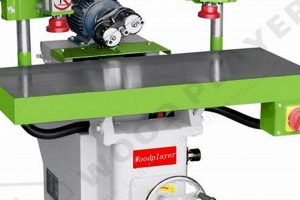
A compact, benchtop apparatus designed for shaping wood materials through rotational cutting. Typically smaller and lighter than their industrial counterparts, these tools are often employed for crafting intricate designs, detailed turnings, and smaller wooden components. These units utilize a motor to spin a workpiece against a stationary cutting tool, allowing for precise removal of material to achieve a desired form.
These devices provide woodworkers with the ability to create customized pieces with a high degree of accuracy. Their smaller size makes them suitable for hobbyists, small workshops, and educational settings where space is limited. Historically, hand-powered versions were used for centuries, but the introduction of electric motors greatly enhanced their speed and efficiency, leading to their widespread adoption for small-scale production and artistic endeavors. Their usefulness lies in the creation of objects like pens, bowls, spindles, and decorative items.
The following sections will delve into the key features, selection considerations, operational techniques, and maintenance practices associated with these specialized tools, providing a comprehensive overview for both novice and experienced woodworkers seeking to leverage their capabilities.
Essential Usage Guidelines
The following recommendations are provided to ensure efficient and safe operation, thereby maximizing the utility and lifespan of the apparatus.
Tip 1: Secure Workpiece Mounting: The workpiece must be firmly secured between the headstock and tailstock. Inadequate clamping can result in workpiece slippage, leading to inaccuracies and potential hazards.
Tip 2: Employ Appropriate Cutting Tools: Utilize gouges, skews, and parting tools specifically designed for use on these specialized tools. Dull or improperly sharpened tools can cause tear-out and increased operational difficulty.
Tip 3: Regulate Spindle Speed: Adjust the spindle speed according to the workpiece material and diameter. Higher speeds are generally suitable for smaller diameters and softer woods, while lower speeds are preferred for larger diameters and hardwoods.
Tip 4: Take Shallow Cuts: Avoid removing excessive material in a single pass. Shallow cuts minimize stress on the motor and workpiece, resulting in a smoother finish and reduced risk of tool binding.
Tip 5: Maintain Sharp Tools: Regularly sharpen cutting tools to ensure clean and efficient cutting action. A honing stone and sharpening system are essential for maintaining optimal tool performance.
Tip 6: Practice Proper Stance and Grip: Adopt a stable stance and maintain a firm, controlled grip on the cutting tool. This promotes accuracy and reduces the likelihood of losing control.
Tip 7: Adhere to Safety Precautions: Always wear appropriate safety gear, including eye protection and a dust mask. These tools generate fine dust particles that can be harmful if inhaled, and flying debris poses a risk to the eyes.
Proper adherence to these guidelines will contribute to enhanced precision, reduced risk of operational mishaps, and extended longevity. Integrating these steps into regular practice helps to achieve repeatable quality.
The subsequent sections will focus on methods for selecting suitable equipment models, as well as maintenance protocols for equipment upkeep.
1. Machine Bed Rigidity

Machine bed rigidity represents a critical factor determining the performance and precision of woodworking. It dictates the degree to which the apparatus resists deflection or vibration during operation. Insufficient rigidity in this component compromises accuracy, leading to inconsistencies in the final product and potential safety concerns. The machine bed serves as the foundation upon which all other components, including the headstock, tailstock, and tool rest, are mounted. Any flex or vibration in this foundation directly translates into inaccuracies in the turning process. For instance, a machine bed that deflects under the stress of a cutting tool can result in a finished piece that is not perfectly cylindrical or exhibits unwanted surface undulations.
The effect of this critical aspect is amplified when working with hardwoods or larger workpieces, where the forces exerted during cutting are greater. The vibration can reduce the sharpness of tools, shortening tool life. Consider the creation of furniture legs; even minimal deflection can cause inconsistencies in the diameter and shape of each leg, leading to instability in the assembled furniture piece. The design and materials employed in its construction heavily influence its rigidity. Cast iron beds are generally favored due to their inherent damping properties and resistance to deformation compared to beds made from lighter materials.
In summary, rigidity is paramount for achieving consistent, high-quality results. Its absence introduces inaccuracies and compromises safety. Understanding this relationship is essential for selecting an appropriate tool for specific woodworking applications and implementing techniques to mitigate the effects of vibration, such as using sharp tools and taking light cuts. Without sufficient rigidity, even the most skilled operator will struggle to produce precise and accurate turnings.
2. Motor Power Output
Motor power output is a primary determinant of a small wood-turning apparatuss capability. Insufficient power limits the size and hardness of the wood that can be effectively worked, while excessive power can pose control challenges. Finding the appropriate balance ensures versatility and safety.
- Material Hardness and Cutting Capacity
The motor’s power, typically measured in horsepower or watts, directly dictates the types of wood that can be processed. Harder woods, such as maple or oak, demand higher power levels to maintain consistent spindle speed during cutting operations. Inadequate power results in stalling or significant speed reduction, leading to uneven cuts and potential motor strain. A higher power rating facilitates the removal of material from dense woods without compromising performance.
- Workpiece Size and Torque Requirements
Larger diameter workpieces necessitate greater torque to initiate and maintain rotation. A motor with limited power struggles to overcome the inertia of a heavy or unbalanced workpiece, potentially causing motor overheating or premature failure. Sufficient power ensures a smooth and controlled start-up, preventing jerky movements and improving overall stability.
- Variable Speed Control Effectiveness
The effectiveness of the variable speed control system relies on the motor’s ability to deliver consistent power across the entire speed range. A motor with marginal power exhibits significant speed fluctuations, particularly at lower speeds. This instability compromises precision and control, especially when performing delicate operations or intricate detailing. A robust motor maintains a more consistent speed, allowing for finer adjustments and more predictable results.
- Tool Load and Cutting Tool Type
The type of cutting tool employed and the depth of cut taken impose varying loads on the motor. Gouges and parting tools, when used aggressively, demand significant power to maintain spindle speed. A motor with insufficient power will struggle to deliver the necessary torque, resulting in chatter and reduced cutting efficiency. Selecting a tool appropriate for the machine’s power capabilities optimizes performance and prevents overloading the motor.
The selection of the electric motor’s power rating needs careful assessment to align with intended wood types, project dimensions, and operator proficiency. Balancing the motors capabilities with intended workflow will guarantee operational efficiency and safety. Selecting a motor appropriate for the machine’s power capabilities optimizes performance and prevents overloading. This relationship between power output and performance is the nexus of appropriate usage and tool efficiency.
3. Spindle Speed Control

Spindle speed control is a fundamental aspect determining the versatility and precision achievable with these tools. The ability to adjust the rotational velocity of the workpiece allows the operator to optimize cutting parameters for various wood species, tool types, and project requirements. Without effective spindle speed control, the potential for achieving clean cuts, minimizing tear-out, and ensuring safe operation is severely limited.
- Material Optimization
Different wood species exhibit varying densities and grain structures, necessitating tailored spindle speeds for optimal results. Softer woods, such as pine or basswood, generally require higher speeds to achieve clean cuts and prevent the tool from digging into the material. Harder woods, such as maple or walnut, typically benefit from lower speeds, reducing the risk of burning the wood or damaging the cutting tool. For example, attempting to turn a bowl blank made of hard maple at too high a speed could result in chatter, vibration, and a poor surface finish. In contrast, turning a delicate spindle from soft wood at too low a speed might lead to a rough, uneven surface.
- Tool Type Adaptation
The design and geometry of the cutting tool dictates the appropriate spindle speed. Large roughing gouges, used for initial shaping, require lower speeds to manage the forces involved in removing substantial amounts of material. Finer detail tools, such as skew chisels or parting tools, typically perform better at higher speeds, allowing for precise and delicate cuts. Using a large gouge at too high a speed could result in dangerous vibrations and loss of control, while using a small detail tool at too low a speed might lead to inefficient cutting and a poor finish.
- Safety Considerations
Appropriate spindle speed is crucial for operator safety. Excessive speeds can lead to workpiece instability, tool chatter, and an increased risk of the workpiece detaching from the machine. Conversely, insufficient speeds can result in the tool catching in the wood, potentially causing kickback or injury. Selecting the correct speed minimizes these risks and promotes a more controlled and predictable cutting process. For instance, turning an unbalanced workpiece at high speeds can create excessive vibrations that can cause the lathe to move or the workpiece to break free, posing a significant hazard.
- Finish Quality and Surface Integrity
Spindle speed directly impacts the surface finish and overall quality of the turned piece. Optimal speeds minimize tear-out, reduce sanding time, and enhance the aesthetic appeal of the final product. Inappropriate speeds can lead to a rough, uneven surface that requires extensive sanding to correct. For instance, using too high a speed when turning a bowl can create fine ridges or chatter marks on the inside surface, requiring significant effort to sand smooth. Achieving a consistent and professional finish relies heavily on the operator’s ability to select and maintain the appropriate speed throughout the turning process.
These tools benefit significantly from precise control over spindle speed, enabling adaptation to various wood types, tools, and project phases. A robust spindle speed control system empowers woodworkers to achieve optimal results, ensuring safety, efficiency, and superior craftsmanship. It also unlocks creative potential, facilitating more intricate designs and refined finishes. Without this precise control, many projects would be infeasible or produce unsatisfactory outcomes.
4. Tool Rest Stability

Tool rest stability directly influences the precision, safety, and efficiency of woodworking on these compact lathes. It forms the essential interface between the operator and the cutting tool, providing the necessary support and leverage for controlled material removal. Compromised stability in this component translates to inaccuracies, potential tool slippage, and an overall reduction in the quality of the finished piece. Its functionality must be assured for safe and accurate operation.
- Vibration Dampening and Surface Finish
A stable tool rest minimizes vibration during cutting operations, preventing chatter and resulting in a smoother surface finish. Vibration transmits directly to the cutting tool, causing it to bounce or skip across the workpiece. A rigid and well-secured tool rest absorbs these vibrations, allowing the operator to maintain a consistent cutting angle and achieve a cleaner, more precise cut. For example, when creating a decorative molding on a spindle, even slight vibrations can create noticeable imperfections on the surface. A stable tool rest is paramount.
- Tool Control and Precision
It provides a fixed and reliable point of contact for the operator to control the cutting tool. A wobbly or loose tool rest makes it difficult to maintain a consistent cutting angle and depth, leading to inaccuracies in the shape and dimensions of the workpiece. Consider the creation of a perfectly round tenon for a chair leg; even slight movement in the tool rest can cause the tenon to be out of round, compromising the strength and stability of the joint. Precise adjustments and a locking mechanism are essential to secure the desired position.
- Safety and Kickback Prevention
A securely mounted and stable tool rest reduces the risk of tool slippage or kickback, enhancing operator safety. An unstable tool rest can allow the cutting tool to dig into the workpiece unexpectedly, potentially causing the tool to catch and be thrown back towards the operator. The operator requires a solid platform to control the forces exerted during cutting operations. Ensuring the tool rest is properly secured and adjusted minimizes the likelihood of accidents.
- Adjustability and Versatility
The capacity of the tool rest to be easily adjusted and positioned at various angles and heights expands the range of operations that can be performed on these machines. Operators must be able to adapt the tool rest to accommodate different workpiece sizes, shapes, and cutting techniques. A tool rest that offers limited adjustability restricts the operator’s ability to create complex or intricate designs. A flexible tool rest offers options to optimize performance on a variety of operations.
In summary, tool rest stability is paramount for achieving precision, safety, and versatility in small lathes. The ability to reliably support the cutting tool, dampen vibrations, and prevent tool slippage directly impacts the quality of the finished product and the well-being of the operator. The tool rest is a critical factor to evaluate and is essential to the performance capabilities of any of these tools.
5. Tailstock Alignment
Tailstock alignment is crucial for precision woodworking. It ensures the rotational axis of the workpiece is parallel to the machine bed, directly impacting the accuracy and stability of turning operations. Proper adjustment prevents tapered turnings, reduces vibration, and minimizes stress on both the workpiece and the machine components. It should be part of the overall maintenance and setup process for safe and accurate working.
- Centering Accuracy and Consistent Dimensions
Accurate tailstock alignment guarantees that the workpiece rotates on a consistent axis, producing cylindrical or symmetrical forms. Misalignment results in tapers or uneven dimensions along the length of the turned piece. For example, when crafting a table leg, a misaligned tailstock leads to a leg that is not perfectly cylindrical, affecting the stability and appearance of the final product. Centering processes ensure that dimensions are even and repeatable.
- Vibration Reduction and Surface Finish Quality
Proper alignment minimizes vibration during turning operations. When the tailstock is offset, the workpiece experiences uneven forces, causing chatter and vibration, which degrade the surface finish. A correctly aligned tailstock provides consistent support, dampening vibrations and enabling smoother cuts. This is essential for producing high-quality finishes and reducing the need for extensive sanding. Reduction of vibration results in a more consistent finished workpiece.
- Spindle Stress and Machine Longevity
Misalignment places undue stress on the machine’s spindle and bearings, potentially leading to premature wear and failure. The tailstock supports the far end of the workpiece, distributing the load and reducing strain on the headstock. Maintaining proper alignment ensures that the forces are evenly distributed, prolonging the lifespan of the machine. Routine maintenance will result in longer tool life.
- Drilling and Boring Accuracy
The tailstock often incorporates a center point, or can hold drill chucks. When misaligned, operations like drilling holes through the center of a turning or boring out the inside of a vessel becomes difficult and inaccurate. A properly aligned tailstock allows for precise and consistent drilling along the axis of rotation, essential for creating functional and aesthetically pleasing wooden objects. Accurate drilling supports other operational characteristics of the tool.
In summary, correct tailstock alignment is indispensable for achieving accurate, safe, and efficient woodworking. Its impact spans from dimensional consistency and surface finish quality to machine longevity and operator safety. Paying careful attention to tailstock alignment is a critical practice for any woodworker utilizing these compact machines, ensuring that the desired results are consistently achieved and the equipment is properly maintained.
Frequently Asked Questions
The following section addresses common inquiries concerning the operation, capabilities, and maintenance of specialized tools for woodworking. The information presented is intended to clarify essential concepts and practices.
Question 1: What is the maximum workpiece size that can be accommodated?
The maximum workpiece size varies depending on the specific model. Factors such as swing over bed and distance between centers dictate the largest diameter and length of material that can be turned. Consult the manufacturer’s specifications for precise measurements.
Question 2: What types of wood are suitable for use?
Both hardwoods and softwoods can be turned. Hardwoods, such as maple and oak, require sharp tools and lower speeds, while softwoods, like pine and basswood, are generally easier to work but may require careful sanding to achieve a smooth finish.
Question 3: What safety precautions are essential during operation?
Eye protection is mandatory to prevent injury from flying debris. A dust mask is also recommended to avoid inhaling fine wood particles. Proper tool handling and secure workpiece mounting are crucial for preventing accidents.
Question 4: How frequently should cutting tools be sharpened?
Cutting tools should be sharpened regularly to maintain efficiency and prevent tear-out. The frequency depends on the type of wood being turned and the duration of use. Dull tools require more force, increasing the risk of accidents.
Question 5: What are the key maintenance procedures?
Regular maintenance includes cleaning the machine, lubricating moving parts, and inspecting for wear or damage. Proper maintenance extends the lifespan and ensures reliable performance.
Question 6: Can this type of equipment be used for metalworking?
These tools are primarily designed for shaping wood. Attempting to use it for metalworking may damage the machine and pose a safety hazard. Metalworking requires specialized equipment with different speed ranges and construction materials.
These answers address common inquiries and provide useful insights for maximizing effectiveness and longevity. Adherence to safety measures is required for all operational activities.
The next section offers a comparative analysis of leading manufacturers and models currently available on the market.
Conclusion
The exploration of compact devices designed for shaping wood has highlighted their capabilities in small-scale woodworking endeavors. Key aspects, including bed rigidity, motor power, spindle speed control, tool rest stability, and tailstock alignment, dictate the performance and suitability of these machines for diverse applications. Operational guidelines and maintenance practices contribute to the longevity and sustained precision of these tools. Proper application will enhance their working capabilities.
The judicious selection and responsible utilization of a woodworking apparatus empowers woodworkers to craft intricate designs and functional components with precision and efficiency. Continuous skill refinement and adherence to safety protocols remain paramount for maximizing the creative potential and mitigating operational risks. Continued technological advancements promise future developments that may enhance capabilities and broaden woodworking possibilities.