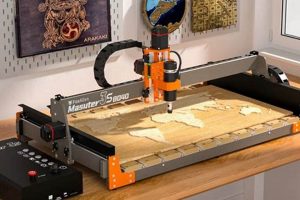
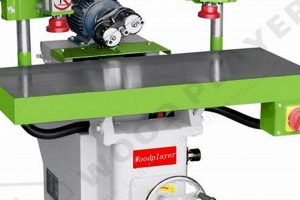
A power tool employed in shaping wood, this equipment utilizes a high-speed rotating bit to cut, trim, and mold various designs and profiles. The device allows for precise detailing, edge forming, and joinery creation in a wide array of woodworking projects. An example application includes crafting decorative edges on tables, creating intricate patterns on cabinet doors, and producing mortise and tenon joints for furniture construction.
The value of this technique stems from its capacity to enhance efficiency and accuracy in woodworking processes. Compared to manual methods, it offers significantly faster material removal and enables the reproduction of complex designs with greater consistency. Its adoption has played a crucial role in the evolution of woodworking, from traditional craftsmanship to modern industrial production, expanding the scope of achievable designs and improving overall project quality.
The following sections will delve into different types of these power tools, explore essential safety precautions, describe the selection of appropriate bits, and outline various applications and techniques for optimal utilization.
Essential Guidance for Wood Shaping
The effective and safe application of high-speed rotary cutting devices in woodworking hinges on careful planning and execution. Attention to detail, appropriate technique, and adherence to safety protocols are paramount.
Tip 1: Secure Workpiece Clamping: Ensuring the workpiece is firmly secured is critical. Movement during operation can lead to inaccurate cuts and potential hazards. Use clamps or a vise to maintain stability.
Tip 2: Directional Cutting Technique: Advance the tool against the rotation of the bit for controlled material removal. This method prevents the tool from pulling away from the operator and ensures a smoother finish.
Tip 3: Multiple Passes for Deep Cuts: Avoid removing excessive material in a single pass. Instead, perform multiple shallow passes to reduce strain on the tool and achieve a cleaner, more precise cut.
Tip 4: Appropriate Bit Selection: Matching the cutting bit to the specific task and material is essential. Different bit profiles are designed for various applications, such as edge forming, groove cutting, or joinery.
Tip 5: Speed Control Optimization: Adjust the tool’s speed according to the material being cut. Slower speeds are generally recommended for hardwoods to prevent burning, while softer woods may tolerate higher speeds.
Tip 6: Regular Bit Inspection: Examine cutting bits for sharpness and damage before each use. Dull or damaged bits can compromise cut quality and increase the risk of kickback.
Tip 7: Dust Extraction System Utilization: Employ a dust collection system to remove wood particles during operation. This improves visibility, reduces health hazards, and maintains a cleaner working environment.
By adhering to these guidelines, operators can maximize the precision, safety, and efficiency of wood shaping endeavors, resulting in high-quality finished products.
The following section will summarize the key concepts discussed and provide recommendations for further learning and skill development in woodworking techniques.
1. Bit profile selection

The selection of the appropriate bit profile directly dictates the resulting shape and detail imparted to a workpiece through powered rotary cutting equipment. Each bit profile is engineered to execute a specific task, such as creating rounded edges, decorative grooves, or precise rabbets. The correlation between bit choice and desired outcome is causal: an incorrect profile selection will inevitably yield unsatisfactory or unintended results.
For instance, a Roman ogee bit is specifically designed to produce an elegant, decorative edge, commonly seen on furniture and cabinetry. Employing a straight bit in its place would fail to replicate the intended profile. Similarly, a dovetail bit is essential for creating interlocking dovetail joints, while a round-over bit is suited for softening sharp edges, enhancing both aesthetics and safety. The precision afforded by specialized bit profiles eliminates the need for time-consuming and less accurate manual shaping techniques. Practical examples extend from architectural molding replication to crafting custom door panels, all contingent upon the appropriate bit selection.
In summary, proficiency in bit profile selection is paramount to successful powered rotary cutting outcomes. Challenges arise from the sheer variety of available profiles, necessitating a thorough understanding of their individual applications. However, the capacity to precisely control the shape and detail of wood components underscores the fundamental importance of this aspect within the broader context of advanced woodworking techniques.
2. Machine speed control
Operational velocity is a critical parameter influencing the performance and safety of woodworking devices. The rotation speed of the cutting bit, measured in revolutions per minute (RPM), directly affects the quality of the cut, the tool’s longevity, and the operator’s safety. Excessive speed can lead to burning of the wood, premature bit wear, and increased risk of kickback. Insufficient speed, conversely, can result in a rough, uneven cut and potential stalling of the motor. Therefore, appropriate adjustment of machine speed based on material type, bit diameter, and depth of cut is essential for optimal results. Example: Cutting hardwoods such as maple or oak necessitates lower speeds compared to softer woods like pine or cedar.
Furthermore, bit diameter dictates the optimal operational velocity. Larger diameter bits require slower speeds to maintain a consistent cutting rate and prevent overheating. Utilizing a speed control mechanism allows operators to fine-tune the RPM to match the specific requirements of the woodworking task. Consider the creation of a decorative edge using a large-diameter roundover bit. If the device is operated at an excessive speed, the bit may vibrate excessively, leading to an uneven profile and potential damage to both the workpiece and the tool. The implementation of a speed control enables the operator to select a lower RPM, resulting in a clean, precise cut.
In summary, machine speed control represents an integral component of safe and effective woodworking. Failure to properly adjust the operational velocity can lead to compromised cut quality, accelerated tool wear, and increased operator risk. A thorough understanding of the relationship between material type, bit diameter, and optimal RPM, coupled with the skillful utilization of speed control mechanisms, is vital for achieving professional-grade results and ensuring a safe working environment.
3. Workpiece stabilization

Effective workpiece stabilization is paramount in the application of powered rotary cutting equipment to woodworking. Insufficient stability directly compromises precision, increases the risk of tool malfunction, and presents potential safety hazards. Securely holding the material being shaped is not merely a procedural step; it is a foundational requirement for achieving desired outcomes and maintaining a safe working environment.
- Clamping Mechanisms
Clamping mechanisms are a primary means of ensuring workpiece immobility. Various clamp types, including bench clamps, edge clamps, and quick-release clamps, provide varying degrees of holding power and versatility. The appropriate clamp selection depends on workpiece size, shape, and orientation. For example, routing a decorative edge on a large tabletop necessitates multiple clamps strategically positioned to prevent movement or vibration during the cutting process. Failure to adequately clamp the workpiece may result in inconsistent cuts, chatter marks, or even catastrophic tool kickback.
- Jigs and Fixtures
Jigs and fixtures provide specialized support and constraint for specific routing tasks. These custom-built or commercially available devices offer repeatable accuracy and enhance safety. A mortising jig, for instance, guides the cutting bit along a precise path, creating mortises for joinery with consistent dimensions. The utilization of jigs and fixtures is particularly beneficial when executing repetitive cuts or intricate designs, minimizing the potential for error and improving overall efficiency.
- Non-Slip Surfaces
The application of non-slip surfaces, such as rubber mats or sandpaper adhered to workbenches and auxiliary supports, enhances friction and prevents workpiece slippage. While clamping provides primary constraint, non-slip surfaces offer supplementary stabilization, particularly when routing small or irregularly shaped objects. The addition of a non-slip surface can significantly reduce the likelihood of accidental workpiece movement during operation.
- Bench Dogs and Supporting Structures
Bench dogs, inserted into pre-drilled holes on a workbench, provide a means of registering and securing workpieces of varying sizes. In conjunction with supporting structures such as fences or rails, bench dogs create a stable platform for routing operations. This combination is particularly useful when processing long or wide boards, ensuring consistent alignment and preventing warping or deflection during the cutting process. Example: Using the technique for cut the wood plank for shelving.
The integration of these workpiece stabilization techniques represents a fundamental aspect of woodworking with powered rotary cutting equipment. Proper attention to securing the workpiece not only enhances cut quality and precision but also significantly mitigates the risk of accidents and tool damage, ultimately contributing to a safer and more efficient woodworking practice.
4. Cut depth adjustment

Cut depth adjustment constitutes a critical variable in the operation of powered rotary cutting equipment for woodworking. Precise control over the depth of cut directly influences the accuracy, efficiency, and safety of shaping wood. An inadequate or incorrectly set cut depth will manifest in a spectrum of undesirable outcomes, ranging from superficial imperfections to structural compromise of the workpiece. The inherent connection between cut depth adjustment and the broader application of powered rotary cutting lies in its capacity to regulate the amount of material removed per pass. Shallow cuts, typically employed for intricate detailing or delicate materials, minimize the risk of tear-out and maintain optimal control. Deeper cuts, suitable for rapid material removal in coarser tasks, demand heightened caution and stability to prevent tool overload or kickback. A practical example includes creating a precisely dimensioned rabbet joint. Failure to accurately set the cut depth will result in a joint that is either too shallow, compromising its strength, or too deep, altering the intended dimensions of the connected components.
The implementation of precise cut depth adjustment mechanisms within powered rotary cutting devices facilitates repeatable accuracy across multiple workpieces. Adjustable depth stops, micro-adjustment knobs, and digital depth gauges enable operators to fine-tune the cutting parameter to within fractions of an inch. This precision is particularly valuable in applications requiring tight tolerances, such as cabinet making or furniture construction. Consider the creation of a series of identical door panels. Precise depth adjustment ensures that each panel is routed to the same thickness, resulting in a uniform appearance and seamless fit within the cabinet frame. Conversely, inconsistent depth settings will lead to variations in panel thickness, resulting in unsightly gaps or misalignment. Similarly, the crafting of inlays or decorative grooves requires precise depth control to achieve the desired aesthetic effect. If the cut depth is not accurately calibrated, the resulting inlay or groove may be too shallow, failing to achieve the intended visual impact, or too deep, compromising the structural integrity of the workpiece.
In summation, cut depth adjustment is an indispensable element in the application of powered rotary cutting equipment to woodworking. Its accurate manipulation dictates the precision, quality, and safety of the cutting process. While modern equipment offers sophisticated mechanisms for fine-tuning this parameter, the operator’s understanding of its significance remains paramount. The ongoing challenge lies in effectively balancing the desire for efficient material removal with the need for precise control and safe operating practices, ensuring optimal outcomes in a wide range of woodworking applications.
5. Safety protocol adherence

The intersection of safety protocol adherence and woodworking is defined by a direct cause-and-effect relationship. Non-compliance with established safety procedures when operating power tools results in an elevated risk of injury. Using a router, specifically, requires strict adherence to protocols due to the high-speed rotation of the cutting bit and the potential for kickback. Consistent application of safe practices mitigates the occurrence of accidents and ensures the operator’s well-being.
Within the context of woodworking, safety protocol adherence functions as an indispensable component of equipment operation. It involves a multi-faceted approach encompassing the use of personal protective equipment (PPE), proper machine setup, and an awareness of potential hazards. Real-life examples underscore the significance of these practices. The consistent use of eye protection prevents projectiles from causing ocular damage. The implementation of dust collection systems mitigates respiratory hazards associated with airborne particulate matter. The proper securing of workpieces reduces the likelihood of uncontrolled tool movement and subsequent injury.
The practical significance of understanding and implementing safety protocols in woodworking lies in the preservation of physical integrity and the creation of a sustainable work environment. The failure to adhere to safety guidelines can result in injuries ranging from minor cuts and abrasions to severe lacerations, amputations, and even fatalities. Understanding the correlation between safety practices and accident prevention is essential for ensuring that woodworking remains a safe and productive endeavor. Therefore, rigorous training, consistent enforcement of safety rules, and a proactive approach to hazard identification are paramount.
Frequently Asked Questions
This section addresses common inquiries regarding the safe and effective application of woodworking tools.
Question 1: What safety precautions are paramount when operating a woodworking router?
Eye and ear protection are mandatory. Workpieces must be securely clamped. The machine should be inspected for proper function before use. Avoid loose clothing or jewelry. Disconnect power before changing bits or making adjustments.
Question 2: How does bit selection impact the quality of the cut?
Bit profile directly determines the shape and detail imparted to the wood. Selecting the correct bit for the desired outcome is critical. Using the wrong bit can result in inaccurate cuts, tear-out, or damage to the workpiece.
Question 3: What is the optimal speed setting for different types of wood?
Hardwoods generally require lower speeds to prevent burning. Softer woods may tolerate higher speeds. Refer to the machine’s manual for specific speed recommendations based on material type and bit diameter.
Question 4: How can kickback be prevented?
Always feed the tool against the direction of bit rotation. Maintain a firm grip on the machine. Avoid removing excessive material in a single pass. Ensure the workpiece is securely clamped. Utilize a push stick when routing small pieces.
Question 5: What are the signs of a dull or damaged bit?
Dull bits may produce rough cuts, burning, or excessive vibration. Damaged bits may exhibit chipped edges or cracks. Replace dull or damaged bits immediately to prevent accidents and ensure optimal cutting performance.
Question 6: How does dust collection contribute to safety and efficiency?
Dust collection systems remove airborne wood particles, improving visibility and reducing respiratory hazards. They also maintain a cleaner work environment and prevent dust buildup on the machine, extending its lifespan.
Prioritizing safety, selecting appropriate bits, understanding speed settings, and implementing effective dust collection are crucial for successful woodworking.
The subsequent section will delve into advanced techniques and troubleshooting tips for woodworking tools.
Conclusion
The preceding exploration has illuminated various facets of powered rotary cutting equipment utilized in woodworking. Emphasis has been placed on the importance of meticulous preparation, the judicious selection of components, and the unwavering adherence to safety protocols. The ability to harness these tools effectively requires a comprehensive understanding of their capabilities and limitations, fostering a synergy between operator skill and technological capacity.
The continued advancement of woodworking technology necessitates a commitment to ongoing education and refinement of technique. By embracing best practices and prioritizing safety, practitioners can unlock the full potential of this equipment, contributing to both the preservation of traditional woodworking craftsmanship and the innovation of new design paradigms.