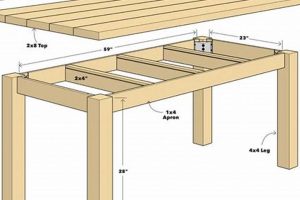
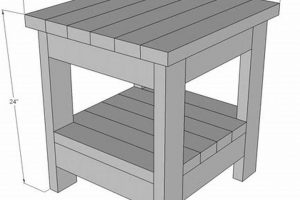
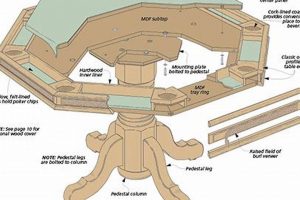
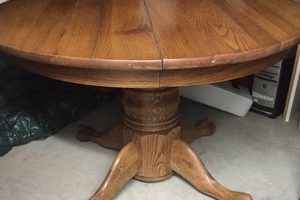
The addition of decorative edging to a table, constructed through woodworking techniques, enhances its aesthetic appeal. These crafted elements, often referred to as aprons or skirts, are attached beneath the tabletop and above the legs. A common example is a solid wood apron attached to a farmhouse style dining table, adding visual weight and a defined border.
These woodworking details provide structural reinforcement to the table, increasing its stability and longevity. Historically, they served to conceal hardware and joinery, presenting a cleaner, more refined appearance. The presence of such crafted features elevates the perceived value and quality of the furniture piece.
The subsequent discussion will detail the selection of appropriate lumber, the joinery methods employed in attaching these decorative elements, and various finishing techniques to achieve a desired aesthetic.
Essential Considerations for Table Skirt Woodworking
The following guidelines aim to improve the construction and aesthetic outcome of edging applications to tables.
Tip 1: Material Selection: Choose hardwoods like maple, cherry, or walnut for durability and visual richness. Softwoods, while less expensive, are more susceptible to damage and may not hold joinery as securely.
Tip 2: Joint Strength: Employ mortise and tenon, dovetail, or dowel joints for secure attachment of the skirt to the table legs and tabletop. These joints provide greater resistance to racking and separation over time.
Tip 3: Consistent Grain Matching: Select lumber with a consistent grain pattern across all skirt pieces to create a unified and aesthetically pleasing appearance. Careful matching enhances the perception of quality craftsmanship.
Tip 4: Precise Measurement and Cutting: Ensure accurate measurements and precise cuts to achieve a seamless fit between the skirt and the table components. Errors in measurement can compromise the structural integrity and visual appeal.
Tip 5: Proper Sanding and Finishing: Thoroughly sand all skirt surfaces to achieve a smooth, uniform texture prior to applying a finish. Apply multiple coats of a durable finish, such as varnish or polyurethane, to protect the wood and enhance its natural beauty.
Tip 6: Consider Reveal: Determine the desired reveal, the amount the table skirt protrudes below the tabletop, to strike the right balance of visual presence and functionality.
Tip 7: Dry Fitting: Prior to final assembly, dry-fit all components to ensure proper alignment and fit. This step allows for adjustments and corrections before glue is applied, minimizing potential errors.
Adhering to these considerations will result in a well-constructed, aesthetically pleasing, and structurally sound table enhancement.
The subsequent section will explore specific design options and advanced techniques.
1. Material Selection

Material selection exerts a significant influence on the success of edging applications to tables, affecting both the structural integrity and the aesthetic outcome. The choice of wood determines the skirt’s resistance to warping, cracking, and wear, directly impacting the lifespan of the furniture piece. For instance, using a stable hardwood like maple or oak will provide a durable, long-lasting skirt. Conversely, employing a softwood without proper sealing and finishing may lead to premature degradation, necessitating repairs or replacement. The selection also influences the joinery’s effectiveness; hardwoods generally hold fasteners and glues more securely than softwoods, ensuring the skirt remains firmly attached to the table.
Beyond structural considerations, material selection dictates the visual character of the finished product. Different wood species exhibit distinct grain patterns and natural colors. Cherry, for example, imparts a warm, reddish tone, while walnut offers a darker, richer hue. Matching the skirting material to the tabletop and leg material is important for visual harmony. Failure to do so can result in a disjointed aesthetic. Finishes will react differently depending on the lumber chosen. Open grain woods such as oak will need to be filled prior to finishing to achieve a smooth surface.
The judicious selection of appropriate materials is therefore paramount in ensuring both the longevity and the visual appeal of the table. Neglecting this crucial step can compromise the entire project. Consideration of wood species properties, grain patterns, and finish compatibility are essential components of any successful furniture crafting endeavor.
2. Joint Integrity

Joint integrity constitutes a critical factor in the successful and durable construction of edging applications to tables. The strength and stability of the joints directly impact the overall structural integrity and longevity of the furniture piece. Compromised joints can lead to premature failure, instability, and aesthetic degradation.
- Mortise and Tenon Joints
Mortise and tenon joints, characterized by a projecting tenon inserted into a mortise (hole), provide exceptional strength and resistance to racking forces. In edging applications, these joints securely attach the skirt to the table legs. Their robust nature ensures the skirt remains firmly connected, preventing wobble and maintaining the table’s structural stability. A well-executed mortise and tenon joint can withstand significant stress and strain, common in furniture subjected to regular use.
- Dovetail Joints
Dovetail joints, interlocking wedge-shaped projections, offer superior tensile strength and prevent the skirt from pulling away from the tabletop. Often employed in high-end furniture construction, dovetail joints showcase craftsmanship and durability. They are particularly effective in resisting shear forces, providing long-term structural integrity. The interlocking design distributes stress evenly, minimizing the risk of joint failure under load.
- Dowel Joints
Dowel joints, utilizing cylindrical pins inserted into precisely drilled holes, provide a simpler, yet effective, method of joining the skirt to the tabletop or legs. While not as strong as mortise and tenon or dovetail joints, dowel joints, when properly executed with appropriate glue and clamping pressure, offer sufficient strength for many edging applications. The use of multiple dowels increases the joint’s resistance to movement and enhances its overall durability.
- Miter Joints with Reinforcements
Miter joints, created by joining two pieces at a 45-degree angle, offer a clean, aesthetically pleasing appearance for skirt corners. However, miter joints inherently lack strength. Reinforcements, such as splines, keys, or biscuits, are essential to bolster the joint’s integrity and prevent separation. Without reinforcement, miter joints are prone to failure under stress, compromising the structural stability of the entire table.
The selection and proper execution of appropriate joints are thus paramount in ensuring a durable and aesthetically pleasing edging application. Each joint type offers specific advantages and disadvantages, and careful consideration should be given to the intended use and design of the table to determine the most suitable option. Ignoring joint integrity can lead to costly repairs and ultimately, a diminished lifespan for the furniture piece.
3. Design Consistency

Design consistency plays a pivotal role in the overall success of incorporating edging into table construction. The skirt, being a visually prominent element, directly impacts the table’s aesthetic harmony. Lack of design consistency creates a discordant visual effect, detracting from the intended elegance and perceived quality. Consistency considerations encompass several areas, including wood species, grain direction, style of joinery, and finishing techniques. For example, if a tabletop is constructed from quarter-sawn oak with a clear finish, the skirt should ideally mirror these characteristics. Utilizing a different wood species or finish will disrupt the visual flow and create an unbalanced appearance. Disparities in joinery, such as exposed dovetails on the skirt contrasting with hidden fasteners elsewhere on the table, can also detract from the overall design cohesion.
The practical implications of prioritizing design consistency extend beyond mere aesthetics. A unified design suggests a higher level of craftsmanship and attention to detail. Conversely, a poorly designed skirt may lead to perceptions of lower quality and diminished value. In high-end furniture construction, consistency is paramount. Designers and manufacturers often specify precise material matches and finishing processes to ensure a seamless integration of the skirt with the rest of the table. For instance, many antique furniture pieces exhibit skirts that are virtually indistinguishable from the tabletop, highlighting the historical emphasis on meticulous material selection and execution.
Achieving design consistency in table edging requires careful planning, material sourcing, and execution. Challenges include matching wood grain patterns, achieving consistent finish coloration, and accurately replicating design details across multiple components. Overcoming these challenges necessitates a keen eye for detail, skilled craftsmanship, and a thorough understanding of woodworking principles. Prioritizing design consistency elevates the table from a functional object to a refined piece of furniture, reflecting thoughtful design and skilled construction.
4. Precise Execution

Precise execution is intrinsically linked to the successful outcome of integrating edging into table construction. Errors in measurement, cutting, or joinery propagate throughout the project, leading to structural instability, aesthetic flaws, and ultimately, a compromised finished product. Accurate dimensions are paramount; even slight deviations can result in gaps, uneven surfaces, and misalignment, diminishing the overall quality of the table. For example, an imprecisely cut miter joint in a skirt corner will inevitably reveal a visible seam, detracting from the intended seamless appearance. Such inaccuracies undermine the design intent and indicate a lack of attention to detail.
The application of precise execution extends beyond initial cutting and joinery. Consistent sanding and finishing techniques are crucial for achieving a uniform surface and a professional appearance. Uneven sanding can create inconsistencies in the finish, resulting in blotchy coloration and textural variations. Similarly, imprecise application of varnish or lacquer can lead to drips, runs, and an uneven sheen. Adherence to strict tolerances and meticulous workmanship is essential for achieving the desired level of refinement. Consider the construction of a high-end dining table; each step, from selecting the lumber to applying the final coat of finish, demands precision to ensure a flawless result. Any deviation from established standards can significantly impact the piece’s value and longevity.
In conclusion, precise execution is not merely a desirable attribute but a fundamental requirement for high-quality table skirting. The consequences of neglecting this aspect are far-reaching, affecting both the structural integrity and the aesthetic appeal. Maintaining unwavering focus on accuracy and detail throughout the woodworking process is crucial for creating furniture that meets the highest standards of craftsmanship and durability. The practical significance lies in producing furniture that not only functions effectively but also exhibits a refined and enduring quality.
5. Surface Preparation

Surface preparation is a critical phase in the construction of edging for tables, directly impacting the quality, appearance, and longevity of the finished product. Proper preparation ensures optimal adhesion of finishes, enhances the wood’s natural beauty, and mitigates potential defects.
- Sanding Techniques
Sanding, a primary aspect of surface preparation, involves removing imperfections, leveling the surface, and creating a smooth substrate for finishing. Progressive sanding, utilizing increasingly finer grits of sandpaper (e.g., starting with 80 grit and progressing to 220 grit), is essential. Failure to adequately sand results in visible scratches, uneven stain absorption, and a rough tactile feel. For instance, improperly sanded skirts will reveal swirl marks under a clear coat, detracting from the table’s overall aesthetic.
- Wood Filling and Pore Sealing
Open-grained hardwoods, such as oak and ash, require pore filling to achieve a smooth, glass-like surface. Wood filler fills the open pores, preventing excessive absorption of finish and creating a uniform surface texture. Improper filling leads to an uneven finish, with visible pores and a textured surface. In table skirting, neglecting this step can result in an unprofessional appearance, particularly under glossy finishes. Shellac or specialized pore fillers are used to seal the grain.
- Dust Removal and Cleaning
Thorough dust removal is paramount prior to applying any finish. Residual dust particles compromise the finish’s adhesion and result in a gritty, textured surface. Compressed air, tack cloths, and vacuum cleaners are employed to eliminate dust. Failure to remove all dust particles can lead to visible imperfections and a compromised finish. For example, dust trapped under a coat of varnish creates unsightly bumps and requires corrective sanding.
- Moisture Content Control
Controlling the wood’s moisture content is critical to prevent warping, cracking, and finish failure. Wood absorbs and releases moisture based on ambient humidity. Applying a finish to wood with excessive moisture content can trap moisture, leading to finish delamination and substrate deformation. Kiln-dried lumber should be acclimated to the shop environment before finishing. Maintaining a consistent humidity level during the finishing process is also important. A table skirt constructed from improperly dried lumber will be prone to warping or cracking, undermining its structural integrity and appearance.
These facets of surface preparation are integral to achieving a professional-grade finish in table skirting. Diligence in sanding, filling, cleaning, and moisture control yields a smooth, durable, and aesthetically pleasing surface that enhances the table’s overall value and longevity. Neglecting surface preparation compromises the integrity of the finish and diminishes the quality of the final product.
6. Finish Durability

Finish durability is a paramount consideration in edging for tables, directly correlating with the furniture’s longevity and aesthetic preservation. The skirt, being exposed to potential impacts, spills, and abrasion, requires a robust protective coating. A durable finish safeguards the underlying wood from moisture penetration, preventing warping, swelling, and decay. Furthermore, it resists scratches, stains, and chemical damage, preserving the skirt’s appearance over prolonged use. For example, a table used in a dining setting benefits from a durable, water-resistant finish, such as polyurethane or catalyzed varnish, to withstand frequent spills and cleaning. The absence of a durable finish inevitably leads to surface damage, necessitating costly repairs or premature replacement of the entire edging element.
The choice of finish significantly impacts the skirt’s resistance to wear and tear. Oil-based finishes, while enhancing the wood’s natural grain and providing a warm tone, offer limited protection against moisture and abrasion. Conversely, water-based finishes, while generally less toxic and faster drying, may require multiple coats to achieve comparable durability. Catalyzed varnishes and polyurethanes, known for their exceptional hardness and chemical resistance, represent optimal choices for high-traffic areas or environments prone to spills. The appropriate application technique, involving proper surface preparation and multiple thin coats, is equally crucial for maximizing finish durability. Inadequate surface preparation or improper application can result in adhesion failures, blistering, or uneven coverage, undermining the finish’s protective properties. Furniture restorers often encounter antique tables with poorly applied or maintained finishes, highlighting the long-term consequences of neglecting finish durability.
In summation, finish durability is an indispensable attribute of well-constructed table skirts. The selection of appropriate materials, coupled with meticulous application techniques, ensures long-term protection against environmental factors and physical damage. Prioritizing finish durability translates directly into increased furniture lifespan, reduced maintenance requirements, and sustained aesthetic appeal, representing a significant investment in the overall quality and value of the table.
Frequently Asked Questions
The subsequent section addresses common inquiries and potential misunderstandings concerning the construction and application of edging details to tables.
Question 1: What is the primary function of a table skirt beyond aesthetics?
Beyond enhancing visual appeal, a table skirt reinforces the table’s structural integrity by providing additional support to the tabletop and legs. It also serves to conceal the joinery, presenting a cleaner, more refined appearance.
Question 2: Which wood species are most suitable for crafting a durable table skirt?
Hardwoods such as maple, oak, cherry, and walnut are recommended due to their strength, stability, and resistance to wear. Softwoods may be used, but require additional precautions and may not provide the same level of durability.
Question 3: What joinery methods are most effective for attaching a table skirt to the table legs?
Mortise and tenon, dovetail, and dowel joints are commonly employed for their strength and reliability. The choice of joint depends on the design, material, and desired level of craftsmanship.
Question 4: How does wood grain direction impact the appearance and stability of a table skirt?
Consistent grain direction across all skirt pieces is essential for a unified aesthetic and to minimize warping or twisting. Matching the grain direction to the tabletop can further enhance visual harmony.
Question 5: What type of finish offers the best protection for a table skirt?
Durable finishes such as polyurethane, catalyzed varnish, and lacquer provide excellent resistance to moisture, scratches, and stains. The choice of finish depends on the desired level of protection and aesthetic preferences.
Question 6: Is it necessary to acclimate lumber to the shop environment before constructing a table skirt?
Acclimation is crucial to allow the wood to adjust to the shop’s temperature and humidity levels, minimizing the risk of warping or cracking after construction. This step is particularly important for kiln-dried lumber.
Adhering to these principles ensures a structurally sound, aesthetically pleasing, and long-lasting edging detail for tables.
The following section will delve into advanced techniques and innovative design concepts.
Conclusion
This exploration of table skirt woodworking has underscored the essential considerations for crafting durable, aesthetically pleasing table edging. From material selection and joint integrity to design consistency, precise execution, surface preparation, and finish durability, each element contributes significantly to the quality and longevity of the final product. Understanding these principles is crucial for achieving optimal results.
The enduring relevance of these woodworking techniques lies in their ability to transform functional furniture into refined pieces that reflect skilled craftsmanship and attention to detail. Mastering these skills offers the opportunity to create lasting, valuable works. Continued exploration and application of these principles will advance the craft and ensure the creation of exceptional furniture pieces.