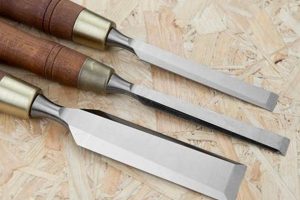
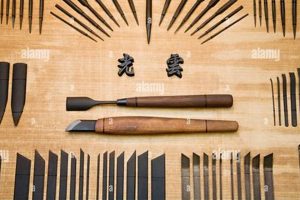
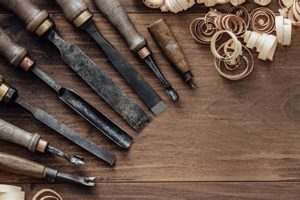
Essential implements for shaping, joining, and finishing wood are fundamental to woodworking. This collection comprises items such as hand planes for smoothing surfaces, chisels for detailed carving, saws for cutting stock, and measuring instruments for accuracy. For example, a well-tuned hand plane produces a flawless surface, while a sharp chisel allows for intricate detailing.
Possessing appropriate instruments empowers craftspeople to execute projects with precision and efficiency. Investment in quality equipment reduces errors, minimizes material waste, and enhances the longevity of finished pieces. Historically, woodworking’s progression has been intrinsically linked to the development and refinement of specialized devices.
The subsequent sections will delve into specific categories of these instruments, exploring their functionalities and applications in detail. Discussions will encompass both manually operated devices and power-driven alternatives, providing a comprehensive overview of available options.
Guidance on Selecting Woodworking Equipment
Careful consideration should be given to the acquisition and maintenance of implements for woodworking endeavors. Informed choices lead to increased efficiency, improved safety, and superior results.
Tip 1: Prioritize Quality Over Quantity: Investing in durable, well-crafted instruments yields long-term benefits. Superior materials and construction withstand rigorous use and maintain accuracy over time. For instance, a high-quality hand saw will retain its sharpness and precision far longer than a cheaper alternative.
Tip 2: Begin with Essential Items: Establishing a foundation of fundamental equipment is crucial. Prioritize core items like a hand plane, chisels, a measuring square, and saws before acquiring specialized tools. This approach allows a woodworker to develop skills and identify specific needs before expanding their collection.
Tip 3: Research and Compare Options: Thorough research is necessary before purchasing any instrument. Consult reviews, compare specifications, and consider the intended application to ensure the selected item aligns with project requirements. Online forums and trade publications provide valuable insights.
Tip 4: Properly Maintain Equipment: Regular maintenance is paramount for preserving functionality and extending lifespan. Sharpening blades, lubricating moving parts, and cleaning after each use are essential practices. Neglecting maintenance can lead to diminished performance and premature failure.
Tip 5: Consider Ergonomics and Comfort: The physical demands of woodworking necessitate ergonomic designs. Select instruments that fit comfortably in the hand and minimize strain. Prolonged use of poorly designed equipment can lead to fatigue and injury.
Tip 6: Evaluate Power Tool Alternatives: Power-driven implements can significantly enhance efficiency for certain tasks. However, consider factors such as noise levels, dust control, and safety features before incorporating power tools into the workshop. Always prioritize safety when operating power equipment.
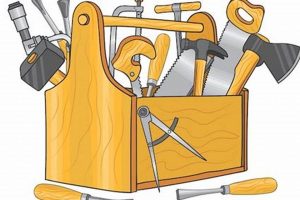
Tip 7: Ensure Adequate Storage: Organized storage is essential for protecting valuable instruments and maintaining a safe workspace. Invest in tool chests, cabinets, or wall-mounted racks to keep equipment readily accessible and prevent damage. A well-organized workshop promotes efficiency and safety.
By adhering to these guidelines, one can make informed decisions when acquiring and maintaining woodworking equipment, ultimately enhancing the woodworking experience and the quality of finished projects.
The subsequent article sections will explore specific aspects of using these devices and best practices for achieving optimal results.
1. Precision measuring instruments

The execution of woodworking projects relies critically on accurate dimensional control. Therefore, precision measuring instruments constitute an indispensable segment within the comprehensive collection of equipment a woodworker needs. Deficiencies in measurement directly translate to errors in cutting, joinery, and assembly, compromising the structural integrity and aesthetic appeal of the finished piece. The connection between dimensional accuracy and project outcome is causal: imprecise measurements invariably lead to subpar results. A project requiring precise 90-degree angles, such as a cabinet carcass, necessitates a square accurate to within fractions of a degree. Failure to achieve this tolerance will result in a cabinet that is not square, impacting door alignment and overall stability.
The array of precision measuring instruments utilized in woodworking encompasses devices such as rulers, calipers, squares, protractors, and levels. Each instrument serves a distinct function in establishing and verifying dimensions. A ruler provides linear measurements, while calipers enable the precise measurement of internal and external dimensions, crucial in fitting components like drawers. Squares ensure right angles in corners and joints, whereas protractors facilitate the accurate marking and cutting of angles for complex designs. Levels confirm horizontal and vertical alignment, which is critical for installation and stability. The correct selection and utilization of these instruments are essential for achieving the desired dimensions.
In summary, precision measuring instruments are not merely accessories but fundamental components within the complete set of equipment. Their accuracy directly influences project success, and their proper utilization distinguishes skilled craftspeople from those who produce inferior work. The investment in high-quality measuring instruments and the development of skills in their correct application are therefore vital for any woodworker aspiring to excellence. The need to ensure calibration and maintenance is also critical, addressing any issues such as the scale worn by time.
2. Sharp cutting edges
The effectiveness of equipment designed for material removal in woodworking hinges predominantly on the condition of the cutting edge. Sharpness is not merely a desirable attribute but a fundamental requirement for efficient and precise material manipulation. Dull cutting edges introduce a cascade of negative consequences, impacting both the quality of the finished product and the safety of the operator.
- Clean and Accurate Cuts
A keen edge severs wood fibers cleanly, resulting in surfaces that require minimal further processing. Sharp saws produce smooth edges free from tear-out, while sharp chisels create crisp, defined details. Conversely, a dull edge crushes and tears the wood, producing ragged, uneven surfaces that necessitate extensive sanding and rework. The time saved and the quality gained through sharp cutting edges are significant.
- Reduced Effort and Increased Control
Sharp cutting implements require less force to operate, leading to reduced fatigue and improved control. This translates into greater accuracy and consistency, particularly during intricate operations such as carving or joinery. The ability to precisely control the cutting action minimizes the risk of errors and ensures that the final product meets the desired specifications. A sharper blade is safer, requiring less force, and therefore more controllable.
- Prolonged Tool Lifespan
Maintaining sharp edges reduces wear and tear on the tool itself. A dull edge necessitates increased force, which can lead to premature dulling, chipping, or even breakage. Regular sharpening, on the other hand, preserves the tool’s geometry and extends its usable life. Investment in sharpening equipment and skills is therefore a prudent measure for maximizing the value of woodworking instruments.
- Enhanced Safety
Dull cutting edges increase the risk of accidents. Applying excessive force to a dull blade or chisel can cause it to slip or bind, potentially leading to injury. Sharp tools, conversely, require less force and provide greater control, reducing the likelihood of mishaps. Prioritizing sharpness is therefore a fundamental safety practice in woodworking.
In summary, the attribute of keen edges is inextricably linked to the functionality and effectiveness of a comprehensive toolkit. These edges dictate the precision, efficiency, and safety of woodworking operations. The resources devoted to edge maintenance are not merely an expenditure, but an investment, yielding superior results, extending implement lifespans, and mitigating operational hazards.
3. Effective joinery mechanisms

The realization of structural integrity and aesthetic refinement in woodworking is inextricably linked to the efficacy of joinery. The strength and precision of connections between wooden elements directly determine the durability and visual appeal of any constructed object. Therefore, implements for creating reliable joints represent a critical component of the comprehensive set a woodworker needs. Ineffective joinery leads to weakened structures, dimensional instability, and compromised aesthetics, rendering the finished piece functionally deficient and visually unappealing. Consider a table constructed with poorly executed mortise and tenon joints; the legs may wobble, the tabletop may sag, and the overall structure will be prone to failure under load. Conversely, well-executed joints provide robust, long-lasting connections that enhance the object’s value and longevity.
The repertoire of joinery techniques encompasses a wide array of methods, each requiring specific equipment for its effective execution. Dovetail joints, prized for their strength and visual appeal, demand precision saws, chisels, and marking gauges to achieve tight-fitting, interlocking connections. Mortise and tenon joints, similarly, necessitate chisels, saws, and mortising machines to create precisely dimensioned mortises and tenons that interlock securely. Screw and dowel joinery relies on drills, drivers, and specialized jigs to ensure accurate alignment and secure fastening. The proper selection and use of these implements are crucial for achieving the desired strength and precision in any woodworking project. A craftsman skilled in joinery recognizes not only the mechanical properties of each joint type but also the appropriate usage and implementation for specific construction requirements.
In summary, effective joinery mechanisms are not merely supplementary aspects of woodworking, but foundational elements that dictate the success of any project. The implements required for creating robust and precise joints are therefore essential components of the entire toolkit. Mastering joinery techniques and selecting appropriate instruments are critical for achieving durable, aesthetically pleasing, and functionally sound woodworking creations. Without such expertise and resources, structural failures are probable, negating a considerable portion of the benefits derived from the use of woodworking.
4. Surface preparation implements

The achievement of a flawless finish in woodworking hinges directly on the quality of surface preparation. Consequently, implements designed for this purpose constitute a critical subset within a woodworker’s essential equipment. Inadequate surface preparation inevitably leads to imperfections in the final finish, detracting from the overall aesthetic and potentially compromising the durability of the protective coating. The relationship between surface preparation and finish quality is causal: a poorly prepared surface invariably yields a substandard result. For example, applying a varnish to a surface riddled with scratches and planer marks will only accentuate these defects, resulting in a finish that appears uneven and unprofessional.
The array of surface preparation implements encompasses tools such as planes, scrapers, sandpaper, and specialized abrasives. Planes, both hand-operated and power-driven, are employed to level uneven surfaces and remove mill marks. Scrapers are utilized for refining surfaces and eliminating blemishes, offering a level of precision that planes cannot achieve. Sandpaper, available in a range of grits, serves to smooth surfaces progressively, removing fine scratches and creating a uniform texture. Specialized abrasives, such as abrasive pads and steel wool, are used for tasks such as distressing wood or achieving a specific sheen. The proper selection and utilization of these implements are essential for creating a surface that is receptive to a flawless finish. The nature of wood used, for instance soft or hard wood, has a large effect on this.
In summary, surface preparation implements are not merely optional accessories but essential components of a complete set of equipment. Their proper utilization dictates the final quality of any finished woodworking project. The investment in high-quality surface preparation implements and the development of skill in their correct application are crucial for any craftspeople aspiring to produce professional-grade results. The challenge of achieving a truly flawless finish often lies not in the application of the finish itself, but in the meticulous preparation of the surface beneath.
5. Workholding devices

Securely immobilizing workpieces during woodworking operations is fundamental to achieving precision, safety, and efficiency. Therefore, devices designed for this purpose comprise an indispensable category within a woodworker’s inventory.
- Bench Vises: Stability and Control
Bench vises provide a fixed clamping surface, enabling secure retention of stock for tasks such as sawing, planing, and joinery. The vise’s stability minimizes workpiece movement, enhancing accuracy and control. For instance, securely clamping a board in a vise allows for the application of consistent pressure during hand planing, resulting in a smooth, even surface. Without a reliable vise, the risk of slippage increases, leading to potential inaccuracies and safety hazards.
- Clamps: Versatile Securing Mechanisms
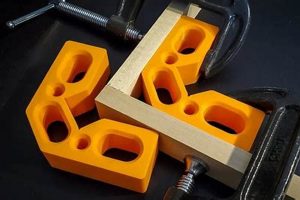
Clamps, available in various types such as bar clamps, pipe clamps, and spring clamps, offer versatile solutions for holding workpieces together during assembly and gluing. Their adjustable clamping force ensures uniform pressure distribution, promoting strong and durable bonds. During the glue-up of a table top, multiple bar clamps are strategically positioned to apply even pressure across the joints, preventing gaps and ensuring a flush surface. The absence of appropriate clamps can lead to weak joints and structural instability.
- Jigs and Fixtures: Task-Specific Workholding
Jigs and fixtures are custom-built or commercially available devices designed to hold workpieces in specific orientations for repetitive tasks, enhancing accuracy and repeatability. A dovetail jig, for example, guides a router or saw to create precise dovetail joints, streamlining the joinery process. Using jigs and fixtures minimizes errors and improves efficiency when producing multiple identical components. Attempting to execute complex joinery without the aid of specialized jigs can be time-consuming and prone to inaccuracies.
- Hand Screws: Adjustable and Precise Clamping
Hand screws, also known as handscrew clamps, offer adjustable and precise clamping pressure, making them suitable for delicate or irregularly shaped workpieces. Their wooden jaws distribute pressure evenly, minimizing the risk of damage or distortion. When clamping a curved piece of wood, the adjustable jaws of a handscrew clamp conform to the contours, providing secure and even pressure. Using conventional clamps on delicate workpieces can lead to crushing or marring of the surface.
These implements, individually and collectively, ensure workpiece stability, promoting accuracy, safety, and efficiency in woodworking. Their presence in the workshop expands the range of achievable tasks and improves the quality of finished products, directly correlating with success of woodworking work.
6. Safety equipment
The utilization of power and hand tools in woodworking inherently presents risks. Eye protection, hearing protection, respiratory protection, and appropriate clothing constitute essential safeguards. Disregard for safety protocols and the omission of appropriate safety devices result in elevated probabilities of injury or long-term health complications.
For instance, the operation of a table saw without eye protection exposes the user to projectiles such as wood chips or splinters, potentially causing severe ocular damage. Similarly, prolonged exposure to high noise levels generated by power tools, absent hearing protection, leads to irreversible hearing loss. The sanding of certain wood species or the application of finishes releases particulate matter and volatile organic compounds, necessitating respiratory protection to prevent respiratory illnesses. Loose clothing or jewelry poses entanglement hazards when operating machinery, underscoring the importance of appropriate attire.
The incorporation of safety equipment within the toolkit is not discretionary; it is an indispensable element of responsible woodworking practice. Prioritization of safety minimizes the risk of injury, contributing to a sustainable and enjoyable engagement with the craft.
7. Maintenance materials
The longevity and optimal performance of implements for woodworking are directly contingent upon consistent upkeep. Therefore, a selection of maintenance materials constitutes a critical, often overlooked, aspect of the full complement of “tools a woodworker needs”. Neglecting maintenance diminishes the efficacy of equipment, shortens its lifespan, and can compromise safety. A dull saw, for instance, requires increased force to operate, increasing the risk of kickback and potential injury.
- Sharpening Stones and Hones: Maintaining Cutting Edges
Sharpening stones, both natural and synthetic, are essential for preserving the keenness of cutting edges on chisels, planes, and knives. Hones, with their finer grit, refine the edge to an even greater degree of sharpness. Regularly honing or sharpening these tools maintains their cutting efficiency, minimizing effort and ensuring clean, precise cuts. A dull chisel, by contrast, requires excessive force, leading to reduced control and potential damage to the workpiece. Consider the maintenance requirements prior to purchasing woodworking equipments.
- Lubricants: Reducing Friction and Wear
Lubricants, such as oils and waxes, are vital for reducing friction and wear on moving parts of tools like hand planes, saws, and machinery. Regular lubrication ensures smooth operation, prevents corrosion, and extends the lifespan of the equipment. A hand plane with properly lubricated components glides effortlessly across the wood surface, producing a smooth, even cut. Neglecting lubrication can lead to increased friction, binding, and premature wear of critical parts.
- Cleaning Agents: Removing Residue and Corrosion
Cleaning agents, including solvents and specialized wood cleaners, are necessary for removing pitch, resin, and corrosion from tools and surfaces. Regular cleaning prevents the build-up of residue that can impede performance and accelerate deterioration. A saw blade coated with pitch, for example, cuts less efficiently and is more prone to binding. Cleaning agents also help protect against rust and corrosion, extending the tool’s lifespan.
- Protective Coatings: Preventing Corrosion and Damage
Protective coatings, such as rust inhibitors and waxes, safeguard tools from corrosion and environmental damage. Applying these coatings after cleaning and lubrication creates a barrier against moisture and contaminants, preventing rust and extending the tool’s lifespan. A well-protected hand plane stored in a humid environment will remain rust-free and ready for use, whereas an unprotected plane may develop corrosion, rendering it unusable without extensive restoration.
In conclusion, maintenance materials are not merely ancillary items but integral components of a woodworker’s fundamental assets. Their consistent application directly influences the performance, longevity, and safety of woodworking equipment. The investment in these materials and the dedication to regular maintenance practices are essential for any craftsperson aspiring to achieve consistent, high-quality results and preserve their tools. The lack of such components is detrimental to the success in the woodworking journey.
Frequently Asked Questions
This section addresses prevalent inquiries regarding equipment employed in woodworking, providing succinct and factual responses to facilitate informed decision-making.
Question 1: What constitutes the most essential instrument for a novice woodworker?
A measuring square, a sharp chisel, and a reliable hand saw are fundamental for introductory projects. These implements enable basic cutting, shaping, and joinery operations, providing a foundation for skill development.
Question 2: What attributes distinguish a high-quality hand plane?
A rigid body, a precisely machined sole, and a well-fitted blade are hallmarks of a superior hand plane. These characteristics ensure smooth, controlled cuts and minimize chatter.
Question 3: How frequently should cutting edges be sharpened?
Sharpening frequency depends on the type of wood being worked and the intensity of use. As a general guideline, cutting edges should be sharpened whenever they exhibit a noticeable decrease in performance.
Question 4: What safety precautions are paramount when operating woodworking machinery?
Eye protection, hearing protection, and respiratory protection are indispensable. Loose clothing and jewelry should be avoided, and machinery guards should always be in place and functional.
Question 5: What types of adhesives are commonly employed in woodworking?
Polyvinyl acetate (PVA) glue, epoxy resin, and polyurethane glue are widely used for various woodworking applications. The selection of an appropriate adhesive depends on the specific materials being joined and the desired bond strength.
Question 6: What are the key considerations when selecting a workbench?
Stability, a robust work surface, and integrated workholding capabilities are essential attributes of a functional workbench. The workbench should be sized appropriately for the intended tasks and the available workspace.
Understanding these concepts is crucial for safe and effective work in the woodworking realm.
The subsequent sections will delve into specific aspects of advanced equipment and the considerations of a proper workshop setup.
Essential Implements for Woodworking
This exploration of essential implements for woodworking has underscored the critical role of appropriate instruments in achieving precision, safety, and enduring quality. From meticulously measuring devices to acutely honed cutting edges and reliable workholding mechanisms, the selection and maintenance of these items are paramount. Adherence to established safety protocols and the utilization of suitable maintenance materials are integral to preserving equipment functionality and mitigating operational hazards.
Continued dedication to honing skills, procuring quality instruments, and maintaining a safe working environment remains paramount. The pursuit of woodworking excellence demands a continuous commitment to mastering both the craft and the proper care of its instruments, thereby safeguarding the woodworker’s well-being and elevating the quality of the woodworker’s artistic and functional output.