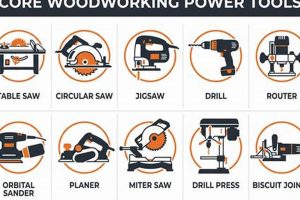
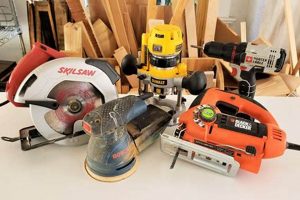
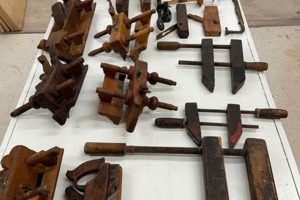
Instruments that enhance the accuracy, efficiency, and safety of shaping wood are essential for successful woodworking projects. These implements, ranging from hand-operated devices to power-driven machinery, facilitate tasks such as cutting, shaping, joining, and finishing timber. A hand saw and a chisel represent traditional examples, while a power drill and a table saw exemplify more modern variations.
Employing appropriate instruments results in projects of superior quality and durability. Precise cuts and secure joinery contribute to structural integrity and aesthetic appeal. Furthermore, the employment of such implements reduces the physical strain on the operator and minimizes the risk of workplace injuries. The historical evolution of these implements mirrors the progress of woodworking itself, with advancements in materials and design continuously refining their functionality.
The subsequent sections will delve into specific categories and individual examples, providing detailed information on their functions, proper usage techniques, and maintenance requirements. This will encompass cutting instruments, shaping implements, joining mechanisms, and finishing implements, offering a comprehensive overview of the resources available to woodworkers of all skill levels.
Guidance on Implements for Woodworking
The following recommendations are designed to optimize the selection, utilization, and maintenance of implements employed in woodworking practices, promoting enhanced project outcomes and prolonged equipment lifespan.
Tip 1: Prioritize Safety Equipment: Protective eyewear, hearing protection, and respiratory masks are critical components. These items mitigate the potential for injury from flying debris, excessive noise, and airborne particulate matter generated during woodworking processes.
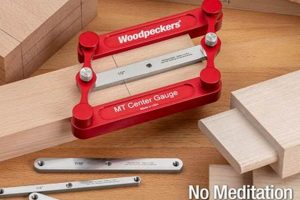
Tip 2: Invest in Quality Measuring Instruments: Accurate measurements are fundamental to precise woodworking. A high-quality measuring tape, precision squares, and marking gauges will ensure dimensional accuracy in all project phases.
Tip 3: Select Appropriate Cutting Instruments: Choose cutting implements tailored to the specific task. A fine-toothed saw is recommended for delicate work, while a coarser blade is suitable for rapid material removal. The selection should align with the wood type and cut geometry.
Tip 4: Maintain Sharp Cutting Edges: Dull cutting edges compromise efficiency and safety. Regularly sharpen chisels, plane irons, and saw blades to ensure clean cuts and reduced exertion. A sharpening system is a worthwhile investment.
Tip 5: Implement Dust Collection Systems: Wood dust is a respiratory irritant and potential fire hazard. Employ a dust collector or shop vacuum to minimize dust accumulation and maintain a clean and healthy work environment.
Tip 6: Secure Workpieces Effectively: Proper clamping and work holding are essential for stability and safety. Employ a variety of clamps, vises, and jigs to securely position workpieces during cutting, shaping, and assembly operations.
Tip 7: Adhere to Manufacturer’s Instructions: Carefully review and follow the operating instructions provided by the manufacturer for all power-driven implements. This will ensure safe and effective utilization and prevent equipment damage.
These recommendations emphasize the importance of safety, accuracy, and preventative maintenance in woodworking. Adhering to these guidelines will contribute to the successful completion of projects and the longevity of the implements used.
The subsequent discussion will transition to the practical application of these implements in various woodworking techniques.
1. Precision

Precision, in the context of woodworking, denotes the degree of accuracy and exactness achieved in measurements, cuts, and joinery. The relationship between precision and implements used in woodworking is direct and causal: implements designed and maintained for precision enable woodworkers to produce work of higher quality and dimensional accuracy. Imprecise implements, conversely, result in errors that can compromise the structural integrity and aesthetic appeal of a finished piece.
Accurate measuring implements, such as finely graduated rules and digital calipers, are fundamental to ensuring precision in initial layout and marking. Similarly, the sharp and properly set blades of saws, planes, and chisels facilitate clean and controlled material removal, minimizing deviations from intended dimensions. Jigs and fixtures play a crucial role in achieving repetitive accuracy, particularly in joinery operations. For example, a dovetail jig, when used with a router and appropriate bit, allows for the creation of consistently accurate and strong dovetail joints. The impact of precise implements extends beyond individual components; it affects the overall fit and finish of the assembled project. Gaps, misalignments, and variations in surface finish are all indicative of a lack of precision in either the implements used or the techniques employed.
In summary, precision is an indispensable component of woodworking, directly influenced by the quality and proper utilization of implements. Achieving a high degree of precision demands careful selection, meticulous maintenance, and skillful application of suitable implements. Overcoming challenges such as tool wear and material variations requires a commitment to ongoing refinement of technique and a thorough understanding of the instruments used. This emphasis on precision is essential for creating durable, aesthetically pleasing, and functionally sound woodworking projects.
2. Durability

Durability, in the context of woodworking, refers to the capacity of implements to withstand prolonged use and repeated stress without experiencing significant degradation in performance or structural integrity. The longevity and reliability of implements directly impact woodworking efficiency, safety, and cost-effectiveness.
- Material Composition
The constituent materials of an implement dictate its resistance to wear, corrosion, and mechanical stress. High-carbon steel, for example, is commonly employed in cutting edges due to its hardness and ability to maintain a sharp profile. Conversely, cheaper, less resilient materials are prone to blunting, bending, or fracturing under load, requiring frequent replacement and potentially compromising user safety. The selection of appropriate alloys and heat treatments is crucial in maximizing the lifespan of tools.
- Construction Quality
The method of manufacturing significantly influences an implement’s overall robustness. Forged tools, produced through a process of shaping metal under extreme pressure, exhibit superior grain structure and resistance to fatigue compared to cast or stamped alternatives. Solid, well-fitted components minimize play and vibration, enhancing precision and reducing the likelihood of premature failure. Precise machining and careful assembly contribute to long-term reliability.
- Design Considerations
The ergonomic design and structural configuration of an implement impact its ability to withstand repeated use. A handle shaped to distribute force evenly reduces stress concentration and minimizes the risk of breakage. Reinforcements at points of high stress, such as the tang of a chisel or the body of a plane, prevent structural failure under heavy loads. Thoughtful design considerations contribute significantly to the extended service life of a woodworking tool.
- Maintenance Practices
Regular maintenance is essential for preserving the durability of woodworking implements. Proper cleaning, lubrication, and sharpening prevent corrosion, reduce friction, and maintain optimal cutting performance. Neglecting these maintenance practices accelerates wear and tear, leading to diminished effectiveness and eventual failure. Adherence to recommended maintenance schedules prolongs the service life and ensures consistent performance.
The inherent durability of woodworking implements, coupled with diligent maintenance practices, directly affects the overall cost and efficiency of woodworking endeavors. Investing in robust, well-constructed implements represents a long-term value proposition, minimizing the need for frequent replacements and ensuring consistent, reliable performance across a range of woodworking applications. The lifespan and reliability of these instruments are intertwined with the quality and success of woodworking projects.
3. Versatility

Versatility, in the context of implements employed for shaping wood, denotes the capability to perform multiple functions or adapt to a range of applications. The effectiveness and practicality of a given implement are substantially enhanced by its capacity to execute diverse tasks within the woodworking process. The consequence of implementing versatile implements is a reduction in the number of specialized instruments required, thereby decreasing capital expenditure and minimizing storage space requirements.
The importance of versatility can be illustrated by examining the combination square. This instrument serves not only as a square for establishing right angles but also as a depth gauge, height gauge, and marking tool. Its multifaceted utility streamlines tasks and reduces the need for separate, specialized instruments. Similarly, a multi-tool equipped with interchangeable blades and attachments can perform cutting, sanding, and shaping operations, replacing a collection of single-purpose implements. The practical significance of this understanding lies in the ability of woodworkers to optimize their implement inventory, selecting instruments that offer the greatest return on investment and maximizing their utility across various project phases.
The challenge lies in balancing versatility with specialization. While a multi-tool may offer a broad range of functionalities, it may not perform each task as effectively as a dedicated instrument. The judicious selection of implements requires a careful assessment of project requirements and a thorough understanding of the trade-offs between versatility and specialized performance. The integration of versatile implements into a woodworking practice necessitates a comprehensive evaluation of project needs, balancing the advantages of multi-functionality against the precision and efficiency of specialized instruments to achieve the optimal combination for specific woodworking goals.
4. Safety

The correlation between safety and implements used in woodworking is intrinsic and critical. Properly designed and maintained implements, when used according to established safety protocols, minimize the risk of injury. Conversely, substandard or misused implements constitute a significant hazard. A direct causal relationship exists: safe implements, coupled with sound practices, lead to a reduced incidence of accidents, while unsafe implements or procedures increase the likelihood of harm. The importance of safety as an inherent component of implements for woodworking is paramount; without it, the potential for serious injury is unacceptable. For example, a table saw equipped with effective blade guards and anti-kickback pawls demonstrably reduces the risk of finger or hand injuries. The practical significance of this understanding is that prioritizing safety in the selection, maintenance, and operation of implements is not merely a desirable attribute but a fundamental requirement.
The impact of safety features extends beyond the immediate operation of the implement. Ergonomic design, for instance, reduces strain and fatigue, mitigating the risk of long-term musculoskeletal disorders. Dust collection systems minimize exposure to harmful airborne particulates, safeguarding respiratory health. Proper training in the safe use of each implement is equally crucial. A woodworker fully aware of the potential hazards associated with a lathe, and trained in its safe operation, is far less likely to experience an accident than an untrained individual. Real-world examples abound: a woodworker consistently wearing safety glasses avoids eye injuries from flying debris; another who employs push sticks when operating a jointer minimizes the risk of finger contact with the cutting blades.
In summary, the safety of implements for woodworking is not an optional add-on but an essential characteristic that permeates design, manufacturing, operation, and maintenance. Overcoming challenges such as complacency, cost-cutting measures that compromise safety, and inadequate training requires a continuous and proactive approach. Emphasizing safety in all aspects of woodworking is ethically imperative and contributes directly to the well-being and productivity of the woodworker. Neglecting this foundational element jeopardizes both the individual and the integrity of the craft.
5. Efficiency

Efficiency, in woodworking, relates directly to the output achieved relative to the resources expended, including time, energy, and materials. The selection and proper utilization of implements exert a significant influence on this crucial metric.
- Optimized Task Completion Time
The appropriate tool accelerates specific tasks. A power planer, for example, removes material from a board surface at a rate significantly exceeding that of a hand plane. This direct reduction in task completion time contributes substantially to overall project efficiency. Conversely, using an inadequate or poorly maintained implement prolongs the process, increasing labor costs and potentially introducing errors.
- Reduced Material Waste
Implements facilitating precise cuts and joinery minimize material waste. A sharp, properly set miter saw, for instance, enables accurate angle cuts, reducing the likelihood of errors that necessitate recutting or discarding material. Inefficient or poorly calibrated implements result in inaccurate cuts, leading to increased material consumption and associated financial losses. A band saw, with its narrow blade, creates less waste when cutting curves compared to a jigsaw.
- Minimized Physical Exertion
Power-driven implements reduce physical strain on the operator, conserving energy and minimizing fatigue. A power drill, for example, simplifies drilling operations, requiring significantly less physical exertion compared to a hand-operated brace. Decreased physical demand allows for sustained work periods, enhancing overall productivity. Furthermore, ergonomic designs and features contribute to user comfort and reduce the risk of repetitive strain injuries.
- Enhanced Project Throughput
The cumulative effect of optimized task completion time, reduced material waste, and minimized physical exertion translates to increased project throughput. A workshop equipped with efficient implements can produce a greater volume of finished goods within a given timeframe compared to one relying on outdated or inadequate resources. This enhanced productivity directly impacts profitability and competitiveness.
The preceding facets illustrate the profound connection between efficient implements and productivity in woodworking. Investment in appropriate, high-quality implements represents a strategic allocation of resources, yielding tangible returns in terms of reduced costs, enhanced output, and improved overall operational efficiency. An evaluation of project needs, implement capabilities, and resource constraints is essential for maximizing efficiency and ensuring the successful completion of woodworking endeavors.
6. Maintenance

Maintenance is a foundational component of useful implements for shaping wood, directly impacting their operational lifespan, performance consistency, and safety. A causal relationship exists: consistent and appropriate maintenance procedures extend the usefulness and reliability of woodworking tools, while neglect leads to degradation, reduced efficiency, and increased risk of failure. The practical significance of this understanding lies in the ability to preserve the initial investment in woodworking equipment and ensure safe and effective operation over an extended period. For example, regular sharpening of a chisel maintains its cutting edge, enabling clean and precise wood removal; neglecting this maintenance results in a dull edge, requiring excessive force and increasing the potential for slippage and injury.
The scope of maintenance encompasses a range of activities tailored to specific implements. For edged tools, such as saws, planes, and chisels, regular sharpening and honing are essential for preserving cutting performance. Power tools require periodic lubrication of moving parts, inspection of electrical components, and replacement of worn brushes. Dust collection systems demand regular cleaning of filters and inspection of hoses to maintain airflow and prevent blockages. Failure to adhere to these maintenance schedules leads to diminished performance, increased energy consumption, and potential equipment damage. The practical application of this knowledge involves implementing a proactive maintenance program, including scheduled inspections, cleaning, lubrication, and repairs.
In summary, maintenance is not merely a supplementary task but an integral aspect of ensuring that implements for woodworking remain useful, safe, and efficient throughout their operational life. Overcoming challenges such as time constraints and a lack of awareness regarding proper maintenance procedures requires a commitment to education and a structured approach to equipment care. Emphasizing maintenance as a core competency is crucial for optimizing the value of woodworking implements, minimizing downtime, and fostering a safe and productive work environment. The inherent benefits of proactive maintenance outweigh the short-term inconvenience, contributing to long-term cost savings and operational effectiveness.
7. Ergonomics

Ergonomics, the study of designing equipment and workplaces to fit the worker, possesses a critical relationship with woodworking implements. The effectiveness and usability of implements are significantly impacted by their ergonomic design. Poor ergonomics can lead to fatigue, discomfort, and, more seriously, musculoskeletal disorders, directly affecting a woodworker’s health and productivity. Consequently, ergonomics is not merely a desirable feature but a fundamental requirement for implements intended for shaping wood. Consider a hand plane: a handle designed to fit comfortably in the hand and allow for efficient force transmission minimizes strain on the wrist and forearm. Conversely, a plane with a poorly shaped handle requires excessive grip strength and awkward positioning, increasing the risk of carpal tunnel syndrome. The practical significance of this understanding lies in recognizing that an investment in ergonomically designed implements constitutes an investment in the long-term health and well-being of the woodworker.
The integration of ergonomic principles extends beyond handle design. The weight and balance of an implement are critical factors. A tool that is excessively heavy or poorly balanced requires greater exertion to control, accelerating fatigue and increasing the likelihood of accidents. Power tools, such as sanders and routers, should incorporate vibration damping features to reduce hand-arm vibration syndrome (HAVS). Furthermore, the positioning of controls and switches should allow for easy access and operation without requiring awkward postures or excessive reaching. Examples include adjustable-height workbenches, which allow woodworkers to maintain a comfortable and neutral spine posture, and power tools with adjustable handles, enabling customized grip and control. Adherence to ergonomic guidelines minimizes the physical stress associated with woodworking, enhancing both efficiency and safety.
In summary, ergonomics is an indispensable aspect of useful implements for woodworking, impacting user comfort, productivity, and long-term health. Overcoming challenges such as cost considerations and a lack of awareness regarding ergonomic principles requires a commitment to education and the prioritization of worker well-being. Emphasizing ergonomics in the selection and design of implements is not merely a matter of compliance but a fundamental ethical responsibility. Ignoring this critical element jeopardizes the health and safety of woodworkers and undermines the sustainability of the craft. Therefore, the integration of ergonomic design principles is paramount for creating truly useful and effective tools for shaping wood.
Frequently Asked Questions About Implements for Shaping Wood
This section addresses common inquiries and misconceptions regarding implements employed in woodworking practices. The following questions and answers aim to provide clarity and enhance understanding of this topic.
Question 1: What constitutes a “useful” implement for woodworking?
A “useful” implement possesses characteristics such as precision, durability, versatility, safety features, efficiency in operation, ease of maintenance, and an ergonomic design. It performs its intended function effectively and contributes to the successful completion of woodworking projects.
Question 2: How should a woodworker select implements appropriate for specific tasks?
Selection should be based on a thorough assessment of the project requirements. Consider the type of wood being worked, the complexity of the cuts required, the desired level of precision, and the physical demands of the task. Selecting implements specifically designed for the task will optimize performance and minimize the risk of errors or injuries.
Question 3: What are the essential safety precautions when using power-driven implements?
Prioritize safety by wearing appropriate personal protective equipment, including safety glasses, hearing protection, and respiratory masks. Ensure that all safety guards and features are properly installed and functioning correctly. Read and adhere to the manufacturer’s operating instructions, and never operate power-driven implements while fatigued or under the influence of substances that impair judgment.
Question 4: How frequently should implements be maintained to ensure optimal performance?
Maintenance schedules vary depending on the implement type and usage frequency. Edged tools, such as saws and chisels, require regular sharpening or honing. Power tools require periodic lubrication of moving parts and inspection of electrical components. Refer to the manufacturer’s recommendations for specific maintenance intervals and procedures.
Question 5: What are the key factors to consider when evaluating the ergonomic design of implements?
Assess the handle shape, weight distribution, vibration damping features, and positioning of controls. Implements should fit comfortably in the hand and allow for efficient force transmission without requiring excessive grip strength or awkward postures. Ergonomic design minimizes fatigue and reduces the risk of musculoskeletal disorders.
Question 6: What are the potential consequences of using substandard or poorly maintained implements?
Using substandard or poorly maintained implements can compromise the quality of the finished product, increase the risk of accidents, and reduce overall efficiency. Dull cutting edges, worn components, and inadequate safety features can lead to inaccurate cuts, material waste, and potential injuries.
The preceding questions and answers provide a foundational understanding of the selection, use, and maintenance of woodworking implements. A thorough comprehension of these principles will contribute to safer, more efficient, and more successful woodworking endeavors.
The following section will explore advanced techniques and strategies for optimizing implement utilization in specific woodworking applications.
Conclusion
This exploration of useful tools for woodworking has emphasized the multifaceted nature of these instruments. The analysis encompasses precision, durability, versatility, safety, efficiency, maintenance, and ergonomics, demonstrating their individual and collective impact on woodworking outcomes. A thorough understanding of these elements is essential for effective implement selection and utilization.
The continued advancement of woodworking depends upon the informed application of appropriate instruments and techniques. The pursuit of excellence in craftsmanship necessitates a commitment to safety, precision, and ongoing education. Woodworkers must remain vigilant in adapting to evolving technologies and methods to preserve and elevate this skilled trade.