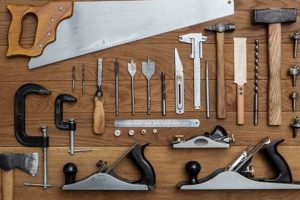
Instruments employed in woodworking for dimensional assessment and marking are essential for precision and accuracy in fabrication. These instruments facilitate the determination of length, width, depth, angle, and other spatial attributes of materials. A common example includes a steel rule, used to measure linear distances and mark cut lines.
The accurate employment of these instruments yields numerous advantages. Properly measured and marked materials ensure joints fit correctly, finished pieces maintain intended dimensions, and waste is minimized. Historically, simple rules and squares were the primary means of measurement, but advancements have introduced more sophisticated devices increasing efficiency and accuracy. This evolution reflects the demand for higher precision in woodworking projects.
The following sections will delve into specific categories of these instruments, examining their functionality, proper usage, and maintenance for optimal performance in woodworking endeavors. The emphasis will be on practical application and achieving consistently accurate results in diverse woodworking scenarios.
Essential Guidance for Dimensional Accuracy
The following tips outline best practices for utilizing dimensional assessment instruments, aiming to enhance the precision and consistency of woodworking projects.
Tip 1: Calibrate Instruments Regularly: Periodically check the accuracy of squares, rules, and levels against a known standard. Discrepancies can compound over time, leading to inaccuracies in finished work.
Tip 2: Employ Consistent Measuring Techniques: Maintain a uniform pressure when using marking gauges or rulers to avoid parallax errors and variations in measurement.
Tip 3: Use Sharp Marking Tools: A dull pencil or marking knife can result in imprecise lines. Regularly sharpen these tools to ensure clarity and accuracy in layout work.
Tip 4: Measure Twice, Cut Once: This adage underscores the importance of verifying measurements before committing to a cut. A single error can ruin a workpiece.
Tip 5: Account for Blade Kerf: When making cuts, factor in the width of the saw blade. This is especially crucial when cutting multiple pieces to precise dimensions.
Tip 6: Use Appropriate Tools for the Task: Employing the correct instrument for a specific measurement improves efficiency and reduces the likelihood of errors. For instance, a digital angle finder is more suited for complex angles than a protractor.
Tip 7: Store Instruments Properly: Keep measuring tools in a clean, dry environment to prevent damage and maintain their accuracy. Avoid dropping or mishandling them.
Accurate dimensional assessment is paramount in woodworking. Adhering to these guidelines contributes to improved joinery, reduced material waste, and enhanced overall project quality.
The subsequent section will address specific types of dimensional assessment instruments, offering in-depth analyses of their features and applications.
1. Accuracy
Accuracy, in the context of dimensional assessment instruments, directly influences the precision of woodworking projects. Erroneous measurements stemming from inaccurate tools propagate through the entire fabrication process, leading to misaligned joints, components that deviate from intended dimensions, and ultimately, structural or aesthetic defects in the final product. For instance, if a square is not precisely 90 degrees, any project relying on that square for establishing right angles will exhibit cumulative errors, resulting in a piece that is out of square. Thus, the initial accuracy of the measuring tool dictates the potential for achieving the desired level of precision in the woodworking outcome.
The dependence on accuracy extends beyond basic linear measurements. When constructing complex joinery, such as dovetails or mortise and tenon joints, even minor inaccuracies in marking or measurement can prevent proper fitment. The cumulative effect of these small errors often necessitates rework, material wastage, or, in severe cases, the complete abandonment of a project. For example, when cutting dovetails, an error of even a fraction of a millimeter in the layout can result in gaps or overlaps, compromising the joint’s strength and appearance. The use of a highly accurate marking gauge or dovetail marker is therefore essential for achieving successful and aesthetically pleasing joinery.
Maintaining accuracy in dimensional assessment instruments is therefore crucial. Regular calibration and proper handling are essential to avoid introducing errors. The selection of high-quality measuring tools, known for their precision and stability, represents a fundamental investment in achieving accurate and predictable woodworking results. Ultimately, the degree of accuracy achieved through careful tool selection and usage directly correlates to the quality and longevity of the finished product.
2. Durability

Durability, a crucial attribute of dimensional assessment instruments, directly influences their longevity and reliability within a woodworking environment. The inherent stresses of a workshopincluding repeated use, exposure to dust, moisture, and potential impactsnecessitate robust construction. For instance, a steel rule fabricated from tempered steel resists bending or deformation, maintaining its accuracy over extended periods. Conversely, a poorly constructed rule may easily distort, rendering it unreliable for precise measurements. The material composition and manufacturing processes therefore directly impact the useful lifespan of such instruments. A durable measuring tool minimizes the need for frequent replacements, representing a long-term cost saving.
The relationship between durability and accuracy is also significant. A tool compromised by damage, such as a bent arm on a combination square, is incapable of providing accurate measurements. The implications of this extend to the final product: weakened joinery, dimensional inaccuracies, and compromised structural integrity can result from the use of damaged or substandard dimensional assessment instruments. Therefore, the selection of tools constructed from high-quality materials and designed to withstand the rigors of a woodworking environment becomes a critical consideration. The ability of a marking gauge to maintain its setting under pressure, or a protractor to resist wear on its pivot point, are direct reflections of its durability and contribute to consistent accuracy.
In summary, durability in woodworking dimensional assessment instruments is not merely a matter of longevity, but a fundamental requirement for sustained accuracy and reliable performance. Investing in durable tools translates to long-term cost-effectiveness, improved accuracy, and greater confidence in the quality of finished woodworking projects. The careful selection and maintenance of these instruments are essential components of responsible woodworking practice.
3. Calibration

Calibration, in the context of woodworking dimensional assessment instruments, refers to the process of verifying and adjusting the accuracy of these tools against a known standard. This procedure ensures that instruments provide measurements that are consistently reliable, adhering to specified tolerances. Its importance stems from the potential for even minute inaccuracies to compound throughout a project, ultimately affecting the quality and integrity of the finished piece.
- Frequency of Calibration
The frequency with which dimensional assessment instruments require calibration depends on several factors, including the intensity of use, the environment in which they are stored, and the instrument’s inherent stability. Instruments used daily in a demanding workshop environment necessitate more frequent calibration compared to those used less often or stored in controlled conditions. Regular calibration intervals minimize the accumulation of errors that can arise from wear, impacts, or environmental changes. Periodic checks against a known standard, such as a precision granite surface plate, provide a means of verifying instrument accuracy and identifying the need for adjustments.
- Methods of Calibration
The methods employed for calibrating dimensional assessment instruments vary depending on the type of tool. Squares, for instance, can be calibrated by comparing them to a known right angle, often achieved using a precision reference square or a drafting triangle. Rulers and measuring tapes may be calibrated against a certified length standard, ensuring that the graduations are accurately spaced. Digital instruments, such as angle finders, often have built-in calibration routines that allow for adjustment against a known reference angle. The selection of an appropriate calibration method is critical for achieving accurate and reliable results.
- Impact of Environmental Factors
Environmental factors, such as temperature and humidity, can influence the accuracy of dimensional assessment instruments. Changes in temperature can cause expansion or contraction of materials, leading to variations in measurements. High humidity can promote corrosion, affecting the readability of graduations or the smooth operation of moving parts. Maintaining a stable workshop environment, with consistent temperature and humidity levels, minimizes these effects and reduces the need for frequent recalibration. Proper storage practices, such as keeping instruments in a dry location, further mitigate the impact of environmental factors.
- Consequences of Neglecting Calibration
Neglecting the calibration of dimensional assessment instruments can have significant consequences for woodworking projects. Inaccurate measurements can lead to ill-fitting joints, components that deviate from specified dimensions, and ultimately, a finished product that is structurally unsound or aesthetically displeasing. The cost of rectifying these errors, in terms of wasted materials and labor, can be substantial. Regular calibration, therefore, represents a preventative measure that safeguards the quality and profitability of woodworking endeavors.
The consistent and accurate calibration of dimensional assessment instruments is essential for achieving the high level of precision demanded in quality woodworking. The considerations of frequency, methods, environmental influences and the potential consequences all contribute to the necessity of proper calibration within the woodworking shop.
4. Ergonomics

Ergonomics, the study of efficiency in the workplace, significantly impacts the usability and effectiveness of dimensional assessment instruments in woodworking. Tool design that neglects ergonomic principles can lead to discomfort, fatigue, and potentially, repetitive stress injuries. For instance, a measuring tape with a small, difficult-to-grip housing requires more force to operate, increasing hand strain. Similarly, a marking gauge with a poorly shaped handle may cause discomfort during prolonged use, leading to decreased precision and increased error rates. The design and implementation of tools that consider ergonomics are therefore essential for promoting the comfort and safety of woodworkers, improving overall efficiency in measurement and marking tasks.
The characteristics of dimensional assessment instruments that directly influence ergonomics include handle design, weight distribution, and ease of operation. Handles should conform to the natural contours of the hand, minimizing pressure points and allowing for a secure grip. Lightweight materials reduce muscle fatigue, particularly during extended use. Clear and easily readable scales minimize eye strain. Real-world examples include steel rules with etched graduations that reduce glare, and digital calipers with large, high-contrast displays. Tools that incorporate these ergonomic features contribute to improved user experience, reduced risk of injury, and enhanced accuracy.
In summary, ergonomics plays a vital role in the selection and utilization of woodworking dimensional assessment instruments. Neglecting ergonomic considerations can lead to discomfort, fatigue, and reduced accuracy, whereas tools designed with ergonomics in mind promote comfort, safety, and efficiency. Understanding and prioritizing ergonomic principles in tool selection is therefore essential for maximizing productivity and minimizing the risk of injury in the woodworking environment. This awareness should be matched with regular breaks and proper posture while working to ensure safe and precise use of woodworking measuring tools.
5. Versatility
Versatility, as it pertains to dimensional assessment instruments in woodworking, reflects the capacity of a single tool to perform multiple measurement and marking functions effectively. This adaptability is crucial for optimizing workflow, minimizing tool inventory, and accommodating diverse project requirements. The scope of versatility can range from basic dual-functionality to complex instruments capable of addressing a wide array of measurement challenges.
- Multi-Functional Tools
Certain instruments inherently offer multiple functionalities. The combination square, for example, can serve as a square for establishing right angles, a ruler for linear measurement, a depth gauge for assessing mortise depths, and a level for ensuring horizontal or vertical alignment. Similarly, a protractor with an integrated ruler can simultaneously measure angles and linear distances. The selection of multi-functional tools maximizes utility while minimizing the number of individual instruments required.
- Adaptable Measurement Range
Versatility can also manifest in the ability of a tool to accommodate a wide range of measurement scales. A measuring tape with both imperial and metric graduations allows for seamless transitions between measurement systems, facilitating collaboration with individuals accustomed to different standards. Similarly, a digital caliper capable of switching between decimal and fractional inch displays offers increased flexibility in expressing measurements.
- Application Across Project Phases
Versatile instruments find application across diverse phases of a woodworking project, from initial material layout to final assembly. A marking gauge capable of scribing lines parallel to both straight and curved edges can be used for marking joinery, cutting lines, and decorative details. Similarly, a digital angle finder can be employed for determining complex angles during design and construction, streamlining the fabrication process.
- Suitability for Various Materials
Versatility extends to the capacity of an instrument to accurately measure and mark different types of materials. A fine-pointed marking knife, for example, can be used on both hardwoods and softwoods to create crisp, precise lines without tearing the wood fibers. Similarly, a set of dividers with hardened steel points can be employed for accurately transferring dimensions onto a variety of materials, including wood, metal, and plastic.
The integration of versatile dimensional assessment instruments streamlines woodworking processes, reducing tool clutter and enhancing efficiency. These multi-functional tools not only save space and cost but also promote a more fluid and adaptable workflow, catering to the evolving demands of woodworking projects.
6. Maintenance

Proper maintenance of dimensional assessment instruments directly affects their accuracy and lifespan. Neglecting maintenance leads to inaccuracies, premature wear, and eventual failure of the instruments. For example, a steel rule left exposed to moisture will corrode, obscuring the graduations and compromising its ability to provide precise measurements. A combination square with a loose locking mechanism, resulting from lack of maintenance, will not maintain a true 90-degree angle, rendering it useless for accurate squaring operations. Therefore, regular maintenance is a crucial aspect of preserving the integrity and functionality of these instruments, ensuring reliable performance in woodworking applications.
Practical maintenance procedures vary depending on the type of instrument. Steel rules and measuring tapes require regular cleaning to remove dust and debris that can obscure graduations. Application of a light oil prevents corrosion and ensures smooth operation. Squares and protractors should be checked periodically for squareness and alignment, with adjustments made as necessary. Digital instruments require battery replacement and occasional cleaning of the display screen. Calipers should be cleaned and lubricated to maintain smooth jaw movement. Wooden-bodied tools, such as marking gauges, require periodic waxing or oiling to prevent warping and cracking. Consistent application of these maintenance practices ensures that instruments retain their accuracy and functionality over time.
Effective maintenance strategies for dimensional assessment instruments are therefore essential for accurate and consistent woodworking. The cause-and-effect relationship between maintenance and accuracy is direct, with neglected instruments leading to unreliable measurements and compromised project outcomes. A proactive approach to maintenance, encompassing cleaning, lubrication, and periodic calibration, ensures that these instruments remain reliable tools for achieving high-quality woodworking results. Recognizing the practical significance of this connection allows woodworkers to preserve their investment in quality instruments and uphold the precision demanded in woodworking practice.
7. Material

The selection of materials used in the construction of dimensional assessment instruments significantly influences their accuracy, durability, and suitability for woodworking applications. The material’s inherent properties dictate the instrument’s ability to withstand the rigors of a workshop environment and maintain its precision over time.
- Steel Composition and Stability
Steel, commonly employed in rulers, squares, and calipers, varies in composition and heat treatment. High-carbon steel, when properly hardened and tempered, offers superior wear resistance and dimensional stability, crucial for maintaining accuracy. Lower-grade steel may be prone to bending or corrosion, compromising the instrument’s precision. The choice of steel directly impacts the tool’s ability to withstand the stresses of frequent use and environmental factors, affecting its long-term performance.
- Wood Selection and Dimensional Change
Certain instruments, such as marking gauges, incorporate wood components. The type of wood used, its grain orientation, and its moisture content influence its dimensional stability. Dense, stable hardwoods like maple or beech minimize expansion and contraction due to humidity changes, preserving the accuracy of the gauge. Softer or less stable woods are more susceptible to warping, affecting the parallelism of the marking face and the stem, reducing precision during layout.
- Polymer Properties and Impact Resistance
Modern instruments often incorporate polymers in handles, housings, or digital displays. The type of polymer used determines the instrument’s impact resistance and overall durability. High-impact polymers, such as polycarbonate, offer greater protection against damage from accidental drops, extending the tool’s lifespan. Lower-grade plastics may be brittle and prone to cracking, compromising the instrument’s integrity.
- Surface Treatment and Corrosion Resistance
Surface treatments, such as chrome plating or powder coating, enhance the corrosion resistance of metal components. These treatments protect against rust and oxidation, preserving the legibility of graduations and the smooth operation of moving parts. Untreated metal surfaces are more susceptible to corrosion, leading to inaccuracies and premature failure of the instrument.
The material composition of dimensional assessment instruments directly influences their performance and longevity in the woodworking environment. Understanding the properties of different materials allows woodworkers to select tools that meet specific needs, ensuring accuracy and durability for consistent results. The selection and subsequent care of tools based on their material construction contribute significantly to the overall quality of woodworking projects.
Frequently Asked Questions
This section addresses common inquiries regarding dimensional assessment instruments utilized in woodworking, providing clarity and guidance on their selection, use, and maintenance.
Question 1: What constitutes an essential set of dimensional assessment instruments for a beginning woodworker?
An essential set includes a steel rule (6″ or 12″), a combination square, a marking gauge, and a reliable measuring tape. These instruments provide the foundation for basic linear measurements, right-angle assessments, and parallel marking, catering to fundamental woodworking tasks.
Question 2: How frequently should dimensional assessment instruments be calibrated?
Calibration frequency depends on usage and environment. Instruments subjected to daily use in demanding environments necessitate more frequent calibration, ideally every three to six months. Less frequently used instruments should be calibrated annually. Any instrument subjected to impact or suspected damage warrants immediate recalibration.
Question 3: What factors contribute to the inaccuracy of measuring tapes?
Inaccuracy in measuring tapes stems from several factors, including wear on the tape’s hook, stretching of the tape material, and parallax error when reading measurements. Consistent use of the same measuring tape and verifying its accuracy against a known standard can mitigate these issues.
Question 4: What are the benefits of using digital dimensional assessment instruments over their analog counterparts?
Digital instruments offer several advantages, including increased precision, ease of readability, and the ability to switch between measurement units. They often incorporate features such as zeroing and hold functions, streamlining complex measurements. However, they require battery power and may be more susceptible to damage from impact or moisture.
Question 5: How does wood movement affect dimensional accuracy in woodworking projects?
Wood movement, caused by changes in moisture content, can significantly affect dimensional accuracy. Employing stable wood species, allowing wood to acclimate to the workshop environment before fabrication, and designing joinery that accommodates movement can minimize the impact of this phenomenon.
Question 6: What are appropriate methods for cleaning dimensional assessment instruments?
Cleaning methods vary depending on the instrument material. Steel instruments can be cleaned with a dry cloth and a light application of oil to prevent corrosion. Wooden instruments should be cleaned with a soft brush and a specialized wood cleaner. Avoid abrasive cleaners, as they can damage graduations or finishes.
Accurate and precise dimensional assessment is a cornerstone of quality woodworking. Understanding the proper use, care, and limitations of dimensional assessment instruments contributes directly to successful project outcomes.
The subsequent section will explore advanced techniques in utilizing dimensional assessment instruments for complex woodworking tasks.
Conclusion
This exposition has addressed the significance of instruments utilized for dimensional assessment within woodworking practices. From basic linear measurement to complex angle determination, the accuracy, durability, and consistent calibration of woodworkers measuring tools are paramount. The selection of appropriate materials, the implementation of ergonomic designs, and versatile functionality each contribute to the overall efficacy of these essential implements.
A thorough understanding of these factors, coupled with diligent maintenance protocols, ensures the reliability and longevity of woodworkers measuring tools. Continued adherence to these principles not only elevates the precision and quality of woodworking projects but also reinforces the foundational role these tools play in the craft, enabling woodworkers to translate vision into tangible form with consistent accuracy and enduring quality.