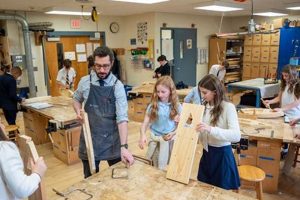
Introductory woodworking courses provide foundational knowledge and practical skills for individuals seeking to enter the craft. These programs typically cover basic tool usage, wood identification, joinery techniques, and safety protocols. Participants often complete small projects, such as constructing a simple box or frame, to apply newly acquired skills.
Acquiring fundamental woodworking skills offers numerous benefits, including fostering creativity, developing problem-solving abilities, and enhancing fine motor skills. Historically, woodworking skills were essential for constructing shelter, tools, and furniture. Today, these skills provide opportunities for personal enrichment, artistic expression, and potential career paths.
The subsequent discussion will delve into specific aspects of introductory woodworking education, including curriculum design, essential tools and equipment, safety considerations, and available learning resources.
Introductory Woodworking Course Tips
The following suggestions aim to enhance the learning experience for individuals participating in foundational woodworking programs. Adherence to these guidelines can promote safety, efficiency, and skill development.
Tip 1: Prioritize Safety. Always wear appropriate personal protective equipment, including safety glasses, hearing protection, and dust masks. Ensure familiarity with the safe operation of each tool before use.
Tip 2: Master Basic Tool Handling. Focus on developing proficiency with fundamental hand tools such as saws, chisels, and planes. Accurate use of these tools is crucial for precise woodworking.
Tip 3: Practice Accurate Measurement. Precise measurements are essential for successful woodworking projects. Utilize a high-quality measuring tape or ruler and double-check all dimensions before cutting.
Tip 4: Understand Wood Grain. Grain direction significantly impacts cutting and shaping. Analyze the wood grain pattern before commencing any operation to avoid tear-out or splintering.
Tip 5: Learn Basic Joinery Techniques. Mortise and tenon, dovetail, and rabbet joints are foundational techniques. Practice these joints to develop strong and aesthetically pleasing connections.
Tip 6: Sharpen Tools Regularly. Sharp tools are safer and more efficient. Develop a consistent sharpening routine for chisels, planes, and other edged tools.
Tip 7: Start with Simple Projects. Begin with smaller, less complex projects to build confidence and refine skills before tackling larger or more intricate designs.
Following these tips promotes a safer, more productive, and ultimately more rewarding experience in introductory woodworking.
The subsequent section will discuss the importance of selecting the right tools and materials for success in basic woodworking.
1. Safety Procedures

Safety procedures constitute an indispensable component of introductory woodworking courses. These protocols are designed to minimize the risk of injury and ensure a safe learning environment for all participants.
- Eye Protection
The use of safety glasses or face shields is mandatory during all woodworking operations. Flying debris, such as wood chips and dust, poses a significant risk to eye health. Proper eye protection mitigates this risk, preventing potential injuries.
- Hearing Protection
Prolonged exposure to loud noises from power tools can cause irreversible hearing damage. Earplugs or earmuffs are essential for reducing noise levels and safeguarding auditory health during woodworking activities.
- Dust Control
Wood dust is a known respiratory irritant and potential carcinogen. Effective dust control measures, including the use of dust masks, respirators, and dust collection systems, are crucial for maintaining air quality and protecting respiratory health.
- Machine Guarding
Power tools must be equipped with appropriate safety guards to prevent accidental contact with moving parts. Ensuring that all machine guards are in place and properly adjusted is essential for preventing injuries such as cuts, abrasions, and amputations.
The diligent implementation and enforcement of safety procedures are paramount in introductory woodworking courses. Consistent adherence to these guidelines significantly reduces the likelihood of accidents and promotes a culture of safety within the woodworking environment.
2. Tool Identification

Tool identification forms a foundational component of introductory woodworking courses. The ability to accurately identify and differentiate between various woodworking tools is crucial for safe and effective participation in the craft. Courses typically provide instruction on both hand tools and power tools, covering their specific functions, proper usage, and maintenance requirements. Inability to identify a tool correctly can lead to its misuse, resulting in damaged materials, compromised project quality, or, more seriously, physical injury. For example, attempting to use a chisel as a screwdriver can damage the chisel’s blade and potentially cause the user to lose control, leading to cuts or puncture wounds.
Instruction in tool identification extends beyond mere recognition; it encompasses understanding the tool’s intended purpose and the specific tasks for which it is best suited. Students learn to differentiate between various types of saws, such as rip saws for cutting with the grain and crosscut saws for cutting against the grain. They also learn to identify different types of planes, chisels, and measuring tools, understanding how each tool contributes to the overall woodworking process. Practical exercises, such as demonstrations and hands-on tool handling, reinforce theoretical knowledge. Furthermore, instruction covers the proper care and maintenance of each tool, including sharpening techniques and lubrication procedures, to ensure optimal performance and longevity.
In summary, tool identification is not merely a preliminary step in woodworking education but an ongoing process of learning and refinement. A solid understanding of tool identification enables individuals to select the appropriate tool for the task, perform woodworking operations safely and effectively, and maintain their tools in optimal condition. This knowledge is essential for developing proficiency in woodworking and preventing accidents or damage. The skill set helps bridge the gap between novice and skilled woodworker.
3. Wood Selection

Wood selection is a fundamental aspect of introductory woodworking courses. The choice of wood directly impacts the workability of the material, the aesthetic qualities of the finished product, and the structural integrity of the project. “Woodworking 101 classes” emphasize wood identification, properties, and appropriate uses. For example, a beginner attempting to construct a delicate jewelry box might encounter challenges using a hardwood like oak, which is more difficult to cut and shape than a softwood like pine or basswood. Instructors provide guidance on recognizing different wood species, understanding grain patterns, and assessing moisture content, all of which influence the success of a woodworking project. Improper wood selection can lead to difficulties in cutting, joining, and finishing, resulting in frustration and potentially structurally unsound outcomes.
Practical exercises within “woodworking 101 classes” often involve working with a variety of wood species to illustrate the differences in their properties. Students may be tasked with creating identical projects using different types of wood to observe the impact of wood choice on the final product’s appearance, strength, and durability. For example, constructing a simple box using both pine and walnut will highlight the difference in grain pattern, color, and hardness. Furthermore, the course can touch upon sustainable wood sourcing and the environmental impact of choosing different wood types, such as the differences between using reclaimed wood and purchasing new lumber. The understanding of wood selection contributes significantly to the ability to create high-quality and long-lasting woodworking projects.
The integration of wood selection knowledge into introductory woodworking education presents challenges, including the need for instructors to balance theoretical knowledge with practical experience and the variation in wood availability depending on geographic location. Nevertheless, a strong foundation in wood selection principles enables students to make informed choices, optimize their woodworking techniques, and ultimately produce projects that are both aesthetically pleasing and structurally sound. Addressing challenges in this field requires innovative teaching strategies, such as virtual wood libraries and interactive simulations, to supplement hands-on experience and broaden students’ understanding of wood characteristics.
4. Basic Joinery

Basic joinery constitutes a core component of woodworking 101 classes, providing the foundational techniques necessary for constructing structurally sound and aesthetically pleasing wooden objects. A comprehensive understanding of joinery methods is essential for any aspiring woodworker.
- Mortise and Tenon Joints
The mortise and tenon joint, a hallmark of traditional woodworking, involves inserting a protruding tenon into a corresponding mortise (hole). This method provides exceptional strength and stability, making it suitable for furniture frames and structural elements. Woodworking 101 classes often dedicate significant time to mastering this joint, as it serves as a basis for more complex joinery techniques. A well-executed mortise and tenon joint demonstrates precision and attention to detail, enhancing the overall quality of the woodworking project.
- Dovetail Joints
Dovetail joints, characterized by their interlocking, fan-shaped projections, are renowned for their exceptional resistance to pulling forces. These joints are commonly employed in drawer construction, box making, and other applications where strength and durability are paramount. Woodworking 101 classes introduce students to both hand-cut and machine-cut dovetail techniques, emphasizing the importance of accurate layout and precise execution. Dovetail joints represent a significant step in skill development, showcasing a woodworker’s ability to create complex and visually appealing connections.
- Rabbet Joints
Rabbet joints, formed by cutting a recess along the edge of a board, provide a simple and effective method for joining two pieces of wood at a right angle. These joints are frequently used in cabinetmaking, box construction, and picture frame assembly. Woodworking 101 classes often utilize rabbet joints as an introductory joinery technique due to their relative simplicity and versatility. While not as strong as mortise and tenon or dovetail joints, rabbet joints offer a practical solution for creating enclosed structures.
- Dado Joints
Dado joints, similar to rabbet joints, involve cutting a channel or groove across the width of a board to receive another piece of wood. These joints are commonly used for shelving, cabinet dividers, and drawer bottoms, providing support and stability to the structure. Woodworking 101 classes demonstrate the use of dado joints in various applications, emphasizing the importance of accurate measurements and precise cutting. Dado joints offer a clean and functional means of creating strong and reliable connections.
These core joinery methods taught in woodworking 101 classes equip students with the essential skills to construct a wide range of woodworking projects. Mastery of these techniques not only enhances the structural integrity of their creations but also allows for greater creative expression and design possibilities. Continued practice and experimentation with these joints are crucial for developing expertise in woodworking.
5. Finishing Techniques
Finishing techniques represent a crucial stage in woodworking 101 classes, transforming raw or assembled wood into a refined and protected final product. Proper finishing enhances the wood’s natural beauty, protects it from environmental damage, and significantly extends its lifespan. The application of appropriate finishes is therefore integral to the overall quality and longevity of any woodworking project undertaken within these courses.
- Surface Preparation
Surface preparation is the foundational step in any finishing process. It involves sanding, cleaning, and repairing imperfections in the wood to create a smooth, even surface. In woodworking 101 classes, students learn to use sandpaper of varying grits to achieve the desired level of smoothness, understanding that a properly prepared surface is essential for the uniform adhesion and appearance of subsequent finishes. Neglecting surface preparation can result in uneven color absorption, visible scratches, and a generally unprofessional appearance.
- Staining and Dyeing
Staining and dyeing techniques are used to alter the color of the wood, enhancing its grain pattern or achieving a specific aesthetic effect. Woodworking 101 classes provide instruction on the application of various stains and dyes, emphasizing the importance of even application and proper drying times. For instance, a student might learn to apply a cherry stain to pine to mimic the appearance of more expensive hardwoods. Understanding the interaction between different wood species and stains is crucial for achieving predictable and desirable results.
- Protective Coatings
Protective coatings, such as varnish, lacquer, polyurethane, and oil finishes, provide a barrier against moisture, scratches, and UV damage. Woodworking 101 classes educate students on the properties of these different coatings, their application methods, and their suitability for various projects. For example, a student might learn that polyurethane is a durable and water-resistant finish suitable for tabletops, while oil finishes provide a more natural look and feel for furniture pieces. Selection depends on use case.
- Application Techniques
The method of applying finishes, whether by brush, spray, or wiping, significantly impacts the final result. Woodworking 101 classes offer hands-on experience with these various application techniques, emphasizing the importance of proper brush control, spray gun settings, and wiping techniques to achieve a smooth, even finish. A student might learn that spraying lacquer requires precise adjustments to the spray gun and careful application to avoid runs and drips. Correct technique prevents product failure.
These facets of finishing techniques are meticulously integrated into the curriculum of woodworking 101 classes to ensure that students develop a comprehensive understanding of the finishing process. By mastering these techniques, students can enhance the appearance, durability, and value of their woodworking projects, transforming them from simple constructions into finished works of craftsmanship. The emphasis on proper finishing not only improves the aesthetic quality of the final product but also instills a sense of pride and accomplishment in the woodworker.
6. Project Planning

Project planning within woodworking 101 classes constitutes a critical element in fostering successful outcomes. Its integration allows learners to transform abstract ideas into tangible creations through structured processes. A direct correlation exists between thorough project planning and the ultimate quality and efficiency of woodworking endeavors. Without adequate planning, students may encounter unforeseen challenges, such as material shortages, design flaws, or inefficient workflow, leading to project delays or suboptimal results. For example, constructing a basic bookshelf requires careful measurement of available space, calculation of material quantities, and design considerations for structural stability. Neglecting any of these aspects during the planning stage can result in a bookshelf that is either too large for the intended space, structurally unstable, or aesthetically unappealing.
The practical application of project planning involves several key steps. First, students define project goals and specifications, including dimensions, materials, and desired aesthetic qualities. Second, they create a detailed plan outlining the sequence of tasks, material procurement, tool requirements, and safety protocols. Third, students develop a budget, accounting for the cost of materials, tools, and potential waste. Fourth, they establish a timeline, setting realistic deadlines for each stage of the project. Furthermore, project planning encompasses risk assessment, identifying potential challenges and developing contingency plans to mitigate their impact. As an example, if a student plans to use reclaimed wood, they must anticipate the possibility of encountering hidden nails, rot, or other defects and develop strategies for addressing these issues. Similarly, students must consider alternative methods for joining pieces of wood should the initial plan prove unfeasible.
In summary, project planning is an indispensable component of woodworking 101 classes, providing students with the skills and knowledge necessary to manage woodworking projects effectively. While challenges may arise in the implementation of project planning, such as time constraints, resource limitations, or unforeseen complications, the benefits far outweigh the obstacles. The ability to plan, execute, and evaluate woodworking projects instills a sense of competence and confidence in students, empowering them to pursue increasingly complex and ambitious endeavors. This competency extends beyond the workshop, cultivating valuable skills in problem-solving, organization, and critical thinking that are applicable to various aspects of life.
7. Hands-on Practice
Hands-on practice is an indispensable element of woodworking 101 classes. Its integration enables learners to translate theoretical concepts into tangible skills, fostering a deeper comprehension of woodworking principles and techniques. The effectiveness of any woodworking course hinges substantially on the provision of ample opportunities for practical application.
- Tool Familiarization
Hands-on practice facilitates direct engagement with various woodworking tools, enabling students to develop proficiency in their safe and effective utilization. This includes learning the proper grip, stance, and cutting techniques for hand tools, as well as understanding the operation and maintenance of power tools. The ability to handle tools confidently and accurately is crucial for achieving precise results and preventing accidents. For instance, students might practice cutting straight lines with a hand saw, gradually improving their control and accuracy through repeated attempts. This direct interaction cultivates tactile knowledge, essential for fine motor skill refinement in woodworking.
- Joinery Application
Hands-on practice provides a platform for applying joinery techniques learned in the classroom. Students construct various joints, such as mortise and tenon, dovetail, and rabbet, developing an understanding of their respective strengths and weaknesses. Repeated practice refines their ability to cut accurate joints, assemble them securely, and assess their structural integrity. Constructing a small frame using mortise and tenon joints, for instance, allows students to experience the challenges and rewards of creating strong, lasting connections. This practical application solidifies the theoretical knowledge of joint construction.
- Finishing Execution
Hands-on practice enables students to experiment with different finishing techniques, such as sanding, staining, and applying protective coatings. Through direct engagement, they learn to prepare surfaces properly, apply finishes evenly, and achieve the desired aesthetic effects. This hands-on experience cultivates an understanding of the properties of different finishes and their interaction with various wood species. For example, students might practice applying different stains to samples of pine, oak, and maple to observe the variations in color absorption and grain enhancement. This direct interaction with finishing materials cultivates an understanding of their behavior, enabling students to achieve desired results.
- Project Completion
Hands-on practice culminates in the completion of woodworking projects, allowing students to apply their acquired skills to create tangible objects. This experience reinforces their understanding of the entire woodworking process, from project planning to final finishing. Successfully completing a project, such as a small box or a simple table, provides a sense of accomplishment and reinforces their motivation to continue learning. Furthermore, it allows them to identify areas for improvement and refine their skills. Each project provides a tangible record of their progress and a foundation for future growth.
The correlation between hands-on practice and woodworking 101 classes highlights the importance of active engagement in the learning process. By providing ample opportunities for practical application, these courses empower students to develop the skills, knowledge, and confidence necessary to pursue their woodworking aspirations. The emphasis on practical experience ensures that students not only understand the theory but also develop the ability to apply their knowledge effectively in real-world scenarios. This emphasis helps bridge the gap between novice and skilled woodworker.
Frequently Asked Questions
The following addresses common inquiries regarding introductory woodworking courses. Information is provided to clarify expectations and assist prospective students.
Question 1: What prerequisites are required for enrolling in woodworking 101 classes?
No prior woodworking experience is typically necessary. These courses are designed for beginners with little to no existing knowledge of the craft. However, a basic understanding of measurement and a willingness to learn are beneficial.
Question 2: What tools and materials are provided during woodworking 101 classes?
Most courses provide access to essential tools and materials for in-class projects. However, students may be required to purchase personal safety equipment, such as safety glasses and hearing protection. Detailed information regarding required materials is generally provided upon enrollment.
Question 3: What safety precautions are emphasized in woodworking 101 classes?
Safety is paramount. These courses cover proper tool handling, machine guarding, dust control, and the use of personal protective equipment. Strict adherence to safety protocols is mandatory to minimize the risk of injury.
Question 4: What specific skills will be acquired upon completion of woodworking 101 classes?
Participants will learn fundamental skills, including basic tool usage, wood identification, joinery techniques, and finishing methods. The aim is to provide a foundation for pursuing more advanced woodworking projects.
Question 5: What is the typical duration of woodworking 101 classes?
Course duration varies depending on the institution and curriculum. Introductory courses commonly range from several weeks to a few months, with classes meeting once or twice per week.
Question 6: What are the potential career paths for individuals who complete woodworking 101 classes?
While these courses primarily serve as an introduction to the craft, they can serve as a stepping stone towards various career paths, including carpentry, cabinetmaking, furniture design, and woodworking instruction. Further education and experience are typically required for professional advancement.
Woodworking 101 classes offer a solid foundation for those interested in exploring the craft. Careful consideration of the provided information is recommended prior to enrollment.
The subsequent section will explore resources for continued learning in the field of woodworking.
Conclusion
This article explored woodworking 101 classes, encompassing definition, advantages, techniques, fundamental elements, safety protocols, and frequently asked questions. A comprehensive examination demonstrates that introductory woodworking education delivers essential knowledge and skills for aspiring craftspeople. Emphasis was placed on tool identification, wood selection, joinery methods, finishing techniques, and project planning, culminating in hands-on experience.
The value of structured instruction in woodworking should not be underestimated. Continued education and practice are recommended for those seeking mastery of this craft. The acquisition of woodworking skills enhances creative expression, problem-solving capabilities, and the potential for personal and professional fulfillment. These classes offer a strong foundation for those seeking to enter the world of woodworking, whether for personal enrichment or potential career advancement.

![Learn Woodworking: Classes in Fort Collins [Skills!] | Step-by-Step Guides, Tools & Inspiration to Build Beautiful Wooden Decor on a Budget](https://woodfromhome.com/wp-content/uploads/2026/04/th-267-300x200.jpg "Learn Woodworking: Classes in Fort Collins [Skills!] Step-by-Step Guides, Tools & Inspiration to Build Beautiful Wooden Decor on a Budget")