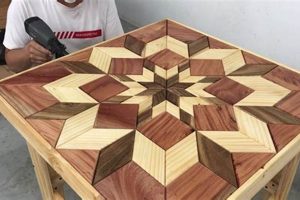
The use of thermosetting polymers with wood to create unique and durable constructions encompasses a wide range of design applications. This process involves embedding, coating, or binding wood components with a synthetic resin that cures to form a rigid, protective layer or structural element. Examples include river tables featuring a clear or colored resin channel, encapsulation of decorative items within wood, and strengthening wood surfaces for increased longevity.
Employing these resins offers significant advantages, including enhanced resistance to moisture, impact, and wear. The technique allows for artistic expression by incorporating pigments, dyes, and embedded objects to create visually striking pieces. Historically, the combination of wood and synthetic resins has evolved from simple protective coatings to sophisticated structural and aesthetic integrations, improving both the functionality and value of woodworking projects.
The following sections will delve into specific techniques, material selection considerations, project planning strategies, and essential safety protocols for successfully integrating polymers into woodworking endeavors. Discussions will cover various application methods, suitable wood species, resin types, and finishing processes that optimize the final product’s appearance and performance.
Essential Guidance for Resin-Enhanced Woodworking
The following guidelines outline critical considerations for achieving optimal results when integrating thermosetting polymers into woodworking projects. Adherence to these points will enhance project durability, aesthetics, and safety.
Tip 1: Material Compatibility Assessment: Prior to commencing any project, rigorously evaluate the compatibility of the chosen wood species with the selected resin system. Certain wood species, particularly those with high oil content, may impede proper resin adhesion and curing. Conduct small-scale tests to confirm compatibility and adjust surface preparation accordingly.
Tip 2: Precise Measurement and Mixing: Accurate measurement and thorough mixing of resin components are paramount. Deviation from the manufacturer’s recommended ratios can result in incomplete curing, compromised strength, and undesirable surface tackiness. Employ calibrated measuring devices and implement a systematic mixing protocol to ensure homogeneity.
Tip 3: Environmental Control During Curing: Maintain a stable ambient temperature and humidity level within the recommended range specified by the resin manufacturer during the curing process. Fluctuations in these parameters can affect the resin’s chemical reactions, leading to surface imperfections, internal stresses, and diminished structural integrity.
Tip 4: Effective Bubble Removal Techniques: Air bubbles trapped within the resin matrix can detract from the finished product’s appearance and weaken its structure. Implement effective degassing techniques, such as vacuum chambers or heat guns, to eliminate entrapped air. Exercise caution when using heat guns to avoid scorching or damaging the resin.
Tip 5: Proper Surface Preparation: The wood surface must be meticulously prepared to promote optimal resin adhesion. This includes sanding to the appropriate grit level, removing dust and debris with compressed air or tack cloths, and applying a suitable sealant or primer if recommended by the resin manufacturer. Neglecting surface preparation can lead to delamination and premature failure.
Tip 6: Strategic Layering for Complex Pours: When executing deep or complex pours, implement a strategic layering approach. Pour resin in thin, manageable layers, allowing each layer to partially cure before applying the next. This minimizes the risk of overheating, cracking, and distortion caused by the exothermic reaction of the curing resin.
Tip 7: Appropriate Finishing Procedures: Once the resin has fully cured, employ appropriate finishing procedures to enhance its gloss, clarity, and durability. This may involve sanding with progressively finer grits, applying a clear coat or varnish, and polishing to achieve the desired level of sheen. Select finishing products that are compatible with the specific resin type.
Effective application of these guidelines will contribute significantly to the successful integration of thermosetting polymers in woodworking, yielding durable, aesthetically pleasing, and structurally sound finished pieces.
The subsequent sections will examine specific project examples, highlighting the practical application of these principles in diverse woodworking scenarios.
1. Resin Selection
Resin selection is a foundational component of woodworking projects incorporating polymers. The type of resin directly influences the project’s structural integrity, aesthetic appeal, and long-term durability. For instance, projects intended for outdoor use, such as garden furniture, necessitate UV-resistant resins to prevent yellowing and degradation over time. Conversely, decorative pieces like river tables might prioritize crystal-clear resins with low viscosity to showcase embedded objects or wood grain with maximum clarity. The chemical properties of different resins, including their hardness, flexibility, and resistance to chemicals, must align with the intended function of the final product. Failure to select an appropriate resin can result in premature failure, discoloration, or structural instability. An example is using a non-UV stable resin for an outdoor epoxy woodworking idea that would become yellow. Therefore, the correlation between resin selection and project success is directly causal and profoundly significant.
Practical applications of resin selection knowledge extend to various woodworking domains. In the creation of cutting boards, a food-safe resin must be used to prevent the leaching of harmful chemicals into food. Similarly, for projects involving electrical components, such as lamps or illuminated signage, a resin with high dielectric strength is crucial to prevent electrical hazards. Understanding the specific requirements of each woodworking idea, and matching them with the correct resin properties, allows craftsmen to execute projects that are not only visually appealing but also safe and functional. The choice dictates not only workability during the creation phase, but also long term utility.
In summary, careful resin selection is paramount for achieving successful outcomes in polymer-enhanced woodworking. The appropriate resin choice ensures the project fulfills its intended purpose, maintains its aesthetic qualities over time, and avoids potential safety hazards. Overcoming challenges in resin selection involves thorough research, consultation with manufacturers, and potentially, experimentation with different resin types to identify the optimal solution for a specific project. This detailed consideration solidifies the link between resin selection and the overarching theme, ensuring that these projects are both innovative and lasting.
2. Wood Species Compatibility

The successful integration of polymers with wood in woodworking hinges critically on the compatibility between the chosen wood species and the selected resin system. Wood exhibits varying degrees of porosity, oil content, and density, all of which influence resin adhesion and curing characteristics. Species with high oil content, such as teak or rosewood, can impede proper resin bonding, leading to delamination or incomplete curing. Similarly, highly porous woods may absorb excessive resin, resulting in uneven surfaces and compromised structural integrity. Therefore, understanding the inherent properties of different wood species is paramount for achieving optimal results in any endeavor involving synthetic resins. A misjudgment of these properties leads to the failure of some complex epoxy woodworking ideas, such as creating a deep pour on oily wood.
Practical implications of this understanding are manifold. Prior to commencing a project, thorough assessment of the wood’s surface characteristics is essential. This may involve conducting small-scale adhesion tests or applying sealants to mitigate the effects of oil content or porosity. For instance, when creating resin-encapsulated furniture using oily hardwoods, a barrier coat of epoxy primer is often applied to promote adhesion. For porous woods, multiple thin layers of resin may be required to saturate the wood before proceeding with the primary pour. Specific woodworking ideas may also demand the selection of wood with matching thermal expansion coefficients to minimize cracking post-cure. These considerations should be included in a project plan.
In summary, the selection of wood species is inextricably linked to the success of any polymer-enhanced woodworking project. Ignoring the inherent properties of the wood can lead to adhesion failures, structural weaknesses, and aesthetic imperfections. Careful evaluation of wood characteristics, coupled with appropriate surface preparation and resin selection, ensures the creation of durable, visually appealing, and structurally sound woodworking creations. Challenges exist in predicting every interaction; however, adherence to these principles significantly enhances the likelihood of a satisfactory outcome. A successful implementation of these epoxy woodworking ideas starts with the species selection.
3. Pour Depth Limitations

The maximum pour depth achievable with synthetic resins is a critical consideration in polymer-enhanced woodworking. This limitation dictates the feasibility of certain design elements and influences material selection, application techniques, and overall project planning. Exceeding the recommended pour depth can result in a cascade of adverse effects, compromising the structural integrity and aesthetic qualities of the finished piece.
- Exothermic Reaction Management
Thick resin pours generate substantial heat due to the exothermic reaction during curing. Uncontrolled heat buildup can lead to rapid curing, resulting in cracking, discoloration, and even combustion. Therefore, the pour depth must be carefully controlled to manage heat dissipation and prevent these detrimental effects. For instance, a deep river table pour exceeding manufacturer specifications may require multiple, thinner pours to mitigate heat generation.
- Shrinkage and Stress
Resins undergo volumetric shrinkage during the curing process. In deep pours, this shrinkage can induce significant internal stresses within the resin matrix, particularly where it interfaces with the wood substrate. These stresses can manifest as cracking, warping, or delamination. Strategic layering, combined with the selection of low-shrinkage resins, is essential to minimize these effects. An example includes using resins with additives designed to reduce shrinkage in applications involving substantial resin volumes.
- Bubble Entrapment
The likelihood of air bubble entrapment increases proportionally with pour depth. As resin cures, dissolved gases can be released, forming bubbles that become trapped within the viscous material. Deep pours make it more challenging to effectively degas the resin, resulting in visual imperfections and potential structural weaknesses. Mitigation strategies include vacuum degassing, heat gun application, and slow, controlled pouring techniques. One example is utilizing pressure pots to force bubbles out of the epoxy during the curing process.
- Curing Time and Uniformity
Deep pours significantly extend the curing time of the resin. Moreover, curing may occur unevenly throughout the pour, with the outer layers curing more rapidly than the interior. This differential curing can induce stress and lead to distortions. Employing slow-curing resins, combined with environmental control, helps to promote uniform curing and minimize these issues. An example includes utilizing temperature-controlled environments for large casting projects to ensure consistent cure rates throughout the entire volume.
These limitations are integral to the planning and execution of polymer-enhanced woodworking projects. A thorough understanding of pour depth constraints, coupled with appropriate material selection and application techniques, is crucial for achieving successful outcomes and realizing the full potential of creative endeavors that integrate resins with wood.
4. Pigmentation Techniques

The introduction of color into polymer resins significantly expands the aesthetic possibilities within projects. Pigmentation techniques are, therefore, an indispensable component of many designs. The effects of pigmentation on resin properties, such as viscosity, cure time, and UV resistance, necessitate careful consideration. For instance, excessive pigment loading can inhibit curing or reduce the resin’s structural integrity. The selection of appropriate pigments whether powder, liquid, or paste directly influences the final color saturation, opacity, and lightfastness of the piece. Real-life examples include the use of translucent dyes in river tables to create depth and dimension or the application of opaque pigments in resin castings to achieve a solid, uniform color. The practical significance lies in the ability to tailor the visual appearance of projects to meet specific design requirements, creating products that are both functional and aesthetically compelling.
Further analysis reveals that the choice of pigmentation technique also depends on the desired effect and the scale of the project. Smaller projects may benefit from the precision afforded by liquid dyes, which allow for gradual color adjustments. Larger projects often utilize powder pigments for cost-effectiveness and ease of bulk mixing. Furthermore, techniques such as layering pigmented resins, creating swirls, or incorporating metallic flakes can add complexity and visual interest. Successful application requires precise measurement, thorough mixing, and an understanding of how the pigment interacts with the specific resin system being used. An illustrative example is the creation of faux marble effects using carefully controlled swirls of pigmented resin, which adds a luxury element to many epoxy woodworking ideas
In summary, pigmentation techniques are integral to achieving desired aesthetic outcomes in projects involving resins. The careful selection and application of pigments influence color, opacity, and durability. Overcoming potential challenges, such as color consistency and resin compatibility, requires a detailed understanding of materials and techniques. The connection solidifies through the ability to realize innovative and lasting designs, thereby fulfilling the overarching goal of aesthetic and structural enhancement in modern woodworking.
5. Finishing processes

The application of final surface treatments constitutes a critical phase in the execution of projects that integrate polymers and wood. These processes are not merely cosmetic enhancements; they significantly influence the long-term performance, durability, and aesthetic appeal of the finished piece. Therefore, a deliberate and informed approach to finishing is essential for realizing the full potential of such woodworking endeavors.
- Sanding and Polishing
Subsequent to curing, polymer resin surfaces often exhibit imperfections, such as minor irregularities, haziness, or residual surface tack. Sanding, employing progressively finer grits, removes these blemishes and prepares the surface for subsequent polishing. Polishing then refines the surface to achieve the desired level of clarity and gloss. In river table construction, meticulous sanding and polishing are imperative to achieve a flawless, glass-like surface that showcases the embedded wood elements. Failing to execute these steps adequately compromises the overall visual impact and perceived quality of the finished piece.
- Application of Protective Coatings
While resins offer inherent resistance to moisture and chemicals, the application of supplemental protective coatings can further enhance these properties and safeguard against UV degradation, scratching, and staining. Polyurethane varnishes and specialized resin coatings are commonly employed for this purpose. For instance, a bar top constructed with polymer resins may benefit from a durable, chemical-resistant coating to withstand spills and wear from frequent use. The selection of an appropriate coating must consider compatibility with the underlying resin and the intended use environment.
- Buffing and Waxing
Buffing and waxing processes serve to further refine the surface finish and impart a lustrous sheen. These techniques are particularly effective for enhancing the clarity and depth of the resin, as well as providing a degree of scratch resistance. The application of wax also creates a barrier that repels moisture and contaminants. High-end furniture pieces incorporating resin elements frequently undergo buffing and waxing to achieve a luxurious, tactile finish.
- Edge Treatment and Detailing
The treatment of edges and other exposed areas is an often-overlooked aspect of finishing. These areas are particularly vulnerable to chipping, cracking, and moisture ingress. Applying a resin fillet, rounding over sharp edges, or incorporating decorative trim can significantly improve durability and aesthetic appeal. In resin-encapsulated woodworking projects, careful edge treatment is essential to prevent delamination and ensure a seamless transition between the resin and wood components.
Each of these facets collectively influences the final quality and longevity of constructions that creatively combine epoxy and wood. A well-executed finishing strategy not only enhances the visual appeal but also protects the underlying materials, ensuring that these woodworking ideas are both beautiful and durable for years to come. The selection of suitable finishing techniques should therefore be considered an integral part of the design process, aligning with the intended use and environmental conditions of the final product.
6. Structural Reinforcement

Structural reinforcement, when integrated with polymer materials, represents a critical consideration for woodworking projects demanding enhanced load-bearing capacity, resistance to deflection, or long-term durability. The strategic incorporation of reinforcement elements mitigates inherent weaknesses in wood and resin composites, yielding constructions capable of withstanding significant stresses and environmental challenges.
- Fiberglass Cloth Lamination
Fiberglass cloth lamination involves bonding layers of woven fiberglass fabric to wood or resin surfaces using an adhesive resin. This technique substantially increases the tensile and flexural strength of the composite material. In instances of creating large-span resin tables, fiberglass lamination on the underside prevents sagging and minimizes deflection under load. The resultant structure exhibits increased resistance to cracking and deformation, thereby extending the lifespan of the woodworking project.
- Carbon Fiber Inlays
Carbon fiber inlays consist of embedding strips or sheets of carbon fiber composite within wood or resin matrices. Carbon fiber’s high strength-to-weight ratio offers exceptional reinforcement without adding significant bulk. This is particularly advantageous in constructing lightweight yet rigid components, such as chair frames or table legs. The embedded carbon fiber augments the material’s resistance to bending and twisting forces, resulting in a more robust and stable structure.
- Metal Rod Integration
The strategic incorporation of metal rods or bars provides localized reinforcement in areas subjected to high stress concentrations. Steel or aluminum rods can be embedded within resin pours or wood laminations to enhance the material’s resistance to shear and compressive forces. This approach is often employed in crafting load-bearing joints or supporting heavy objects. Embedding metal rods within the epoxy woodworking ideas improves the overall strength and stability of the final product.
- Wire Mesh Embedment
Embedding wire mesh within polymer resin layers offers distributed reinforcement, enhancing resistance to cracking and impact damage. The wire mesh acts as a crack arrestor, preventing the propagation of fractures throughout the material. This technique is particularly useful in creating durable surfaces for countertops or flooring. Wire mesh embedded projects that combine wood and resin enhances impact resistance of finished items.
In conclusion, structural reinforcement techniques provide woodworking projects utilizing polymers with enhanced strength, stability, and durability. These approaches mitigate inherent limitations in the materials themselves, allowing for the creation of woodworking ideas that meet demanding performance requirements. The application of these principles extends beyond mere aesthetic considerations, creating projects that are both visually appealing and structurally sound.
Frequently Asked Questions about epoxy woodworking ideas
The following section addresses common inquiries and misconceptions surrounding the integration of thermosetting polymers in woodworking projects. These responses aim to provide clarity and guidance for achieving optimal results.
Question 1: Is specialized equipment required for most resin-based woodworking ideas?
While sophisticated equipment, such as vacuum chambers and pressure pots, can enhance the outcome of complex projects, the fundamental requirements for most undertakings are relatively modest. Essential tools include accurate measuring devices, mixing containers, stirring implements, and appropriate personal protective equipment. The complexity of the project dictates the need for specialized tools.
Question 2: How does temperature affect the curing process of resins used in woodworking?
Temperature significantly impacts the curing kinetics of resins. Elevated temperatures accelerate the curing process, potentially leading to rapid hardening, cracking, or discoloration. Conversely, low temperatures retard curing, possibly resulting in incomplete polymerization and compromised mechanical properties. Adherence to the manufacturer’s recommended temperature range is crucial for optimal results.
Question 3: What measures can be taken to prevent air bubbles from forming in polymer resin pours?
Several strategies mitigate air bubble formation. These include slow, controlled pouring techniques; pre-heating the resin to reduce viscosity; applying a heat gun to the surface to release trapped air; and utilizing vacuum degassing equipment to remove dissolved gases prior to pouring. The effectiveness of each method varies depending on the resin type and pour depth.
Question 4: Are all types of wood suitable for use with polymer resins?
Not all wood species exhibit equal compatibility with polymer resins. Woods with high oil content, such as teak, can inhibit resin adhesion and curing. Similarly, porous woods may absorb excessive resin, leading to uneven surfaces. Selecting wood species with moderate density and low oil content is recommended. Surface preparation, including sealing, can improve adhesion with less suitable woods.
Question 5: How can discoloration of polymer resins over time be prevented?
Exposure to ultraviolet (UV) radiation is a primary cause of resin discoloration. Employing UV-resistant resins and incorporating UV-absorbing additives can mitigate this effect. Additionally, applying a UV-protective topcoat can provide further protection. Shielding finished pieces from direct sunlight also prolongs their aesthetic lifespan.
Question 6: What safety precautions should be observed when working with polymer resins?
Polymer resins can cause skin and respiratory irritation. Wearing appropriate personal protective equipment, including gloves, eye protection, and a respirator, is essential. Working in a well-ventilated area minimizes exposure to harmful vapors. Familiarizing oneself with the resin’s safety data sheet (SDS) and adhering to all manufacturer’s instructions is crucial for ensuring a safe working environment.
Understanding these factors provides a foundation for successful integration of polymers into woodworking, leading to durable, aesthetically pleasing, and structurally sound creations.
The subsequent sections will examine real-world applications and case studies that illustrate the practical implementation of these techniques and considerations.
Conclusion
This exploration of creations combining polymers and wood underscores the importance of material compatibility, process control, and informed decision-making. Successfully integrating resins into woodworking requires a nuanced understanding of resin chemistry, wood properties, and finishing techniques. Projects demand adherence to manufacturer guidelines and a commitment to safety protocols.
The fusion of these materials offers a broad canvas for functional and artistic expression. Ongoing research into new resin formulations and application methods promises further innovation in this evolving field. Continued vigilance regarding best practices and safety considerations will ensure the sustainable and responsible advancement of construction using thermosetting polymers and wood.