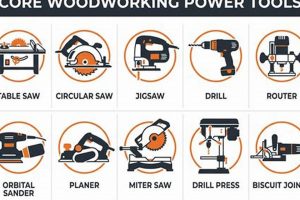
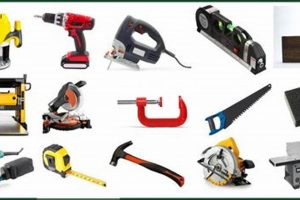
Implements employed in shaping, cutting, joining, and finishing wood are essential for both detailed craftsmanship and structural construction. These instruments range from hand-operated devices offering precision to power-driven machines enabling efficiency in larger-scale projects. Examples include saws for cutting, planes for smoothing, chisels for shaping, and hammers for fastening.
The utilization of these instruments is fundamental to creating functional and aesthetically pleasing wooden objects, contributing to construction, furniture making, and artistic endeavors. Throughout history, the evolution of these items has paralleled advancements in material science and manufacturing techniques, increasing productivity and expanding design possibilities. Their proper selection, maintenance, and skillful application are critical for achieving durable and high-quality results.
A detailed exploration of specific categories including cutting, shaping, measuring, and fastening devices will follow. Furthermore, the safe operation and care of these instruments, as well as emerging technologies impacting the field, will be addressed.
Essential Guidance for Optimal Use
The following recommendations aim to enhance efficiency, precision, and safety when working with these implements. Adherence to these guidelines facilitates project success and minimizes the risk of injury or material damage.
Tip 1: Implement Regular Sharpening: Maintaining sharp edges on cutting implements, such as saws, chisels, and planes, is paramount. Sharp tools require less force, improving control and reducing the likelihood of slippage, which can cause injury or damage the workpiece. Utilize appropriate sharpening stones and honing techniques specific to each tool type.
Tip 2: Employ Correct Tool Selection: Choosing the appropriate device for a specific task is essential. Using an inadequately sized or designed instrument can compromise the quality of the work and increase the risk of tool failure or user strain. Consider the material, dimensions, and desired outcome when selecting.
Tip 3: Prioritize Safety Equipment: Consistent use of personal protective equipment, including safety glasses, hearing protection, and dust masks, is non-negotiable. These items safeguard against common hazards such as flying debris, excessive noise levels, and respiratory irritants associated with woodworking activities.
Tip 4: Practice Proper Work Holding: Securing the workpiece firmly is crucial for accurate and safe operation. Utilize vices, clamps, and other work-holding devices to prevent movement during cutting, shaping, or fastening. An unstable workpiece increases the risk of tool slippage and potential injury.
Tip 5: Master Fundamental Techniques: Proficiency in basic techniques, such as sawing straight lines, planing flat surfaces, and creating accurate joints, forms the foundation for more complex projects. Invest time in practicing these skills to develop precision and control.
Tip 6: Ensure Adequate Workspace Illumination: Sufficient lighting is critical for clear visibility and accurate execution. Position light sources to minimize shadows and glare, ensuring a well-lit work area that reduces eye strain and improves overall safety.
Tip 7: Conduct Regular Tool Maintenance: Routine cleaning, lubrication, and inspection are necessary for prolonging the lifespan and optimal performance. Remove sawdust, apply protective coatings to prevent rust, and check for loose or damaged components.
Consistent application of these suggestions will contribute significantly to improved craftsmanship, enhanced safety, and extended longevity of these tools.
With a solid understanding of fundamental implements and techniques, the following sections will delve into specific project types and advanced methods.
1. Cutting Implement Types

The selection of appropriate cutting implements is paramount in woodworking and carpentry. The nature of the material, the precision required, and the scale of the project dictate the choice of tool. Understanding the diverse range of cutting implements available and their specific applications is crucial for achieving desired results and ensuring safety.
- Hand Saws
Hand saws, including rip saws, crosscut saws, and back saws, offer control and precision. Rip saws are designed for cutting along the grain of wood, while crosscut saws are used for cutting across the grain. Back saws, characterized by a reinforced spine, provide stability for fine cuts, particularly in joinery. Their portability and lack of reliance on electricity make them suitable for on-site work and intricate tasks. Proper technique and maintenance, including sharpening and setting the teeth, are critical for optimal performance.
- Power Saws
Power saws, such as circular saws, jigsaws, and reciprocating saws, provide speed and efficiency for larger projects. Circular saws are employed for straight cuts in sheet materials and lumber, while jigsaws are suited for curved cuts and intricate shapes. Reciprocating saws excel in demolition work and cutting through various materials, including wood, metal, and plastic. These tools require careful handling and adherence to safety protocols due to their increased power and potential for injury. Blade selection and appropriate speed settings are essential for achieving clean cuts and preventing kickback.
- Specialty Saws
Specialty saws, encompassing coping saws, fret saws, and miter saws, cater to specific cutting needs. Coping saws and fret saws are designed for intricate curved cuts and are often used in detail work. Miter saws enable precise angled cuts for creating joints in picture frames, trim, and moldings. These specialized tools require practice and precision to master but allow for a higher level of detail and accuracy in woodworking projects.
- Sharpening Tools
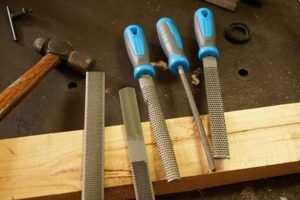
Although not cutting implements themselves, sharpening tools are intrinsically linked to their efficient operation. Files, sharpening stones, and honing guides are essential for maintaining the cutting edge of saws and other edged tools. Dull tools require more force, increasing the risk of slippage and injury. Regular sharpening ensures clean, precise cuts and extends the lifespan of the tools.
In conclusion, the selection and maintenance of cutting implements are integral aspects of woodworking and carpentry. A comprehensive understanding of hand saws, power saws, specialty saws, and sharpening tools allows for informed decisions and optimal performance in various projects, contributing to both efficiency and the overall quality of finished work.
2. Shaping Tool Precision

The accuracy achievable with shaping implements directly influences the quality and functionality of woodworking and carpentry projects. The close relationship between these tools and the precision they offer determines the finesse and structural integrity of finished products. Imperfections in shaping can cascade through a project, affecting joint stability, surface smoothness, and aesthetic appeal. For instance, an inaccurately planed surface on a door frame can lead to improper sealing, causing drafts and compromised energy efficiency. The selection and skillful application of shaping implements, therefore, hold paramount significance.
Various implements offer different levels of precision. Hand planes, for example, allow for meticulous material removal, enabling the creation of flawlessly flat surfaces and precisely fitted joints. Chisels, when wielded with skill, enable the creation of intricate details and the refinement of joinery connections. Conversely, power routers, while efficient for shaping edges and creating decorative profiles, require careful setup and control to prevent errors. In furniture making, precise shaping ensures drawers glide smoothly and doors align perfectly. In construction, accurately shaped structural members contribute to the overall stability and load-bearing capacity of a building. Consequently, mastering the use of shaping tools is vital for achieving desired outcomes in both decorative and structural applications.
Ultimately, the pursuit of shaping tool precision underscores the commitment to quality and craftsmanship in woodworking and carpentry. While technological advancements offer alternatives, the fundamental principles of accurate material removal and controlled shaping remain essential. Challenges include the need for continuous skill development and the careful selection of tools appropriate for specific tasks. Recognizing the central role of precision ensures that shaping implements are employed effectively, resulting in projects that meet the highest standards of functionality and aesthetic excellence.
3. Fastening Method Variety
The selection of appropriate fastening methods is crucial in woodworking and carpentry, directly impacting the structural integrity, aesthetic appeal, and longevity of finished projects. Diverse fastening methods, executed with appropriate implements, allow for the creation of strong, durable, and visually appealing structures and objects.
- Screws and Drills
Screws offer a strong and relatively easily reversible fastening solution. The appropriate choice of screw type (e.g., wood screws, drywall screws, self-tapping screws) depends on the materials being joined and the desired holding power. Drills are essential for creating pilot holes, preventing wood splitting, and driving screws efficiently. The variety in screw head types (flat, round, pan) also provides options for aesthetic integration into the design.
- Nails and Hammers
Nails represent a traditional and rapid fastening method, particularly suited for framing and construction applications. Different nail types, such as common nails, finish nails, and roofing nails, are designed for specific materials and purposes. Hammers, available in various weights and head designs, are used to drive nails securely. Nail guns offer increased speed and efficiency in large-scale projects.
- Adhesives and Clamps
Adhesives provide a powerful and often invisible fastening solution, especially for joining wood surfaces. Different adhesive types, including wood glue, epoxy, and construction adhesive, offer varying strengths and bonding characteristics. Clamps are essential for applying pressure during the adhesive curing process, ensuring a strong and consistent bond. The selection of appropriate adhesive and clamping techniques is critical for achieving durable joints.
- Joinery Techniques
Traditional joinery techniques, such as dovetails, mortise-and-tenon joints, and lap joints, provide strong and aesthetically pleasing connections without relying on external fasteners. These methods require precise cutting and shaping of the wood components to create interlocking structures. Chisels, saws, and planes are essential tools for executing these techniques. The complexity and strength of joinery joints vary, allowing for customization based on the project’s requirements.
The effective application of various fastening methods depends on a thorough understanding of material properties, joint design, and tool selection. The choice of method must align with the project’s intended use, aesthetic goals, and structural requirements. Proper implementation guarantees lasting structures and fine craftsmanship.
4. Measuring Device Accuracy
The accuracy of measuring devices is fundamentally intertwined with the successful application of implements used for shaping and constructing with wood. Deviations in measurement, even minor, can propagate errors throughout a project, leading to misaligned joints, unstable structures, and aesthetically displeasing results. A misread measurement on a framing square, for example, could result in a wall that is not perfectly square, affecting the alignment of doors, windows, and subsequent construction phases. Therefore, the precision of these instruments is not merely desirable but essential for achieving professional-grade outcomes.
Specific examples illustrate the practical significance of accurate measurement. When constructing a cabinet, precise measurements of internal dimensions are crucial for ensuring that shelves fit correctly and doors align properly. Inaccurate measurements during the cutting of components for a dovetail joint can lead to a weak or non-functional joint. Similarly, when installing flooring, accurate measurements are necessary to minimize waste and ensure a seamless fit. The selection of appropriate measuring devices, such as precision squares, laser levels, and digital calipers, is thus a critical step in any woodworking or carpentry endeavor, providing a foundation for accuracy in subsequent operations.
In conclusion, accurate measurement constitutes a cornerstone of competent woodworking and carpentry. While skill in using implements is undoubtedly important, the fidelity of measuring instruments and the rigor with which they are applied exert a profound influence on the final product. Challenges include ensuring proper calibration of devices and understanding the limitations of each tool. Recognizing the vital connection between accurate measurement and successful project execution is paramount, leading to improved efficiency, reduced material waste, and enhanced structural integrity.
5. Maintenance For Longevity
The operational lifespan and performance consistency of woodworking and carpentry implements are inextricably linked to diligent maintenance practices. Neglecting maintenance procedures inevitably leads to diminished performance, increased risk of operational failure, and premature replacement, resulting in increased costs and reduced productivity. Regular maintenance, conversely, ensures optimal functionality, minimizes safety hazards, and maximizes the return on investment in these valuable tools. For instance, a dull saw blade requires increased force to operate, leading to inaccurate cuts, user fatigue, and potential kickback injuries. Regular sharpening mitigates these risks and extends the blade’s useful life.
Specific maintenance protocols vary depending on the tool type. Edge tools, such as chisels and planes, require frequent sharpening and honing to maintain their cutting efficiency. Power tools necessitate regular cleaning of dust and debris, lubrication of moving parts, and inspection of electrical components to prevent overheating and malfunctions. Hand tools benefit from rust prevention measures, such as the application of protective oils or waxes. Measuring devices require periodic calibration to ensure accuracy. The investment of time and resources in these maintenance activities yields significant benefits in terms of tool performance and longevity. A well-maintained hand plane, for example, can last for generations, providing superior results compared to a neglected or poorly maintained power tool.
In conclusion, maintenance constitutes an integral component of responsible tool ownership and professional practice in woodworking and carpentry. Overlooking maintenance requirements undermines the functionality and lifespan of these implements, leading to increased costs and compromised safety. Adherence to established maintenance schedules and protocols ensures optimal performance, minimizes risks, and maximizes the long-term value of these essential assets, contributing to both efficient workflow and exceptional craftsmanship.
Frequently Asked Questions
The following addresses common inquiries regarding the selection, application, and maintenance of implements used in woodworking and carpentry.
Question 1: What constitutes an essential starter set for a beginner in woodworking?
A fundamental set includes a hand saw (crosscut), a measuring tape, a combination square, a set of chisels, a hand plane, a hammer, a selection of screwdrivers, and safety glasses. This collection provides a basis for performing basic cutting, shaping, and fastening operations.
Question 2: How frequently should edged tools be sharpened?
Sharpening frequency depends on usage and material. As a general guideline, edged implements should be sharpened whenever a noticeable decrease in cutting efficiency is observed, or when the tool fails to produce clean, precise cuts. Regular honing can extend the intervals between sharpenings.
Question 3: What are the key safety precautions to observe when operating power tools?
Essential safety measures include wearing appropriate personal protective equipment (safety glasses, hearing protection, dust mask), ensuring proper grounding of electrical equipment, maintaining a clean and well-lit workspace, thoroughly reading and understanding the tool’s operating manual, and never operating power tools while fatigued or under the influence of substances.
Question 4: How should measuring instruments be calibrated to ensure accuracy?
Calibration methods vary depending on the instrument. Measuring tapes can be checked against a known standard length. Squares can be tested for perpendicularity using a reliable right-angle reference. Digital instruments may require specific calibration procedures outlined in their respective manuals.
Question 5: What are the best practices for storing woodworking and carpentry implements?
Tools should be stored in a clean, dry environment to prevent rust and corrosion. Edge tools should be protected with blade guards or sheaths to prevent accidental injury and maintain sharpness. Power tools should be stored in their cases or on designated shelves, with cords properly coiled.
Question 6: How does one determine the appropriate screw or nail type for a given application?
Selection should be based on the materials being joined, the required holding power, and the desired aesthetic appearance. Wood screws are designed for joining wood components, while drywall screws are suitable for attaching drywall to framing. The length of the fastener should be sufficient to penetrate deeply into both materials, ensuring a secure connection.
Accurate tool selection, diligent maintenance, and adherence to safety protocols are vital for successful woodworking and carpentry endeavors.
The subsequent section will explore advanced methods and project-specific considerations.
Woodworking and Carpentry Tools
This exploration has underscored the critical role of “woodworking and carpentry tools” in achieving precise and durable results. The selection, maintenance, and skilled application of these instruments directly influence the quality, safety, and longevity of finished projects. From the fundamental cutting, shaping, and fastening implements to the advanced techniques employed in joinery and finishing, a thorough understanding of these elements is essential.
As advancements in materials and technology continue to shape the field, a commitment to continuous learning and adaptation remains paramount. The responsible and informed utilization of “woodworking and carpentry tools” not only enables the creation of functional and aesthetically pleasing objects but also contributes to the preservation of craftsmanship and the advancement of building practices. Further investigation and practical application are encouraged to foster mastery and innovation in this enduring domain.