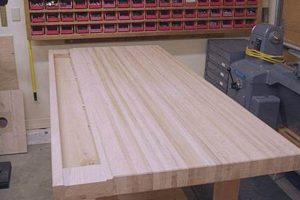
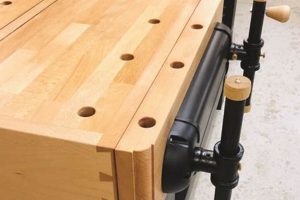
Workholding is a fundamental aspect of woodworking. Devices that secure material to a workbench surface allow for precise and safe execution of various operations. One common method utilizes pegs or stops inserted into corresponding holes in the bench surface. These components provide a fixed point against which wood can be held, enabling planing, sawing, and joinery tasks. They are typically cylindrical and made from materials such as wood, metal, or plastic.
The employment of these fixtures greatly enhances efficiency and accuracy. They permit repeatable positioning of stock, aiding in batch production or complex assemblies. Historically, these tools were simple wooden pegs, but modern iterations offer a range of features including adjustable height, spring-loaded mechanisms for quick insertion and removal, and compatibility with various hole sizes and spacing. Their use contributes significantly to a stable and controlled working environment.
Subsequent sections will delve into the specifics of choosing the appropriate style for different woodworking needs, discuss optimal hole placement strategies, and explore various accessory options that expand the versatility of this workholding method.
Practical Considerations for Bench Dog Use
Effective utilization of bench dog systems requires careful planning and informed decisions. Optimizing the setup is critical for maximizing workholding potential and improving efficiency.
Tip 1: Material Selection: Evaluate the workpiece material hardness. Softer woods necessitate dogs with larger surface areas or softer materials to prevent damage, while harder woods can tolerate more aggressive clamping force.
Tip 2: Hole Spacing Consistency: Maintain uniform hole spacing across the bench surface. Regular, consistent spacing facilitates predictable positioning and clamping, particularly for repetitive tasks.
Tip 3: Dog Height Adjustment: Invest in adjustable-height dogs or create shims for fine-tuning the clamping pressure. Over-tightening can damage both the workpiece and the bench.
Tip 4: Complementary Clamping Methods: Integrate them with other clamping techniques, such as face clamps or bar clamps, for secure workholding on complex geometries or oversized workpieces.
Tip 5: Regular Maintenance: Periodically inspect them for wear and damage. Replace worn or damaged components to maintain consistent performance and prevent potential hazards.
Tip 6: Consider Dog Geometry: Select a geometry optimized for a specific task, such as round for general purpose, or rectangular for maximum holding power when working with wide boards.
Tip 7: Dog Material: Consider the material. Metal provide a rigid holding force, while wooden or plastic may provide less damage to the material being worked on.
By adhering to these guidelines, the user will optimize the efficacy of their setup, ensuring a stable and reliable workholding solution.
The following section will address the benefits of incorporating customized solutions to further enhance the functionalities of these fundamental workholding components.
1. Material Rigidity

Material rigidity, in the context of woodworking bench dogs, refers to the resistance of the dog itself to deformation under load. This attribute is directly proportional to the dog’s effectiveness in securing a workpiece. A bench dog lacking adequate rigidity will bend or compress when pressure is applied, leading to slippage and diminished accuracy during woodworking operations such as planing or sawing. For example, a bench dog made from soft wood when used to secure a large, heavy board for planing will likely compress, allowing the board to shift and compromising the flatness of the planed surface. Conversely, a steel or hardened plastic dog maintains its shape under the same load, ensuring a stable work platform.
The selection of materials, therefore, becomes paramount. Steel, certain hardwoods like maple or beech, and high-density polymers are commonly employed due to their inherent rigidity. This inherent strength not only prevents deformation but also improves the transfer of clamping force from the dog to the workpiece. Consider a scenario where a dovetail joint is being chiseled; a rigid dog will hold the wood firmly, enabling clean and precise cuts. Furthermore, the diameter of the dog, alongside the material, contributes to overall rigidity. A wider dog of the same material will resist bending forces more effectively.
In conclusion, material rigidity is a crucial factor impacting the performance and reliability of woodworking bench dogs. Choosing appropriate material with sufficient rigidity minimizes deformation, maximizes clamping force, and ultimately contributes to accuracy and safety in woodworking projects. Neglecting this aspect can lead to flawed results and increased risk of injury.
2. Shape Versatility
Shape versatility, concerning woodworking bench dogs, reflects the ability of these workholding devices to accommodate a diverse range of workpiece geometries. The effectiveness of a bench dog system is significantly enhanced by its adaptability to various shapes, contributing to overall efficiency and precision in woodworking operations.
- Round Dogs for General Purpose
Cylindrical bench dogs represent the most common and versatile shape. They excel at securing flat or slightly curved workpieces for planing, sanding, or assembly tasks. Their simple design allows for easy insertion and removal from bench dog holes, facilitating rapid adjustments during workflow. The rounded shape also minimizes the risk of marring the workpiece surface, making them suitable for a broad range of materials.
- Square or Rectangular Dogs for Edge Support
Bench dogs with square or rectangular cross-sections offer increased contact area against the workpiece edge. This design is particularly beneficial when working with wide boards or panels, providing enhanced stability and preventing slippage during edge jointing or routing operations. The flat face of these dogs ensures a flush fit against the workpiece, maximizing holding power along the edge.
- Tapered Dogs for Angled Work
Tapered bench dogs are designed with a conical shape, allowing them to accommodate angled cuts or irregular workpiece profiles. This configuration is useful when creating dovetail joints or other angled joinery. The taper allows the dog to self-adjust to the angle, providing secure support and preventing the workpiece from rocking during the cutting process.
- L-Shaped Dogs for Face Clamping
L-shaped dogs incorporate a right-angle bend, enabling them to function as a combination of a bench dog and a face clamp. The vertical portion inserts into the bench dog hole, while the horizontal portion extends over the workpiece surface, providing downward clamping force. This design is advantageous when gluing up panels or assembling boxes, offering additional security and preventing movement during the clamping process.
The array of available shapes demonstrates the importance of considering the specific woodworking task when selecting bench dogs. While round dogs provide general-purpose utility, specialized shapes such as square, tapered, and L-shaped dogs offer targeted solutions for specific workholding challenges. An investment in a variety of shapes allows for greater adaptability and versatility in the woodworking shop, ultimately contributing to improved project quality and efficiency.
3. Holding Power

In woodworking, the term “holding power,” when associated with bench dogs, refers to the ability of these devices to securely fix a workpiece to the workbench surface. This capability is paramount for accurate and safe execution of various woodworking operations. Insufficient holding power leads to workpiece movement, compromising precision and potentially causing injury. Therefore, an understanding of the factors influencing holding power is crucial for any woodworker employing bench dog systems.
- Friction Coefficient
The friction coefficient between the bench dog and the workpiece is a primary determinant of holding power. A higher friction coefficient resists slippage more effectively. Materials like rubber or textured coatings applied to the surface of the bench dog increase this coefficient, enhancing grip. Consider a scenario where a smooth metal bench dog is used on a polished surface; the resulting holding power is significantly lower than that of a rubberized dog on the same surface.
- Contact Area
The area of contact between the bench dog and the workpiece directly influences the magnitude of the frictional force. A larger contact area distributes the force over a greater surface, increasing resistance to movement. Bench dogs with wider heads or those designed to interface with the entire edge of a workpiece provide superior holding power compared to smaller, point-contact designs. For example, rectangular bench dogs offer greater edge support, preventing rotation of the stock when hand planing, increasing holding power.
- Clamping Force
Clamping force, whether applied directly through the bench dog itself (e.g., using a spring-loaded or cam-action dog) or indirectly via other clamping mechanisms acting in concert, plays a vital role. Greater clamping force increases the normal force between the dog and the workpiece, proportionally increasing the frictional resistance. Over-tightening, however, can damage the workpiece or the bench. A balance must be struck to achieve optimal holding power without causing harm. An example of this is a bench vise, that is used in concert with bench dogs, to increase holding power.
- Material Compatibility
The compatibility of the materials used for the bench dog and the workpiece is a factor to be considered. Significant disparities in hardness or texture can diminish holding power. For instance, using a hardened steel bench dog on a soft wood like pine may result in the dog embedding itself into the wood rather than providing secure holding. Matching the dog material to the workpiece material, or utilizing protective shims, can mitigate this effect.
These interconnected facets highlight the multifaceted nature of holding power in woodworking bench dog systems. Optimizing each factor, from friction to clamping force, contributes to a robust and reliable workholding setup. The judicious selection and application of these principles are essential for achieving accurate and safe results in woodworking endeavors.
4. Size Adaptability

Size adaptability, when discussing woodworking bench dogs, pertains to the ability of these workholding devices to accommodate variations in workpiece dimensions and bench dog hole diameters. This flexibility is crucial for a versatile and efficient woodworking setup, allowing for secure holding of diverse stock thicknesses and compatibility with different bench configurations. Lack of size adaptability limits the system’s utility, restricting the types of projects and workpieces that can be handled effectively.
- Dog Diameter and Hole Tolerance
The diameter of a bench dog must closely match the diameter of the bench dog hole for optimal performance. Excessive clearance results in wobble and reduced holding power, while an undersized dog may not fit securely. Some manufacturers offer dogs in slightly different diameters or provide shims to fine-tune the fit. For example, a bench with precisely drilled 3/4″ holes benefits from 3/4″ diameter dogs with minimal deviation. Conversely, a poorly drilled bench may necessitate dogs with slightly larger or adjustable diameters to ensure a snug fit.
- Dog Length and Workpiece Thickness
The length of a bench dog should be appropriate for the thickness of the workpiece being held. A dog that is too short may not engage sufficiently, resulting in slippage. A dog that is too long may protrude excessively above the workpiece, obstructing tools or interfering with operations. Adjustable-height dogs or the use of spacers can compensate for variations in workpiece thickness. For instance, when working with thin stock, short dogs or dogs with height adjustment mechanisms are preferable to prevent excessive protrusion. A dog with length is needed to secure an edge on a piece of plywood or similar product.
- Tapered Dogs and Variable Hole Diameters
Tapered bench dogs offer a degree of size adaptability, allowing them to function effectively in bench dog holes with slight variations in diameter. The taper ensures a secure fit, even if the hole is not perfectly uniform. This design is particularly useful in older benches where the holes may have become slightly worn or distorted over time. An example would be a tapered dog being able to expand to fill the variable sized hole, thereby increasing the holding power to the workbench surface.
- Adjustable Height and Clamping Pressure
Bench dogs with adjustable height mechanisms provide a means of controlling clamping pressure, particularly when used in conjunction with other workholding devices. By adjusting the height of the dog, the user can fine-tune the amount of force applied to the workpiece, preventing damage or distortion. This is especially important when working with delicate materials or when clamping irregular shapes. For instance, an adjustable-height dog can be used to gently secure a fragile carving blank without crushing it.
In summary, size adaptability in woodworking bench dogs encompasses a range of factors related to fit, length, and adjustability. Addressing these considerations ensures a versatile and reliable workholding system capable of accommodating diverse woodworking tasks. From selecting the appropriate dog diameter to utilizing adjustable height mechanisms, the ability to adapt to different sizes and dimensions is essential for achieving accuracy and efficiency in woodworking projects. These dogs with correct adaptability allow for holding an edge on a piece of plywood for cutting.
5. Surface Protection
Surface protection, in the context of woodworking bench dogs, refers to measures taken to prevent damage to both the workpiece and the bench surface during workholding. The inherent function of a bench dog to exert pressure and maintain stability carries the risk of marring, denting, or otherwise compromising the integrity of the material being worked on. Consequently, integrating surface protection considerations into the selection and utilization of bench dogs is critical for preserving the aesthetic and structural qualities of woodworking projects. For example, a metal bench dog used directly against a softwood surface will likely leave indentations or scratches, necessitating additional sanding or repair.
Several approaches mitigate this risk. One common method involves using bench dogs constructed from softer materials, such as wood or high-density polymers. These materials offer sufficient holding power while minimizing the potential for damage. Another strategy is to employ protective shims or pads between the bench dog and the workpiece. These shims, often made from cork, leather, or felt, act as a buffer, distributing the pressure and preventing direct contact between the harder dog material and the more vulnerable workpiece surface. As an example, when securing a delicate instrument component for repair, leather shims used in conjunction with bench dogs ensure the component remains undamaged during the process. Surface protection can also involve the design of the bench dogs themselves. Many bench dogs have rounded edges or chamfered corners to minimize the likelihood of sharp edges digging into the material.
Ultimately, surface protection is an integral aspect of responsible woodworking practice. By understanding the potential for damage inherent in workholding and implementing appropriate preventative measures, woodworkers can maintain the quality and appearance of their projects. Failure to consider surface protection can lead to costly repairs, rework, or even the destruction of valuable materials. Consequently, careful attention to detail in the selection and application of bench dogs, incorporating materials and techniques that prioritize surface protection, is essential for achieving professional-quality results. The use of Nylon tipped bench dogs are a good example of surface protection.
6. Precision Placement
The effective utilization of woodworking bench dogs hinges critically on precise placement. This principle transcends mere insertion into pre-drilled holes; it encompasses the strategic positioning of these devices to optimize workholding capabilities and ensure accurate execution of woodworking operations. Precise placement directly influences the stability, repeatability, and ultimately, the quality of the finished product.
- Grid System Accuracy
A consistent and accurately spaced grid system of bench dog holes forms the foundation for precise placement. Deviations in hole spacing or alignment compromise the ability to reliably position workpieces. Errors in the grid propagate through the entire project, leading to misaligned joints, uneven surfaces, and dimensional inaccuracies. The implementation of precision drilling techniques, often employing jigs or CNC machinery, is essential for establishing a reliable grid system. For example, a grid deviation of only 1/16″ over a 24″ span can result in cumulative errors that significantly impact the fit of intricate joinery.
- Dog Hole Diameter Consistency
Uniformity in bench dog hole diameter is paramount for achieving consistent holding power and preventing unwanted movement. Variations in hole size introduce slop or binding, hindering the ability to precisely position and secure the workpiece. Precision reaming or boring techniques are necessary to ensure consistent hole diameters across the bench surface. Consider a scenario where some holes are slightly oversized; the dogs inserted into these holes will exhibit play, reducing their effectiveness in resisting lateral forces during planing or routing operations.
- Workpiece Alignment Strategies
Strategic placement, in conjunction with auxiliary tools like fences, stops, or measuring devices, allows for precise alignment of the workpiece relative to the bench dogs. These alignment strategies enable repeatable positioning, facilitating batch production or the creation of complex assemblies with tight tolerances. For instance, a fence aligned parallel to the bench dog grid allows for accurately trimming multiple pieces to the same dimension. Similarly, stop blocks positioned between bench dogs ensure consistent placement of components during glue-ups.
- Consideration of Grain Direction
Precision placement must account for wood grain direction to minimize the risk of splitting or crushing the workpiece under clamping pressure. Orienting the clamping force parallel to the grain reduces stress and distributes the load more evenly. Incorrectly positioned bench dogs, particularly when combined with excessive clamping force, can induce splitting, especially in brittle woods or near the end grain. For example, when clamping a miter joint, placing bench dogs strategically to support both sides of the joint while aligning the force with the grain prevents the joint from opening up or fracturing.
Collectively, these facets highlight the critical importance of precision placement in leveraging the full potential of woodworking bench dogs. Achieving accuracy in hole spacing, diameter consistency, workpiece alignment, and grain consideration translates directly into enhanced workholding stability, improved project precision, and a reduction in material waste. The investment in precise placement techniques and tools, therefore, represents a foundational step towards achieving professional-quality results in woodworking endeavors.
Frequently Asked Questions
This section addresses common inquiries regarding the selection, utilization, and maintenance of woodworking bench dogs. The information provided aims to clarify best practices and dispel potential misconceptions.
Question 1: What is the optimal material for bench dogs intended for general-purpose use?
Hardwood, such as maple or beech, provides a balance of rigidity and workpiece protection. Metal variants, while durable, increase the risk of marring softer woods. Polymers offer a compromise but may lack the long-term durability of wood or metal.
Question 2: How should one determine the appropriate spacing for bench dog holes on a workbench?
A grid pattern with 4-6 inch spacing offers versatility for various workpiece sizes. Closer spacing provides greater clamping options but increases drilling complexity. Wider spacing reduces drilling effort but may limit clamping configurations.
Question 3: What is the best method for preventing bench dogs from slipping or rotating within their holes?
A snug fit is paramount. Bench dogs should be sized to match the hole diameter accurately. Minor deviations can be addressed with shims. Textured surfaces or slight tapers on the dog shaft can also enhance grip.
Question 4: Is it necessary to use bench dogs in conjunction with other clamping mechanisms?
While bench dogs provide a foundational workholding method, supplementary clamps, such as face clamps or bar clamps, are often required for complex geometries or when applying significant clamping force. The optimal combination depends on the specifics of the task.
Question 5: How can bench dogs be effectively utilized for securing irregularly shaped workpieces?
Custom-shaped bench dogs, such as those with concave or convex surfaces, can be fabricated to conform to the workpiece geometry. Alternatively, flexible clamping arms or adjustable stops can be used in conjunction with standard bench dogs to accommodate non-uniform shapes.
Question 6: What are the recommended maintenance procedures for woodworking bench dogs?
Regular inspection for wear or damage is crucial. Worn or damaged dogs should be replaced promptly. Wooden dogs may require occasional refinishing to maintain a smooth surface. Metal dogs should be protected from rust.
Understanding these principles ensures effective and safe application of woodworking bench dogs across diverse projects. Careful consideration of material selection, hole spacing, and supplementary clamping methods allows for optimized workholding solutions.
The subsequent section will provide best practice in selecting the right bench dogs for the right job.
Conclusion
The preceding exploration has elucidated the multifaceted nature of woodworking bench dogs. From material rigidity and shape versatility to holding power, size adaptability, surface protection, and precision placement, each attribute contributes significantly to a robust and reliable workholding system. The careful consideration of these factors, coupled with an understanding of optimal hole spacing and the judicious use of supplementary clamping mechanisms, empowers woodworkers to achieve unparalleled accuracy and efficiency in their craft.
The informed application of these principles fosters not only enhanced project quality but also a safer and more enjoyable woodworking experience. Mastery of workholding, with woodworking bench dogs playing a central role, represents a fundamental step toward professional excellence. The continuing refinement of this system promises to unlock further advancements in precision woodworking.
![Build A Roman Woodworking Bench [DIY Guide] | Step-by-Step Guides, Tools & Inspiration to Build Beautiful Wooden Decor on a Budget](https://woodfromhome.com/wp-content/uploads/2026/05/th-207-300x200.jpg "Build A Roman Woodworking Bench [DIY Guide] Step-by-Step Guides, Tools & Inspiration to Build Beautiful Wooden Decor on a Budget")