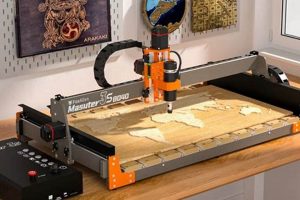
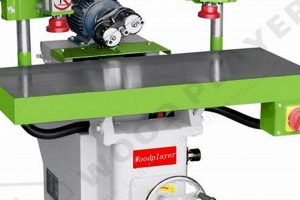
This automated apparatus facilitates the precise removal of material from wood to create intricate designs and forms. These tools employ computer numerical control (CNC) technology to execute patterns specified by digital design files. For example, an operator might use such a device to reproduce a complex architectural molding or craft detailed relief carvings on furniture panels.
The utilization of this technology offers significant advantages in efficiency, repeatability, and accuracy compared to traditional hand carving methods. Historically, intricate woodwork demanded skilled artisans and considerable time. Modern automation enables the rapid production of identical components, reducing manufacturing costs and expanding design possibilities. It also opens opportunities for hobbyists and smaller workshops to produce high-quality, complex wood products previously unattainable.
The subsequent sections will explore the various types of these automated devices, their operational principles, the software employed in their use, and considerations for selecting the appropriate model for specific woodworking applications. This will provide a foundational understanding for anyone considering incorporating this technology into their woodworking workflow.
Essential Guidance for Automated Wood Carving
The following guidelines offer crucial insights for achieving optimal performance and longevity from automated wood carving equipment. Adherence to these recommendations minimizes errors, maximizes efficiency, and safeguards the investment.
Tip 1: Select Appropriate Cutting Tools: The choice of router bit significantly impacts the quality of the finished product. Employ bits designed for the specific wood species being carved. For hardwoods, carbide-tipped bits offer superior durability compared to high-speed steel. Regularly inspect bits for sharpness and replace them when dull.
Tip 2: Implement a Robust Dust Collection System: Wood dust poses health hazards and can interfere with the accurate operation of the equipment. A properly sized dust collection system, connected directly to the carving apparatus, is essential. Ensure the system’s filters are regularly cleaned or replaced to maintain optimal suction.
Tip 3: Calibrate the Machine Accurately: Before initiating any carving operation, meticulously calibrate the device according to the manufacturer’s instructions. This includes setting the zero point, verifying axis alignment, and confirming the accuracy of the spindle speed. Inaccurate calibration can lead to dimensional errors in the final product.
Tip 4: Program Toolpaths Strategically: The efficiency of the carving process depends heavily on the design and implementation of toolpaths. Optimize toolpaths to minimize unnecessary movements and reduce cutting time. Consider using adaptive clearing strategies for roughing passes to remove large amounts of material quickly.
Tip 5: Monitor Machine Performance Consistently: During operation, closely monitor the device for unusual noises, vibrations, or temperature increases. These symptoms may indicate underlying mechanical problems. Address any anomalies promptly to prevent further damage or safety risks.
Tip 6: Implement a Preventative Maintenance Schedule: Adherence to a regular maintenance schedule is critical for extending the lifespan of the equipment. Lubricate moving parts, inspect belts and pulleys for wear, and clean the machine thoroughly after each use. Refer to the manufacturer’s guidelines for specific maintenance procedures.
Tip 7: Secure Workpieces Rigorously: Proper workpiece clamping is paramount for achieving accurate and safe carving. Employ appropriate clamping methods based on the size and shape of the material. Verify that the workpiece is securely fastened before starting the machine.
Following these tips will contribute to enhanced efficiency, improved output quality, and prolonged operational life of the equipment. Prioritizing these practices fosters a safer and more productive woodworking environment.
These considerations establish a basis for a deeper exploration of the practical applications of automated woodworking, which will be addressed in the article’s concluding sections.
1. Precision and Accuracy

Precision and accuracy are paramount considerations in the realm of automated wood carving. These characteristics dictate the fidelity of the final product to the original digital design, influencing both aesthetic appeal and functional performance. The attainment of optimal precision and accuracy relies upon a confluence of mechanical design, control systems, and operational practices.
- Mechanical Rigidity and Stability
The structural integrity of the woodworking carving machine directly impacts its capacity to maintain precision during operation. Flex or vibration within the frame or gantry can introduce inaccuracies, especially when carving dense hardwoods or complex geometries. Machines with robust frames, constructed from materials like cast iron or welded steel, exhibit superior resistance to deflection and thus contribute to enhanced precision. Stable foundations and vibration dampening further mitigate unwanted movements that could compromise accuracy.
- Drive System Resolution and Control
The drive system, typically consisting of stepper motors or servo motors coupled with lead screws or ball screws, governs the movement of the cutting tool along the X, Y, and Z axes. Higher resolution drive systems, capable of executing smaller incremental movements, enable finer detail and smoother curves. Closed-loop control systems, which incorporate feedback mechanisms to monitor and correct positional errors, provide greater accuracy compared to open-loop systems. Precise control over acceleration and deceleration is also critical for minimizing overshoot and ensuring smooth transitions between toolpaths.
- Spindle Runout and Tool Holding
Spindle runout, the deviation of the rotating cutting tool from its true center, introduces inaccuracies in the carved features. Minimizing runout requires high-quality spindles with precision bearings and balanced rotors. Secure and concentric tool holding is equally important. Collets, which clamp the cutting tool shank, must be properly sized and tightened to prevent slippage or vibration. Regular inspection and maintenance of the spindle and tool-holding system are essential for maintaining optimal accuracy.
- Calibration and Compensation
Even with high-quality components, manufacturing tolerances and assembly imperfections can introduce systematic errors in the machine’s operation. Calibration procedures, involving the use of precision measuring instruments, are necessary to identify and quantify these errors. Compensation techniques, implemented through software or hardware adjustments, can then be applied to correct for these inaccuracies. Regular recalibration is recommended to account for wear and thermal expansion, ensuring that the machine maintains its specified level of precision over time.
In summary, achieving satisfactory precision and accuracy in automated wood carving necessitates a holistic approach that considers the mechanical structure, drive system, spindle performance, and calibration procedures. Each of these facets contributes to the overall quality of the finished product, and neglecting any one aspect can compromise the machine’s ability to faithfully reproduce the intended design. The integration of these factors defines the apparatus’ value.
2. Material Compatibility

Material compatibility constitutes a critical parameter in the effective and safe operation of any automated woodworking apparatus. The capacity of a carving apparatus to process various wood species and related materials is dictated by a complex interplay of factors, including the machine’s power, rigidity, and control system capabilities.
- Wood Density and Hardness
The density and hardness of the wood species directly influence the cutting forces required and the rate at which material can be removed. Hardwoods such as maple, oak, and cherry demand more robust machines with higher spindle power and greater structural rigidity to prevent deflection or vibration during the carving process. Softwoods, such as pine, fir, and cedar, require less power but may necessitate higher spindle speeds and specialized cutting tools to prevent tearing or splintering of the wood fibers. The machine’s control system must be capable of precisely regulating feed rates and spindle speeds to accommodate the specific properties of the wood being carved. An inadequate adaptation may result in increased tool wear and surface finish degradation.
- Abrasiveness and Grain Structure
Certain wood species contain abrasive minerals or exhibit complex grain structures that can accelerate the wear of cutting tools. Exotic hardwoods such as teak or wenge, which are frequently used in high-end woodworking projects, are known for their high silica content, which rapidly dulls carbide-tipped router bits. Similarly, woods with interlocked or figured grain patterns can pose challenges for automated carving, as the cutting tool may encounter varying resistance as it traverses the workpiece. Optimal machine operation requires using cutting tools with specialized coatings or geometries, such as diamond-coated bits, and adjusting feed rates to minimize wear and prevent chipping or tear-out.
- Moisture Content
The moisture content of the wood significantly affects its machinability and dimensional stability. Wood that is too wet can be difficult to carve cleanly and may warp or shrink after the carving process, leading to inaccuracies in the final dimensions. Conversely, wood that is excessively dry can become brittle and prone to cracking or splintering. Ideally, wood should be properly seasoned and brought to equilibrium moisture content before being processed by an automated carving apparatus. The environmental conditions in the workshop should also be controlled to maintain a stable moisture level and prevent fluctuations that could impact the wood’s behavior.
- Engineered Wood Products
In addition to solid wood, automated woodworking carving machines are frequently used to process engineered wood products such as plywood, MDF (medium-density fiberboard), and particleboard. These materials offer advantages in terms of cost, dimensional stability, and availability in large sizes. However, they also present unique challenges for automated carving. Plywood can be prone to delamination if the cutting tool is not properly sharpened or if the feed rate is too high. MDF and particleboard generate large amounts of fine dust during carving, requiring effective dust collection systems to maintain a clean and safe working environment. The machine’s software must be capable of generating optimized toolpaths for processing these materials, taking into account their specific properties and minimizing the risk of defects.
The selection of a woodworking carving machine must consider the intended range of materials and their physical characteristics. The machine’s specifications, including spindle power, axis control, and cutting tool compatibility, should align with the demands of the materials to be processed. Inadequate consideration leads to diminished efficiency, shortened tool life, and potential equipment damage.
3. Software Integration

Software integration is a foundational element in the operation of modern automated woodworking carving machines. The software serves as the bridge between the design intent and the physical execution, enabling the conversion of digital models into precise movements of the cutting tool. Its efficacy determines the accuracy, efficiency, and versatility of the carving process.
- CAD/CAM Design Workflow
Computer-Aided Design (CAD) software enables the creation of digital models representing the desired carved object. These models, typically in formats such as DXF or STL, are then imported into Computer-Aided Manufacturing (CAM) software. The CAM software generates toolpaths, which define the precise movements of the cutting tool to remove material and create the final shape. The complexity of the CAM software dictates the level of control the operator has over the carving process, including tool selection, cutting parameters, and optimization strategies. For instance, a sophisticated CAM system allows for the simulation of the carving process, identifying potential collisions or inefficiencies before they occur on the machine.
- Machine Control Software
The generated toolpaths are then translated into machine-readable code, typically G-code, which is interpreted by the machine control software. This software directly controls the movement of the machine’s axes, spindle speed, and other operational parameters. Advanced machine control software incorporates features such as real-time monitoring of the carving process, error detection, and adaptive feed rate control, adjusting the cutting speed based on the load on the spindle. These features contribute to both the quality of the finished product and the safety of the operation. An example is the ability to pause the carving process mid-operation, allowing for tool changes or adjustments without losing the precise location.
- Material Libraries and Cutting Parameters
Many software packages include material libraries that contain pre-defined cutting parameters for various wood species and other materials. These parameters, such as feed rate, spindle speed, and depth of cut, are optimized to achieve the best possible surface finish and minimize tool wear. The availability of these libraries simplifies the process of setting up the carving operation and ensures consistent results. Furthermore, the ability to customize and expand these libraries allows the operator to fine-tune the cutting parameters for specific materials or applications. For instance, a user might create a custom profile for a particular exotic hardwood that is not included in the standard library.
- Remote Monitoring and Control
Modern software integration extends beyond the immediate operation of the carving machine. Some systems offer remote monitoring and control capabilities, allowing the operator to track the progress of the carving process, adjust parameters, and even pause or stop the machine from a remote location. This is particularly useful for unattended operation or when the machine is located in a separate room or building. Additionally, data logging and analysis features can provide valuable insights into machine performance, allowing for optimization of the carving process and preventative maintenance.
In conclusion, software integration is an inextricable component of contemporary automated woodworking. It directly impacts the precision, efficiency, and versatility of the machine, enabling the creation of intricate and complex designs that would be impossible to achieve through manual methods. Effective software integration requires a seamless flow of information from the design phase to the machine control, ensuring accurate and reliable execution of the carving process.
4. Operational Safety

Operational safety is a paramount concern in the utilization of woodworking carving machines. The inherent risks associated with high-speed rotating tools and the potential for projectile debris necessitate comprehensive safety protocols and equipment safeguards. A proactive approach to safety minimizes the potential for accidents, injuries, and equipment damage.
- Emergency Stop Systems
Emergency stop (E-stop) systems constitute a fundamental safety feature on woodworking carving machines. These systems provide a rapid means of halting all machine operations in the event of an anomaly or emergency situation. E-stop buttons should be readily accessible to the operator and strategically located around the machine. Regular testing of the E-stop system is crucial to ensure its functionality. In a scenario where a cutting tool breaks or a workpiece becomes dislodged, the immediate activation of the E-stop can prevent further damage or injury.
- Enclosure and Guarding
Enclosures and guarding mechanisms are essential for containing projectile debris and preventing accidental contact with moving parts. A full enclosure, typically constructed from polycarbonate or similar impact-resistant materials, provides a physical barrier around the cutting area. Interlocks on enclosure doors prevent the machine from operating when the doors are open. Additionally, strategically placed guards protect against accidental contact with belts, pulleys, and other moving components. The absence of adequate guarding exposes operators to the risk of lacerations, abrasions, or more severe injuries.
- Dust Collection and Ventilation
Woodworking carving machines generate significant amounts of airborne dust, which poses both respiratory hazards and fire risks. Effective dust collection systems, connected directly to the machine, are essential for capturing and removing dust particles. These systems typically employ a high-efficiency particulate air (HEPA) filter to remove fine dust particles. Adequate ventilation in the workshop further reduces the concentration of airborne dust. Prolonged exposure to wood dust can lead to respiratory illnesses, such as asthma or bronchitis, highlighting the importance of these safety measures.
- Operator Training and Procedures
Comprehensive operator training is crucial for ensuring the safe and effective use of woodworking carving machines. Training should cover all aspects of machine operation, including setup, programming, maintenance, and emergency procedures. Operators must be thoroughly familiar with the machine’s safety features and understand the potential hazards associated with its operation. Clear and concise operating procedures, readily accessible to the operator, reinforce safe work practices and minimize the risk of errors. A well-trained and informed operator is the first line of defense against accidents and injuries.
These elements collectively contribute to a safer operational environment for woodworking carving machines. The proactive implementation of these measures mitigates potential risks, protects operators from harm, and ensures the longevity and reliable performance of the equipment. Prioritizing safety is not merely a regulatory obligation but an ethical imperative in any woodworking operation employing automated carving technology.
5. Maintenance Requirements

The longevity and consistent performance of a woodworking carving machine are directly contingent upon adherence to a structured maintenance schedule. Neglecting routine maintenance protocols precipitates equipment malfunctions, diminished carving accuracy, and potential safety hazards. Maintenance encompasses various activities, ranging from lubrication of moving parts and cleaning of debris to systematic inspections and timely replacement of worn components. Failure to maintain the apparatus results in a cascade of negative consequences, including increased downtime, elevated repair costs, and compromised output quality. For instance, a neglected lead screw may exhibit increased friction, leading to inaccurate axis movements and flawed carving details. A clogged dust collection system impairs airflow, creating a fire hazard and reducing the lifespan of the machine’s internal components.
A comprehensive maintenance plan should include daily, weekly, and monthly tasks, tailored to the specific model and usage intensity. Daily maintenance typically involves cleaning the machine bed, inspecting cutting tools for damage, and lubricating critical points. Weekly tasks might encompass checking the alignment of the axes, verifying the spindle runout, and inspecting the dust collection system. Monthly maintenance often includes a more thorough inspection of all mechanical and electrical components, as well as a comprehensive system calibration. Replacing worn bearings, belts, and filters at specified intervals is essential for preventing catastrophic failures. For example, neglecting to replace a worn spindle bearing can lead to complete spindle failure, necessitating a costly repair and prolonged downtime. Consistent observation of the machine’s operation facilitates early detection of potential problems, enabling proactive intervention and preventing more severe damage.
In summation, scheduled maintenance constitutes an indispensable element in the operation of a woodworking carving machine. It mitigates the risks of mechanical failures, maintains carving precision, and enhances operator safety. The implementation of a meticulously planned and consistently executed maintenance regime maximizes the return on investment in the equipment, ensuring its reliable performance and extending its operational lifespan. The challenges associated with neglecting maintenance far outweigh the time and resources required to implement a proactive maintenance strategy, solidifying its importance in successful woodworking operations.
Frequently Asked Questions
This section addresses prevalent inquiries regarding the operation, selection, and maintenance of automated woodworking carving machinery, providing succinct and authoritative responses.
Question 1: What safety precautions are paramount when operating a woodworking carving machine?
Adherence to stringent safety protocols is imperative. This includes wearing appropriate personal protective equipment (PPE), such as eye protection and hearing protection, ensuring the machine is properly grounded, and verifying that all safety interlocks are functional. Operators must be thoroughly trained in machine operation and emergency procedures. Additionally, maintaining a clean and well-ventilated workspace minimizes fire hazards and respiratory risks. The workspace also must have quick access to E-stop buttons and machine must be enclosed.
Question 2: How frequently should cutting tools be replaced on a woodworking carving machine?
The replacement frequency of cutting tools depends on several factors, including the material being carved, the cutting parameters, and the tool’s material composition. Regular inspection of cutting tools is crucial. Signs of wear, such as chipping, dulling, or excessive vibration, indicate the need for replacement. Employing high-quality cutting tools and adhering to recommended cutting parameters can extend tool life. The replacement should be performed immediately as soon as the signs are visible, for the quality and safety of the whole woodworking carving machine system.
Question 3: What are the primary considerations when selecting a woodworking carving machine for a specific application?
Key considerations include the size and type of workpieces to be carved, the required level of precision and accuracy, the materials to be processed, and the available budget. Machine specifications such as spindle power, axis travel, and control system capabilities should align with the demands of the intended application. Future needs must also be considered. The more robust the future needs are covered, the better longevity investment can be reached.
Question 4: How can the accuracy of a woodworking carving machine be optimized?
Optimizing accuracy requires a multifaceted approach. This involves ensuring the machine is properly calibrated, utilizing high-quality cutting tools, programming precise toolpaths, and maintaining a stable and vibration-free operating environment. Regular inspection and maintenance of mechanical components, such as lead screws and bearings, also contribute to enhanced accuracy. If one component is not good, others will be negatively affected.
Question 5: What role does software play in the operation of a woodworking carving machine?
Software is integral to the automated carving process. Computer-Aided Design (CAD) software is used to create digital models of the desired carved object. Computer-Aided Manufacturing (CAM) software generates toolpaths, which dictate the machine’s movements. Machine control software interprets the toolpaths and directs the machine’s operation. The proficiency of the software significantly impacts the efficiency, precision, and complexity of the carving process. If possible, always use original software, avoid pirated or illegal access of software in woodworking carving machine.
Question 6: What are the common causes of malfunctions in woodworking carving machines?
Common causes of malfunctions include inadequate lubrication, dust accumulation, worn or damaged cutting tools, loose connections, and electrical problems. Adhering to a comprehensive maintenance schedule, which includes regular cleaning, inspection, and component replacement, minimizes the risk of malfunctions. If a more serious machine problem is present, always contact professional and credible experts to solve the problem.
These responses offer a concise overview of critical aspects pertaining to automated woodworking carving machinery. Further investigation into specific machine models and applications is encouraged for informed decision-making.
The concluding section of this article will summarize the key concepts discussed and offer guidance on integrating this technology into woodworking operations.
Conclusion
This exploration has illuminated the multifaceted nature of woodworking carving machines, encompassing their operational principles, safety considerations, maintenance requirements, and software integration. The precision and efficiency afforded by this technology represent a significant advancement in woodworking, enabling the creation of intricate designs and complex forms with unparalleled accuracy. Careful consideration of material compatibility, appropriate tool selection, and robust safety protocols are essential for maximizing the benefits and minimizing the risks associated with these machines.
The continued evolution of woodworking carving machine technology promises further enhancements in automation, precision, and material versatility. Woodworkers and manufacturers are encouraged to remain abreast of these advancements and to adopt best practices in machine operation and maintenance to ensure the long-term success of their woodworking endeavors. The proper implementation of this technology holds the potential to revolutionize woodworking practices, opening new avenues for creativity and efficiency.