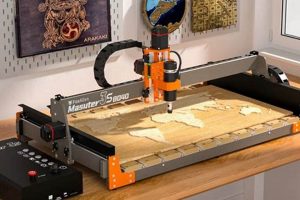
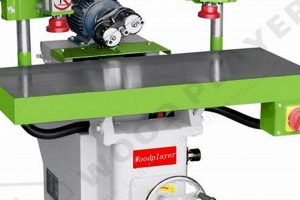
This automated tool, widely employed in fabrication, utilizes computer numerical control to execute precise cuts and engravings on wood. It combines the capabilities of traditional wood routers with the accuracy and repeatability of CNC technology, enabling the creation of intricate designs and complex shapes. For instance, this equipment can produce ornate furniture components, detailed signage, or custom-fitted cabinetry with significantly reduced manual labor.
Such equipment offers numerous advantages, including increased production speed, improved accuracy, and reduced material waste. Historically, skilled artisans painstakingly crafted these items by hand. The introduction of this technology revolutionized the woodworking industry by enabling mass production while maintaining a high degree of precision. This capability is paramount in contemporary manufacturing environments where efficiency and consistency are highly valued.
The following sections will delve into the specific components of these systems, examining their operational principles, exploring the various types available, and providing guidance on selecting the most suitable option for particular woodworking applications. Further discussion will cover software considerations, maintenance procedures, and safety protocols critical for ensuring optimal performance and longevity.
Optimizing the Performance of Automated Wood Routers
The following tips provide guidance on maximizing the effectiveness and longevity of woodworking CNC routers.
Tip 1: Material Selection and Preparation: Always select wood that is properly seasoned and free from defects. Ensure the material is securely clamped to the router table to prevent movement during the cutting process. Inconsistent material density or warping can negatively impact cutting precision and tool life.
Tip 2: Toolpath Optimization: Implement efficient toolpaths to minimize cutting time and reduce stress on the machine. Consider using climb milling for smoother surface finishes, and employ optimized feed rates and spindle speeds based on the wood species and cutter diameter. Utilize CAM software features like adaptive clearing to maintain consistent tool engagement.
Tip 3: Cutter Selection and Maintenance: Choose cutters specifically designed for CNC routing applications. Regularly inspect cutters for sharpness and replace them as needed. Dull cutters can lead to increased cutting forces, poor surface finishes, and potential damage to the machine or workpiece. Proper cutter maintenance, including cleaning and sharpening, extends their lifespan and improves cut quality.
Tip 4: Regular Calibration and Maintenance: Perform routine calibration of the CNC router to ensure accuracy and repeatability. Regularly lubricate moving parts, clean the machine of debris, and inspect belts and bearings for wear. A well-maintained machine operates more efficiently and reliably, resulting in fewer errors and reduced downtime.
Tip 5: Dust Extraction and Collection: Implement an effective dust extraction system to remove wood chips and dust generated during the routing process. This not only improves visibility and operator safety but also prevents dust accumulation that can damage machine components. Efficient dust collection also contributes to a cleaner and healthier work environment.
Tip 6: Software Proficiency: Invest time in learning and mastering the CAM software used to program the CNC router. Understand the software’s capabilities for creating complex toolpaths, optimizing cutting parameters, and simulating the routing process. Proficiency in the software allows for greater control over the machine and more efficient production of intricate designs.
Adhering to these guidelines can significantly enhance the performance, accuracy, and longevity of automated wood routers, ultimately leading to improved productivity and higher-quality finished products.
The subsequent sections will explore practical applications and case studies showcasing the impact of these systems across different sectors of the woodworking industry.
1. Precision

The operational effectiveness of a woodworking CNC router machine is intrinsically linked to the level of precision it offers. Precision, in this context, refers to the machine’s ability to execute programmed cuts and engravings with minimal deviation from the intended design. The demand for intricate designs and consistent replication in woodworking necessitates a high degree of accuracy, making precision a critical factor in the selection and utilization of such equipment. Inaccurate cuts can lead to assembly problems, structural weaknesses, and aesthetic imperfections, impacting the overall quality and value of the finished product. Therefore, the inherent precision of the machine directly influences the quality and marketability of the output.
Several factors contribute to achieving a high level of precision in a woodworking CNC router machine. These include the quality of the machine’s mechanical components, the sophistication of the control system, and the accuracy of the cutting tools. The rigidity of the frame, the smoothness of the motion system, and the accuracy of the spindle all play a significant role. Advanced control systems, employing sophisticated algorithms, compensate for inherent inaccuracies and minimize errors. Examples of how precision becomes vital are evident in creating intricate inlays, replicating complex furniture designs, or manufacturing components requiring tight tolerances. In architectural millwork, for instance, even a slight deviation in dimensions can compromise the structural integrity and aesthetic appeal of the final installation.
Ultimately, precision in a woodworking CNC router machine translates to reduced material waste, improved product quality, and increased efficiency. However, achieving and maintaining precision requires careful attention to machine setup, calibration, and maintenance. Challenges include addressing thermal expansion, vibration, and tool wear. Comprehending the relationship between precision and the machine’s operational capabilities is essential for maximizing its potential and meeting the demanding requirements of modern woodworking applications. This understanding underscores the importance of investing in high-quality equipment and adopting best practices for operation and maintenance, linking back to the overarching theme of optimizing woodworking processes.
2. Automation

The implementation of automation within woodworking CNC router machines represents a paradigm shift, moving the industry from labor-intensive manual processes to streamlined, computer-controlled operations. Automation, in this context, signifies the integration of technology to perform tasks previously executed by human operators, enhancing efficiency and reducing the potential for human error.
- Automated Tool Changing
This facet refers to the machine’s capability to automatically switch between different cutting tools during a single operation. Previously, manual tool changes were time-consuming and required operator intervention. With automated tool changing, the machine can seamlessly select and install the appropriate tool for each stage of the cutting process, leading to reduced downtime and increased throughput. For example, a machine could automatically switch from a large diameter bit for roughing to a smaller bit for fine detail work. The elimination of manual intervention also reduces the risk of operator error during tool changes, improving accuracy.
- Computer-Controlled Cutting Paths
A core element of automation is the ability to generate and execute complex cutting paths based on digital designs. CAM software is used to translate design files into machine-readable code, which then guides the router head along precise trajectories. This eliminates the need for manual layout and cutting, significantly reducing production time and improving accuracy. Examples include the creation of intricate patterns, complex curves, and precisely dimensioned components. This computer-controlled automation allows for the mass production of previously unattainable designs.
- Automated Material Handling
Automation can extend beyond the cutting process itself to include material handling. Automated loading and unloading systems can feed raw materials into the machine and remove finished parts, further reducing manual labor and increasing efficiency. In large-scale manufacturing environments, automated material handling can significantly increase production volume and reduce the overall cost per part. Examples include robotic arms that load sheet materials onto the router table and conveyor systems that remove finished parts for further processing.
- Real-time Monitoring and Adjustment
Advanced CNC routers incorporate sensors and monitoring systems that provide real-time feedback on machine performance. This data can be used to automatically adjust cutting parameters, such as feed rate and spindle speed, to optimize performance and prevent errors. For instance, if the machine detects excessive vibration, it can automatically reduce the feed rate to prevent tool breakage. Real-time monitoring and adjustment enhance process stability and minimize the need for operator intervention.
The convergence of these automated features in woodworking CNC router machines enables a level of efficiency and precision unattainable through traditional woodworking methods. The capacity to mass-produce intricate designs, coupled with the reduced labor requirements and improved material utilization, underscores the transformative impact of automation on the woodworking industry. Such enhancements not only benefit large-scale manufacturers but also empower smaller workshops to increase their productivity and competitiveness.
3. Versatility
The concept of versatility, when applied to woodworking CNC router machines, highlights their capacity to perform a wide array of tasks and accommodate diverse project requirements. This characteristic is pivotal for businesses seeking to maximize the utility of their equipment investment and adapt to evolving market demands.
- Material Adaptability
One significant aspect of versatility is the ability to process a broad spectrum of materials beyond standard wood species. These systems can effectively cut and shape plastics, composites, and even soft metals with appropriate tooling. For example, a sign shop might use the same router to create wooden signs, acrylic displays, and aluminum lettering. This adaptability allows businesses to diversify their product offerings and cater to a wider range of customer needs, mitigating the risk associated with specializing in a single material.
- Operation Variety
The term “versatility” encompasses the ability to perform various operations beyond simple cutting. A CNC router can be equipped to perform tasks such as drilling, carving, engraving, and even 3D milling. This operational breadth allows a single machine to accomplish multiple stages of a project, reducing the need for specialized equipment. For instance, a furniture manufacturer could use the router to cut the basic shapes, drill hardware mounting holes, and engrave decorative details, all in a single setup. This consolidation of operations streamlines the workflow and reduces handling time.
- Project Scale Range
Versatile woodworking CNC router machines can handle projects ranging from small, intricate components to large-scale architectural elements. This adaptability is often achieved through modular designs and configurable work areas. For example, a custom cabinet maker might use the same machine to create small decorative boxes and large cabinet doors. The ability to scale projects without requiring additional equipment allows businesses to efficiently manage varying production volumes and meet the diverse demands of their clientele.
- Software Integration and Customization
The versatility of these systems is enhanced by their ability to integrate with a wide range of CAD/CAM software. This compatibility allows users to create and import designs from various sources and customize the machine’s operation to meet specific project requirements. For instance, a woodworker might use different software packages to design a complex 3D carving and generate the corresponding toolpaths. The ability to tailor the software and machine settings to the specific project ensures optimal results and expands the range of possibilities.
These facets collectively illustrate how versatility contributes to the value and adaptability of woodworking CNC router machines. The capability to handle diverse materials, perform varied operations, accommodate different project scales, and integrate with various software packages allows businesses to maximize their return on investment and remain competitive in a dynamic market. The practical applications of this technology, therefore, extend far beyond simple wood processing, impacting various sectors of the woodworking and manufacturing industries.
4. Material compatibility

Material compatibility is a critical factor determining the operational effectiveness and longevity of a woodworking CNC router machine. The capacity of the machine to process diverse materials directly impacts its application range and the potential return on investment. Incompatibility between the machine’s capabilities and the material being processed can lead to several adverse effects, including tool breakage, poor cut quality, and accelerated machine wear. Cause-and-effect relationships are evident; for example, attempting to rout hardwood with a tool designed for softwood will likely result in a damaged or broken tool, increased cutting time, and a substandard finish. Conversely, using an inappropriate cutting tool on composite materials may cause delamination or splintering, rendering the workpiece unusable. Therefore, selecting a machine with adequate material compatibility is paramount to ensure optimal performance and minimize the risk of damage or material waste.
The importance of material compatibility extends beyond the immediate processing parameters. The machine’s frame rigidity, spindle power, and control system sophistication are all factors influencing its ability to handle different materials effectively. A machine designed primarily for softwood may lack the necessary torque to cut hardwoods efficiently or precisely. Moreover, the dust extraction system must be capable of handling the specific types of debris generated by different materials. For instance, routing MDF (Medium-Density Fiberboard) produces a fine dust that requires a high-efficiency dust collection system to prevent machine contamination and ensure operator safety. Examples illustrating the practical significance of this understanding are numerous. A cabinet manufacturer working primarily with solid hardwoods requires a more robust and powerful machine than a sign shop processing primarily acrylic or foam. The choice of machine must align with the intended material range to ensure efficient and reliable operation.
In summary, material compatibility is an indispensable component of a woodworking CNC router machine’s overall utility. Understanding the interplay between the machine’s specifications, cutting tool selection, and material properties is crucial for achieving optimal results. Challenges related to material compatibility often stem from a mismatch between the machine’s capabilities and the material being processed, highlighting the need for careful consideration during the machine selection process. Choosing a machine designed to handle the intended range of materials, coupled with appropriate tooling and dust extraction systems, is essential for ensuring efficient and reliable woodworking operations and realizing the full potential of this technology.
5. Software integration

The effective operation of a woodworking CNC router machine is inextricably linked to its software integration capabilities. Software serves as the bridge between design intent and physical execution, dictating the machine’s movements and ensuring the accurate realization of complex geometries.
- CAD/CAM Software Compatibility
CAD (Computer-Aided Design) software enables the creation of digital models representing the desired end product. CAM (Computer-Aided Manufacturing) software then translates these models into machine-readable code (G-code) that directs the CNC router’s movements. Seamless compatibility between the CNC router’s control system and industry-standard CAD/CAM software is paramount. For example, a design created in AutoCAD or SolidWorks must be accurately interpreted and converted into a toolpath by the CAM software without loss of detail or introduction of errors. Incompatible software can lead to inaccurate cuts, material waste, and increased production time. The industry’s reliance on specialized software necessitates continuous updates and adaptations to maintain compatibility with emerging design tools.
- Control System Integration
The CNC router’s control system, often a dedicated computer or microcontroller, interprets the G-code and precisely controls the movement of the router head along the X, Y, and Z axes. Seamless integration between the control system software and the machine’s hardware is crucial for achieving accuracy and reliability. The control system must be capable of interpreting complex commands, managing tool changes, and monitoring machine performance in real time. For instance, advanced control systems can compensate for tool wear and material variations, ensuring consistent cut quality. Issues arising from inadequate control system integration include machine stalls, inaccurate positioning, and potential damage to the workpiece or machine.
- Simulation and Verification Tools
Many advanced CNC router systems offer simulation and verification tools that allow users to preview the cutting process before execution. These tools simulate the machine’s movements and identify potential collisions, toolpath errors, and other issues that could compromise the final product. For example, simulating a complex 3D carving can reveal areas where the toolpath is inefficient or where the tool is likely to collide with the workpiece. Simulation tools significantly reduce the risk of costly errors and minimize material waste, thereby improving the overall efficiency of the woodworking process.
- Data Management and Connectivity
Contemporary woodworking CNC router machines are increasingly integrated with network systems and data management platforms. This connectivity allows for the seamless transfer of design files, tool libraries, and machine settings between different systems. Data management capabilities also facilitate the tracking of production progress, monitoring machine performance, and analyzing production data to identify areas for improvement. For example, a networked CNC router can automatically download the latest design files from a central server and upload production data to a management dashboard. These connectivity features enhance workflow efficiency and enable data-driven decision-making, transforming the woodworking process into a more transparent and controllable operation.
These intertwined facets underscore the fundamental role of software integration in maximizing the capabilities of woodworking CNC router machines. Effective software integration ensures that designs are accurately translated into physical products, the machine operates efficiently and reliably, and the entire woodworking process is streamlined and optimized. Continued advancements in software technology will further enhance the capabilities of these machines, enabling increasingly complex and innovative woodworking applications.
6. Maintenance

Sustained operational effectiveness of a woodworking CNC router machine is contingent upon diligent maintenance practices. The sophisticated mechanical and electronic components within these machines demand regular inspection, lubrication, and calibration to ensure consistent performance and prevent premature failure. Lack of appropriate maintenance leads to a cascade of negative consequences, including reduced accuracy, increased downtime, and heightened repair costs. A neglected machine, for instance, may exhibit backlash in its lead screws, resulting in inaccurate cuts and requiring costly component replacement. Conversely, a properly maintained machine consistently delivers precise results, extending its lifespan and maximizing return on investment. Regular scheduled downtime for maintenance prevents unscheduled and more disruptive breakdowns during critical production periods.
Specific maintenance procedures vary depending on the machine’s design and usage patterns, but several core elements remain consistent. These include: regular cleaning to remove dust and debris, lubrication of moving parts to minimize friction and wear, inspection of belts and bearings for signs of wear or damage, and calibration of axes to ensure accurate positioning. Furthermore, the cutting tools themselves require consistent sharpening or replacement to maintain optimal cutting performance. Failing to address these maintenance requirements leads to gradual degradation of the machine’s capabilities and ultimately compromises its overall reliability. Consider the impact of neglecting the dust extraction system: accumulated dust can clog air filters, reduce airflow, and even damage electronic components, leading to costly repairs and downtime. Implementing a comprehensive maintenance schedule, tailored to the specific machine and its operating environment, is therefore crucial.
In summary, maintenance is not merely an ancillary task but an integral component of the overall woodworking CNC router machine system. Consistent, proactive maintenance practices mitigate the risk of costly breakdowns, extend the machine’s lifespan, and ensure consistently high-quality output. Addressing the challenges of scheduling and allocating resources for maintenance is essential for maximizing the machine’s potential and minimizing operational costs over its lifespan. Proper adherence to maintenance protocols is therefore directly linked to the long-term profitability and sustainability of woodworking operations employing these advanced machines.
7. Scalability

Scalability, in the context of woodworking CNC router machines, refers to the capacity to increase production output and handle larger or more complex projects without requiring a complete replacement of existing equipment. This characteristic is crucial for businesses experiencing growth or those anticipating future expansion. An investment in a woodworking CNC router machine should ideally consider not only current needs but also projected demands, ensuring the equipment can adapt to evolving business requirements. For example, a small woodworking shop might initially utilize a compact router for basic tasks. As the business expands and order volumes increase, the ability to upgrade the machine with a larger work area, faster spindle speeds, or automated material handling systems becomes critical. A machine lacking these scalability options could become a bottleneck, hindering growth and potentially necessitating a costly replacement.
The significance of scalability extends beyond simple production volume. It also encompasses the ability to diversify product offerings and tackle more intricate designs. A machine with limited scalability might restrict the range of projects a business can undertake, limiting its market reach and revenue potential. Consider a custom furniture manufacturer: initially, the machine may be used for producing standard cabinet components. However, with scalability features, the machine could be adapted to create complex curved elements, intricate carvings, or large-scale architectural millwork. This versatility allows the business to compete in a broader market segment and attract higher-value projects. Scalability options might include the addition of a rotary axis for 3D carving, an automatic tool changer for increased efficiency, or software upgrades to support more complex toolpaths. Each of these enhancements contributes to the machine’s ability to handle diverse project requirements.
In conclusion, scalability represents a critical factor in the long-term value and adaptability of a woodworking CNC router machine. Ignoring scalability during the initial investment can lead to limitations and potentially require premature equipment replacement, resulting in significant financial implications. The ability to expand the machine’s capabilities, diversify project offerings, and handle increased production volumes is essential for sustained growth and competitiveness in the woodworking industry. Therefore, a thorough assessment of scalability options should be an integral part of the machine selection process, ensuring the equipment can evolve alongside the business and meet its future needs. A machine designed with scalability in mind offers a significant advantage, allowing businesses to adapt to changing market conditions and capitalize on emerging opportunities, thereby promoting long-term success and sustainability.
Frequently Asked Questions
The following section addresses frequently encountered queries regarding woodworking CNC router machines. The information provided aims to clarify common misconceptions and offer insights into the practical aspects of utilizing this technology.
Question 1: What is the typical lifespan of a woodworking CNC router machine?
The lifespan varies significantly based on usage intensity, maintenance practices, and the quality of the machine itself. Generally, a well-maintained industrial-grade machine can provide reliable service for 10-15 years or more. However, factors such as continuous operation, exposure to harsh environments, and inadequate maintenance can substantially reduce this lifespan.
Question 2: What level of technical expertise is required to operate these machines?
Operating woodworking CNC router machines requires a combination of woodworking knowledge, computer literacy, and familiarity with CAD/CAM software. While basic operation can be learned relatively quickly, mastering advanced techniques and troubleshooting complex issues demands a more in-depth understanding of the machine’s mechanics, electronics, and software.
Question 3: What are the primary safety considerations when using woodworking CNC router machines?
Safety is paramount when operating these machines. Key considerations include wearing appropriate personal protective equipment (PPE) such as safety glasses and hearing protection, ensuring the work area is clear of obstructions, implementing effective dust extraction systems, and adhering to lockout/tagout procedures during maintenance. Furthermore, operators must be thoroughly trained on the machine’s safety features and emergency stop mechanisms.
Question 4: How does the cost of a woodworking CNC router machine compare to traditional woodworking equipment?
The initial investment in a woodworking CNC router machine is generally higher than that of traditional woodworking equipment. However, the increased efficiency, accuracy, and automation offered by CNC technology can lead to significant cost savings in the long run, reducing labor costs, material waste, and production time.
Question 5: What types of maintenance are essential for ensuring optimal performance?
Essential maintenance includes regular cleaning, lubrication of moving parts, inspection of belts and bearings, calibration of axes, and sharpening or replacement of cutting tools. A comprehensive maintenance schedule, tailored to the specific machine and its operating environment, is crucial for preventing breakdowns and ensuring consistent performance.
Question 6: What are the key factors to consider when selecting a woodworking CNC router machine?
Key factors to consider include the machine’s work area, spindle power, material compatibility, software integration capabilities, scalability options, and the availability of support and training. The choice of machine should align with the specific needs and budget of the user, considering both current and future requirements.
In conclusion, woodworking CNC router machines offer numerous benefits, but their effective utilization requires careful consideration of factors such as maintenance, safety, and software integration. The information provided in this FAQ aims to provide a foundational understanding for those considering adopting this technology.
The subsequent sections will explore case studies and real-world applications of these machines across diverse industries.
Conclusion
This exploration has elucidated various facets of the woodworking CNC router machine, from its core operational principles and diverse applications to critical considerations surrounding maintenance, material compatibility, and software integration. The examination has underscored the equipment’s capacity to enhance precision, streamline production, and diversify manufacturing capabilities within the woodworking sector. An appreciation for the machine’s potential, however, must be tempered with an understanding of the technical expertise and diligent maintenance required to ensure consistent performance and longevity.
The woodworking CNC router machine represents a significant advancement in manufacturing technology, offering substantial benefits to those who invest in its responsible implementation and continued support. Ongoing advancements in software, tooling, and automation will continue to shape the future of woodworking, making these machines an increasingly indispensable tool for businesses seeking to remain competitive and innovative.