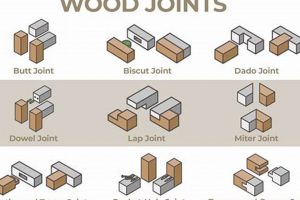
A method of joinery utilizes cylindrical pins, typically made of wood, to reinforce the connection between two workpieces. These pins, inserted into precisely drilled holes in both pieces, create a strong and accurate alignment, enhancing the joint’s overall stability. An example includes connecting two pieces of wood to form a tabletop, where several of these cylindrical fasteners are strategically placed to resist shear forces and maintain a flush surface.
This technique offers enhanced strength and precision compared to simpler joining methods. Its history spans centuries, with evidence of similar techniques used in ancient woodworking. The enduring appeal of this approach lies in its ability to create durable, aesthetically pleasing joints without the need for complex tools or extensive expertise. It results in a clean appearance, as the majority of the connection is concealed within the wood itself, ideal for furniture making and cabinet construction. It enhances structural integrity and extends the lifespan of the finished product.
The following sections will delve into the specifics of preparing and executing this type of wood joinery, examining optimal dowel selection, accurate hole placement, and best practices for achieving strong, reliable connections.
Essential Guidelines
Achieving robust and precise connections necessitates careful attention to detail throughout the process. The following guidelines outline critical aspects of executing this method effectively.
Tip 1: Dowel Selection: Employ dowels of appropriate material and grain orientation. Hardwood dowels, with grain running parallel to their length, offer superior strength and resistance to splitting.
Tip 2: Hole Diameter: Drill pilot holes slightly smaller than the dowel diameter. This ensures a tight, interference fit, maximizing the joint’s holding power. A difference of 0.2mm-0.5mm is generally recommended.
Tip 3: Hole Depth: Accurately measure and mark hole depth on both workpieces. Insufficient depth compromises joint strength, while excessive depth can weaken the surrounding wood.
Tip 4: Alignment Precision: Employ jigs or marking gauges to ensure accurate and consistent hole alignment between mating pieces. Misalignment significantly reduces joint integrity.
Tip 5: Glue Application: Apply wood glue liberally to both the dowel and the interior surfaces of the holes. This provides lubrication during insertion and creates a strong adhesive bond.
Tip 6: Clamping Pressure: Use clamps to apply even pressure across the joint during glue drying. This ensures intimate contact between surfaces and maximizes bond strength.
Tip 7: Dowel Length: Select dowel lengths that allow for sufficient penetration into both workpieces, typically extending slightly beyond half the combined thickness of the materials.
Adherence to these guidelines will significantly enhance the strength, accuracy, and longevity of wood assemblies. Implementing these techniques ensures a professional and structurally sound finished product.
The subsequent section will discuss common challenges and troubleshooting techniques related to creating this joint, further refining the user’s understanding and skill.
1. Dowel Material Selection

The selection of appropriate materials constitutes a foundational decision in executing reliable joinery. The chosen material directly influences the strength, stability, and longevity of the joint.
- Hardwood Dowels
Hardwood dowels, such as oak, maple, or birch, provide superior strength and resistance to shear forces. Their density and tight grain structure enhance the overall durability of the connection. An example includes using maple dowels in high-stress joints within chair construction, where they withstand significant weight and movement. The implications of using softer woods, like pine, in these applications can lead to joint failure over time.
- Softwood Dowels
While generally less robust than hardwood options, softwood dowels, such as pine or fir, are suitable for lighter-duty applications. These are often chosen for projects where aesthetics or ease of working are prioritized over ultimate strength. An example would be using pine dowels in a decorative box construction. However, when substantial weight or stress is involved, softwood alternatives are not recommended.
- Grain Orientation
The grain orientation of the dowel significantly affects its performance. Dowels with grain running parallel to their length exhibit greater tensile strength and resistance to splitting. Conversely, dowels with short grain or visible knots are prone to fracture under stress. Therefore, careful inspection and selection of dowels with straight, consistent grain patterns are critical for ensuring joint integrity.
- Manufactured Dowels
Beyond solid wood, manufactured composite dowels are available. These are often created from compressed wood fibers and resin. These offer consistent dimensions and can have enhanced moisture resistance compared to natural wood, making them suitable for environments with humidity fluctuations. An example is their use in kitchen cabinetry. However, their performance regarding strength should be evaluated on a case-by-case basis.
Ultimately, careful consideration of the material properties and intended application is essential when selecting materials. This decision directly impacts the resulting robustness of the joinery. Employing inappropriate materials undermines the integrity of the construction, regardless of the precision used in execution. Therefore, thoughtful material selection is a crucial component in successful outcomes.
2. Hole Alignment Accuracy

In the context of woodworking using cylindrical fasteners, the precision of hole alignment stands as a cardinal factor determining the structural integrity and aesthetic quality of the finished product. Deviations from accurate alignment compromise the intended strength and precision of the joint.
- Shear Strength Reduction
Misaligned holes introduce stress concentrations and reduce the effective bonding surface area. A joint designed to withstand significant shear forces relies on the fasteners being perfectly aligned to distribute the load evenly. If the holes are off, the fastener will be bent and the forces are concentrated on a smaller portion of the wood. This leads to premature failure. For example, a chair leg connected with this method and misaligned holes is prone to wobbling and eventual breakage.
- Assembly Difficulty and Stress
Incorrectly aligned holes necessitate forcing the members together, which induces stress into the wood surrounding the joint. This stress can lead to cracks, warping, or weakened bonds. An illustrative case involves a tabletop assembly where forcing misaligned components together creates visible gaps and long-term instability. The initial difficulty in assembly is a warning sign of future problems.
- Aesthetic Imperfections
Misalignment translates into visible gaps or uneven surfaces at the joint. This detracts from the overall aesthetic appeal of the piece. A cabinet door with misaligned fasteners will present an unprofessional appearance. This visible flaw undermines the perceived quality of the workmanship.
- Jig Use and Accuracy
Employing precision drilling jigs is crucial for ensuring consistent and accurate hole placement. Jigs provide a physical template, guiding the drill bit to the exact desired location. The use of self-centering jigs greatly simplifies the process and minimizes the potential for human error. A well-designed jig is an investment in accuracy, improving the quality and reliability of the finished piece.
The correlation between precise hole alignment and the overall effectiveness of woodworking joints cannot be overstated. Consistent accuracy achieved through careful measurement, marking, and the utilization of appropriate jigs directly contributes to superior joint strength, stability, and visual appeal. Neglecting this aspect compromises the entire assembly process.
3. Glue Application Consistency

The structural integrity of woodworking assemblies involving cylindrical fasteners is inextricably linked to the consistency of adhesive application. Inadequate or uneven distribution of adhesive introduces weak points, undermining the joint’s capacity to withstand stress. The primary purpose of wood glue in this context is to establish a robust bond between the dowel, the interior surfaces of the drilled holes, and the mating wood pieces. This bond serves to transfer loads effectively across the joint, preventing premature failure. An inconsistent glue line creates areas of reduced adhesion, concentrating stress in the remaining bonded regions. This is particularly crucial under shear forces, where the adhesive layer acts as a critical intermediary. Imagine a chair leg attached using this method; if sections of the dowel lack proper adhesive coverage, the leg is predisposed to loosen or break under normal use.
Achieving consistent adhesive application requires meticulous technique. Factors influencing success include the viscosity of the chosen adhesive, the method of application (e.g., brush, syringe, specialized glue applicators), and the surface preparation of the wood. High-viscosity adhesives may require more forceful application to ensure adequate penetration into the wood grain. A thin, even coat is more effective than a thick, uneven one. Furthermore, surface contaminants, such as dust or oil, impede the adhesive’s ability to form a strong bond. Consistent glue application is enhanced through use of glue spreaders or injectors that guarantee all surfaces are covered with the same amount of glue.
In conclusion, the bond strength of this type of wood joinery depends heavily on the consistency of glue application. Uneven distribution can lead to weakened joints and eventual failure. Proper technique, appropriate adhesive selection, and thorough surface preparation are all essential for achieving reliable and long-lasting results. Ignoring this aspect risks compromising the entire woodworking project, highlighting the practical significance of understanding and implementing best practices for adhesive application. To overcome this risk and ensure a strong joint, the use of glue injectors is highly recommended, as they cover and distribute the glue evenly in a thin layer.
4. Joint Clamping Pressure

In woodworking involving cylindrical reinforcement, the applied pressure during the adhesive curing phase constitutes a critical determinant of the joint’s ultimate strength and longevity. Proper clamping pressure ensures intimate contact between mating surfaces, facilitating optimal adhesive bonding and load transfer. Inadequate or excessive pressure can compromise the joint’s integrity, leading to premature failure.
- Adhesive Bond Optimization
Sufficient pressure forces the adhesive into the wood’s pores, maximizing mechanical interlocking and promoting a stronger bond. Inadequate pressure results in gaps and reduced contact area, diminishing the bond’s effectiveness. Consider a scenario where two boards are joined using this technique to form a table leaf. Insufficient clamping would leave voids in the glue line, causing the joint to weaken and eventually separate under stress. Optimal pressure ensures a continuous, gap-free adhesive layer.
- Component Alignment Maintenance
Clamping maintains precise alignment during the adhesive curing process. Cylindrical fasteners offer initial alignment, but clamping ensures the components remain fixed in their intended positions. Misalignment during curing introduces stress and reduces joint strength. For example, when assembling a cabinet frame, proper clamping prevents the frame from shifting, ensuring square corners and a stable structure.
- Glue Squeeze-Out Management
Appropriate clamping pressure encourages a controlled amount of adhesive squeeze-out, indicating sufficient adhesive coverage. Excessive squeeze-out suggests excessive pressure, potentially starving the joint of adhesive or damaging the wood fibers. Insufficient squeeze-out indicates inadequate pressure. A balance is required. The expelled glue should be removed before it dries. The squeezed-out glue indicates an adhesive coat with a correct thickness.
- Wood Fiber Compression Mitigation
Excessive clamping pressure can crush wood fibers, particularly in softer wood species, weakening the joint and creating an uneven surface. Judicious pressure distribution and the use of cauls (protective clamping blocks) are essential for preventing damage. For instance, clamping a delicate molding detail too tightly can deform the wood, compromising its aesthetic and structural integrity. Care should be taken to avoid deforming the wood fibers.
The application of appropriate clamping pressure is integral to achieving robust and reliable connections using cylindrical fasteners. Balancing the competing demands of adhesive bonding, component alignment, and wood fiber preservation requires careful consideration and technique. Neglecting this aspect can negate the benefits of precise dowel placement and adhesive selection, resulting in a structurally unsound and aesthetically compromised joint. The method of applying clamping pressure should be thought out to prevent any wood fibers from being damaged.
5. Dowel Diameter Precision
The dimensional accuracy of the cylindrical fastener represents a critical parameter influencing the integrity and performance of woodworking joints. Discrepancies in diameter, even seemingly minor, can profoundly affect joint strength, alignment, and overall aesthetic quality. Achieving consistent diameter within specified tolerances is therefore paramount for reliable and predictable outcomes.
- Interference Fit and Joint Strength
A precisely sized dowel, slightly larger than the drilled hole (resulting in an interference fit), generates compressive forces that enhance frictional resistance and bonding strength. Conversely, an undersized dowel results in a loose fit, diminishing the adhesive bond and reducing resistance to shear forces. For instance, in frame-and-panel construction, undersized fasteners may lead to panel rattle or joint separation over time. This close fit creates a more robust mechanical bond in addition to the adhesive bond.
- Alignment Control and Accuracy
Consistent diameter ensures accurate alignment of mating pieces during assembly. Variations in diameter can cause slight misalignments, resulting in uneven surfaces or visible gaps. A drawer front constructed with fasteners of inconsistent diameter might exhibit uneven gaps around the drawer box. This affects both the aesthetic appeal and the functional performance of the finished piece, and can cause sticking or difficulty opening and closing.
- Adhesive Film Thickness Optimization
Precise diameter control allows for optimization of adhesive film thickness. An ideal adhesive film thickness maximizes bonding strength. Too much space reduces the load bearing capacity. The proper size creates an appropriate squeeze-out. Variations in diameter can lead to inconsistent film thickness, compromising the adhesive bond. In a tabletop assembly, inconsistent dowel diameters can result in localized variations in the glue line, potentially weakening the joint in those specific areas, even with consistent glue application. The dowel must have a consistent surface to allow the adhesive to bond correctly.
- Manufacturing Tolerance and Consistency
Maintaining tight manufacturing tolerances for dowel diameter is crucial for ensuring consistent results across multiple joints. Variations in diameter across a batch of fasteners can lead to unpredictable joint performance. For example, in mass-produced furniture, inconsistencies in dowel diameter would result in variable joint strength and increased likelihood of defects. The manufacturing process must be controlled in order to guarantee proper diameter.
In summation, meticulous attention to diameter, and adherence to stringent manufacturing tolerances, are indispensable for achieving high-quality, reliable woodworking joints. The influence of dowel diameter extends beyond simple dimensional accuracy; it directly impacts the strength, alignment, and overall performance of the finished product, and is vital for structural and visual integrity.
6. Wood Grain Orientation

Wood grain orientation is a fundamental consideration in woodworking, directly influencing the strength, stability, and aesthetic properties of assembled components. In the context of cylindrical fastener joinery, understanding and strategically utilizing wood grain becomes crucial for maximizing joint performance and preventing structural weaknesses.
- Dowel Grain Direction and Shear Strength
The grain direction of the dowel relative to the applied force significantly affects shear strength. Dowels with grain running parallel to their length offer maximum resistance to shear stress. Using dowels with grain perpendicular to the force dramatically reduces strength and increases the risk of splitting. A chair leg joint, for instance, must utilize dowels with vertical grain to withstand the constant downward force. Failure to do so can lead to rapid joint degradation.
- Workpiece Grain Direction and Wood Movement
Wood expands and contracts primarily across the grain. When joining two pieces, aligning grain direction minimizes differential movement that can stress the fasteners. Joining pieces with opposing grain directions creates internal stresses as the wood responds to humidity changes. A tabletop constructed with boards having wildly varying grain orientation can exhibit cupping, warping, or joint failure over time. Careful selection and arrangement of boards mitigates these risks.
- End Grain vs. Face Grain Gluing
End grain, being more porous, absorbs more glue than face grain, but the resulting bond is generally weaker. When inserting cylindrical fasteners into end grain, adequate glue application and clamping pressure are essential to compensate for this weaker bond. Reinforcing the joint with additional joinery techniques may be necessary for high-stress applications. A mitered corner joint reinforced with dowels in end grain requires extra care to ensure a robust connection.
- Dowel Hole Placement and Wood Splitting
Drilling too close to the edge of a board, especially in weaker wood species, can cause splitting along the grain. Strategic fastener placement, respecting grain direction and distance from edges, prevents this. Pre-drilling pilot holes and using sharp drill bits minimizes stress on the wood fibers. When joining thin pieces, careful hole placement is critical to avoid compromising the material’s integrity. The hole placement should be assessed prior to drilling.
These considerations highlight the intricate relationship between wood grain and the efficacy of this joining technique. Understanding and accounting for grain direction, wood movement, and gluing properties, and appropriate hole placement are key to achieving strong, durable, and aesthetically pleasing woodworking projects. Ignoring these principles will inevitably lead to compromised structural integrity and premature joint failure.
7. Material Thickness Balance
The proportion of material thickness in relation to fastener dimensions is a critical factor influencing the success of woodworking joints. Adequate material thickness is essential to accommodate the diameter and depth of fastener holes without compromising structural integrity. In the context of woodworking joints utilizing cylindrical fasteners, an imbalance between material thickness and fastener size can lead to weakened joints, splitting, or aesthetic imperfections.
- Edge Distance and Splitting Risk
Insufficient material thickness around fastener holes reduces edge distance, increasing the risk of splitting during drilling or assembly. The thinner the material, the greater the chance that the pressure exerted by the fastener will cause the wood to crack along the grain. For instance, attempting to use a large diameter fastener in thin stock for cabinet face frames can result in unsightly splits, requiring repair or rejection of the component. Proper material thickness ensures sufficient wood surrounding the hole to resist splitting forces.
- Dowel Length and Material Support
The length of the cylindrical fastener should be proportional to the thickness of the materials being joined. Overly long fasteners in thin stock can protrude or require excessive countersinking, weakening the joint and creating aesthetic problems. Conversely, short fasteners in thick stock provide insufficient support. Consider a situation where thick table legs are attached to a thin apron using too-short fasteners; the resulting joint would be unstable and prone to failure under load. Material thickness dictates appropriate fastener length for optimal support.
- Joint Strength and Load Distribution
Material thickness affects the overall strength of the joint and its ability to distribute load effectively. Thin materials joined with relatively large fasteners may experience localized stress concentrations, leading to premature failure. Conversely, thick materials provide ample support for larger fasteners, enabling them to withstand greater forces. For example, constructing a bookcase with thin shelves supported by large diameter fasteners may result in shelf sag or fastener pull-out under the weight of books. Proper material thickness ensures balanced load distribution and sustained joint integrity.
- Aesthetic Proportions and Visual Harmony
Material thickness should be considered in relation to fastener size to achieve aesthetically pleasing proportions. Overly large fasteners in delicate components can appear visually jarring, while undersized fasteners may seem inadequate for supporting larger structures. The goal is to maintain visual harmony, with fastener size complementing the overall design. In furniture construction, carefully selecting fastener dimensions that harmonize with the material thickness contributes to a refined and professional appearance.
The interplay between material thickness and fastener dimensions profoundly influences the structural and aesthetic outcomes of joinery. Balancing these factors through careful planning and execution is essential for achieving strong, reliable, and visually appealing finished pieces. Ignoring this balance compromises the integrity of the construction and diminishes the longevity of the assembled article.
Frequently Asked Questions About Woodworking Dowel Joints
The following addresses common inquiries regarding the application and execution of woodworking using cylindrical fasteners, offering insights into best practices and potential challenges.
Question 1: What are the primary advantages of employing cylindrical fasteners in joinery?
Cylindrical fasteners offer enhanced joint strength compared to simpler methods, provide accurate alignment during assembly, and conceal the majority of the connection within the wood, creating a clean and aesthetically pleasing appearance.
Question 2: What types of wood are best suited for constructing woodworking dowel joints?
Hardwoods, such as oak, maple, and birch, are generally preferred for both dowels and workpieces due to their superior strength and resistance to splitting. Softwoods can be used for lighter-duty applications.
Question 3: How critical is hole alignment in achieving a strong and reliable joint?
Precise hole alignment is paramount. Misaligned holes reduce joint strength, introduce stress concentrations, and can create aesthetic imperfections. Jigs or marking gauges are recommended to ensure accuracy.
Question 4: What constitutes an ideal dowel fit within the drilled hole?
An interference fit, where the dowel is slightly larger than the hole, is ideal. This creates compressive forces that enhance frictional resistance and bonding strength. A difference of 0.2mm-0.5mm is generally recommended.
Question 5: How should wood glue be applied to ensure a robust bond in woodworking dowel joints?
Wood glue should be applied liberally to both the dowel and the interior surfaces of the holes, ensuring a thin, even coat. This provides lubrication during insertion and creates a strong adhesive bond.
Question 6: How much clamping pressure is necessary during the glue drying process?
Adequate clamping pressure is essential to ensure intimate contact between mating surfaces. Excessive pressure, however, can crush wood fibers, particularly in softer wood species. A balance is required, and cauls (protective clamping blocks) can be used to distribute pressure evenly.
In summary, successful implementation relies on precise execution, appropriate material selection, and a thorough understanding of the factors influencing joint strength and stability.
The subsequent section explores common troubleshooting scenarios and techniques for addressing challenges encountered while using woodworking dowel joints.
Woodworking Dowel Joints
This exploration has underscored the multifaceted nature of employing cylindrical fasteners in woodworking. Achieving robust and aesthetically pleasing assemblies requires meticulous attention to material selection, dimensional precision, glue application, clamping pressure, and grain orientation. The delicate balance between these elements dictates the joint’s capacity to withstand stress, maintain alignment, and resist long-term degradation. Mastery of these techniques empowers woodworkers to create durable and visually compelling structures.
Continued research and refinement of joinery methods, including innovative material pairings and advanced adhesive technologies, promise to further enhance the capabilities and broaden the applications of woodworking dowel joints. A commitment to precision and a deep understanding of material properties will remain the cornerstones of successful craftsmanship in this domain.