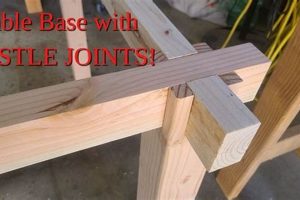
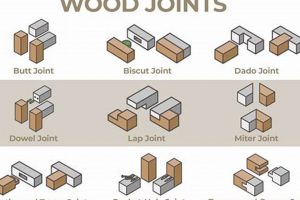
A structural technique creates a robust connection between two pieces of wood. This joint is formed by removing half the thickness of each piece at the point of intersection, allowing them to overlap and create a flush surface. A common application is in frame construction, where it adds significant strength to the corners while maintaining a clean, even appearance.
This type of joinery offers superior strength compared to butt joints, effectively resisting racking and shear forces. Its longevity stems from its ability to distribute stress across a larger surface area. Historically, it has been employed in furniture making, timber framing, and boat building, demonstrating its versatility and enduring value in woodworking.
Further exploration of this technique involves considerations such as selecting appropriate wood species, precise cutting methods, and the use of adhesives and fasteners to optimize its structural integrity. Subsequent sections will detail the tools, techniques, and considerations for creating effective versions of this joint.
Essential Considerations for Half Lap Joint Execution
The effective execution of this technique requires meticulous planning and precise craftsmanship. The following tips address critical aspects of the process, ensuring structural integrity and aesthetic appeal.
Tip 1: Wood Selection: Choose wood species with compatible grain patterns and densities to ensure uniform stress distribution across the joint. Avoid using dissimilar woods that may expand or contract at different rates, compromising joint stability.
Tip 2: Precise Measurement and Marking: Accurate measurements are paramount. Use sharp marking tools and a precise measuring device to delineate the areas to be removed. Errors in marking will result in misaligned or weakened joints.
Tip 3: Consistent Depth Control: Maintain a consistent cutting depth when removing material. Employ depth stops on saws or routers to ensure uniformity, resulting in a flush and structurally sound connection.
Tip 4: Square Cuts: Verify that cuts are square to the face of the material. Inconsistent angles can lead to gaps and reduced surface contact, negatively impacting joint strength.
Tip 5: Dry Fit Prior to Glue Application: Always perform a dry fit to assess the accuracy of the joint before applying adhesive. This allows for corrections and adjustments to be made without compromising the final assembly.
Tip 6: Adhesive Selection and Application: Use a high-quality wood adhesive appropriate for the wood species being joined. Apply a uniform layer to both surfaces, ensuring adequate coverage for a strong bond.
Tip 7: Clamping Pressure: Apply even clamping pressure during the adhesive curing process. Excessive pressure can starve the joint of adhesive, while insufficient pressure can result in weak bonds. Use cauls to distribute pressure evenly.
Accurate execution of these considerations will yield joints that exhibit both structural robustness and aesthetic refinement, enhancing the quality and longevity of woodworking projects.
The subsequent sections will further explore advanced techniques and applications, reinforcing the importance of this foundational skill.
1. Strength Distribution

The efficiency of a structural connection is intrinsically linked to its ability to distribute loads evenly across its surfaces. A characteristic feature of one technique is its large gluing area and interlocking design, contributing significantly to enhanced load distribution. Instead of concentrating stress at a single point, the overlapping surfaces spread the load, minimizing the risk of failure under pressure or strain. This characteristic makes it particularly well-suited for applications where structural integrity is paramount, such as in load-bearing framework or furniture construction where joints are subjected to significant forces.
Consider a table leg attached to a tabletop using only butt joints. The stress is concentrated on the end grain of the leg, making it prone to breakage with lateral force. By contrast, a joint utilizing this structural technique distributes the load along the entire length of the overlap, providing far greater resistance to racking and shear forces. Similarly, in large-scale timber framing, these techniques are used extensively to join beams and posts, ensuring the overall stability and longevity of the structure.
Understanding the relationship between joint design and load distribution is crucial for any woodworker aiming to create durable and structurally sound projects. By optimizing the surface area and ensuring a tight fit, the load can be distributed effectively, leading to increased joint strength and a reduced risk of failure. The correct execution of this joining method leads to significant enhancement in structural strength in the finished product.
2. Surface Alignment

Surface alignment is a critical determinant of structural integrity and aesthetic quality in woodworking. In the context of a technique such as the specified joinery method, any deviation from perfect alignment directly impacts the joint’s load-bearing capacity and visual appeal. Misalignment introduces stress concentrations, weakening the overall connection and increasing the likelihood of failure under load. An example of this can be seen in table construction; if the aprons are not perfectly aligned with the legs, the table will be wobbly and unstable. The visual imperfections are immediately apparent, detracting from the overall quality of the piece.
Achieving optimal alignment requires precise measurement, accurate cutting, and careful assembly. The use of jigs and fixtures can aid in maintaining consistency and reducing errors. Furthermore, the woodworker must account for potential variations in material thickness and adjust their techniques accordingly. The impact of even minor misalignments is amplified over time, as stresses accumulate and the joint is subjected to environmental factors such as humidity and temperature fluctuations. Therefore, attention to surface alignment is an investment in the longevity and durability of the project.
In summary, surface alignment is not merely an aesthetic concern but a fundamental requirement for a structurally sound and visually pleasing joint. Diligence in achieving proper alignment, through meticulous craftsmanship and the application of appropriate techniques, is essential for realizing the full potential of this particular joining method. Imperfect alignment can lead to rapid joint failure under stress.
3. Cutting Precision

In the realm of woodworking, achieving dimensional accuracy is paramount, nowhere more so than when executing the specified joining method. The success of this technique hinges directly on the precision of each cut, as even minor deviations can compromise the joint’s integrity and visual appeal.
- Depth Consistency
Maintaining a uniform cutting depth is crucial for achieving a flush surface. Inconsistent depth leads to uneven load distribution and potential weakness. For example, if one piece is cut slightly deeper than the other, the resulting joint will not sit flush, creating a stress point. Utilizing depth stops on saws and routers helps to ensure depth consistency, leading to a stronger, more aesthetically pleasing result.
- Squareness of Cuts
Ensuring that cuts are perfectly square to the face of the wood is essential for achieving tight-fitting joints. Non-square cuts create gaps and reduce the surface area available for gluing, significantly weakening the bond. A speed square or combination square should be used to meticulously mark and check the squareness of cuts before proceeding with assembly. Failure to achieve squareness results in a compromised structural integrity, rendering the piece more prone to failure.
- Accurate Measurement and Marking
Precise measurements and markings are fundamental to cutting accuracy. Using a sharp marking knife rather than a pencil allows for finer lines and reduces the risk of parallax errors. Accurate measurements ensure that the two halves of the joint interlock perfectly, maximizing surface contact and strength. Consider the consequences of inaccurate measurement: a joint that is too loose will be weak, while a joint that is too tight may be impossible to assemble without causing damage.
- Clean, Crisp Edges
The quality of the edges is an indicator of cutting precision. Clean, crisp edges provide optimal surface area for glue adhesion and ensure a tight fit. Tear-out, splintering, or fuzzy edges compromise the bond and detract from the joint’s appearance. Sharp blades, appropriate feed rates, and backing boards when cutting across the grain are essential for achieving clean edges. The presence of tear-out along the edges indicates a lack of precision, directly impacting the structural integrity of the joint.
These facets of cutting precision, while seemingly disparate, are interconnected and collectively determine the success of the method. A failure in any one area can undermine the entire process, highlighting the necessity for meticulous attention to detail and rigorous adherence to best practices. The strength and longevity of the constructed piece are therefore direct outcomes of exacting cut precision, ensuring structural stability and refined aesthetic appeal.
4. Adhesive Bond

The adhesive bond is a critical component in the successful execution of a woodworking half lap joint, significantly impacting its overall strength and longevity. While the mechanical interlock of the overlapping wood pieces provides initial stability, the adhesive fills gaps, distributes stress, and prevents movement that can lead to joint failure. A weak or improperly applied adhesive bond negates many of the advantages offered by the geometric design. For instance, consider a bookcase constructed with this type of joinery. Without a robust adhesive bond, the shelves may sag or separate under the weight of books, compromising the structure’s functionality and appearance. Similarly, in frame construction, inadequate adhesive can result in corner separation, leading to structural instability.
Adhesive selection plays a crucial role in ensuring a strong and durable bond. Different wood species possess varying densities and porosity, requiring adhesives with specific properties to achieve optimal penetration and adhesion. Polyvinyl acetate (PVA) adhesives are commonly used for general woodworking applications, while polyurethane adhesives offer superior water resistance and gap-filling capabilities. Epoxy resins are employed when high strength and chemical resistance are required. Furthermore, proper surface preparation is essential for maximizing adhesive effectiveness. Surfaces must be clean, dry, and free from contaminants such as dust, oil, and wax. The application method, clamping pressure, and curing time must also be carefully controlled to ensure a complete and uniform bond. Failure to address any of these factors can significantly reduce the adhesive bond’s strength, rendering the joint vulnerable to failure.
In conclusion, the adhesive bond is not merely an ancillary element but an integral aspect of a woodworking half lap joint. Its proper selection, application, and curing are essential for realizing the full potential of this joinery technique. While the mechanical advantages of the joint design contribute to its inherent strength, the adhesive bond provides the necessary cohesion and stability to withstand stress, prevent movement, and ensure long-term structural integrity. Challenges such as selecting the appropriate adhesive for specific wood species and environmental conditions must be addressed to optimize the joint’s performance. Proper management of this critical detail solidifies its role in long-lasting furniture and structural elements.
5. Material Compatibility

Material compatibility is a foundational consideration when constructing a half lap joint. The successful performance and longevity of this joint rely significantly on the physical and mechanical properties of the wood species employed and their interactions within the assembled structure. Mismatched materials can lead to premature joint failure due to differential expansion, contraction, or varying levels of strength.
- Coefficient of Thermal Expansion
Different wood species exhibit varying coefficients of thermal expansion, indicating their propensity to expand or contract with temperature fluctuations. When dissimilar wood species are joined using a half lap joint, these differential movements can induce significant stress, potentially weakening the adhesive bond or causing structural deformation. An example of this is the long term stress due to this thermal activity can ruin the bonding between two pieces of wood.
- Moisture Content and Dimensional Stability
Wood is hygroscopic, meaning it absorbs and releases moisture from the surrounding environment. This moisture exchange causes dimensional changes, primarily across the grain. Using woods with significantly different moisture content or dimensional stability in a half lap joint can lead to warping, cracking, or separation. This issue is very important when designing a table with the specified joinery.
- Density and Hardness
The density and hardness of the wood species influence the joint’s resistance to wear and tear. Joining a dense, hard wood with a softer, less dense wood in a half lap joint can create an imbalance in strength, leading to uneven stress distribution and potential failure of the weaker material. For example, a half lap joint connecting a soft pine shelf to a hardwood frame may see the pine compress under load before the hardwood yields, leading to joint instability.
- Grain Orientation and Wood Movement
Grain orientation influences the direction and magnitude of wood movement. When using a half lap joint, aligning the grain of both pieces parallel to each other can minimize the effects of wood movement and maintain the joint’s integrity. Conversely, crossing the grain can exacerbate the effects of expansion and contraction, leading to joint distortion or failure. The orientation of the wood, with the specified joinery, has a direct connection to its long-lasting ability.
These interconnected factors underscore the importance of careful material selection when employing a half lap joint. A thorough understanding of the physical and mechanical properties of different wood species, and their potential interactions within the joint, is essential for ensuring structural integrity, aesthetic appeal, and long-term durability. Ignoring material compatibility can negate the advantages of the joinery technique, resulting in costly repairs or premature failure.
6. Structural Longevity

Structural longevity, referring to the ability of a constructed element to maintain its integrity and functionality over an extended period, is inextricably linked to the careful execution of woodworking half lap joints. The half lap, characterized by its interlocking design where half the material thickness is removed from each joining piece, inherently distributes stress across a larger surface area compared to simple butt joints. This expanded contact area minimizes stress concentration points, thereby mitigating the risk of premature failure and contributing significantly to the joint’s long-term stability. The meticulous creation of this joint, employing precise measurements and accurate cuts, forms the foundation for its enduring performance. For instance, in antique furniture where half lap joints were skillfully employed, the continued structural soundness after centuries of use exemplifies the connection between skilled execution and lasting durability. This contrasts with less robust joinery methods that often exhibit signs of degradation and failure within a much shorter timeframe.
The selection of appropriate wood species further impacts structural longevity. Wood, being a hygroscopic material, expands and contracts with changes in humidity. When employing half lap joints, it is crucial to consider the wood’s stability and its resistance to decay. The use of decay-resistant woods such as cedar or redwood in outdoor applications, coupled with properly executed half lap joints, ensures the structure’s ability to withstand environmental stressors. Conversely, using less durable woods in high-moisture environments can lead to rot and subsequent joint failure, irrespective of the precision employed in its construction. The strategic application of adhesives also plays a critical role in promoting structural longevity. High-quality adhesives not only bond the wood surfaces but also fill gaps and create a moisture barrier, preventing water penetration and inhibiting the growth of decay-causing organisms. The combined effect of proper wood selection, adhesive application, and precise joint construction guarantees that the structure can withstand the demands of its intended environment for a prolonged period.
In summary, structural longevity in woodworking is a direct consequence of the cumulative effects of meticulous planning, material selection, precise execution, and appropriate adhesive application when employing half lap joints. The inherent design of the joint, coupled with the right materials and techniques, distributes stress, minimizes the risk of decay, and enhances the joint’s resistance to environmental stressors. Achieving optimal structural longevity requires a comprehensive understanding of the wood’s properties, the adhesive’s characteristics, and the principles of joint construction. Neglecting any of these factors can compromise the joint’s long-term performance, underscoring the importance of a holistic approach to woodworking. Therefore, prioritizing structural longevity is not merely a matter of aesthetics but a fundamental principle for creating durable and functional woodworking projects that can withstand the test of time.
Frequently Asked Questions
This section addresses common inquiries regarding the construction, application, and considerations associated with half lap joints in woodworking.
Question 1: What defines a woodworking half lap joint?
It is a joinery technique where half the thickness of each piece is removed at the intersection, creating an overlapping, flush connection.
Question 2: What are the primary advantages of utilizing this particular joint over other joining methods?
It offers superior strength compared to butt joints, distributes stress efficiently, and maintains a flush surface, ideal for applications requiring both structural integrity and aesthetic appeal.
Question 3: What wood characteristics are most important when executing this technique?
Density, grain orientation, and stability are crucial considerations to ensure uniform stress distribution and prevent warping or separation over time.
Question 4: What adhesives are best suited for maximizing the strength of a woodworking half lap joint?
High-quality polyvinyl acetate (PVA) adhesives are commonly used, while polyurethane and epoxy resins offer enhanced water resistance and strength for specific applications.
Question 5: What are the common pitfalls to avoid when constructing this joint?
Inaccurate measurements, inconsistent cutting depths, and insufficient clamping pressure during adhesive curing are common mistakes that can compromise joint strength and longevity.
Question 6: In what applications is this joint most effectively utilized?
It is frequently employed in frame construction, furniture making, and timber framing where strong, flush connections are required to withstand racking and shear forces.
Mastering this technique requires a deep understanding of material properties, adhesive science, and the principles of structural mechanics. Precision and attention to detail are paramount.
The subsequent section explores advanced techniques and troubleshooting tips to further refine expertise in this fundamental woodworking skill.
Conclusion
This exploration has elucidated the intricacies of the woodworking half lap joint, detailing its construction, material considerations, and adhesive requirements. Emphasis has been placed on the importance of precision in measurement and cutting, as well as the selection of compatible wood species. The benefits of this joint, including its superior strength and flush surface, render it a valuable technique in diverse woodworking applications.
Mastery of the woodworking half lap joint represents a fundamental skill for achieving robust and aesthetically pleasing results. Its continued application, driven by a commitment to meticulous craftsmanship, will ensure enduring quality in both functional and artistic woodworking endeavors. Further independent exploration of joint variations and advanced techniques is encouraged to maximize its potential in diverse projects.