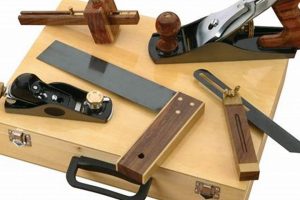
The practice involves shaping and joining wood using hand tools exclusively. Examples include sawing, chiseling, and planing wood manually to create furniture, decorative objects, or structural components without the aid of electricity or other external power sources.
This method fosters a deeper connection with the material, promoting precision and control unattainable with motorized equipment. It offers a quieter, cleaner working environment, and reduces reliance on energy consumption. Historically, this was the only method of woodworking, resulting in craftsmanship celebrated for its detail and longevity.
Subsequent discussions will address the selection of appropriate hand tools, techniques for achieving accurate cuts and joints, strategies for efficient workflow, and considerations for wood selection in this specialized craft. Emphasis will be placed on acquiring skills and understanding the nuances of working wood by hand.
Tips for Hand Tool Woodworking
Achieving success with woodworking hand tools requires careful planning, precise execution, and a commitment to developing fundamental skills. The following recommendations aim to improve accuracy and efficiency in the absence of power assistance.
Tip 1: Sharpen Tools Regularly. Sharpness is paramount. Dull tools require excessive force, leading to inaccurate cuts and increased fatigue. Invest in quality sharpening equipment and develop a consistent sharpening routine.
Tip 2: Use High-Quality Wood. The consistency and stability of the wood greatly influence the outcome. Opt for hardwoods that are properly seasoned and free of knots or significant imperfections. This minimizes the likelihood of splitting or warping during shaping.
Tip 3: Practice Layout and Marking. Precision begins with accurate marking. Employ sharp knives and marking gauges to establish clear and precise guidelines for cuts and joinery. Double-check measurements before committing to any cuts.
Tip 4: Secure Workpieces Firmly. A stable workpiece is essential for safe and accurate work. Use a robust workbench with effective clamping systems to prevent movement during sawing, planing, or chiseling.
Tip 5: Prioritize Proper Body Mechanics. Maintaining correct posture and using the entire body to generate force reduces strain and increases efficiency. Avoid relying solely on arm strength; engage core muscles and use leverage effectively.
Tip 6: Learn to Read the Grain. Understanding wood grain direction is crucial for achieving clean cuts and avoiding tear-out. Always work with the grain, especially when planing or chiseling delicate areas.
Tip 7: Master Basic Joinery Techniques. Strong, well-fitted joints are the foundation of durable woodworking. Focus on mastering fundamental joinery methods like mortise-and-tenon, dovetail, and rabbet joints, ensuring tight and precise fits.
Consistent application of these techniques will enhance accuracy, reduce errors, and ultimately improve the quality of handcrafted woodworking projects. A mindful approach to hand tool woodworking yields rewards in craftsmanship and personal satisfaction.
The succeeding sections will explore advanced techniques and project ideas, further illustrating the capabilities and creative potential of woodworking with only hand tools.
1. Hand Tool Selection

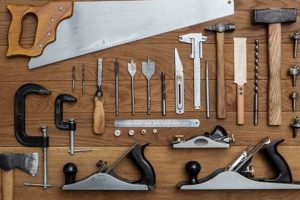
In woodworking using only manual implements, the assortment of tools available determines the scope and quality of potential outcomes. Choosing appropriate instruments forms the foundation of effective and efficient project execution.
- Saws: Rip, Crosscut, and Specialty
Rip saws are designed to cut along the grain of the wood, while crosscut saws are for perpendicular cuts. Specialty saws, such as dovetail saws or coping saws, are tailored for intricate work or specific joint types. Selecting the correct saw significantly impacts the accuracy and ease of cutting.
- Planes: Smoothing, Jack, and Block
Planes are used for shaping and smoothing wood surfaces. Smoothing planes refine surfaces for a polished appearance; jack planes are versatile for general shaping, and block planes excel at end-grain work. The appropriate plane ensures flat, even surfaces and precise shaping.
- Chisels: Beveled Edge and Mortise
Beveled edge chisels are used for general shaping and detail work, while mortise chisels are designed for creating deep, rectangular mortises. Correct chisel selection is crucial for clean, accurate joinery and decorative carving.
- Measuring and Marking Tools: Squares, Gauges, and Knives
Accurate measurement and marking are critical for precise woodworking. Squares ensure right angles, marking gauges establish parallel lines, and marking knives create crisp, defined layout lines. These tools contribute to the overall accuracy and fit of components.
The deliberate selection of suitable hand tools, therefore, directly influences the precision, efficiency, and quality attainable in woodworking when powered equipment is excluded. Each instrument’s specific function and design contribute uniquely to shaping and assembling wood into functional and aesthetically pleasing objects.
2. Sharpening Proficiency

In woodworking where no power tools are utilized, sharpening proficiency stands as a non-negotiable skill. The sharpness of the cutting edge dictates the efficiency, accuracy, and safety of every operation. Dull tools require excessive force, compromising control and increasing the likelihood of errors or injury.
- Effort Reduction
A honed edge minimizes the force required to sever wood fibers. This reduction in effort allows for greater control, particularly in detailed work, and reduces physical fatigue over extended periods of use. An example is planing a surface; a sharp blade produces consistent shavings with minimal resistance, while a dull blade chatters and requires significant downward pressure.
- Cut Precision and Finish Quality
Sharp tools sever wood fibers cleanly, resulting in smoother cuts and reduced tear-out. This is particularly critical when working with hardwoods or creating joinery. For example, a razor-sharp chisel enables the creation of clean, tight-fitting dovetails without ragged edges or gaps.
- Safety Enhancement
Contrary to intuition, sharp tools are safer than dull ones. Sharp edges engage the material readily, reducing the chance of slippage and unexpected movements. A dull tool requires excessive force to initiate a cut, increasing the risk of losing control. Controlled cuts inherently reduce the risk of injury.
- Wood Grain Management
Proficient sharpening allows for the creation of customized edge geometries to suit different wood types and grain orientations. A finely honed, slightly cambered blade, for instance, is ideal for minimizing tear-out when planing figured woods. This level of control is unobtainable with dull or improperly sharpened tools.
The cumulative effect of these facets highlights the indispensable nature of sharpening proficiency in woodworking when powered implements are absent. It is not merely a skill, but a prerequisite for achieving quality, precision, and safety. Mastery of sharpening techniques directly correlates with the ability to execute intricate designs and enduring pieces.
3. Joinery Precision

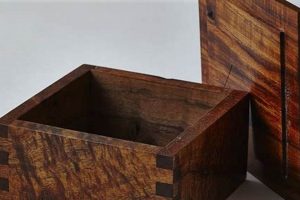
The absence of power tools in woodworking necessitates a heightened emphasis on joinery precision. The reliance on hand tools demands that joints be executed with exacting accuracy, as there is no mechanical force to compensate for imprecision. Any deviation from correct angles or dimensions directly affects the structural integrity and aesthetic appeal of the finished piece. This constraint inherently elevates the importance of skill and meticulousness in the joinery process. For instance, a hand-cut dovetail joint, crafted without power assistance, requires precise sawing and chiseling to achieve a tight, interlocking fit. Failure to do so results in a weakened joint susceptible to failure under stress.
Achieving precision in joinery with hand tools involves several factors. First, the sharpness and maintenance of tools are paramount. Dull tools necessitate greater force, leading to uncontrolled cuts and potential inaccuracies. Second, the mastery of layout techniques, including the use of marking gauges and sharp knives, ensures accurate transfer of dimensions and angles. Finally, the development of muscle memory through repeated practice allows for consistent and precise execution. A craftsman might spend years perfecting the mortise and tenon joint, gradually refining technique to achieve minimal gaps and maximum strength entirely through hand-tool methods. The inherent slowness of hand-tool work fosters deliberation and careful attention to detail, which positively impacts accuracy.
Therefore, joinery precision is not merely a desirable attribute in woodworking without power tools; it is a fundamental requirement for success. The reliance on manual techniques demands a deeper understanding of wood behavior, meticulous attention to detail, and the mastery of hand-tool skills. The challenges associated with this approach yield outcomes characterized by durability, craftsmanship, and a tangible connection between the artisan and the work, standing as testaments to the rigor and reward of this method.
4. Wood Grain Awareness

Wood grain awareness constitutes a pivotal skill in woodworking devoid of power tools. The unidirectional structure of wood fibers dictates its behavior under stress and during shaping. Ignorance of grain direction leads to tear-out, splitting, and inaccuracies that are difficult, if not impossible, to correct when relying solely on hand tools. The reliance on manual force amplifies the effects of grain direction, making its understanding paramount for achieving clean cuts, smooth surfaces, and strong joinery. For example, attempting to plane against the grain results in a chattering, uneven surface that requires significantly more effort to rectify with hand planes compared to working with the grain.
The practical significance of this awareness extends to every facet of the woodworking process. When sawing, cutting with the grain requires less effort and produces a cleaner edge, while cutting against the grain can cause the saw to bind and deviate from the intended line. When chiseling, recognizing grain direction prevents splitting and ensures precise removal of material. Moreover, knowledge of grain orientation is critical in joint design. Orienting grain direction strategically within a joint maximizes strength and resistance to stress. A mortise and tenon joint, for instance, benefits from aligning the grain of the tenon with the direction of force applied to the joint, preventing shearing.
Ultimately, wood grain awareness is not merely a theoretical understanding but a practical necessity in hand-tool woodworking. Its mastery allows the woodworker to anticipate the material’s response to shaping and joining, resulting in efficient, accurate, and aesthetically pleasing outcomes. The challenges inherent in hand-tool work underscore the importance of this knowledge, as mistakes are more difficult to rectify without the assistance of powered equipment. This understanding connects directly to the broader theme of craftsmanship, where skill and knowledge are intertwined to create enduring and functional objects.
5. Physical Endurance

Manual woodworking fundamentally requires substantial physical exertion. The absence of powered assistance places the burden of force generation and sustained effort directly on the practitioner. Sawing, planing, chiseling, and other shaping operations necessitate repetitive motions and the application of significant muscle power. Extended periods spent standing, bending, and manipulating tools contribute to physical fatigue. The demands on the musculoskeletal system are considerable, impacting both immediate performance and long-term physical well-being. An individual constructing a large timber frame structure entirely by hand, for example, must possess the capacity to swing a mallet and drive chisels for extended durations, day after day. The cumulative effect of these activities directly influences project completion time and the quality of workmanship.
The development of physical endurance in this context involves more than raw strength. Techniques for efficient movement, proper body mechanics, and strategic pacing are crucial for mitigating fatigue and preventing injury. Correct posture, utilizing core muscles for stability, and leveraging body weight to generate force can significantly reduce strain on individual muscle groups. The practice of alternating between tasks, incorporating regular breaks, and maintaining a well-conditioned physique further enhance physical resilience. For instance, a woodworker might alternate between sawing tasks, which heavily engage the arms and shoulders, and planing tasks, which distribute the workload more evenly across the body, allowing for periods of relative rest for specific muscle groups. Proper nutrition and hydration also play a key role in sustaining energy levels and promoting muscle recovery.
Therefore, physical endurance is not merely a peripheral consideration but an integral component of woodworking that excludes powered equipment. The capacity to sustain physical effort, combined with the strategic application of technique and physical conditioning, determines the scope and quality of achievable projects. Recognizing and addressing the physical demands of this craft is essential for long-term participation and for realizing the full potential of hand-tool woodworking.
Frequently Asked Questions
This section addresses common inquiries regarding the practice of woodworking using only manual implements, providing clarity on scope, methods, and expected outcomes.
Question 1: What defines “woodworking no power tools”?
This refers to shaping and joining wood using only hand-operated tools, excluding electrically powered, pneumatic, or gasoline-driven equipment. Techniques include sawing, planing, chiseling, and hand-driven fastening methods.
Question 2: Is it feasible to create complex projects solely with hand tools?
Yes, while requiring greater time and skill, intricate furniture, detailed carvings, and large-scale timber structures are achievable. Historical examples demonstrate the capabilities of hand-tool woodworking.
Question 3: What are the primary advantages of excluding power tools in woodworking?
Benefits include reduced noise pollution, lower energy consumption, enhanced control over material removal, and a deeper connection with the craft and materials.
Question 4: What are the fundamental tools required to begin woodworking without power tools?
Essential items include a rip saw, crosscut saw, jack plane, smoothing plane, a set of chisels (beveled edge and mortise), a marking gauge, a square, and sharpening equipment.
Question 5: How does the absence of power tools affect project timelines?
Project completion typically requires more time compared to power-tool-assisted methods. Each operation demands deliberate execution and may involve multiple passes or adjustments.
Question 6: What considerations are important to physical safety when woodworking without power tools?
Maintaining sharp tools, securing workpieces firmly, employing proper body mechanics, and taking frequent breaks are crucial for preventing injuries and minimizing fatigue.
In summary, woodworking by hand prioritizes skill, precision, and physical exertion. While more demanding, this approach provides heightened material control and a closer connection with the craft.
The following article section will explore project ideas well-suited for execution using only manual woodworking techniques.
Conclusion
This exploration has examined the methods, challenges, and rewards inherent in woodworking no power tools. Key facets highlighted include tool selection and maintenance, joinery precision, wood grain awareness, and physical endurance. The discussion addressed fundamental techniques and common inquiries, establishing the framework for understanding the nuances of manual woodworking.
The choice to pursue woodworking through solely manual means represents a deliberate commitment to craftsmanship and skill. Its importance lies not only in the creation of functional objects but also in the preservation of traditional techniques. The continued practice of woodworking no power tools ensures the longevity of these skills and fosters a deeper appreciation for the relationship between the artisan, the material, and the finished piece.