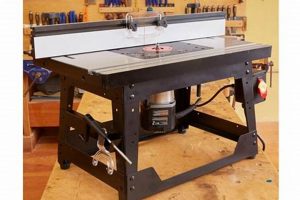
The flat, horizontal surface designed for activities related to shaping and joining pieces of lumber is a central element in any carpentry workspace. This surface provides a stable and reliable area for performing tasks such as cutting, sanding, assembling, and finishing wood projects. For instance, a craftsman might use this surface to construct a dovetailed drawer or assemble a complex cabinet.
The presence of a dedicated surface significantly improves precision and efficiency in woodcraft. Its robust construction offers crucial support, preventing movement during intricate work. Historically, these surfaces were often simple, utilizing readily available materials. However, modern iterations incorporate advanced features such as integrated clamping systems, embedded measuring tools, and dust collection capabilities, enhancing both the accuracy and safety of woodworking processes. These advancements contribute to higher quality results and a more streamlined workflow.
The following sections will delve into the diverse materials suitable for constructing these surfaces, explore considerations for optimal sizing and height, and examine essential features that contribute to enhanced functionality and longevity. Further discussion will cover effective maintenance practices to ensure years of reliable service and safety precautions to minimize potential hazards during operation.
Essential Considerations for Woodworking Surfaces
The following guidelines provide critical insight for selecting, constructing, or maintaining a surface optimized for woodworking tasks. These tips emphasize safety, precision, and longevity.
Tip 1: Material Selection is Paramount: Hardwoods like maple and birch offer superior durability and resistance to dents and scratches compared to softwoods. When selecting a material, consider the intended frequency and intensity of use.
Tip 2: Ensure Adequate Dimensions: The surface area should accommodate the largest projects anticipated. Insufficient space compromises accuracy and can lead to instability during complex assemblies.
Tip 3: Prioritize a Flat and Stable Foundation: A warped or uneven plane introduces inaccuracies that propagate through the entire project. Regular checks with a straightedge are essential, and shimming the base may be necessary.
Tip 4: Integrate a Robust Clamping System: The ability to securely fix workpieces is crucial for precision cutting, routing, and joinery. Options range from simple bench dogs to more sophisticated vise configurations.
Tip 5: Regularly Inspect and Maintain the Surface: Clean spills immediately and address any imperfections such as dents or gouges promptly. A well-maintained surface contributes to both safety and accuracy.
Tip 6: Ground Electrical Equipment Properly: Woodworking equipment often involves power tools, and a properly grounded workstation is essential to prevent electrical shock hazards.
Tip 7: Consider Integrated Dust Collection: Sawdust accumulation poses a health hazard and reduces visibility. Incorporating a dust collection system keeps the workspace clean and improves air quality.
Tip 8: Ergonomics Matter: The height of the surface should allow for comfortable work posture, reducing strain and fatigue during extended periods. Adjust the height to suit individual preferences and common tasks.
Adhering to these guidelines ensures a safer, more efficient, and more rewarding woodworking experience. A properly configured surface is fundamental to achieving professional-quality results.
The subsequent section will explore specific methods for constructing a durable and functional surface, covering design considerations and best practices for achieving a long-lasting and reliable workstation.
1. Surface Material

The selection of surface material is fundamental to the performance and longevity of a woodworking table. The material directly impacts the surface’s ability to withstand the rigors of woodworking, influencing factors such as resistance to impact, stability under varying environmental conditions, and ease of maintenance. Careful consideration of these material properties is essential for optimizing the functionality of a woodworking table.
- Hardwood Composition and Durability
Hardwoods, such as maple, birch, and beech, are frequently chosen for woodworking table surfaces due to their density and resistance to dents and scratches. A maple surface, for instance, can endure repeated impacts from mallets and chisels without significant damage, maintaining a smooth and consistent plane. This durability translates directly into a longer lifespan and reduced maintenance requirements for the table.
- Softwood Considerations and Limitations
While softwoods like pine and fir are less expensive and easier to work with, their lower density makes them more susceptible to damage. A softwood surface is prone to dents from dropped tools and can be easily marred by abrasive materials. While softwoods might be suitable for light-duty tasks, they are generally not recommended for high-intensity woodworking due to their limited durability.
- Engineered Wood Products and Stability
Engineered wood products, such as MDF (Medium Density Fiberboard) and plywood, offer advantages in terms of dimensional stability. These materials are less prone to warping and twisting compared to solid wood, particularly in environments with fluctuating humidity. A plywood surface, for example, can maintain its flatness over time, ensuring consistent accuracy during cutting and assembly operations.
- Surface Treatment and Protection
Regardless of the base material, the application of a protective finish significantly enhances the surface’s resistance to moisture, stains, and abrasion. A polyurethane coating, for instance, can create a durable barrier against spills and prevent wood from absorbing moisture, which can lead to warping. Proper surface treatment is critical for preserving the integrity and appearance of a woodworking table over its lifespan.
The choice of surface material profoundly affects the usability and longevity of any woodworking table. Selecting a material that balances durability, stability, and workability is crucial for creating a surface that can withstand the demands of woodworking and provide a reliable platform for crafting projects. The appropriate material ensures the surface remains a valuable asset in the workshop for years to come.
2. Dimensional Stability

Dimensional stability, in the context of a woodworking table surface, refers to the material’s ability to maintain its original shape and size despite changes in environmental conditions, particularly temperature and humidity. The relationship between dimensional stability and the performance of a woodworking table is direct: a lack of stability introduces inaccuracies that negatively impact the precision of woodworking operations. For example, if the table’s surface warps or twists due to moisture absorption, any joinery performed on that surface will be compromised, leading to misaligned components and weakened structures. In essence, a dimensionally unstable surface becomes a source of error, undermining the craftsman’s skill and the project’s integrity.
The significance of dimensional stability extends to the longevity of the woodworking surface. Repeated expansion and contraction caused by fluctuating humidity levels can weaken the wood’s internal structure, leading to cracks, splits, and eventual failure. This is particularly problematic with solid wood surfaces. Engineered wood products, such as MDF or plywood, often exhibit superior dimensional stability compared to solid wood because their layered construction minimizes the effects of moisture-induced expansion and contraction. However, even these materials are not immune and must be protected with appropriate finishes and maintained in a stable environment. Practical application of this understanding involves selecting materials with known stability characteristics, applying moisture-resistant finishes, and controlling the humidity levels in the workspace to minimize dimensional changes.
In summary, dimensional stability is a critical attribute of a woodworking surface. Its absence results in decreased accuracy and reduced lifespan. The challenges associated with maintaining stability necessitate careful material selection, proper finishing techniques, and environmental control. Understanding the interplay between dimensional stability and the woodworking environment is essential for constructing or selecting a surface that can reliably support precise and durable woodworking projects. Therefore, choosing dimensionally stable components is paramount.
3. Clamping Options

The integration of effective workholding systems within the surface is critical to the functionality of a woodworking table. The ability to securely restrain workpieces directly influences the precision, safety, and efficiency of woodworking operations.
- Bench Dog Systems and Versatility
Bench dogs, typically cylindrical pegs inserted into holes on the table surface, provide a flexible method for securing work. Their placement allows for clamping workpieces of varying shapes and sizes. A series of bench dog holes, combined with a vise, enables the user to apply controlled pressure across a wide area. The versatility of bench dog systems makes them a staple in many woodworking environments.
- Vise Integration and Clamping Force
A vise, either face-mounted or end-mounted, offers substantial clamping force for tasks such as edge jointing, dovetailing, and carving. The rigid jaws of a vise securely grip the workpiece, preventing movement during intricate operations. High-quality vises feature parallel clamping action and minimal jaw deflection, ensuring consistent pressure distribution.
- T-Track Systems and Custom Fixtures
T-tracks, embedded within the surface, provide a channel for attaching clamps, jigs, and custom fixtures. This system allows for the creation of specialized workholding setups tailored to specific tasks. T-tracks are particularly useful for repetitive operations, where consistent positioning and secure clamping are essential.
- Quick-Release Clamps and Efficiency
Quick-release clamps, often mounted directly to the surface or used in conjunction with bench dogs, offer rapid clamping and unclamping action. These clamps are beneficial for tasks that require frequent adjustments or workpiece changes. Their ease of use improves workflow efficiency and reduces setup time.
The selection and implementation of appropriate clamping solutions on a woodworking table directly impacts the quality and safety of woodworking projects. A well-equipped surface with diverse clamping options enhances precision, minimizes the risk of workpiece slippage, and improves overall productivity. Consideration of the types of projects undertaken, the materials used, and the desired level of versatility should guide the selection of clamping methods. These considerations collectively enhance the functionality and value of the woodworking table.
4. Height Optimization
The elevation of a surface, in woodworking, is a critical determinant of both efficiency and physical well-being. The correlation between the surface’s height and the user’s posture directly impacts the potential for musculoskeletal strain. A surface that is too low necessitates excessive bending, leading to lower back pain and fatigue. Conversely, a surface that is too high forces the user to raise their shoulders, causing discomfort in the neck and upper back. Optimal surface height facilitates a neutral spine position, allowing for prolonged work periods with minimized physical stress. A cabinet maker, for example, spends considerable time assembling components. A surface that forces them to hunch over will quickly lead to discomfort and reduced productivity. Thus, the surface’s height influences long-term physical health and immediate work performance.
Practical applications of height optimization range from adjustable-height workbenches to the use of risers or platforms to modify existing surface levels. An adjustable workbench allows a woodworker to tailor the surface height to specific tasks, such as fine detail work requiring close proximity or rough cutting that benefits from leverage. Risers or platforms provide an economical solution for raising the height of a surface, particularly in situations where adjustable benches are not available. Furthermore, understanding the relationship between individual body dimensions and surface height is essential. A taller individual will naturally require a higher surface than a shorter one to maintain a neutral posture. This individualized approach ensures that the surface promotes ergonomic comfort and reduces the risk of work-related injuries. Ergonomic design is paramount.
In summary, the surface’s height is not merely a dimensional characteristic; it is a key factor in optimizing both the efficiency and health aspects of woodworking. The challenges associated with improper surface height include physical strain, reduced productivity, and potential long-term injuries. Addressing these challenges through adjustable surfaces or customized solutions is essential for creating a safe and productive woodworking environment. This critical element underscores the interconnectedness of workspace design, ergonomic principles, and the well-being of the woodworker.
5. Dust Management
Effective management of particulate matter generated during woodworking is integral to maintaining a safe, efficient, and accurate workspace. Integration of systems designed to mitigate the spread of airborne debris, specifically in proximity to the surface, directly impacts the health of the woodworker, the precision of cuts, and the overall cleanliness of the environment. Prioritizing this aspect is thus paramount.
- Source Capture and Containment
Implementation of localized dust collection mechanisms at the point of material removal represents a primary strategy. This may involve shrouds connected to vacuum systems directly integrated into power tools, or strategically positioned ports on the surface itself. For example, a downdraft sanding table utilizes a perforated surface connected to a powerful fan, drawing dust downwards and away from the operator’s breathing zone. Containment strategies significantly reduce the dispersion of fine particles into the surrounding air.
- Filtration Systems and Air Quality
Regardless of source capture efforts, some amount of dust will inevitably become airborne. Ambient air filtration systems employing HEPA filters are essential for removing these fine particles from the workshop environment. These systems cycle air through filters capable of trapping microscopic debris, improving air quality and reducing the risk of respiratory irritation. Regular maintenance and filter replacement are crucial for maintaining system effectiveness.
- Material Properties and Dust Generation
The type of wood being worked significantly influences the volume and composition of dust produced. Certain hardwoods, such as walnut or mahogany, generate finer dust particles than softwoods like pine. Furthermore, some exotic woods contain irritants that can cause allergic reactions. Understanding these material properties informs the selection of appropriate dust collection and personal protective equipment. For example, a woodworker handling cocobolo, known for its allergenic properties, should utilize both a high-efficiency dust collector and a respirator.
- Table Surface Design and Cleanability
The physical characteristics of the surface itself contribute to dust management. Smooth, non-porous surfaces are easier to clean than rough, textured surfaces that trap dust particles. Incorporating features such as rounded edges and sealed seams minimizes dust accumulation in hard-to-reach areas. Regular cleaning of the surface, using a vacuum or damp cloth, prevents the buildup of dust that can compromise visibility and contaminate finishes.
These multifaceted approaches to dust management are essential components of a well-designed woodworking surface. By prioritizing source capture, implementing effective filtration, understanding material properties, and optimizing surface design, a safer and more productive woodworking environment can be achieved. This holistic approach mitigates health risks, enhances precision, and promotes a cleaner workspace.
6. Structural Integrity

Structural integrity, pertaining to a woodworking table, is the capacity to withstand applied forces and maintain its intended geometry under load. This property dictates the table’s ability to provide a stable and reliable platform for woodworking tasks. Without sufficient structural integrity, the surface may deflect, vibrate, or even collapse, compromising accuracy and posing safety hazards.
- Frame Construction and Load Distribution
The underlying frame of a woodworking table is crucial for distributing weight and resisting deformation. Robust frame designs, often employing mortise-and-tenon or similar joinery techniques, provide exceptional strength and rigidity. The arrangement of frame members dictates how loads are transferred to the floor, preventing localized stress concentrations that could lead to failure. A well-designed frame ensures that the surface remains flat and stable under heavy loads, such as the weight of large workpieces or heavy machinery.
- Material Selection and Resistance to Deflection
The choice of materials for the surface and frame directly impacts the table’s resistance to bending and twisting. Dense hardwoods, such as maple or oak, offer superior stiffness compared to softwoods. Furthermore, the thickness of the surface material contributes significantly to its ability to resist deflection. A thicker surface, constructed from a rigid material, minimizes vibrations and provides a more stable platform for precision work. Proper material selection is therefore paramount.
- Joinery Techniques and Joint Strength
The type and quality of joinery used to connect the various components of the table determine its overall strength and stability. Strong, well-executed joints, such as dovetails or mortise-and-tenons, provide resistance to racking forces and prevent the frame from shifting or collapsing under load. The use of high-quality adhesives further strengthens joints and enhances their long-term durability. Improperly executed joinery compromises the entire structure.
- Leg Design and Stability
The design and placement of the legs are essential for providing a stable base and preventing the table from tipping or wobbling. Legs should be sufficiently wide and securely attached to the frame to distribute weight evenly and resist lateral forces. Splayed legs or the addition of stretchers between the legs can further enhance stability. The legs must be designed to withstand both vertical and horizontal forces to ensure a safe and reliable work surface.
These facets of structural integrity are interconnected and contribute collectively to the performance and longevity of a woodworking table. A robust frame, appropriate material selection, strong joinery, and a stable leg design ensure that the table can withstand the demands of woodworking, providing a reliable and accurate platform for crafting projects. Deficiencies in any of these areas can compromise the entire structure, rendering the table unsuitable for its intended purpose. Consequently, careful attention to detail in design and construction is essential for maximizing structural integrity and ensuring the long-term value of the woodworking table.
Frequently Asked Questions
The following section addresses common inquiries regarding woodworking surfaces, aiming to provide clarity and practical guidance for selection, maintenance, and usage.
Question 1: What is the optimal material for a woodworking surface, considering both cost and durability?
Hard maple represents a favorable balance between cost and durability. While more expensive than softwoods, it offers superior resistance to dents and scratches. Lower cost alternatives, such as birch or laminated plywood, can provide adequate performance with proper sealing and maintenance.
Question 2: How can the flatness of a woodworking surface be maintained over time, given fluctuations in humidity?
Employing a kiln-dried hardwood or a dimensionally stable engineered product, such as MDF, is crucial. Applying a moisture-resistant finish and controlling humidity levels in the workspace further mitigate warping. Regular inspection and occasional resurfacing may be necessary to maintain optimal flatness.
Question 3: What is the recommended height for a woodworking surface to minimize back strain?
The ideal height varies based on individual stature. A general guideline is to position the surface at a height that allows for comfortable work with the elbows bent at a 90-degree angle. Adjustable-height surfaces provide the greatest flexibility for accommodating diverse tasks and users.
Question 4: How should a woodworking surface be cleaned and maintained to prolong its lifespan?
Regularly remove dust and debris with a vacuum or brush. Clean spills immediately with a damp cloth and mild detergent. Periodically apply a protective finish, such as wax or oil, to prevent moisture absorption and protect against abrasion. Avoid using harsh chemicals or abrasive cleaners.
Question 5: What types of clamping systems are most effective for securing workpieces on a woodworking surface?
The selection of clamping systems depends on the types of projects undertaken. Bench dogs, vises, and T-track systems offer versatile workholding options. Quick-release clamps can expedite workflow for tasks requiring frequent adjustments. A combination of clamping methods provides the greatest flexibility.
Question 6: How can dust collection be effectively integrated into a woodworking surface?
Source capture is the most effective method. This involves connecting dust collection hoses directly to power tools and utilizing downdraft tables or surface-mounted collection ports. Ambient air filtration systems further improve air quality by removing airborne particles. A comprehensive dust management strategy is essential for health and safety.
These answers represent a foundational understanding for effectively utilizing a woodworking surface. Prioritizing material selection, maintenance, ergonomics, and safety practices ensures a productive and enduring workspace.
The subsequent section will offer insights into the creation of custom woodworking surfaces, providing detailed guidance on design, construction, and essential features.
Woodworking Table Top
This exploration has illuminated the multifaceted considerations inherent in selecting, constructing, and maintaining a proper surface for woodworking. From material properties and dimensional stability to clamping options, ergonomic optimization, and effective dust management, each element contributes significantly to the overall functionality and longevity of the workstation. Structural integrity, underpinned by robust frame construction and sound joinery, ensures a stable and reliable platform. These features, when meticulously addressed, empower the craftsman to execute projects with precision and confidence.
The selection or creation of a dedicated plane represents a fundamental investment in the pursuit of quality woodworking. Prioritizing its characteristics ensures not only enhanced efficiency and accuracy, but also the long-term well-being of the individual. It is therefore incumbent upon woodworkers to approach this selection with diligence and foresight, recognizing its pivotal role in transforming raw materials into enduring works of craftsmanship. A properly conceived plane enables, but its absence inhibits creation.