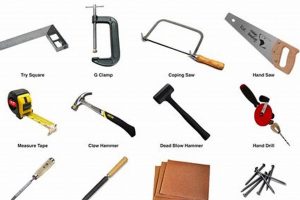
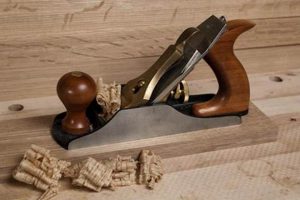
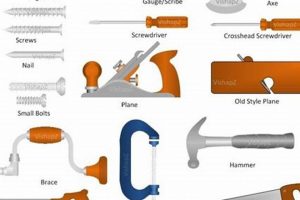
Proficiency in manipulating implements powered solely by human force is a cornerstone of refined timber construction. Mastery over these methods enables precise shaping, joining, and finishing of wood components. Skillful execution produces results characterized by intricate detail and enduring quality.
These traditional methods foster a deeper understanding of material properties and grain direction, cultivating a tactile awareness often absent in mechanized processes. This approach cultivates resourcefulness, reduces reliance on electrical power, and connects practitioners to a legacy of craftsmanship extending back through centuries. The resulting work frequently exhibits a distinctive character reflecting individual skill and intention.
Subsequent sections will address the selection, maintenance, and application of specific implements. Guidance will be offered on achieving optimal control, accuracy, and safety. Emphasis will be placed on efficient movement and consistent execution to minimize fatigue and maximize the quality of the finished product.
Essential Guidance
The following constitutes practical recommendations for optimizing outcomes when employing manual implements for shaping wood. These points emphasize precision, control, and the minimization of potential hazards.
Tip 1: Implement Sharpness. Regular honing and sharpening of blades are paramount. A keen edge reduces the force required, yielding cleaner cuts and diminishing the likelihood of slippage.
Tip 2: Secure Workpiece. Firmly anchoring the material is crucial. Clamps, vises, or bench dogs should be employed to prevent movement during cutting or shaping operations.
Tip 3: Grain Direction Awareness. Understanding the orientation of wood fibers is essential. Cutting with the grain minimizes tear-out and produces smoother surfaces.
Tip 4: Controlled Pressure. Applying measured force is vital. Avoid excessive pressure, which can lead to loss of control and potential injury. Let the sharpness of the tool do the work.
Tip 5: Proper Stance. Maintaining a stable and balanced posture enhances control and reduces fatigue. Position feet firmly on the ground and align the body with the direction of the cut.
Tip 6: Practice on Scrap. Before undertaking critical tasks, practice on expendable material to refine technique and develop muscle memory.
Tip 7: Tool Maintenance. Regular cleaning and lubrication of implements prolong their lifespan and ensure optimal performance. Protect blades from rust and damage.
These guidelines aim to promote accuracy, efficiency, and safety in manual timber construction. Adherence to these principles will improve the quality of work and reduce the risk of accidents.
Further exploration of specific tools and techniques will provide a deeper understanding of this traditional craft.
1. Sharpness Maintenance

Maintaining a keen cutting edge is paramount in manual timber construction. Optimal tool performance directly correlates with edge acuity, affecting cut quality, efficiency, and operator safety. Frequent attention to edge maintenance transcends simple prolongation of tool life; it is integral to achieving predictable and refined results.
- Reduced Force Requirement
A sharp tool minimizes the force necessary to sever wood fibers. This reduction lessens operator fatigue, promotes controlled movement, and decreases the risk of slippage. For instance, attempting to pare a mortise sidewall with a dull chisel necessitates increased pressure, raising the likelihood of inaccurate cuts or accidental injury.
- Enhanced Cut Quality
Sharp implements produce cleaner cuts, minimizing tear-out and surface irregularities. This is particularly crucial in joinery where precise fitting is essential. A dull plane iron, for example, will tear rather than shear wood fibers, resulting in a rough surface requiring further remediation.
- Improved Safety
Counterintuitively, sharp tools are safer than dull ones. A dull tool requires excessive force, increasing the probability of losing control. A sharp saw blade, requiring minimal pressure, reduces the risk of binding and kickback, common causes of injury.
- Increased Efficiency
Tools with well-maintained edges operate more efficiently. Material removal is faster and requires less effort, increasing productivity and reducing overall project time. A dull hand plane requires multiple passes and significant pressure to achieve the same result as a single pass with a sharp plane.
The consistent maintenance of sharp edges on manual implements directly contributes to the efficiency, safety, and quality of output within woodworking. Neglecting this crucial aspect undermines the potential for precision and control inherent in this craftsmanship.
2. Grain Consideration

The orientation of wood fibers, commonly referred to as grain, profoundly influences the behavior of timber during shaping and joining processes. Understanding and accommodating grain direction is therefore paramount when employing manual implements for woodworking. Failure to account for grain can result in compromised structural integrity, aesthetic imperfections, and increased difficulty in execution.
- Tear-out Mitigation
Cutting against the grain, particularly with bladed tools like planes or chisels, often leads to “tear-out,” where wood fibers are lifted and fractured rather than cleanly severed. This results in a rough, uneven surface requiring extensive remediation. Conversely, cutting with the grain promotes a smooth, clean finish, minimizing the need for subsequent smoothing operations. For instance, planing against the grain on a figured maple board can result in significant tear-out, rendering the piece unsuitable for fine furniture construction.
- Joinery Strength
The orientation of grain significantly affects the strength of wood joints. When creating mortise and tenon joints, aligning the grain of the tenon with the grain of the mortise cheek provides maximum gluing surface and resistance to splitting. Conversely, a poorly oriented tenon is prone to shearing under stress. The selection of timber, considering its grain alignment, is essential for reliable joint construction.
- Splitting Tendency
Wood is more easily split along the grain than across it. This characteristic is exploited in traditional techniques like riving, where logs are split along their grain to produce boards. However, unintended splitting can occur if fasteners are driven too close to the edge of a board, particularly if the grain runs parallel to that edge. Awareness of grain direction allows for strategic placement of screws or nails to avoid creating or exacerbating splits.
- Wood Movement
Wood expands and contracts with changes in moisture content, primarily across the grain. Understanding this movement is crucial when designing and constructing wooden objects. Constraining wood movement across the grain can lead to stress buildup and eventual joint failure. Therefore, joinery techniques must accommodate seasonal changes in wood dimensions. For example, frame-and-panel construction allows the panel to float within the frame, accommodating its expansion and contraction without stressing the surrounding structure.
In summary, careful consideration of grain direction is integral to successful manual timber construction. By understanding its effects on cutting, joining, splitting, and movement, practitioners can mitigate potential problems and achieve superior results, aligning the craftsperson’s intentions with the inherent properties of the material.
3. Secure Fixturing

The unwavering stability of a workpiece is fundamental when employing manual implements for shaping timber. Secure fixturing directly influences precision, safety, and efficiency in woodworking. Effective immobilization allows for controlled material removal, minimized risk of injury, and the attainment of desired outcomes.
- Precision Enhancement
Stable support is crucial for achieving accurate cuts and shapes. A securely held workpiece enables the artisan to focus solely on the tool’s interaction with the material, eliminating variables introduced by movement or vibration. For example, attempting to chisel a mortise on an inadequately secured leg will inevitably lead to imprecise dimensions and compromised joint integrity. Conversely, a properly clamped component permits the application of consistent force and the creation of crisp, well-defined edges.
- Safety Assurance
Unsecured workpieces pose a significant safety risk. Sudden movement can cause the tool to slip, potentially resulting in injury to the operator or damage to the piece. Adequate clamping or anchoring minimizes the risk of unexpected shifts, allowing the craftsperson to maintain control throughout the shaping process. Consider the dangers of attempting to saw a small piece of stock without a vise or clamp; the material could easily slip, leading to a loss of control and potential laceration.
- Ergonomic Efficiency
Effective fixturing reduces physical strain and optimizes posture. When a workpiece is adequately supported, the artisan can adopt a comfortable and balanced stance, minimizing fatigue and maximizing control. Conversely, attempting to hold a component while simultaneously applying force with a hand tool leads to awkward positioning and increased exertion. A properly secured board, for instance, allows for efficient planing without the need to compensate for instability, promoting a more sustainable and comfortable workflow.
- Versatility Across Operations
Different woodworking operations demand specific fixturing solutions. From simple clamps and vises to specialized jigs and fixtures, a range of methods exist to accommodate diverse tasks. A miter saw requires a fence and stops to ensure accurate angled cuts, while carving necessitates a robust workholding system to withstand forceful impacts. Selecting the appropriate fixturing method for each operation is essential for achieving optimal results and preventing damage to both the material and the implements.
In conclusion, the implementation of secure fixturing transcends mere convenience; it is an integral component of skilled manual timber construction. The stabilization of a workpiece facilitates precision, enhances safety, and promotes efficiency, thereby enabling practitioners to realize the full potential of traditional woodworking methods. Neglecting this essential aspect can lead to compromised outcomes and unnecessary risks.
4. Controlled Force

The application of regulated pressure constitutes a critical element within manual timber construction. Regulated force application directly affects tool performance, influencing cut accuracy, surface finish, and operator safety. Ineffective or excessive force leads to compromised outcomes, potential tool damage, and increased risk of injury. Mastering controlled force is thus fundamental to proficient woodworking with hand tools. Accurate dovetail joinery, for example, demands meticulous paring of waste material. Excess pressure on the chisel can lead to overcuts, compromising the joint’s integrity and aesthetic appeal. Insufficient pressure, conversely, results in inefficient material removal and ragged edges.
Consider the use of a hand plane. Proper force distribution ensures consistent contact between the blade and the workpiece, resulting in a smooth, even surface. Applying undue pressure at the beginning of the stroke may cause digging, while inadequate pressure at the end leaves the surface uneven. Similarly, sawing straight lines requires balanced pressure on the saw’s push and pull strokes. Uneven force leads to wandering cuts and a departure from the intended line. Moreover, when driving nails or screws manually, controlled force prevents damage to the surrounding wood. Overtightening can strip screw heads or cause wood splitting, necessitating repair or rework.
In summary, the capacity to apply calibrated pressure is integral to successful manual woodworking. By understanding the relationship between force application and material response, practitioners can optimize tool performance, minimize errors, and enhance the overall quality of their work. While seemingly simple, mastering controlled force presents a significant challenge, requiring practice and an acute awareness of the interaction between implement and material.
5. Tool Selection

Appropriate tool selection is not merely a matter of preference; it is a fundamental determinant of outcome quality and efficiency within manual timber construction. The choice of implement directly influences the ability to execute specific techniques effectively, impacting precision, surface finish, and the overall structural integrity of a project. Inadequate tool selection inevitably compromises results, regardless of skill level.
- Task Specificity
Different woodworking operations demand specialized tools. Employing a general-purpose implement in lieu of a task-specific one often results in suboptimal performance and increased effort. For example, attempting to create fine dovetail joints with a coarse-toothed saw sacrifices accuracy and increases the risk of tear-out. Conversely, a dedicated dovetail saw, with its fine teeth and stiff blade, enables precise cuts and clean edges, crucial for tight-fitting joinery.
- Material Compatibility
The properties of the wood being worked must inform tool selection. Dense hardwoods require implements with higher carbon steel content and more acute cutting angles to effectively sever fibers. Softer woods, on the other hand, may be worked with tools of lower hardness and more open cutting angles. Using an inappropriate tool can lead to blunting, inefficiency, or even damage to the workpiece. For instance, attempting to plane a piece of extremely hard ebony with a low-quality plane iron will quickly dull the blade and likely yield a unsatisfactory surface.
- Ergonomic Considerations
The physical characteristics of the artisan, specifically hand size, strength, and reach, should influence tool selection. An implement that is too large or heavy can lead to fatigue, reduced control, and increased risk of injury. Conversely, a tool that is too small may lack sufficient leverage or cutting capacity. Selecting tools that fit comfortably in the hand and allow for a natural range of motion promotes efficiency and reduces the likelihood of strain or discomfort. A small handled spokeshave may be more comfortable for some hands, while a larger one offers better control for others.
- Tool Condition and Maintenance
A high-quality tool in poor condition is often less effective than a modestly priced implement that is well-maintained. Proper sharpening, cleaning, and adjustment are essential for optimal performance. Selecting tools that are easily maintained and durable is a wise investment. A rusted, dull hand plane is functionally useless, regardless of its initial quality; regular honing and rust prevention are crucial for preserving its effectiveness.
Thus, careful consideration of task specificity, material compatibility, ergonomic factors, and tool condition are essential elements of skillful manual timber construction. Appropriate tool selection enables practitioners to execute techniques with precision, efficiency, and safety, ultimately contributing to the creation of high-quality, durable woodworking projects. The right tool, properly maintained and employed, amplifies the skill of the artisan and unlocks the full potential of the craft.
Frequently Asked Questions
This section addresses common inquiries regarding fundamental practices in manual timber construction. The intent is to provide clear, concise answers based on established woodworking principles.
Question 1: What constitutes a “sharp” hand tool, and how frequently must sharpening occur?
Sharpness is defined by the tool’s ability to sever wood fibers cleanly with minimal force. Sharpening frequency depends on wood hardness, tool usage, and steel quality. As a general guideline, implements should be honed before each use and fully sharpened whenever resistance increases noticeably or cut quality diminishes.
Question 2: Why is grain direction significant in manual woodworking?
Wood grain dictates how readily the material cleaves, shapes, and finishes. Ignoring grain can lead to tear-out during planing, weak joints, and unpredictable splitting. Aligning the tool’s action with the grain minimizes these issues, producing smoother surfaces and stronger assemblies.
Question 3: What are the essential elements of a secure workholding system?
A secure system prevents movement of the workpiece during shaping. Essential elements include robust clamping mechanisms, stable workbenches, and appropriate jigs or fixtures. The choice depends on the size and shape of the workpiece, as well as the operations being performed.
Question 4: How does controlled force contribute to effective manual woodworking?
Controlled force optimizes tool performance, reduces the risk of injury, and prevents damage to the workpiece. Excessive force can cause slippage, overcuts, or material fracturing. Insufficient force leads to inefficient material removal and ragged surfaces. Achieving balanced pressure is crucial.
Question 5: What is the best approach to selecting hand tools for a woodworking project?
Tool selection must be driven by the specific tasks required and the properties of the wood. Specialized implements, such as dovetail saws or block planes, are designed for specific operations. Material density and grain characteristics necessitate adjustments in tool choice. A well-stocked toolkit need not be extensive but should contain versatile implements.
Question 6: Are there alternatives if traditional clamping is impossible for a specific job?
When conventional clamping is impractical, alternative methods such as vacuum clamping, hot melt adhesives (used judiciously), or custom-built jigs can provide temporary fixation. The selection depends on the size and complexity of the components, as well as the nature of the joinery.
Mastery of manual woodworking demands a thorough understanding of these fundamental techniques. Continued practice and refinement will yield progressively higher levels of skill and precision.
The subsequent section explores specific manual tools, offering detailed insights into their applications and maintenance.
Working with Hand Tools
This exploration has emphasized sharpness maintenance, grain consideration, secure fixturing, controlled force, and proper tool selection as fundamental elements. The mastery of these techniques ensures accuracy, efficiency, and safety when employing implements powered solely by human force. A deficiency in any of these areas directly undermines the potential for achieving high-quality results in manual timber construction.
Proficient application demands dedication to consistent practice and a continual refinement of understanding regarding both the materials and the implements involved. The pursuit of these skills is a commitment to craftsmanship, offering rewards in the form of durable, aesthetically pleasing, and expertly executed woodworking projects. Further study and practical application are encouraged to fully realize the potential of these techniques.