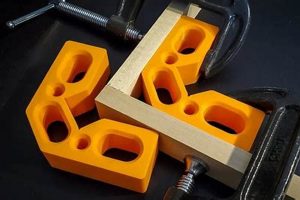
Additive manufacturing techniques have facilitated the creation of implements designed for shaping and manipulating wood. These objects, constructed from materials like polymers using processes such as fused deposition modeling, represent a shift in how craftspeople approach tool acquisition and customization. One might, for instance, fabricate a custom-sized clamp or a specialized jig tailored to a unique project.
The utilization of these digitally fabricated aids offers several advantages. It allows for rapid prototyping, enabling woodworkers to test and refine tool designs quickly and inexpensively. Furthermore, it empowers individuals to produce replacements for obsolete or damaged components, extending the lifespan of existing equipment. Historically, specialized tools required significant investment or were simply unavailable; this technology democratizes access to bespoke solutions.
This exploration will delve into the various materials suitable for the creation of these implements, examine specific design considerations critical for their functionality and durability, and assess the practical applications and limitations within the realm of woodworking. Additionally, it will address the growing community and available resources surrounding this intersection of digital fabrication and traditional craftsmanship.
Essential Guidance for Additively Manufactured Woodworking Implements
The following recommendations are crucial for ensuring the successful design, fabrication, and utilization of implements produced via additive manufacturing for woodworking applications. Adherence to these guidelines will enhance tool performance, longevity, and user safety.
Tip 1: Material Selection is Paramount: The mechanical properties of the filament significantly influence tool performance. Consider factors such as tensile strength, impact resistance, and heat deflection temperature. For high-stress applications, explore reinforced filaments like carbon fiber-infused nylon.
Tip 2: Optimize Layer Orientation for Strength: Align the print orientation such that the layer lines run parallel to the primary stress direction. This minimizes the risk of delamination under load. For example, when printing a clamp jaw, orient the layers vertically.
Tip 3: Incorporate Adequate Wall Thickness and Infill Density: Insufficient wall thickness or low infill density can lead to structural failure. A minimum of 3-4 perimeters is recommended for most tools. Adjust infill density based on the anticipated stress; complex geometries may require higher infill percentages for dimensional stability.
Tip 4: Design for Printability: Minimize overhangs and steep angles to avoid the need for excessive support material. Design features to be self-supporting where possible. Break down complex parts into simpler components that can be assembled after printing.
Tip 5: Account for Dimensional Accuracy and Tolerances: Additive manufacturing processes possess inherent dimensional limitations. Design for slightly looser tolerances than traditional manufacturing methods. For critical dimensions, consider post-processing techniques like sanding or machining.
Tip 6: Consider Post-Processing for Enhanced Durability: Surface treatments, such as coating with epoxy or varnish, can improve resistance to moisture, abrasion, and UV degradation. Annealing can also improve the mechanical properties and reduce internal stresses.
Tip 7: Prioritize Safety: Always use appropriate personal protective equipment (PPE) when operating woodworking tools, regardless of whether they are traditionally manufactured or additively produced. Regularly inspect additively manufactured tools for signs of wear or damage.
Following these guidelines will maximize the effectiveness and safety of additively manufactured woodworking aids. Proper material selection, design considerations, and post-processing techniques are essential for creating durable and reliable tools.
The next section will explore specific applications of these technologies within various woodworking tasks.
1. Material Properties

The suitability of materials for implements made via additive manufacturing for woodworking is directly correlated to the performance and longevity of said instruments. The mechanical characteristics inherent to a given material dictate its capacity to withstand the stresses encountered during woodworking operations. For instance, a material with low tensile strength is likely to fracture under the load of clamping, rendering it unsuitable for constructing clamps or vises. Similarly, a material with poor abrasion resistance will degrade rapidly when used in tools that experience friction, such as marking gauges or sanding blocks.
Material selection also impacts the dimensional stability of the fabricated tools. Polymeric materials exhibit varying degrees of thermal expansion and contraction, potentially affecting the precision of measuring tools or the fit of assembled components. For example, ABS, while relatively strong, is prone to warping during printing, which can compromise the accuracy of jigs and fixtures. In contrast, materials such as PETG offer better dimensional stability and chemical resistance, making them more suitable for tools exposed to solvents or moisture. Furthermore, the impact resistance of a material is critical for tools subjected to sudden shocks or impacts, such as mallets or handles.
In summary, the selection of a material with appropriate mechanical, thermal, and chemical properties is paramount when creating implements using additive manufacturing for woodworking. Neglecting material properties can lead to premature tool failure, reduced accuracy, and potential safety hazards. The optimal material choice will vary depending on the specific application and the anticipated stresses the tool will endure. Ongoing research and development in materials science continue to expand the range of viable options for creating increasingly durable and reliable woodworking tools through additive manufacturing.
2. Design Optimization
Design optimization, within the context of implements made with additive manufacturing for shaping wood, entails a systematic process of refining the digital models of these tools to maximize performance, durability, and printability. This process necessitates a comprehensive understanding of material properties, manufacturing constraints, and functional requirements.
- Geometric Considerations for Structural Integrity
Optimizing geometry involves minimizing stress concentrations and ensuring adequate load-bearing capacity. For example, sharp corners on clamps or vises introduce stress risers, increasing the likelihood of failure under pressure. Implementing fillets and radii at these points distributes stress more evenly. Additionally, incorporating internal ribs or honeycombing structures can increase stiffness without adding significant weight, improving the tool’s resistance to bending or deformation.
- Material-Specific Design Adaptations
Each material exhibits unique properties that influence design decisions. For instance, when working with materials prone to creep, such as certain thermoplastics, designs should incorporate features that minimize sustained stress. This might involve increasing the cross-sectional area of load-bearing components or using a material with higher creep resistance. Similarly, the layer-by-layer construction inherent to additive manufacturing necessitates consideration of anisotropic properties, where strength varies depending on the printing direction.
- Print Orientation and Support Structures
The orientation of a tool during the additive manufacturing process significantly impacts its structural integrity and surface finish. Optimizing print orientation minimizes the need for support structures, which can leave unsightly marks and weaken the part. Orienting parts to align layer lines with the primary load direction maximizes strength. Complex geometries may require strategic placement of support structures to ensure successful printing without compromising functionality.
- Ergonomics and User Experience
Design optimization extends beyond purely structural considerations to encompass ergonomics and user experience. Handles should be shaped for comfortable grip and efficient force transfer. Tool weight should be balanced to minimize fatigue during prolonged use. Features such as textured surfaces can improve grip and prevent slippage. Thoughtful design can enhance both the usability and safety of these aids.
These facets of design optimization are interwoven. Effective implements are not merely replicas of existing tools but represent carefully engineered solutions tailored to the specific capabilities and limitations of both the additive manufacturing process and the chosen materials. Iterative design and testing are essential to achieving optimal performance and reliability in this emerging field.
3. Print Resolution

Print resolution, defined as the level of detail achievable in a three-dimensional print, constitutes a critical parameter influencing the functionality and precision of additively manufactured implements for woodworking. Inadequate resolution can compromise dimensional accuracy, surface finish, and overall structural integrity, thereby diminishing the tool’s effectiveness and lifespan.
- Dimensional Accuracy and Tolerance
Higher resolutions enable the production of tools with tighter tolerances and more accurate dimensions. This is particularly relevant for jigs, fixtures, and measuring devices where precision is paramount. For instance, a marking gauge printed at a low resolution may exhibit inaccuracies in the marked distance, rendering it unsuitable for precise woodworking tasks. Conversely, increased resolution minimizes deviations from the intended design, ensuring accurate and repeatable results.
- Surface Finish and Friction
Print resolution dictates the smoothness of the tool’s surface. A low-resolution print results in a stepped or layered surface, increasing friction and potentially hindering the tool’s operation. For example, a plane sole printed with insufficient resolution will generate excessive friction against the wood surface, making it difficult to achieve a smooth, even cut. Higher resolution reduces surface roughness, minimizing friction and improving the tool’s ease of use.
- Intricate Features and Fine Details
Complex tool designs often incorporate intricate features such as threads, gears, or delicate geometries. High resolution is essential for accurately reproducing these details. For example, a threaded insert designed to reinforce a joint requires sufficient resolution to ensure proper engagement and load transfer. Low resolution may result in distorted or incomplete features, compromising the tool’s functionality.
- Layer Adhesion and Structural Integrity
While primarily influenced by other factors such as temperature and material properties, print resolution plays a secondary role in layer adhesion. Finer layers created by higher resolution can promote better bonding between layers, improving the tool’s overall strength and resistance to delamination. This is especially important for tools subjected to significant stress, such as clamps or handles.
The interplay between print resolution and the performance of digitally fabricated woodworking implements underscores the importance of selecting appropriate printing parameters. While higher resolution generally yields superior results, it also increases printing time and material consumption. Therefore, optimizing print resolution requires careful consideration of the specific tool’s functional requirements and a balance between precision, efficiency, and cost.
4. Functional Testing
Functional testing serves as a critical validation step in the development and deployment of implements created with additive manufacturing techniques for woodworking. This process evaluates whether a given tool performs its intended function effectively and reliably under anticipated operating conditions. It mitigates risks associated with relying on purely theoretical design parameters and material specifications.
- Load-Bearing Capacity Assessment
For implements designed to withstand significant forces, such as clamps or vises, load-bearing capacity assessment is crucial. This involves applying controlled loads to the tool and measuring its deformation or failure point. Testing protocols may include static load tests, where a constant force is applied over a prolonged period, and dynamic load tests, which simulate repetitive or impact loading. The results inform design modifications or material selections to ensure the tool can safely handle intended stresses. A clamp, for example, must maintain clamping force without deforming excessively or fracturing during prolonged use.
- Dimensional Accuracy Verification
Tools intended for precise measurement or alignment necessitate verification of their dimensional accuracy. This involves comparing the tool’s actual dimensions against its design specifications using calibrated measuring instruments. Verification procedures may include coordinate measuring machine (CMM) analysis, laser scanning, or traditional manual measurements. Deviations from the intended dimensions can indicate printing errors, material shrinkage, or design flaws that require correction. A marking gauge, for instance, must accurately transfer distances to ensure precise cuts and joinery.
- Ergonomic Evaluation and Usability Testing
Ergonomic evaluation assesses the tool’s comfort, ease of use, and safety for the end-user. This may involve subjective feedback from woodworkers through surveys or interviews, as well as objective measurements of factors such as grip strength, reach, and posture. Usability testing involves observing woodworkers as they use the tool in a simulated or real-world woodworking environment to identify potential design flaws or areas for improvement. A handle designed for comfortable gripping over extended periods directly influences user fatigue and precision.
- Durability and Longevity Testing
Durability testing evaluates the tool’s ability to withstand repeated use and environmental exposure over time. This may involve subjecting the tool to accelerated aging tests, such as thermal cycling or exposure to UV radiation, to simulate years of normal use. Additionally, the tool may be subjected to repetitive stress testing to assess its resistance to wear and tear. A scraper, for example, must maintain its cutting edge and structural integrity after repeated use on various wood species.
These facets of functional testing collectively contribute to ensuring the quality and reliability of digitally fabricated woodworking implements. The data obtained from testing informs iterative design improvements and material selections, ultimately leading to tools that enhance the efficiency, precision, and safety of woodworking operations. The absence of rigorous functional testing introduces significant risks, potentially leading to tool failure, inaccurate results, or user injury.
5. Cost Efficiency

The economic viability of employing additive manufacturing for creating woodworking implements is a crucial consideration. A thorough analysis of associated costs, from initial investment to long-term operational expenses, is essential to determine the true cost-effectiveness of this approach.
- Reduced Initial Investment in Specialized Tools
Traditionally, acquiring specialized woodworking tools can necessitate significant upfront capital expenditure. Additive manufacturing offers an alternative by enabling the on-demand creation of custom tools tailored to specific project requirements. This eliminates the need to purchase expensive, mass-produced tools that may only be used sporadically. For example, a woodworker undertaking a unique furniture design might require a custom jig that would be prohibitively expensive to have professionally manufactured; additive manufacturing provides a cost-effective solution.
- Lower Material Costs for Prototyping and Iteration
Prototyping and iterative design are integral to the development of effective woodworking tools. Additive manufacturing facilitates rapid prototyping at relatively low material costs compared to traditional machining or fabrication methods. This allows woodworkers to experiment with different designs and materials, optimizing tool performance before committing to final production. The cost of a failed prototype is significantly lower with additive manufacturing, fostering innovation and efficient design refinement.
- Decreased Inventory and Storage Expenses
Maintaining a comprehensive inventory of woodworking tools can incur substantial storage costs and require dedicated space. Additive manufacturing enables a just-in-time production model, eliminating the need to stock rarely used or highly specialized tools. Digital tool designs can be stored electronically and produced only when needed, minimizing inventory expenses and freeing up valuable workspace. This is particularly advantageous for small workshops with limited storage capacity.
- Potential for Localized Production and Reduced Shipping Costs
Additive manufacturing empowers woodworkers to produce tools locally, reducing reliance on centralized manufacturers and minimizing shipping costs. Digital tool designs can be shared and replicated globally, fostering collaboration and knowledge sharing within the woodworking community. This localized production model also reduces lead times and enhances responsiveness to changing project requirements. A woodworker in a remote location can access and produce specialized tools without incurring high shipping fees or waiting for extended delivery times.
Collectively, these factors contribute to the potential cost-efficiency of utilizing implements created via additive manufacturing in woodworking. While initial investment in printing equipment and material costs must be considered, the long-term benefits of reduced upfront expenses, lower prototyping costs, minimized inventory, and localized production can result in significant savings and enhanced economic viability for woodworkers.
6. Tool Customization
Tool customization, facilitated by additive manufacturing techniques, represents a significant paradigm shift within woodworking. The ability to tailor tool geometry, ergonomics, and functionality to specific tasks offers advantages unattainable with mass-produced implements. This capability addresses the inherent limitations of standardized tools, which often fail to adequately meet the diverse and nuanced demands of individual projects. The use of digitally fabricated aids allows the craftsman to create solutions tailored to specific needs.
The cause-and-effect relationship between additive manufacturing and tool customization is direct. The layer-by-layer construction process inherent in these technologies allows for intricate geometries and internal structures to be realized with relative ease. This capability empowers woodworkers to design tools that conform precisely to the contours of complex workpieces, optimizing cutting angles, clamping pressure, or sanding profiles. An example includes creating a custom-contoured sanding block for shaping a guitar neck or a jig designed to accurately drill angled holes in chair legs. The importance lies in the enhanced precision, efficiency, and safety afforded by tools designed for specific tasks and the ability to recreate items. The significance lies in empowering the individual craftsman.
In summary, the ability to customize implements using additive manufacturing represents a key driver in the adoption of this technology within woodworking. Challenges remain in optimizing material properties and ensuring long-term durability, but the potential for enhanced precision, improved ergonomics, and increased design flexibility is undeniable. This intersection of digital fabrication and traditional craftsmanship promises to reshape the future of woodworking, enabling artisans to create tools perfectly suited to their unique skills and creative visions. It allows the construction of niche tools that would be far too expensive through traditional means, and the repair of tools for which parts are no longer produced.
Frequently Asked Questions
The following questions address common concerns and misconceptions regarding the use of tools created via additive manufacturing techniques within woodworking practices. The answers are intended to provide clear and concise information based on current knowledge and best practices.
Question 1: Are 3D printed tools for woodworking durable enough for regular use?
The durability of additively manufactured tools depends heavily on the materials used, the design of the tool, and the printing parameters employed. While some thermoplastics may not be suitable for high-stress applications, reinforced filaments like carbon fiber-infused nylon can offer comparable strength to traditional materials. Proper design optimization and adherence to recommended printing guidelines are crucial for maximizing tool longevity.
Question 2: What are the limitations of using 3D printed tools for woodworking?
The primary limitations stem from material properties and the layer-by-layer construction process. Additively manufactured tools may not possess the same impact resistance or heat resistance as traditionally manufactured steel tools. Additionally, the anisotropic nature of 3D-printed parts can result in varying strength depending on the print orientation. Size limitations imposed by the printer’s build volume also restrict the creation of very large tools.
Question 3: Can 3D printed tools for woodworking replace traditional metal tools entirely?
Additively manufactured tools are unlikely to completely replace traditional metal tools in all applications. However, they offer a compelling alternative for specialized jigs, fixtures, and custom tools where traditional manufacturing methods are cost-prohibitive or impractical. In many cases, a hybrid approach combining 3D-printed components with metal inserts or cutting edges provides the optimal balance of cost, performance, and durability.
Question 4: Are there safety concerns associated with using 3D printed tools for woodworking?
Safety concerns exist, primarily related to material failure or improper use. Tools constructed from brittle materials can fracture under stress, potentially causing injury. It is crucial to select appropriate materials, design tools with adequate safety factors, and adhere to recommended operating procedures. Regular inspection of the tools for signs of wear or damage is also essential.
Question 5: What types of 3D printers are best suited for creating woodworking tools?
Fused deposition modeling (FDM) printers are the most common and accessible type for producing woodworking tools. These printers extrude molten thermoplastic filament to build parts layer by layer. The selection of a printer should consider factors such as build volume, print resolution, and material compatibility. Enclosed printers that maintain a consistent temperature are recommended for printing materials prone to warping.
Question 6: What software is needed to design 3D printed tools for woodworking?
Computer-aided design (CAD) software is essential for creating the digital models of tools to be additively manufactured. Numerous CAD software options are available, ranging from free, open-source programs to professional-grade commercial packages. The choice of software depends on the user’s experience level, the complexity of the tool designs, and budget constraints. Slicing software is also required to convert the CAD model into a format that the 3D printer can understand.
In conclusion, the use of implements made using additive manufacturing for shaping wood presents both opportunities and challenges. By understanding the limitations and adhering to best practices, woodworkers can leverage this technology to create custom tools that enhance their craft.
The following section will examine specific case studies illustrating the successful application of implements made with additive manufacturing within woodworking.
Conclusion
This exploration has illuminated the diverse facets of additive manufacturing’s integration into woodworking. From material selection and design optimization to functional testing and economic considerations, the creation and application of these implements represent a confluence of traditional craftsmanship and digital fabrication. The advantages of customization, reduced initial investment, and potential for localized production have been examined, alongside the inherent limitations regarding material properties and print resolution.
Continued research and development in materials science, printing technologies, and design methodologies will undoubtedly expand the scope and effectiveness of these tools. The proactive adoption of best practices and a commitment to rigorous testing will be essential to ensure their safety, reliability, and long-term viability within the evolving landscape of woodworking. Further investigation into hybrid solutions, combining additively manufactured components with traditional materials, holds significant promise for optimizing both performance and durability. The future direction of this field will be shaped by the ingenuity and collaborative spirit of both woodworkers and digital fabrication experts.
![Buy Woodworking Tools Sales Online - [Your Brand] | Step-by-Step Guides, Tools & Inspiration to Build Beautiful Wooden Decor on a Budget](https://woodfromhome.com/wp-content/uploads/2026/05/th-213-300x200.jpg "Buy Woodworking Tools Sales Online - [Your Brand] Step-by-Step Guides, Tools & Inspiration to Build Beautiful Wooden Decor on a Budget")