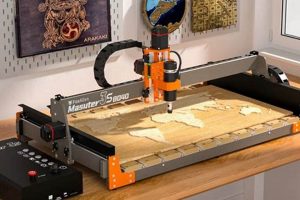
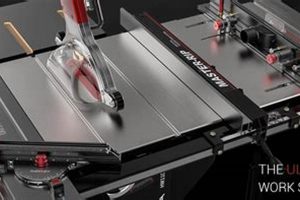
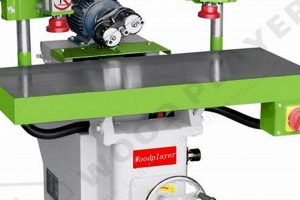
A sophisticated automated tool utilizes computer numerical control (CNC) to execute intricate designs on wood across five axes simultaneously. These axes typically include the standard X, Y, and Z linear axes, along with two rotational axes, typically designated A and B or A and C. This configuration facilitates machining complex shapes and undercuts without the need for manual repositioning of the workpiece. An example application is the creation of ornate furniture components or detailed architectural moldings.
The enhanced machining capabilities offered by this technology lead to increased efficiency, improved accuracy, and the ability to produce parts with complex geometries not easily achievable with traditional methods. Its historical significance lies in the evolution of manufacturing processes, allowing for greater design freedom and reduced labor costs in the woodworking industry. The implementation of such systems has redefined possibilities in custom woodworking and mass production.
The following sections will delve deeper into specific applications, technical specifications, operational considerations, and economic impacts associated with advanced multi-axis wood machining solutions.
Operational Tips for Advanced Wood Machining Centers
The efficient and accurate operation of sophisticated multi-axis woodworking equipment demands meticulous planning and execution. The following tips are intended to optimize performance and ensure longevity of the system.
Tip 1: Material Selection and Preparation: Ensure consistent material density and moisture content. Variations can affect cutting parameters and surface finish, leading to inconsistencies in the final product. Properly kiln-dried lumber is recommended.
Tip 2: Toolpath Optimization: Implement advanced CAM software to generate efficient toolpaths. Minimizing unnecessary movements and optimizing cutting angles reduces machining time and stress on the tooling and machine components.
Tip 3: Regular Maintenance and Calibration: Adhere to the manufacturer’s recommended maintenance schedule. Periodic calibration of the axes is crucial for maintaining accuracy, particularly after periods of high-volume production.
Tip 4: Secure Workholding: Implement robust workholding solutions to prevent movement during machining. Vacuum clamping systems or custom fixtures are often necessary for complex geometries. Vibration during the cutting process compromises precision.
Tip 5: Tool Selection and Condition Monitoring: Utilize high-quality cutting tools specifically designed for wood. Regularly inspect tool condition and replace worn or damaged tools promptly. Dull tools increase cutting forces and can damage the workpiece.
Tip 6: Chip Evacuation: Implement an efficient chip evacuation system to prevent chip buildup in the cutting area. Accumulated chips can interfere with the cutting process and compromise surface finish. A powerful dust collection system is essential.
Tip 7: Software Proficiency: Invest in thorough training for operators and programmers. A strong understanding of the machine’s control software and CAM programming principles is vital for maximizing its capabilities.
The meticulous application of these tips will contribute significantly to increased productivity, reduced downtime, and improved quality in complex woodworking operations. Diligent attention to detail in these areas is paramount for realizing the full potential of advanced multi-axis woodworking systems.
The concluding section will summarize the key benefits and future trends observed in the realm of automated woodworking processes.
1. Complexity
The operational complexity of advanced multi-axis woodworking centers stems from their simultaneous control over five independent axes. This intricacy manifests in several crucial areas, including programming, machine setup, and maintenance. Increased degrees of freedom translate directly to more intricate toolpaths, requiring sophisticated CAM software and skilled programmers capable of optimizing cutting strategies for both efficiency and precision. Failure to adequately address this programming complexity can lead to inefficient machining cycles, increased material waste, and potentially, damage to the machine itself. The complexity also extends to the setup process, which demands careful alignment and calibration of all axes to ensure accurate execution of the programmed toolpaths. A misalignment in even one axis can propagate errors throughout the workpiece, rendering it unusable. Furthermore, maintenance becomes more challenging due to the greater number of moving parts and the intricate control systems governing their operation.
The programming challenge can be exemplified by considering the creation of a complex, curved chair component. Generating a toolpath for such a shape necessitates the simultaneous coordination of all five axes to achieve the desired contours and surface finish. The programmer must account for factors such as material removal rates, cutting tool geometry, and the machine’s kinematic limitations to prevent collisions and ensure optimal performance. Similarly, the setup process for such a project might involve precisely aligning the workpiece using specialized fixtures and verifying the accuracy of each axis using precision measuring instruments. These processes often require specialized training and experience to perform effectively.
In summary, the inherent complexity of advanced multi-axis woodworking centers necessitates a comprehensive understanding of programming principles, machine operation, and maintenance procedures. Successfully managing this complexity is critical for realizing the full potential of the technology and achieving desired outcomes in terms of efficiency, accuracy, and product quality. The challenges associated with complexity highlight the need for ongoing training and investment in skilled personnel to operate and maintain these advanced systems effectively.
2. Precision

Precision constitutes a core attribute of advanced multi-axis woodworking centers, directly influencing the quality and complexity of the final product. The ability to execute intricate designs with tight tolerances is a primary driver for adopting this technology. Errors in machining, even at a micro-level, accumulate across multiple axes, potentially rendering complex workpieces unusable. Therefore, the inherent precision of each axis, the control system’s accuracy, and the calibration processes employed are all critical factors that contribute to the overall achievable precision. For instance, the creation of interlocking components in custom cabinetry demands extremely precise cuts and angles to ensure a seamless fit. Deviation from specified dimensions, even by fractions of a millimeter, can compromise the structural integrity and aesthetic appeal of the finished product.
The link between multi-axis capabilities and precision is further amplified in tasks requiring intricate carving or complex three-dimensional surfaces. Traditional woodworking techniques often necessitate multiple setups and manual adjustments to achieve similar results, increasing the likelihood of human error and dimensional inconsistencies. In contrast, a multi-axis system, when properly programmed and maintained, can execute these complex tasks in a single setup, minimizing the accumulation of errors and ensuring a higher degree of repeatability. A specific example of this application is in the production of musical instruments, where precise curvature and intricate detailing are essential for both aesthetic appeal and acoustic performance. The accurate reproduction of complex geometries is directly enabled by the precision afforded by these advanced machining centers.
In conclusion, precision is not merely a desirable feature but a fundamental requirement for maximizing the potential of advanced multi-axis woodworking centers. Achieving and maintaining this level of accuracy necessitates a holistic approach, encompassing machine design, control system implementation, programming expertise, and rigorous calibration procedures. Overcoming the challenges associated with ensuring precision unlocks new possibilities in woodworking, allowing for the creation of complex, high-quality products with unprecedented efficiency and repeatability. The continuous pursuit of greater precision remains a key driver of innovation in the field of automated woodworking.
3. Versatility

The five-axis configuration provides a significant degree of freedom compared to traditional three-axis systems. This augmented mobility translates directly into an expanded range of machining operations achievable without repositioning the workpiece. As a result, undercuts, complex curves, and intricate three-dimensional shapes become accessible, facilitating the creation of designs previously unattainable or requiring extensive manual intervention. The ability to perform multiple operations in a single setup reduces handling time, minimizes potential alignment errors, and streamlines the overall production workflow. This inherent flexibility renders the equipment suitable for a diverse range of applications, from custom furniture manufacturing to the production of complex architectural components.
The versatility extends beyond mere geometric complexity. The system’s capacity to accommodate a variety of cutting tools and materials further enhances its adaptability. Different wood species, composites, and even certain plastics can be processed with appropriate tooling and parameter adjustments. This capability is particularly valuable in prototyping and small-batch production environments, where frequent material and design changes are common. For example, a single setup might involve roughing out a shape using a large-diameter cutter, followed by precision detailing with smaller, specialized tools. This type of multi-stage machining, seamlessly integrated within a single program, maximizes efficiency and reduces the need for manual intervention.
In conclusion, the versatility offered by advanced multi-axis woodworking centers is a key differentiator, enabling manufacturers to address a wider range of projects and adapt quickly to changing market demands. The capacity to handle complex geometries, diverse materials, and multi-stage machining processes within a single setup provides a significant competitive advantage. However, realizing this potential requires skilled programming and a thorough understanding of the machine’s capabilities and limitations. Effectively harnessing this versatility is crucial for maximizing the return on investment and unlocking new opportunities in the woodworking industry.
4. Automation

Automation is integral to the functionality and efficiency of five-axis CNC woodworking machinery. The core principle behind its design is the automated execution of pre-programmed cutting paths, reducing manual intervention and increasing production throughput. The automated control system manages the simultaneous movement of the five axes, ensuring accurate and repeatable machining operations. This level of automation significantly minimizes the risk of human error, particularly in complex tasks requiring intricate three-dimensional cuts or undercuts. Consider the production of custom furniture with complex carvings; automated systems can execute these designs with a consistency and speed unattainable through manual methods, leading to significant reductions in labor costs and lead times. The automated tool-changing capabilities further streamline the process, allowing for a sequence of operations to be performed without operator intervention.
The integration of advanced sensors and control algorithms enhances the automation capabilities, enabling real-time adjustments to cutting parameters based on material characteristics and tool wear. This adaptive control optimizes cutting performance, minimizes material waste, and extends tool life. For instance, in the manufacturing of musical instruments, where precise curvature and material removal are critical for acoustic performance, automated systems can continuously monitor and adjust cutting parameters to ensure optimal results. Furthermore, the automated monitoring of machine health and performance provides valuable data for predictive maintenance, reducing downtime and extending the lifespan of the equipment. This data-driven approach to maintenance allows for proactive identification of potential issues before they escalate into costly repairs.
In conclusion, automation is not merely an adjunct to five-axis CNC woodworking machinery but a fundamental component that enables its superior performance. The seamless integration of automated control systems, tool-changing mechanisms, and adaptive control algorithms provides significant advantages in terms of efficiency, accuracy, and repeatability. While the initial investment in these automated systems may be substantial, the long-term benefits, including reduced labor costs, increased throughput, and improved product quality, make them a compelling proposition for manufacturers seeking to optimize their woodworking operations. The ongoing advancements in automation technology will continue to drive innovation in the woodworking industry, enabling the creation of increasingly complex and sophisticated designs with greater efficiency and precision.
5. Investment

The financial commitment associated with acquiring a five-axis CNC woodworking machine represents a substantial investment for any woodworking operation. This expenditure encompasses not only the initial purchase price of the equipment, but also ancillary costs related to installation, software licensing, operator training, and ongoing maintenance. The decision to invest in this technology necessitates a thorough evaluation of potential return on investment (ROI), considering factors such as increased production capacity, reduced labor costs, improved product quality, and the ability to offer more complex and customized designs. A real-world example includes a custom furniture manufacturer that invested in such a machine to produce intricate chair components, leading to a 40% reduction in production time and a 25% increase in sales due to the ability to offer more elaborate designs. The capital outlay must be strategically aligned with the company’s long-term business goals and market demands.
Furthermore, the investment extends beyond the tangible assets. The intangible costs associated with integrating the machine into existing workflows and training personnel to operate and maintain it must be carefully considered. This often involves adapting existing manufacturing processes, developing new programming skills, and establishing a comprehensive maintenance schedule. Successful integration requires a commitment to continuous improvement and a willingness to embrace new technologies and workflows. For instance, implementing a robust CAM software system and providing ongoing training for programmers is essential for maximizing the machine’s capabilities. The lack of adequate training and support can significantly diminish the return on investment and lead to operational inefficiencies. Therefore, a holistic approach to investment, encompassing both tangible and intangible assets, is crucial for successful implementation.
In summary, the investment in a five-axis CNC woodworking machine is a multifaceted undertaking that requires careful planning and execution. A thorough understanding of the initial costs, ongoing expenses, and potential benefits is essential for making an informed decision. The decision should be grounded in a realistic assessment of the company’s current capabilities, market opportunities, and long-term strategic goals. While the initial investment may be significant, the potential for increased efficiency, improved product quality, and expanded design capabilities can provide a substantial return on investment over time, ultimately enhancing the company’s competitiveness and profitability within the woodworking industry.
Frequently Asked Questions
This section addresses common inquiries regarding the application, operation, and implications of advanced multi-axis woodworking systems.
Question 1: What distinguishes a 5 axis CNC woodworking machine from a 3 axis system?
A 5 axis CNC woodworking machine incorporates two additional rotational axes, enabling machining from multiple angles in a single setup. A 3 axis system is limited to linear movements along the X, Y, and Z axes, restricting its ability to create complex geometries without repositioning the workpiece.
Question 2: What level of programming expertise is required to operate advanced multi-axis woodworking equipment?
Proficiency in CAM software and a thorough understanding of CNC programming principles are essential. Operators should be capable of creating and optimizing toolpaths for complex three-dimensional shapes and possess a working knowledge of G-code.
Question 3: What types of materials can be processed using a 5 axis CNC woodworking machine?
These machines are primarily designed for wood and wood-based composites. However, with appropriate tooling and parameter adjustments, certain plastics and non-ferrous metals may also be processed.
Question 4: What are the primary maintenance requirements for ensuring the longevity of the equipment?
Regular maintenance includes lubrication of moving parts, calibration of axes, inspection of cutting tools, and cleaning of the work area. Adhering to the manufacturer’s recommended maintenance schedule is crucial.
Question 5: What factors influence the overall accuracy and precision of machining operations?
Machine rigidity, control system accuracy, toolpath optimization, material consistency, and operator skill all contribute to the final outcome. Environmental factors, such as temperature fluctuations, can also impact precision.
Question 6: How does the initial investment in advanced multi-axis woodworking equipment translate into long-term cost savings?
Long-term cost savings arise from increased production efficiency, reduced material waste, lower labor costs, and the ability to produce more complex designs, thereby increasing market competitiveness.
The answers provided offer a fundamental understanding of critical aspects related to advanced multi-axis woodworking. Further research and consultation with industry experts are recommended for specific applications.
The subsequent section will explore case studies demonstrating the practical applications and benefits of this technology.
Conclusion
This exploration has elucidated the multifaceted nature of the 5 axis cnc woodworking machine, emphasizing its complexity, precision, versatility, automation capabilities, and substantial investment requirements. The capacity to execute intricate designs, enhance production efficiency, and expand design possibilities represents a significant advancement in woodworking technology. The adoption of this technology necessitates careful consideration of operational considerations, skilled programming, and meticulous maintenance protocols.
The sustained advancement in computer numerical control and automation will likely continue to drive innovation in the field of woodworking. Businesses considering integrating this technology must conduct thorough due diligence, aligning their investment with strategic objectives and operational capabilities to fully realize its potential and ensure long-term success. The effective implementation of this advanced system represents a pivotal step toward enhanced competitiveness and innovation within the woodworking industry.