



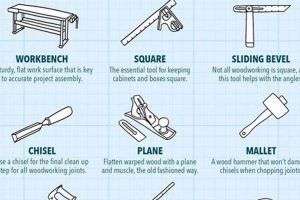
The foundational implements for shaping and manipulating wood are critical for any woodworking endeavor. A select collection of essential items provides the capacity to perform a broad range of tasks, from initial rough shaping to precise final detailing. For example, a saw is used for cutting material to size, while a chisel allows for controlled removal of wood to create specific features.
Proficiency with these key instruments enables the creation of durable and aesthetically pleasing wooden objects. Historically, skilled artisans relied on a limited set of hand tools to produce elaborate and functional pieces. The careful selection and mastery of these instruments translate directly to increased efficiency, accuracy, and the overall quality of the finished product. They serve as the bedrock for both amateur hobbyists and professional woodworkers alike.
The following will detail a carefully curated list of implements that form the cornerstone of effective and rewarding work with timber, outlining their functions and applications in the craft.
Guidance on Essential Woodworking Implements
The selection and proper use of fundamental woodworking implements significantly impact project success. Following are guidelines to optimize their application:
Tip 1: Saw Selection. Employ the appropriate saw type for the specific cut required. Crosscut saws are designed for cutting perpendicular to the wood grain, while rip saws are optimized for cutting parallel to the grain. Using the correct saw enhances efficiency and reduces the risk of tear-out.
Tip 2: Chisel Sharpening. Maintain a razor-sharp edge on chisels. A dull chisel requires excessive force, increasing the likelihood of errors and potential injury. Regular honing and sharpening are crucial for precise and controlled wood removal.
Tip 3: Measuring Accuracy. Prioritize accurate measurements. Inaccurate measurements lead to ill-fitting joints and compromised structural integrity. Utilize a high-quality measuring tape or ruler and double-check all dimensions before cutting.
Tip 4: Joint Selection. Choose the appropriate joint for the application. Dovetail joints offer superior strength for connecting corners, while mortise and tenon joints provide robust connections for frame and panel construction. Selecting the correct joint ensures structural stability and longevity.
Tip 5: Sanding Progression. Utilize a progressive sanding approach. Begin with a coarse grit sandpaper to remove imperfections and then gradually move to finer grits to achieve a smooth surface. Skipping grits can result in uneven sanding and visible scratches.
Effective application of these fundamental implements, when combined with sound technique, leads to superior woodworking results. Consistent adherence to these principles ensures both accuracy and efficiency.
The subsequent sections will further explore the intricacies of woodworking techniques and project planning.
1. Accuracy

Accuracy constitutes a cornerstone of effective woodworking, directly correlating with the functionality and aesthetic appeal of the finished product. The degree of precision afforded by essential woodworking instruments dictates the fidelity with which a design can be realized. Inaccurate measurements or cuts can cascade through a project, resulting in misalignment of joints, structural instability, and overall compromised quality. For instance, a hand plane lacking precise blade adjustment can produce uneven surfaces, necessitating additional corrective work. A misaligned miter saw yields gaps in corner joints, diminishing the overall structural integrity and aesthetic appeal.
The selection and proper calibration of measuring tools, saws, chisels, planes, and joinery implements form the basis for achieving accurate results. A high-quality measuring tape with clearly defined graduations minimizes the risk of transcription errors. Saws with fine teeth and rigid blades allow for cleaner, more precise cuts along designated lines. Chisels honed to a razor-sharp edge enable controlled removal of material, facilitating the creation of tight-fitting joints. The absence of precision in any of these areas leads to cumulative errors, ultimately detracting from the project’s success. Consider the construction of a dovetailed drawer: If the pins and tails are not accurately cut, the joint will be weak and unsightly. Accurate layout lines, precise cuts, and carefully fitted components are non-negotiable for strong and beautiful dovetails.
In conclusion, the symbiotic relationship between accuracy and the selection of fundamental woodworking instruments cannot be overstated. While skill and experience contribute significantly, the inherent precision of the tools themselves establishes a baseline for achieving desired outcomes. Investing in quality instruments and diligently maintaining their calibration promotes accuracy, thereby enhancing the quality and longevity of woodworking projects. The pursuit of accuracy remains a paramount objective in woodworking, demanding unwavering attention to detail and a commitment to utilizing the most appropriate tools for the task at hand.
2. Versatility

Versatility, in the context of fundamental woodworking implements, denotes the capacity of a single tool to perform multiple functions effectively. The ability of a limited set of instruments to address a wide range of woodworking tasks is critical for efficiency, cost-effectiveness, and adaptability in diverse project environments. The selection of implements possessing multifaceted functionality expands the range of possible operations while minimizing the need for a large and specialized tool collection.
- Saw Functionality
A high-quality hand saw, with appropriate blade selection, can execute both crosscuts and rip cuts, albeit with varying levels of efficiency compared to specialized saws. This adaptability allows for dimensioning stock and shaping components without requiring separate saws for each operation. The versatility inherent in a well-chosen saw reduces redundancy and optimizes workspace organization. For example, a back saw can be used for both precise joinery cuts and general-purpose dimensioning.
- Chisel Application
The chisel serves a multitude of purposes beyond simple material removal. It functions as a paring tool for fine-tuning joints, a shaping tool for creating decorative elements, and a splitting tool for initial stock preparation. Its adaptability enables intricate detail work and general stock management, making it an indispensable component of any woodworking toolkit. Utilizing various chisel sizes and profiles further enhances its operational range.
- Plane Adaptability
Hand planes, particularly smoothing planes and block planes, are adaptable to surface preparation, edge truing, and fine-tuning joinery. Adjustable blade depth and lateral alignment enable precise control over material removal, facilitating the creation of flat, square surfaces and perfectly mated joints. This adaptability minimizes the reliance on power tools for surface finishing and ensures a high degree of accuracy in critical dimensions.
- Combination Squares
Combination squares are essential measuring and marking tools with multiple uses. They can be used to check squareness, measure depth, mark parallel lines, and locate centers. This versatile measuring tool ensures accuracy and consistency across various woodworking tasks.
The capacity of these core implements to perform multiple functions underscores the importance of versatility in woodworking tool selection. By prioritizing tools capable of addressing a wide range of tasks, woodworkers can maximize efficiency, minimize equipment investment, and enhance their ability to adapt to diverse project demands.
3. Durability

Durability, as it pertains to fundamental woodworking implements, signifies the tool’s capacity to withstand prolonged use and resist degradation under typical operational stresses. The longevity of these tools is paramount, directly affecting the woodworker’s productivity, cost-effectiveness, and project quality. Implements crafted from inferior materials or lacking robust construction are prone to premature failure, necessitating frequent replacements and disrupting workflow. A dull chisel, for example, crafted with poor-quality steel, could chip or deform after minimal usage, negating its precision and increasing safety risks.
The correlation between durable implements and project success is substantial. A saw with a blade that warps or loses its set quickly compromises cut accuracy. A plane with a sole that is not dimensionally stable fails to produce flat, consistent surfaces. The selection of high-quality materials, such as hardened steel for blades and dense hardwoods for handles, is essential for ensuring the longevity and reliability of these instruments. Furthermore, proper maintenance practices, including regular cleaning, sharpening, and lubrication, extend the lifespan of even the most robust implements. The enduring functionality of a tool such as a high-quality hand plane, handed down across generations, underscores the value and inherent economic efficiency of selecting durable woodworking instruments.
In summary, durability constitutes a vital attribute of essential woodworking implements. The economic and practical benefits of investing in durable tools outweigh the initial costs, leading to increased productivity, improved project quality, and reduced long-term expenses. Understanding the materials, construction techniques, and maintenance protocols that contribute to tool longevity enables woodworkers to make informed purchasing decisions and optimize the performance of their implements. This focus ensures that core woodworking tools remain reliable assets for prolonged periods.
4. Efficiency
Efficiency in woodworking is inextricably linked to the selection and application of core instruments. The effective utilization of these tools streamlines workflows, reduces material waste, and minimizes the physical exertion required to execute woodworking tasks. A properly equipped workshop, centered around well-chosen implements, enhances both the quality and quantity of completed projects.
- Optimized Material Preparation
Efficient material preparation hinges on the proper use of saws and planes. A sharp, well-tuned saw allows for accurate and rapid dimensioning of lumber, minimizing material waste and reducing the time required to prepare stock. Similarly, a properly adjusted hand plane quickly establishes flat, square surfaces, streamlining the subsequent joinery process. The investment in high-quality saws and planes, coupled with diligent maintenance, significantly enhances the efficiency of the initial stages of any woodworking project. For example, a poorly maintained hand plane will take far longer to achieve the desired surface finish, increasing labor costs and diminishing overall project efficiency.
- Streamlined Joinery Techniques
Efficient joinery relies on the precise application of chisels, saws, and measuring tools. Accurate layout and execution of joinery cuts minimize the need for corrective measures and reduce the risk of ill-fitting joints. Sharp chisels enable precise material removal, resulting in tight, strong joints with minimal effort. A combination square, used for marking consistent lines, promotes accuracy and speed in joinery layout. The combination of these tools, employed with skill and precision, streamlines the joinery process, saving time and reducing material waste. Consider the creation of mortise and tenon joints: Accurate marking, precise sawing, and controlled chisel work enable the efficient production of robust and aesthetically pleasing joints.
- Reduced Finishing Time
Efficient surface preparation directly translates to reduced finishing time. A smooth, uniform surface, achieved through careful planing and sanding, minimizes the effort required to apply finishes evenly. Properly prepared surfaces require fewer coats of finish, reducing both material consumption and drying time. Conversely, uneven or poorly sanded surfaces necessitate additional coats of finish to achieve a satisfactory appearance, prolonging the overall project timeline. A well-tuned scraper, for example, can produce a glass-like surface that requires minimal sanding, dramatically reducing finishing time.
- Minimized Physical Exertion
Efficient woodworking techniques minimize the physical exertion required to complete tasks. Properly sharpened tools, correctly adjusted equipment, and ergonomic working practices reduce strain and fatigue, enhancing productivity and reducing the risk of injury. Using a dull saw, for example, requires significantly more force to make a cut, increasing fatigue and potentially compromising accuracy. Conversely, a sharp saw allows for effortless cutting, reducing strain and promoting efficiency. Ergonomic workbench height and tool placement also contribute to reduced physical exertion, allowing for prolonged work sessions without undue strain.
The relationship between efficiency and core implements extends beyond individual tools, encompassing the organization of the workshop and the overall workflow. A well-organized workspace, with tools readily accessible, minimizes wasted time and effort. Streamlining the workflow, from material preparation to final finishing, further enhances efficiency. The selection, maintenance, and application of fundamental woodworking tools, when optimized for efficiency, translate to increased productivity, reduced costs, and improved project quality.
5. Safety

Safety constitutes an indispensable aspect of woodworking, deeply intertwined with the selection, maintenance, and application of core implements. The inherent risks associated with woodworking necessitate a comprehensive understanding of safe operating procedures and the proper utilization of personal protective equipment in conjunction with fundamental tools. A lack of attention to safety protocols can result in severe injuries, equipment damage, and compromised project integrity. The five implements form the foundation of safe woodworking practices, when correctly chosen and deployed.
- Protective Eyewear Necessity
Protective eyewear serves as the primary defense against flying debris, such as wood chips and dust particles, generated during sawing, chiseling, and sanding operations. Impact-resistant safety glasses or goggles prevent these particles from entering the eyes, reducing the risk of corneal abrasions and vision impairment. The consistent use of protective eyewear, regardless of the perceived risk, is paramount for safeguarding vision throughout woodworking activities. Failure to wear protective eyewear can result in irreversible eye damage from even seemingly minor projectiles.
- Respiratory Protection Measures
Respiratory protection mitigates the inhalation of airborne wood dust, which can cause respiratory irritation, allergic reactions, and long-term health problems. Wood dust generated during sanding, sawing, and routing operations poses a significant health hazard. The use of dust masks or respirators filters out these particles, preventing them from entering the respiratory system. The selection of appropriate respiratory protection depends on the type and concentration of wood dust present in the work environment. Consistent use reduces the risk of respiratory illness.
- Proper Hand Protection
Hand protection, in the form of gloves, reduces the risk of cuts, abrasions, and splinters associated with handling lumber and operating sharp tools. Gloves provide a physical barrier between the hands and sharp edges, preventing injuries that can result from accidental contact. The selection of appropriate gloves depends on the task at hand, with heavier-duty gloves providing increased protection against cuts and abrasions, while thinner gloves allow for greater dexterity when performing fine detail work. Maintaining hand protection is critical.
- Safe Sawing Practices
Safe sawing practices encompass a range of techniques and procedures designed to minimize the risk of injuries while operating saws. Securely clamping workpieces, using appropriate saw guards, and maintaining a firm grip on the saw are essential for preventing accidents. Avoiding distractions, maintaining a clear line of sight, and adhering to recommended cutting speeds further enhance safety. Using sharp blades reduces the force required to make cuts, minimizing the risk of kickback and other dangerous situations. Adhering to these protocols is integral.
The integration of safety protocols with the application of fundamental woodworking implements is non-negotiable for preserving personal well-being and ensuring project success. Prioritizing safety through consistent adherence to established procedures minimizes the risk of accidents, allowing woodworkers to pursue their craft with confidence and peace of mind.
6. Precision

Precision, in the context of woodworking, dictates the accuracy and fidelity with which materials are shaped and assembled. Its achievement depends heavily on the intrinsic qualities of the fundamental instruments used. The selection, maintenance, and application of these tools directly influence the achievable level of accuracy, influencing the final products structural integrity and aesthetic appeal.
- Saw Blade Kerf and Set
The saw blade’s kerf, or the width of the cut it produces, significantly impacts precision. A narrow kerf minimizes material waste and allows for finer cuts, particularly in intricate joinery. The set, which is the offset of the teeth to either side, affects the smoothness and accuracy of the cut. Proper selection and maintenance of saw blades, ensuring consistent kerf and set, are critical for achieving precise cuts in woodworking projects. A dull blade or improper set leads to wandering cuts and inaccurate dimensions.
- Chisel Edge Geometry and Sharpness
The geometry of a chisel’s cutting edge, including the bevel angle and overall profile, determines its effectiveness in removing material cleanly and accurately. A well-honed edge allows for controlled paring and shaping, minimizing the risk of tear-out and ensuring clean, crisp lines. The sharpness of the chisel directly impacts its ability to cut fibers cleanly, contributing to precise joinery and detailing. A dull or improperly sharpened chisel can crush wood fibers and result in imprecise cuts, compromising the overall quality of the work.
- Plane Blade Flatness and Adjustment
The flatness of a hand plane’s sole and the precision of its blade adjustment mechanism are essential for achieving consistent surface preparation and accurate dimensioning. A flat sole ensures even contact with the workpiece, allowing for uniform removal of material. Precise blade adjustment enables the woodworker to control the depth of cut, resulting in smooth, even surfaces. A plane with a warped sole or imprecise blade adjustment will produce uneven results, hindering the achievement of precise dimensions and smooth surfaces.
- Measuring Tool Calibration and Resolution
The calibration and resolution of measuring tools, such as rules, squares, and calipers, directly impact the accuracy of layout and dimensioning. A well-calibrated measuring tool provides reliable measurements, minimizing the risk of errors in material preparation and joinery. The resolution of the tool, or the smallest increment it can measure, determines the level of precision achievable. A measuring tool with coarse graduations will limit the woodworker’s ability to make precise measurements, while a tool with fine graduations allows for greater accuracy. Consistency of measurement is necessary for the overall product.
These facets, directly linked to core woodworking implements, underscore the importance of selecting and maintaining instruments optimized for precision. Mastering the use of these implements, combined with a commitment to accuracy, forms the basis for achieving high-quality woodworking results, where dimensional accuracy and refined joinery are paramount.
7. Maintenance
The operational lifespan and accuracy of fundamental woodworking tools hinge significantly on consistent and appropriate maintenance. Neglecting maintenance leads directly to diminished performance, accelerated wear, and ultimately, tool failure. This, in turn, compromises project quality, increases the potential for accidents, and necessitates premature tool replacement. Proper upkeep, therefore, constitutes an integral aspect of responsible tool ownership and contributes directly to the long-term cost-effectiveness of woodworking.
Specific maintenance requirements vary depending on the tool type. For saws, regular blade cleaning removes accumulated pitch and sawdust, preserving cutting efficiency. Sharpening, whether performed by hand or by a professional, maintains the blade’s cutting edge and prevents binding or wandering during use. Chisels demand frequent honing to retain a razor-sharp edge, essential for clean and controlled material removal. Planes benefit from periodic sole flattening to ensure consistent contact with the workpiece and prevent uneven cutting. Measuring tools, such as squares and levels, require careful storage to prevent damage and maintain calibration. Lack of proper care for the blades will degrade performance.
The impact of maintenance extends beyond individual tools to the overall woodworking process. Sharp tools require less force to operate, reducing user fatigue and increasing safety. Accurate tools ensure precise dimensions and joinery, minimizing material waste and improving the structural integrity of finished projects. Consistent maintenance promotes efficiency, reduces downtime, and extends the useful life of essential woodworking implements, making it an indispensable component of any successful woodworking practice. Conversely, neglected tools invariably lead to frustration, diminished results, and increased costs in the long term.
Frequently Asked Questions About Top 5 Woodworking Tools
The following addresses common inquiries regarding the selection, usage, and maintenance of essential woodworking tools. These questions aim to clarify best practices and provide informed guidance for woodworkers of all skill levels.
Question 1: What criteria define a woodworking tool as “essential?”
Essential tools are defined by their versatility, durability, and fundamental role in a wide range of woodworking tasks. They enable core operations such as dimensioning stock, creating joinery, and finishing surfaces. Their absence necessitates significant workarounds or compromises project quality.
Question 2: How does the quality of an implement affect the finished product?
The quality of the implements directly affects the accuracy, efficiency, and durability of the final piece. High-quality tools maintain their sharpness, precision, and structural integrity under prolonged use, leading to cleaner cuts, tighter joints, and a more refined final product. Inferior tools can introduce errors, increase material waste, and compromise structural stability.
Question 3: Is it necessary to invest heavily in premium tools at the outset?
While premium tools offer superior performance and longevity, a complete initial investment is not always necessary. Starting with mid-range tools that meet basic needs and gradually upgrading based on specific project requirements can be a more economical and practical approach. Prioritize quality in tools used most frequently.
Question 4: What safety precautions should be observed when using these items?
Safety precautions include wearing appropriate personal protective equipment, such as safety glasses and dust masks. Ensuring adequate lighting, maintaining a clean and organized workspace, and adhering to safe operating procedures for each tool are also critical. Proper tool maintenance, including sharpening and adjustment, reduces the risk of accidents.
Question 5: How often should woodworking instruments be sharpened or tuned?
The frequency of sharpening or tuning depends on the tool, the type of wood being worked, and the intensity of use. Chisels and planes should be honed frequently, ideally before each use, to maintain a sharp edge. Saws may require sharpening less frequently, depending on the blade type and usage patterns. Regular inspection and adjustment of all tools are recommended.
Question 6: What are the signs that a woodworking instrument needs replacement?
Signs that a tool needs replacement include irreparable damage, such as a cracked blade or a stripped thread. Excessive wear, such as a blade that no longer holds an edge or a sole that is no longer flat, also indicates the need for replacement. Diminished performance that cannot be rectified through maintenance is a further indication.
Effective application of woodworking principles, combined with a core set of implements, can significantly improve woodworking projects. Consistent attention to tool maintenance and safety practices are essential elements of this process.
The next section will explore advanced woodworking techniques and joinery methods.
Conclusion
The preceding exploration of the concept of “top 5 woodworking tools” has illuminated the fundamental importance of these instruments in the craft. A carefully curated selection, maintained with diligence, forms the bedrock of successful woodworking endeavors. The attributes of accuracy, versatility, durability, efficiency, and safety are paramount in their selection and application. Understanding these attributes allows for informed choices that directly affect project outcomes.
Continued adherence to sound practices in tool selection, maintenance, and usage is essential for fostering excellence in woodworking. These principles, when consistently applied, elevate the craft and contribute to the creation of lasting and impactful work. Diligent pursuit of proficiency with these core implements remains a cornerstone of achieving mastery in woodworking.

![Top Picks: Best Woodworking Tools Guide [2024] | Step-by-Step Guides, Tools & Inspiration to Build Beautiful Wooden Decor on a Budget](https://woodfromhome.com/wp-content/uploads/2026/04/th-241-300x200.jpg "Top Picks: Best Woodworking Tools Guide [2024] Step-by-Step Guides, Tools & Inspiration to Build Beautiful Wooden Decor on a Budget")