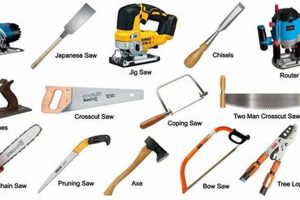
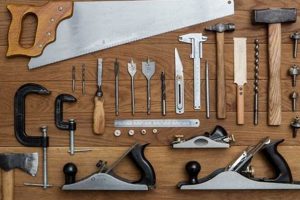
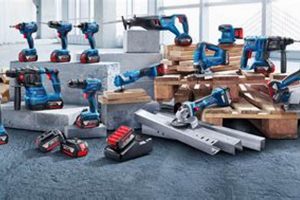
An essential collection of implements for woodworking focuses on acquiring only the most versatile and necessary tools to perform a wide range of tasks. This approach contrasts with accumulating specialized devices that might only be used infrequently. An example involves opting for a high-quality hand saw over multiple powered saws, providing both ripping and crosscutting capabilities.
Adopting this focused strategy offers several advantages. Reduced initial investment makes woodworking more accessible to beginners. Portability is significantly enhanced, allowing for projects in various locations, even without a dedicated workshop. Furthermore, mastering a smaller set of tools encourages a deeper understanding of woodworking techniques, fostering craftsmanship and resourcefulness. Historically, woodworking relied heavily on hand tools, demonstrating the effectiveness of a pared-down approach.
Therefore, further exploration of this collection should consider tools suitable for measuring, cutting, shaping, joining, and finishing wood. The subsequent discussions will detail suggested tools for each of these essential categories, enabling the aspiring or experienced woodworker to effectively build projects with a carefully selected set of equipment.
Essential Guidance for a Streamlined Woodworking Toolkit
The following recommendations provide insight into optimizing a woodworking arsenal for efficiency and versatility. Focusing on quality over quantity, and multipurpose tools over specialized ones, will enhance the woodworking experience.
Tip 1: Prioritize Accurate Measurement: A precise measuring tape and combination square are fundamental. These tools ensure accurate cuts and joints, preventing errors that cascade through the project. A reliable measuring tape with clear markings is indispensable. The combination square serves as both a square and a marking gauge.
Tip 2: Invest in a High-Quality Hand Saw: A well-maintained hand saw, preferably a crosscut saw, can perform many cutting tasks. It offers greater control compared to power saws, particularly when working with delicate pieces. Practice proper sawing techniques to achieve clean and accurate cuts.
Tip 3: Acquire a Versatile Hand Plane: A smoothing plane or block plane is invaluable for refining surfaces, creating precise joinery, and shaping wood. Practice sharpening and tuning the plane to maintain optimal performance. This single tool eliminates the need for multiple grades of sandpaper in some instances.
Tip 4: Choose a Durable Chisels Set: A set of three to four chisels, ranging in size from 1/4 inch to 1 inch, is suitable for mortising, shaping, and cleaning up joinery. Select chisels made from high-carbon steel and learn to sharpen them regularly for optimal performance.
Tip 5: Utilize a Reliable Clamping System: Clamps are essential for holding pieces together during glue-ups. A selection of bar clamps and pipe clamps of varying lengths accommodates most projects. Use cauls to distribute clamping pressure evenly and prevent damage to the wood.
Tip 6: Select a Compact Sharpening Stone: Keeping tools sharp is paramount. A combination waterstone or diamond stone is a space-efficient solution for sharpening chisels and plane irons. Consistent sharpening prolongs tool life and improves woodworking precision.
In Summary, by selecting high-quality, multipurpose tools and maintaining them diligently, a woodworker can accomplish a wide range of projects without the need for an extensive and costly collection. This streamlined approach encourages skill development and a deeper understanding of woodworking principles.
Therefore, with a well-chosen and maintained toolkit, woodworking can become a rewarding and accessible pursuit, regardless of available space or budget. Further refining the toolkit based on specific project requirements can be implemented over time.
1. Essential hand tools

The “minimalist woodworker tool list” concept hinges upon the careful selection of “Essential hand tools.” The former cannot exist effectively without a precise understanding and application of the latter. The causal relationship is direct: a curated inventory focused on essential tools enables a minimalist approach. Examples of cause and effect are evident: selecting a high-quality block plane (an essential hand tool) reduces the need for various specialized shaping tools, contributing directly to a minimized tool collection. A sharp hand saw obviates the need for a power saw for small projects, reducing clutter and cost.
The importance of “Essential hand tools” stems from their versatility and adaptability. A well-chosen set of hand tools allows for a wider range of woodworking tasks to be completed with fewer implements. A real-life example would be using a marking gauge and a chisel to cut perfect dadoes for shelves. Where other woodworkers would use a router, or table saw. As such, understanding the capabilities and limitations of hand tools empowers the woodworker to select only the tools truly needed for the intended scope of work. This understanding directly translates into a “minimalist woodworker tool list” that maximizes efficiency and minimizes waste.
In summary, recognizing and prioritizing “Essential hand tools” is paramount for creating and maintaining a practical “minimalist woodworker tool list.” The emphasis on versatile, adaptable, and well-maintained hand tools leads to a smaller, more efficient toolkit and, consequently, more effective woodworking. A challenge lies in resisting the temptation to acquire specialized tools that offer marginal improvements over core hand tool techniques. Understanding the trade-offs between tool specialization and skill development is crucial for successful minimalism in woodworking.
2. Accurate measuring instruments
The creation and efficacy of a “minimalist woodworker tool list” are directly contingent upon “Accurate measuring instruments.” Precision underpins every aspect of woodworking, and any deviation from accuracy cascades through the entire project, potentially rendering it unsound. Therefore, the selection of instruments capable of delivering consistent and reliable measurements is not merely advisable but fundamentally necessary for minimizing wasted materials and project failures, core tenets of a minimalist approach. For example, utilizing a combination square to verify the 90-degree angle of a cut ensures that joinery will align correctly, preventing the need for corrective actions or material replacement. An inexpensive and inaccurate measuring tape might lead to cumulative errors, ultimately requiring additional wood and increased labor to rectify. This directly contravenes the principles of efficiency and resourcefulness inherent in a streamlined toolkit.
The importance of “Accurate measuring instruments” within a “minimalist woodworker tool list” cannot be overstated, as they directly impact the successful execution of woodworking tasks. A single, high-quality measuring tape that offers both standard and metric measurements, along with fractional markings, eliminates the necessity for multiple specialized tapes. A precision-machined combination square serves as a square, depth gauge, marking gauge, and protractor, further reducing the number of individual tools required. Furthermore, the use of digital calipers provides accurate measurements for interior dimensions and material thickness, tasks that might otherwise necessitate multiple measuring tools or complex calculations. Effective usage of a limited selection of precise instruments promotes efficiency and reduces the likelihood of errors.
In summary, “Accurate measuring instruments” are not simply tools within a “minimalist woodworker tool list,” but rather foundational elements that determine its viability. Emphasizing quality over quantity in measuring tools ensures precision and reduces the need for redundant equipment. The challenge resides in resisting the allure of complex measuring devices when a few carefully selected, accurate instruments can accomplish the same tasks more efficiently. A deep understanding of the principles of measurement and the capabilities of each tool allows for the successful implementation of a minimalist approach, minimizing both the physical size of the toolkit and the likelihood of costly errors.
3. Efficient cutting solutions

The realization of a practical “minimalist woodworker tool list” is inextricably linked to the implementation of “Efficient cutting solutions.” A streamlined toolkit necessitates that each component perform its function optimally, and cutting tools are no exception. The selection of cutting tools directly impacts the versatility of the entire system; inefficient or overly specialized instruments undermine the core tenets of minimalism. For instance, a high-quality handsaw, proficient in both ripping and crosscutting, eliminates the need for multiple specialized saws. A poorly chosen saw, however, necessitates additional tools to compensate for its shortcomings, thereby expanding the toolkit unnecessarily and negating the benefits of a minimalist approach.
The importance of “Efficient cutting solutions” lies in their ability to maximize utility while minimizing redundancy. A well-sharpened and appropriately sized chisel, for example, can perform tasks ranging from delicate paring to rough stock removal, negating the need for a collection of specialized shaping tools. Similarly, a versatile block plane, adept at smoothing, chamfering, and fitting joinery, reduces reliance on sandpaper and other abrasive materials. The selection of cutting tools, therefore, should prioritize adaptability and precision. The ability to perform a wide range of tasks with a single tool is paramount. The consequence of poorly chosen tools will necessitate additional implements.
In summary, “Efficient cutting solutions” are not merely components of a “minimalist woodworker tool list,” but rather essential drivers of its effectiveness. A focus on versatility, precision, and ease of maintenance is paramount when selecting cutting tools. The challenge lies in resisting the allure of specialized tools that offer marginal improvements over established techniques. A thorough understanding of woodworking principles and a commitment to honing skills enable the woodworker to achieve optimal results with a minimal set of high-quality cutting tools, demonstrating the practicality and benefits of a minimalist approach.
4. Reliable joining methods

The efficacy of a “minimalist woodworker tool list” rests significantly on the selection of “Reliable joining methods.” The minimalist approach necessitates that each method employed provides structural integrity and aesthetic appeal using a limited number of tools. The causal link is clear: the more reliable a joining method, the fewer supplementary tools are required for reinforcement or correction. For instance, a well-executed mortise and tenon joint, properly fitted and glued, provides exceptional strength without the need for screws or nails, thereby reducing the tool and material count. Conversely, a poorly executed dovetail joint necessitates the use of fasteners or fillers to compensate for inaccuracies, undermining the minimalist philosophy.
The importance of “Reliable joining methods” within a “minimalist woodworker tool list” stems from their ability to create durable and aesthetically pleasing structures with minimal resource expenditure. The use of hand-cut dovetails, for example, relies primarily on a saw, chisel, and marking gauge, enabling complex joinery with a small set of tools. Similarly, accurate mortise and tenon joints can be achieved with chisels and a marking gauge, eliminating the need for specialized power tools. The selection of appropriate wood species and adhesives further contributes to the reliability of the joint. Therefore, a comprehensive understanding of joinery principles is paramount for maximizing the effectiveness of a streamlined toolkit.
In summary, “Reliable joining methods” are not merely techniques within a “minimalist woodworker tool list,” but rather essential components that ensure its functionality and longevity. An emphasis on precise execution and well-understood joinery principles allows for strong, attractive joints to be created with a limited selection of tools. The challenge lies in mastering fundamental joining techniques and resisting the temptation to rely on hardware or specialized tools as shortcuts. A commitment to craftsmanship and a deep understanding of wood behavior enables the creation of robust structures with a minimal toolkit, exemplifying the core principles of minimalism in woodworking.
5. Effective shaping tools
A direct correlation exists between “Effective shaping tools” and the feasibility of a “minimalist woodworker tool list.” The selection of tools capable of creating a wide range of forms and profiles impacts the size and scope of the overall toolkit. The causal relationship is that versatile implements lessen the need for multiple, specialized devices. For example, a spokeshave, with its ability to shape curved surfaces, reduces the reliance on rasps, files, and sanding blocks, streamlining the shaping process. A poorly selected or inferior tool, by contrast, necessitates additional instruments to compensate for its shortcomings.
The importance of “Effective shaping tools” in the context of a “minimalist woodworker tool list” lies in their capacity to maximize functionality while minimizing redundancy. A single, well-chosen hand plane, such as a block plane or a smoothing plane, can perform a wide variety of shaping tasks, including chamfering edges, creating bevels, and smoothing surfaces. Skillful manipulation of a carving knife allows for intricate details and sculptural forms to be achieved without the need for a multitude of specialized carving gouges. A drawknife, when used with proficiency, enables the efficient shaping of spindles, legs, and other curved components. These tools enhance the toolkit.
In summary, the careful selection of “Effective shaping tools” is crucial for the successful implementation of a “minimalist woodworker tool list.” A focus on versatility, adaptability, and user skill reduces the reliance on specialized, single-purpose devices. Resisting the urge to acquire specialized tools unless absolutely necessary for specific projects is essential. A thorough understanding of shaping techniques and the capabilities of each tool maximizes efficiency and minimizes waste, thus fulfilling the core tenets of woodworking minimalism.
6. Consistent finishing techniques
The successful application of a “minimalist woodworker tool list” necessitates the adoption of “Consistent finishing techniques.” The final appearance and durability of a project hinge on the meticulous execution of finishing processes. Utilizing a limited set of tools and materials requires a deep understanding of their properties and optimal application methods to achieve predictable and satisfactory results.
- Surface Preparation Uniformity
Consistent surface preparation is paramount. Whether sanding, scraping, or using chemical strippers, the goal is a uniform surface free of imperfections. A minimalist approach to sanding may involve using only a few grits of sandpaper, relying on technique to achieve a smooth substrate. The application of finish will accentuate any inconsistencies, making preparation the cornerstone of a successful outcome.
- Application Method Standardization
Standardizing the application method ensures predictable results. Whether brushing, wiping, or spraying, maintaining a consistent technique is crucial. For example, when applying an oil finish, using the same cloth, pressure, and overlapping pattern will result in an even sheen and penetration. Deviations in application technique can lead to uneven coloring or texture, detracting from the overall appearance.
- Material Selection Consolidation
Limiting the number of finishing materials used simplifies the process and reduces the need for specialized tools. Choosing a versatile finish, such as a durable oil-based varnish or a water-based polyurethane, allows for various sheens and protective qualities to be achieved with minimal inventory. Mastering the application of a single finish enables greater control and predictability, reducing the risk of incompatibility issues.
- Controlled Environment Maintenance
Maintaining a controlled environment during the finishing process is critical. Temperature, humidity, and dust levels directly impact the outcome. A consistent environment minimizes the risk of bubbles, cracking, or other finish defects. Utilizing a simple dust collection system and maintaining stable temperature ranges ensures that the finish cures properly and adheres effectively.
By adhering to these facets of “Consistent finishing techniques,” a woodworker can achieve professional-quality results using a “minimalist woodworker tool list.” The emphasis on precision, consistency, and environmental control streamlines the finishing process, minimizing the need for corrective actions or specialized tools. The goal is to create a durable and aesthetically pleasing finish that enhances the natural beauty of the wood, exemplifying the efficiency and resourcefulness of a minimalist approach.
7. Portable sharpening system

The “portable sharpening system” is an indispensable element within a “minimalist woodworker tool list.” The efficacy of edged tools, central to woodworking, is directly proportional to their sharpness. A stationary sharpening station undermines the principles of portability and space efficiency inherent in a minimalist approach. A compact and self-contained sharpening system addresses this need.
- Reduced Footprint
A “portable sharpening system” inherently occupies minimal space, aligning directly with the space-saving objectives of a “minimalist woodworker tool list.” It avoids the need for a dedicated bench grinder or a large collection of sharpening stones. For example, a small double-sided diamond stone and a honing guide can sharpen a wide range of tools while consuming very little space in a toolkit.
- Self-Containment
Effective “portable sharpening system” integrates all necessary components into a single, easily transportable unit. This might include a sharpening stone, honing compound, honing guide, and cleaning materials within a small case or pouch. A self-contained system prevents the scattering of components and ensures readiness for use in any location.
- Versatility of Application
A “portable sharpening system” is capable of maintaining a variety of edged tools, from chisels and plane irons to knives and marking gauges. The inclusion of multiple grits or the ability to use different sharpening media enhances the system’s adaptability. A single system caters to diverse sharpening needs, precluding the need for multiple specialized sharpening devices.
- Independence from Power Sources
The essence of a “portable sharpening system” lies in its independence from electrical power. Relying on manual methods, such as oil stones, water stones, or diamond stones, allows for sharpening in remote locations or during power outages. This off-grid capability is essential for woodworkers who value self-reliance and adaptability.
The integration of a well-chosen “portable sharpening system” amplifies the functionality and self-sufficiency of a “minimalist woodworker tool list.” Prioritizing a compact, versatile, and power-independent system ensures that edged tools remain sharp and effective, regardless of location or circumstances. This commitment to sharpness is a key aspect of achieving quality results within the confines of a streamlined toolkit.
Frequently Asked Questions
The following addresses common inquiries regarding the composition and application of a streamlined woodworking toolkit.
Question 1: What constitutes a minimalist approach to tool selection for woodworking?
A minimalist approach prioritizes versatility and necessity. It focuses on acquiring only the most essential implements capable of performing multiple tasks effectively. The aim is to reduce redundancy and maximize the utility of each item within the toolkit.
Question 2: Is it possible to achieve professional-quality results with a minimalist tool collection?
Yes, provided that the selected tools are of high quality and the woodworker possesses the necessary skills and knowledge. Consistent practice and a thorough understanding of woodworking principles are essential for achieving precision and craftsmanship with a limited set of tools.
Question 3: What are the primary benefits of adopting a minimalist woodworking approach?
The benefits include reduced initial investment, increased portability, enhanced skill development, and a deeper appreciation for craftsmanship. A smaller toolkit also promotes better organization and reduces the likelihood of tool-related clutter.
Question 4: How does one determine which tools are essential for a minimalist woodworking toolkit?
Begin by identifying the most common tasks required for intended projects. Select versatile tools capable of performing these tasks efficiently and accurately. Prioritize tools that can be adapted to multiple functions, reducing the need for specialized implements.
Question 5: Does a minimalist tool list restrict the scope of woodworking projects that can be undertaken?
While it may limit the complexity of certain projects, a minimalist toolkit does not necessarily restrict the scope. A resourceful woodworker can often adapt techniques and tools to overcome limitations, expanding the range of projects achievable with a streamlined collection.
Question 6: How important is tool maintenance within a minimalist woodworking approach?
Tool maintenance is paramount. A well-maintained tool performs optimally and lasts longer, reducing the need for frequent replacements. Sharpening edged tools, cleaning and lubricating moving parts, and storing tools properly are essential for maximizing their lifespan and effectiveness.
In summary, a minimalist approach to woodworking emphasizes careful tool selection, skill development, and consistent maintenance. This combination ensures efficiency, quality, and long-term satisfaction with a streamlined toolkit.
The next section will explore advanced techniques for maximizing the utility of a minimalist woodworking tool collection.
Conclusion
The preceding discussion explored the key components of a “minimalist woodworker tool list,” emphasizing the importance of versatile hand tools, accurate measuring instruments, efficient cutting solutions, reliable joining methods, effective shaping tools, consistent finishing techniques, and portable sharpening systems. It has shown a curated toolkit emphasizing quality over quantity, promoting skill development and resourcefulness. It is a focused strategy over specialization.
Therefore, the enduring value of a thoughtfully composed collection lies not merely in its reduced size but in its capacity to foster a deeper understanding of woodworking principles and an enhanced appreciation for the craft. A skilled artisan can consistently achieve exceptional results with a limited set of carefully chosen and well-maintained tools. This approach invites the artisan to discover the efficiency and effectiveness of carefully chosen tools, creating works of art.
![Essential Specialist Woodworking Tools [Guide] | Step-by-Step Guides, Tools & Inspiration to Build Beautiful Wooden Decor on a Budget](https://woodfromhome.com/wp-content/uploads/2026/04/th-309-300x200.jpg "Essential Specialist Woodworking Tools [Guide] Step-by-Step Guides, Tools & Inspiration to Build Beautiful Wooden Decor on a Budget")
![Smart & Clever Woodworking Tools: [Your Woodworking Goals] | Step-by-Step Guides, Tools & Inspiration to Build Beautiful Wooden Decor on a Budget](https://woodfromhome.com/wp-content/uploads/2026/04/th-305-300x200.jpg "Smart & Clever Woodworking Tools: [Your Woodworking Goals] Step-by-Step Guides, Tools & Inspiration to Build Beautiful Wooden Decor on a Budget")