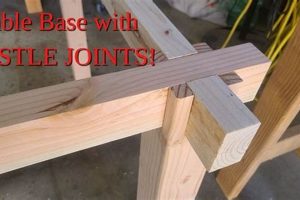
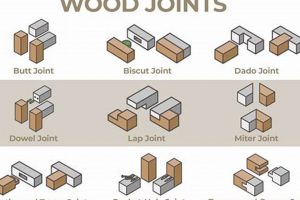
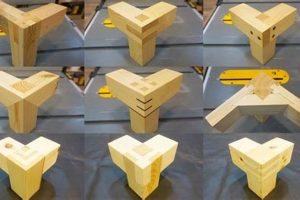
A type of woodworking connection, primarily employed in constructing robust and visually appealing furniture and architectural elements, involves interlocking two pieces of wood through a mortise and tenon arrangement. The tenon, projecting from one piece, fits precisely into the mortise, a cavity cut into the other, creating a strong mechanical bond. This joint is frequently utilized in table legs, door frames, and cabinet construction to ensure structural integrity.
This construction method offers considerable strength and durability, resisting racking and shear forces more effectively than simpler joints. Historically, it has been a cornerstone of woodworking, found in ancient furniture and traditional building designs. Its longevity stems from its ability to distribute stress evenly across the joint, enhancing the overall stability and lifespan of the assembled object.
The subsequent sections of this document will delve into specific techniques for creating these connections, including variations in design, precise cutting methods, and appropriate adhesive selection. Attention will also be paid to the optimal wood species for various applications and finishing techniques that enhance both the aesthetic appeal and functional performance of joined elements.
Essential Guidance for Shoulder Joint Woodwork
The following recommendations are designed to optimize the construction and performance of mortise and tenon joints, ensuring longevity and structural soundness in woodworking projects.
Tip 1: Precise Measurement is Paramount: Accurate dimensioning of both the mortise and tenon is critical. Discrepancies, even minor ones, can compromise the joint’s strength and aesthetic appearance. Employ precision measuring tools and double-check all measurements before cutting.
Tip 2: Wood Selection Affects Performance: The choice of wood species directly impacts the joint’s durability. Hardwoods, such as oak or maple, offer superior strength and resistance to wear compared to softer woods like pine. Consider the intended application when selecting the material.
Tip 3: Ensure Square and Flat Surfaces: The tenon’s shoulders must be perfectly square to the tenon’s face and flush with the surrounding wood. Gaps between the shoulder and the adjoining surface diminish the joint’s strength and require filling, impacting the finish quality.
Tip 4: Mortise Depth Matters: The mortise should be deep enough to accommodate the full length of the tenon without bottoming out. Insufficient depth prevents proper seating of the shoulder, while excessive depth weakens the surrounding material.
Tip 5: Use Appropriate Adhesive: The adhesive used to secure the joint should be specifically formulated for wood and appropriate for the wood species. Follow the manufacturer’s instructions meticulously, ensuring even application and adequate clamping pressure.
Tip 6: Clamping Strategy is Crucial: Apply even and consistent clamping pressure during the adhesive curing process. Uneven pressure can result in skewed joints and compromised strength. Use cauls to distribute the pressure evenly across the joint surface.
These guidelines, if diligently followed, will lead to the creation of strong, reliable mortise and tenon joints, contributing to the overall quality and longevity of woodworking projects.
The subsequent sections of this document will address advanced techniques, including angled joints, draw-bored tenons, and specialized tooling.
1. Precise mortise creation

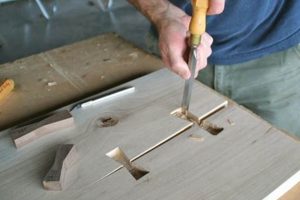
Precise mortise creation forms a fundamental prerequisite for successful implementation. The mortise, a cavity cut into one workpiece, must adhere to specific dimensional tolerances to accommodate the tenon, the projecting element of the adjoining piece. Deviations from these tolerances, even minor ones, can compromise the integrity of the resulting connection. An undersized mortise obstructs tenon insertion, preventing full engagement of the shoulder. Conversely, an oversized mortise introduces excessive play, reducing the surface area available for adhesive bonding and diminishing the joint’s resistance to stress.
Inaccurate mortise creation manifests in various practical consequences. Furniture constructed with poorly executed mortises may exhibit instability, leading to racking or eventual failure under load. Door frames incorporating improperly sized mortises can develop gaps, compromising weather sealing and aesthetic appeal. Cabinet construction suffers similarly, with misaligned components undermining both function and appearance. A real-world example includes a chair leg failing prematurely due to a loose tenon within an improperly sized mortise, highlighting the direct correlation between precision and structural integrity.
Achieving precise mortise creation requires meticulous attention to detail and the employment of appropriate tools and techniques. Accurate layout marking, careful tool selection, and controlled material removal are essential. The practical significance of this understanding lies in the ability to consistently produce robust and aesthetically pleasing joinery, enhancing the overall quality and longevity of woodworking projects. Overcoming challenges in mortise creation often involves honing skills in tool control, material behavior, and the application of sound woodworking principles.
2. Accurate tenon formation

The process of accurately forming the tenon, the protruding element designed to fit within the mortise, represents a critical stage in achieving a structurally sound and aesthetically pleasing connection. Precision in tenon dimensions directly influences the strength and long-term performance of the joint. Deviations from specified measurements can lead to compromised structural integrity and diminished aesthetic quality.
- Dimensional Precision
Achieving precise tenon dimensions ensures a snug fit within the mortise. Undersized tenons result in loose joints, lacking the necessary surface area for effective adhesive bonding. Oversized tenons, conversely, can exert undue stress on the mortise walls, potentially leading to cracking or deformation. The ideal tenon exhibits minimal clearance, allowing for smooth insertion while maximizing contact surface.
- Shoulder Alignment
The tenon’s shoulder, the flat surface that abuts the workpiece containing the mortise, must be perfectly square and flush. Gaps between the shoulder and the mating surface reduce the glue surface area and introduce stress concentrations, weakening the joint. Accurate shoulder alignment ensures even load distribution across the joint, enhancing its resistance to racking and shear forces.
- Tenon Length and Depth
The length of the tenon must correspond precisely to the depth of the mortise. A tenon that is too short fails to fully engage the mortise depth, compromising the joint’s holding power. A tenon that is too long can bottom out within the mortise, preventing proper seating of the shoulder. Correct tenon length and depth are crucial for achieving optimal joint strength and stability.
- Surface Finish and Texture
The surface finish of the tenon should be smooth and free of imperfections. Rough or uneven surfaces hinder adhesive bonding, reducing the joint’s strength. A finely planed or sanded tenon surface promotes optimal adhesion and ensures a consistent clamping pressure across the joint. The texture should be slightly porous to allow the adhesive to penetrate the wood fibers, further enhancing the bond.
In summary, accurate tenon formation, encompassing dimensional precision, shoulder alignment, appropriate length and depth, and optimal surface finish, constitutes an indispensable element. Neglecting these aspects can lead to structurally compromised and aesthetically deficient outcomes. The diligent application of precise woodworking techniques and careful attention to detail are essential for achieving strong and visually appealing connections, ultimately contributing to the overall quality and longevity of woodworking projects.
3. Flush Shoulder Seating

Flush shoulder seating represents a critical element in the successful execution of mortise and tenon joinery. It refers to the precise and complete contact between the shoulder of the tenon and the surface of the workpiece surrounding the mortise. This contact ensures proper load distribution and contributes significantly to the overall strength and stability of the joint.
- Load Distribution and Structural Integrity
The primary role of flush shoulder seating is to distribute forces evenly across the joint. When the shoulder makes full contact with the surrounding surface, stress is spread over a larger area, preventing stress concentrations that can lead to premature failure. In applications such as table legs or door frames, where the joint is subjected to significant loads, proper seating is essential to maintain structural integrity. For instance, a table with poorly seated shoulders may wobble or collapse under weight.
- Aesthetic Considerations
Beyond structural integrity, flush seating contributes to the aesthetic appeal of the finished piece. Gaps between the shoulder and the surrounding surface are visually unappealing and indicate a lack of precision in the joinery. Such gaps disrupt the continuity of the surface and detract from the overall quality of the craftsmanship. In fine furniture making, achieving perfectly flush seating is a hallmark of skilled workmanship.
- Impact on Joint Longevity
Proper seating directly impacts the longevity of the joint. A poorly seated shoulder can allow moisture to penetrate the joint, leading to wood rot or adhesive failure. Furthermore, gaps can accumulate dirt and debris, exacerbating the deterioration process. Joints with flush seating are less susceptible to these issues, ensuring a longer lifespan for the assembled piece. Historic examples of furniture with well-executed mortise and tenon joints demonstrate the durability afforded by this technique.
- Mitigation of Stress Concentrations
The absence of gaps in shoulder seating effectively mitigates the development of stress concentrations. Stress concentrations occur when forces are focused on a small area, exceeding the material’s capacity to withstand the load. This often leads to cracking or fracture. By ensuring even load distribution, flush seating minimizes the risk of stress concentrations, enhancing the joint’s resistance to failure. Examples of engineering applications employing similar principles highlight the effectiveness of distributing load across a wider surface area.
In conclusion, flush shoulder seating is an indispensable component of robust mortise and tenon construction. Its role in load distribution, aesthetic enhancement, longevity, and stress mitigation underscores its importance in achieving high-quality woodworking outcomes. Attention to detail during the cutting and assembly phases is paramount in ensuring proper seating and realizing the full benefits of this traditional joinery technique.
4. Appropriate adhesive application

Adhesive selection and application exert a direct influence on the structural integrity of connections. Adhesive serves not merely as a filler but as an integral component that augments the mechanical strength derived from the physical interlock. The specific adhesive chosen must possess compatibility with the wood species employed, considering factors such as moisture content and porosity. Furthermore, the application method must ensure uniform coverage of the mating surfaces, promoting maximal bond strength across the entire joint area. Insufficient adhesive application leaves voids that compromise the joint’s resistance to tensile and shear forces. An example illustrating this principle is observed in cases where polyvinyl acetate (PVA) adhesive is used with oily woods; the resulting bond is often weak due to interference with the adhesive’s curing process.
The correct application process involves several critical steps. Surfaces must be clean and free from contaminants, such as dust or oil, that inhibit adhesion. The adhesive should be applied in a consistent layer, avoiding excessive amounts that can lead to glue starvation as the joint is clamped. Clamping pressure serves to force the adhesive into the wood pores, creating a mechanical interlock that supplements the chemical bond. Insufficient clamping pressure results in a weaker bond, while excessive pressure can squeeze out too much adhesive, again leading to glue starvation. In practical terms, achieving optimal bond strength requires adherence to the adhesive manufacturer’s recommendations regarding application rate, open time, and clamping pressure.
Ultimately, appropriate adhesive application is not an isolated step but an integrated aspect of the construction process. Failure to attend to this detail can negate the precision and skill invested in other phases. It is a foundational element, directly impacting the strength, durability, and longevity of wood assemblies. The diligent consideration of adhesive selection and application techniques is, therefore, paramount in realizing robust and reliable results.
5. Consistent clamping pressure

Consistent clamping pressure represents a crucial factor in the successful execution of wood joinery, particularly in mortise and tenon connections. Its application directly impacts the strength, stability, and long-term performance of the joint. The principle behind its significance lies in ensuring optimal adhesive bonding between the tenon and the mortise walls. Uniform pressure forces the adhesive into the wood’s pores, creating a mechanical interlock in addition to the chemical bond. Uneven pressure distribution leads to areas of insufficient adhesion, weakening the joint and increasing the risk of failure under stress. For instance, a table leg joined with a mortise and tenon may wobble or break prematurely if clamping pressure was not consistently applied during the adhesive curing process.
In practical applications, achieving consistent clamping pressure necessitates careful consideration of several variables. The type of clamps used, their placement around the joint, and the use of cauls to distribute pressure evenly are all critical. Cauls, typically made of wood or metal, prevent the clamp faces from digging into the workpiece, ensuring that pressure is spread across the entire joint surface. Furthermore, the clamping pressure must be appropriate for the specific adhesive being used. Excessive pressure can squeeze out too much adhesive, leading to glue starvation, while insufficient pressure fails to create a strong bond. Consider the case of constructing a door frame; if one corner of the mortise and tenon joint receives less clamping pressure than the others, the frame may warp or crack over time, compromising its functionality and aesthetic appeal.
In summary, consistent clamping pressure is not merely a procedural step but a fundamental requirement for robust and reliable mortise and tenon joints. Its proper application ensures optimal adhesive bonding, even load distribution, and long-term stability. The challenges associated with achieving consistent pressure can be mitigated through careful clamp selection, strategic clamp placement, and the use of cauls. Understanding the principles governing clamping pressure and its impact on joint performance is therefore essential for producing high-quality woodworking results.
Frequently Asked Questions about Shoulder Joint Woodwork
The following section addresses common inquiries regarding the application, construction, and performance characteristics of mortise and tenon joints, offering clarity on prevalent misconceptions.
Question 1: What constitutes a primary advantage of utilizing this joint construction over simpler methods?
This type of joinery provides superior strength and resistance to racking forces compared to butt joints or dowel joints. The mechanical interlock between the tenon and mortise distributes stress more evenly, enhancing structural integrity.
Question 2: What wood species are generally considered optimal for this type of woodworking?
Hardwoods, such as oak, maple, and ash, are preferred due to their inherent strength and dimensional stability. These species exhibit greater resistance to wear and tear compared to softwoods.
Question 3: How does moisture content affect the longevity of a joint constructed using this method?
Fluctuations in moisture content can cause wood to expand and contract, potentially weakening the joint over time. Proper acclimatization of the wood prior to construction and the use of moisture-resistant adhesives are crucial for mitigating this risk.
Question 4: What clamping strategies contribute to a stronger, more durable joint?
Evenly distributed clamping pressure is essential for ensuring optimal adhesive bonding. The use of cauls and multiple clamps strategically positioned around the joint helps to achieve uniform pressure distribution.
Question 5: How can gaps between the shoulder of the tenon and the surrounding surface be effectively addressed?
Precise cutting and fitting of the tenon and mortise are paramount in preventing gaps. In cases where minor gaps exist, wood filler can be used to fill the voids, although this should be considered a corrective measure, not a substitute for accurate joinery.
Question 6: What are the ramifications of using an adhesive incompatible with the chosen wood species?
Incompatible adhesives may result in a weak or brittle bond, compromising the structural integrity of the joint. It is imperative to select an adhesive specifically formulated for wood and compatible with the wood species being joined.
The successful implementation of solid joinery hinges on a thorough understanding of the principles outlined above, combined with meticulous execution and attention to detail.
The subsequent section will explore advanced techniques and specialized applications of this traditional woodworking method.
Shoulder Joint Woodwork
This document has explored various facets of a fundamental woodworking connection, emphasizing the importance of precision, material selection, and meticulous execution. Key points addressed include accurate mortise and tenon formation, flush shoulder seating, appropriate adhesive application, and consistent clamping pressure. Each element contributes significantly to the structural integrity and aesthetic quality of the finished product.
Mastery of this joint construction technique remains a vital skill for woodworkers seeking to produce durable, aesthetically pleasing, and structurally sound pieces. Continued refinement of these skills will ensure the preservation of traditional woodworking practices and the advancement of innovative design solutions.