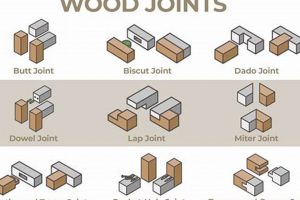
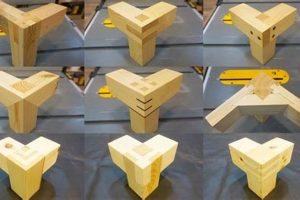
These interlocking corner constructions, often seen in drawers and boxes, feature a series of pins on one board meshing perfectly with corresponding mortises on the adjoining board. The result is a visually appealing and mechanically strong connection. Consider, for example, a dovetailed drawer that has been replaced with this style of woodworking joint.
This method provides exceptional resistance to racking forces due to the increased glue surface area and mechanical interlock. Compared to simple butt joints, this construction is considerably stronger and more durable, making it ideal for applications where longevity and stability are paramount. Historically, it represents a step towards efficient and robust joinery, preceding the widespread adoption of power tools.
The following sections will detail the specific steps involved in creating these connections, exploring various techniques, machine setups, and jig designs that facilitate their accurate and efficient production. We will examine the critical aspects of material selection and proper tool selection for achieving consistently high-quality results.
Essential Considerations for Strong Box Joints
Achieving high-quality interlocking corner joints requires meticulous attention to detail and a thorough understanding of the process. The following tips provide guidance for creating robust and visually appealing connections.
Tip 1: Material Selection: Prioritize hardwoods such as maple, oak, or cherry for their strength and stability. Softwoods may be suitable for less demanding applications, but hardwoods offer superior performance. Consider the grain direction for optimal glue adhesion.
Tip 2: Accurate Measurement: Precision is paramount. Ensure all measurements are accurate to within 1/64 inch. Inaccurate measurements will result in gaps or misalignments that compromise the joint’s integrity. Use high-quality measuring tools and verify their accuracy before proceeding.
Tip 3: Consistent Cutting: Whether using a table saw, router, or dedicated jig, maintain consistent cutting depths and widths. Inconsistent cuts will create uneven pins and mortises, weakening the joint. Employ a test piece to dial in the correct settings before cutting the final workpiece.
Tip 4: Tight-Fitting Joints: Aim for a snug fit between the pins and mortises. A loose fit will weaken the joint and reduce glue surface area. Conversely, an excessively tight fit may cause the wood to split during assembly. A slight resistance when assembling is ideal.
Tip 5: Proper Glue Application: Apply glue evenly to all mating surfaces. Use a high-quality wood glue designed for strong bonds. Ensure complete coverage to maximize the glue’s effectiveness. Avoid excessive glue squeeze-out, which can be difficult to clean and may interfere with the finish.
Tip 6: Clamping Pressure: Apply adequate clamping pressure to ensure a tight bond during glue-up. Use clamps to hold the joint securely in place until the glue has fully cured. Avoid over-clamping, which can starve the joint of glue. Follow the glue manufacturer’s recommendations for clamping time.
Tip 7: Sanding and Finishing: After the glue has cured, carefully sand the joint flush. Begin with a coarse grit sandpaper and gradually move to finer grits for a smooth finish. Apply a suitable finish to protect the wood and enhance its appearance.
By adhering to these guidelines, craftsmen can significantly improve the strength, durability, and aesthetic appeal of interlocking corner joints. These joints represents robust and visually appealing alternative to simple joints.
The following section of this article will address common problems encountered during the execution process and present troubleshooting techniques.
1. Pin/Mortise Ratio

The pin/mortise ratio in interlocking corner joinery significantly influences the joint’s overall strength, aesthetic appeal, and structural integrity. Maintaining a balance between the size and quantity of pins and mortises is essential for optimizing the joint’s performance.
- Strength Considerations
A larger pin-to-mortise ratio, achieved by using wider pins or fewer mortises, can increase the joint’s resistance to tensile forces. However, excessively wide pins can weaken the overall structure by reducing the material surrounding the mortises. Conversely, a smaller pin-to-mortise ratio, achieved by using narrower pins or more mortises, distributes the stress more evenly but might compromise the individual pin’s shear strength. A balanced approach is, therefore, crucial for maximizing the joint’s structural integrity.
- Glue Surface Area
The pin/mortise ratio directly affects the available glue surface area within the joint. A higher number of smaller pins and mortises generally provides a larger total glue surface area, potentially leading to a stronger bond. However, this increased surface area can also make the joint more susceptible to glue starvation if not properly applied. Conversely, fewer, larger pins and mortises may reduce the overall glue surface area but can ensure adequate glue coverage. Proper glue application techniques must be adjusted accordingly.
- Aesthetic Considerations
The pin/mortise ratio influences the visual appearance of the joint. A higher ratio, with fewer, larger pins, creates a bolder, more prominent aesthetic. A lower ratio, with more numerous, smaller pins, results in a finer, more intricate appearance. The choice of ratio should align with the desired aesthetic of the finished piece. Some designs favor a more robust look, while others call for a more delicate finish.
- Wood Movement
The interlocking nature of the corner joints constrains wood movement across the joint’s width. The pin/mortise ratio influences the degree of this constraint. Numerous smaller pins and mortises distribute the stress of wood movement across many points, potentially reducing the risk of cracking or joint failure. Larger pins and mortises concentrate these stresses, making the joint more vulnerable to wood movement. Careful consideration of wood species and environmental conditions is required.
Optimizing the pin/mortise ratio requires a comprehensive understanding of material properties, stress distribution, aesthetic preferences, and the intended application. Appropriate selection will lead to a robust joint capable of withstanding significant stress. Careful evaluation of these elements, combined with sound construction techniques, will contribute to a successful outcome. Alternative joints like miters or rabbets are typically less strong.
2. Material Consistency

Material consistency is of paramount importance when constructing interlocking corner joints, directly affecting joint strength, fit, and long-term stability. Variance in material properties can lead to structural weaknesses and aesthetic imperfections. Attention to these details is crucial for reliable and visually appealing woodworking.
- Wood Density and Hardness
Discrepancies in wood density and hardness between the boards being joined will cause uneven cutting and wear during the joint-making process. Softer wood will compress more readily under the pressure of cutting tools, resulting in pins or mortises that are not dimensionally accurate compared to those cut in harder wood. This inconsistency leads to a poorly fitted joint with gaps and reduced glue surface area. For example, combining pine and maple in a interlocking corner joint is inadvisable.
- Moisture Content
Variations in moisture content between the components of a interlocking corner joint will lead to differential expansion and contraction after assembly. As the wood equilibrates to its environment, the wetter piece will shrink more than the drier piece, resulting in stress within the joint. These stresses can weaken the glue bond, cause cracking, or lead to distortion of the entire assembly over time. Ideally, all wood used for a single project should be acclimatized together to a stable moisture content.
- Grain Orientation
While perfect grain matching is often unattainable, drastic differences in grain orientation between adjacent boards can compromise joint strength. End grain, in particular, provides a poor surface for glue adhesion compared to long grain. If the pins of a interlocking corner joint are predominantly end grain while the mortises are long grain, the joint will be significantly weaker than if both components had consistent grain orientation. Careful selection of lumber and strategic placement of individual pieces are necessary to mitigate this effect.
- Board Thickness Uniformity
Inconsistent board thickness poses challenges in achieving a flush, seamless interlocking corner joint. If one board is slightly thicker than the other, the pins and mortises will not align properly, resulting in an uneven surface. This necessitates additional sanding or planing after assembly, which can alter the dimensions of the joint and potentially weaken it. Precise milling of all boards to the same thickness is essential for a professional-looking and structurally sound joint. This is achievable through use of measuring instrument.
The principles outlined above underscore the necessity for careful material selection and preparation when crafting interlocking corner joints. The performance and longevity of any woodworking project that relies on these structures hinge on the meticulous attention of material related factors. Therefore, adherence to stringent material preparation protocols is crucial for consistently achieving high-quality results.
3. Glue Surface Area

In interlocking corner joinery, the glue surface area represents a critical determinant of joint strength and durability. The substantial increase in bonding surface, compared to simpler joinery methods, stems directly from the interlocking pin and mortise design. This expanded surface provides more area for adhesive bonding, resulting in a significantly stronger connection resistant to racking forces. The size, number, and fit of the pins and mortises directly influence the total bonding area; larger, numerous, and tightly fitted elements maximize the contact between wood and adhesive. Insufficient glue surface area invariably leads to a weakened joint, prone to failure under stress, particularly in applications subject to significant loads or repeated use. For instance, a drawer constructed with these types of joints and ample glue surface will endure far more wear and tear than one using a basic butt joint.
The practical implications of understanding and maximizing glue surface area are considerable. Proper joint design and execution hinge on achieving a close, gap-free fit between pins and mortises. Gaps reduce the effective bonding area, compromising the joint’s integrity. Therefore, precise cutting and meticulous assembly techniques are essential. Furthermore, appropriate glue selection and application are paramount. High-quality wood glues formulated for strong bonds and gap-filling properties are recommended. Even and thorough glue distribution across all mating surfaces ensures maximum contact and prevents dry pockets. The application process should also consider the open time of the glue to prevent premature drying, which could reduce its adhesion.
The correlation between glue surface area and the overall performance of interlocking corner joints highlights the need for precision, attention to detail, and appropriate material selection. Although the interlocking design offers inherent mechanical strength, it is the adhesive bond that truly unites the components and delivers lasting structural integrity. Neglecting the glue surface area, either through poor design, inaccurate execution, or improper gluing techniques, will negate the benefits of this advanced joinery method and inevitably lead to premature failure. Effective execution of interlocking corner joints requires a holistic understanding of the interplay between design, materials, and craftsmanship to fully harness the potential of increased glue surface area.
4. Cutting Precision

In the realm of woodworking, cutting precision is not merely a desirable attribute, but a fundamental requirement for the successful execution of interlocking corner joints. These joints, characterized by their interlocking pins and mortises, demand dimensional accuracy to ensure a tight fit and optimal structural integrity. Deviations from precise measurements during the cutting process can cascade into significant problems, undermining the joint’s strength and aesthetic appeal. For instance, even minor variations in pin or mortise width can lead to gaps, weakened glue bonds, and a visually unappealing outcome. A real-life example underscores this importance: constructing a drawer with these joints where the pins are marginally too wide will result in a drawer that is difficult to assemble, puts undue stress on the wood during assembly and leads to a non-square finished product.
The practical significance of cutting precision extends beyond the initial assembly. A well-executed interlocking corner joint, born from accurate cuts, will maintain its structural integrity over time, resisting the stresses of daily use and environmental fluctuations. Conversely, a poorly cut joint, even if forced together, will be prone to failure, potentially requiring costly repairs or complete replacement. This principle applies across a spectrum of woodworking projects, from small boxes to large cabinets. Achieving the necessary precision often necessitates specialized tools, such as a high-quality table saw, router, or dedicated jig. These tools, when used correctly, enable consistent and accurate cuts, minimizing the risk of error. However, equipment alone does not guarantee success; skilled craftsmanship and a meticulous approach are equally essential.
In summary, cutting precision is an indispensable element of successful interlocking corner joint construction. It directly impacts the joint’s strength, longevity, and visual appeal. The challenges in achieving such precision underscore the value of skilled craftsmanship, specialized tools, and a steadfast commitment to accuracy. Ultimately, a thorough understanding of the cause-and-effect relationship between cutting precision and joint performance is paramount for any woodworker seeking to master the art of interlocking corner joinery.
5. Assembly Technique

The assembly technique employed when working with interlocking corner joints directly dictates the joint’s final strength, appearance, and long-term reliability. These joints, characterized by their intricate interlocking pins and mortises, demand a carefully considered assembly process to ensure proper alignment, prevent damage, and maximize the effectiveness of the adhesive bond. Incorrect assembly can compromise even the most meticulously cut joint, resulting in a weakened structure and a visually flawed outcome. For example, attempting to force a misaligned joint together may cause the pins or mortises to break, rendering the joint unusable. This highlights the critical role of a well-executed assembly strategy.
The practical implications of mastering the assembly technique are numerous. Proper preparation is paramount, involving a dry fit to verify the alignment and identify any potential issues before glue application. Glue should be applied evenly and thoroughly to all mating surfaces, ensuring complete coverage without excessive squeeze-out. Clamping is essential to maintain pressure and ensure a tight fit during the glue’s curing process. Clamps must be strategically placed to distribute pressure evenly across the joint, preventing distortion or misalignment. Furthermore, knowledge of the appropriate clamping pressure is crucial; excessive pressure can starve the joint of glue, while insufficient pressure may result in gaps and a weakened bond. A real-world scenario exemplifies this: constructing a cabinet using interlocking corner joints requires careful consideration of clamp placement to prevent the cabinet from racking or twisting during glue-up.
In summary, the assembly technique is an integral component of successful interlocking corner joint construction. It is not merely a final step, but a crucial process that directly influences the joint’s overall quality and performance. Mastering this technique requires a combination of careful planning, precise execution, and a thorough understanding of woodworking principles. Challenges may arise in achieving perfect alignment and consistent clamping pressure, but these can be overcome with practice and attention to detail. The benefits of a well-executed assembly technique are significant, resulting in a strong, durable, and visually appealing interlocking corner joint.
Frequently Asked Questions
The following section addresses common inquiries regarding interlocking corner joints, offering detailed explanations to clarify aspects of their construction and application.
Question 1: What defines interlocking corner joints from other joinery methods?
Interlocking corner joints distinguishes itself through its interlocking pins and mortises, offering enhanced mechanical strength and a larger glue surface area compared to simpler joints like butt joints or rabbets. The interlocking design provides superior resistance to racking forces.
Question 2: What wood species are most suitable for constructing interlocking corner joints?
Hardwoods such as maple, oak, cherry, and walnut are generally preferred due to their density, strength, and ability to hold fine details. Softwoods can be used for less demanding applications, but hardwoods provide superior durability and resistance to wear.
Question 3: What are the critical factors in achieving a tight-fitting interlocking corner joint?
Accurate measurements, consistent cutting, and precise assembly are paramount. Dimensional inaccuracies, even minor ones, can lead to gaps and weakened joints. Careful attention to detail throughout the construction process is essential.
Question 4: What tools are best suited for cutting interlocking corner joints?
A table saw equipped with a tenon jig, a router with a specialized jig, or a dedicated interlocking corner joint jig are commonly used. The choice depends on the scale of the project, the desired precision, and the available equipment.
Question 5: What type of glue is recommended for interlocking corner joints?
A high-quality wood glue designed for strong bonds and gap-filling properties is recommended. Polyvinyl acetate (PVA) glues are a popular choice, but epoxy or polyurethane glues may be preferred for specific applications or wood species.
Question 6: How can tear-out be minimized when cutting interlocking corner joints?
Using sharp cutting tools, employing backer boards, and carefully controlling the feed rate can help prevent tear-out. Scoring the wood fibers before making the final cut can also reduce the likelihood of splintering.
In summary, the successful construction of interlocking corner joints relies on a combination of careful planning, precise execution, and a thorough understanding of woodworking principles. By addressing these frequently asked questions, a foundation for creating robust and visually appealing woodworking projects is created.
The subsequent section explores common challenges encountered during woodworking box joints and effective troubleshooting strategies.
Conclusion
The exploration of woodworking box joints reveals a multifaceted joinery technique demanding precision, material knowledge, and skillful execution. The strength, aesthetic appeal, and longevity of this construction hinge upon accurate measurements, consistent cutting, appropriate glue selection, and meticulous assembly. Variations in material density, moisture content, or cutting precision directly influence joint performance, underscoring the need for rigorous adherence to established best practices.
Mastery of woodworking box joints empowers craftsmen to create robust, visually compelling structures that withstand the test of time. Further investigation into advanced techniques and material innovations will continue to refine this essential woodworking skill, ensuring its enduring relevance in both functional and artistic applications.