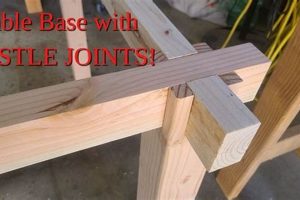
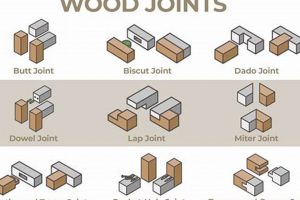
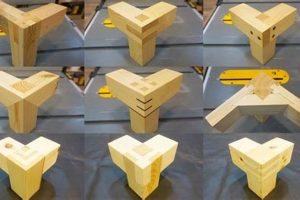
Connections in woodworking that offer exceptional resistance to stress and separation are essential for durable and reliable constructions. These connections, often involving intricate joinery techniques, provide a mechanical bond that withstands significant forces. A mortise and tenon joint, for example, exemplifies this principle by interlocking two pieces of wood with a precisely fitted projection and recess, creating a robust union.
The employment of high-strength connections ensures structural integrity in furniture, cabinetry, and architectural elements. This reliability contributes to the longevity of the finished piece, reducing the likelihood of failure under load or during regular use. Historically, mastery of these techniques was a hallmark of skilled craftsmanship, resulting in lasting works that stand as testaments to both design and execution.
The following sections will explore several methods for achieving exceptionally durable connections, detailing the principles behind their strength and providing guidance on their proper application and construction.
Enhancing Woodworking Through Robust Joinery
The following tips outline crucial considerations for creating reliable and enduring connections in woodworking projects. Adherence to these principles will significantly improve the structural integrity and longevity of finished pieces.
Tip 1: Precise Dimensioning: Accurate measurement and cutting are paramount. Even slight discrepancies can compromise the fit and subsequent strength of a joint. Prioritize meticulous layout and utilize sharp, well-maintained tools.
Tip 2: Grain Orientation: Consider the direction of the wood grain. Aligning grain appropriately can prevent weakness and splitting under stress. For example, avoid placing short grain sections in areas subject to high loads.
Tip 3: Proper Adhesive Selection: Choose an adhesive appropriate for the type of wood and the intended application. Consider factors such as open time, clamp time, and water resistance. Polyurethane glues are suitable for exterior applications, while PVA glues are common for interior work.
Tip 4: Adequate Clamping Pressure: Sufficient clamping force is critical for ensuring proper glue adhesion and joint alignment. Use a variety of clamps to distribute pressure evenly across the joint surface. Avoid over-clamping, which can starve the joint of adhesive.
Tip 5: Joint Surface Preparation: Ensure that all surfaces to be joined are clean, dry, and free of dust or debris. Lightly sanding the surfaces prior to gluing can improve adhesion by increasing surface area.
Tip 6: Reinforcement Strategies: Where additional strength is required, consider incorporating mechanical reinforcement, such as dowels, screws, or wedges. These elements provide supplementary support and resistance to separation.
Tip 7: Test Joints: Before committing to the final assembly, create test joints to verify the accuracy of your cuts and the effectiveness of the chosen technique. This allows for adjustments and refinements without risking the entire project.
By implementing these guidelines, woodworkers can significantly enhance the durability and reliability of their projects. Prioritizing precision, material selection, and proper assembly techniques ensures that connections will withstand the test of time.
The subsequent section will delve into specific types of connections and their optimal applications, providing a deeper understanding of woodworking joinery principles.
1. Precision Fitting

The strength of a woodworking joint is intrinsically linked to the accuracy with which its components are fitted together. Precision fitting is not merely a cosmetic concern; it is a fundamental requirement for achieving robust and reliable connections. The degree of precision directly impacts the surface contact area and the efficiency of load transfer within the joint.
- Maximized Contact Area
Accurate fitting ensures maximum surface contact between the joined pieces. This increased contact area allows for a more effective distribution of adhesive, resulting in a stronger bond. Joints with gaps or irregularities due to imprecise fitting will inevitably exhibit reduced strength due to uneven stress distribution and weakened adhesive bonds. Dovetail joints, for example, rely on precisely cut tails and pins for optimal interlocking and strength.
- Efficient Load Transfer
Precisely fitted joints facilitate efficient transfer of load across the connection. When components fit together seamlessly, the stresses are distributed evenly throughout the joint, minimizing the risk of localized failure. In contrast, poorly fitted joints create stress concentrations at specific points, leading to premature weakening and potential breakage. Mortise and tenon joints, when precisely fitted, transfer tensile and compressive forces effectively.
- Adhesive Bond Integrity
The integrity of the adhesive bond is critically dependent on the accuracy of the fit. Gaps or voids within the joint due to imprecise fitting can weaken the adhesive bond, as the adhesive may not be able to effectively bridge the gaps or maintain consistent pressure. Furthermore, excessive adhesive filling large gaps can result in a weaker, more brittle joint prone to failure. A tight, precise fit minimizes the need for excessive adhesive, promoting a stronger, more durable bond.
- Dimensional Stability
Precise fitting contributes to the overall dimensional stability of the woodworking assembly. Joints that are accurately fitted are less likely to shift, loosen, or distort over time due to environmental changes or applied loads. This stability is crucial for maintaining the structural integrity and aesthetic appeal of the finished piece. Frame and panel construction, where the panel fits precisely within the frame, exemplifies the importance of dimensional stability achieved through precision.
In conclusion, precision fitting is not merely a desirable attribute in woodworking; it is an essential element for achieving strong, durable, and reliable joints. By ensuring accurate dimensions, maximizing contact area, and promoting efficient load transfer, precision fitting plays a crucial role in the long-term performance and stability of woodworking projects. The degree of accuracy directly correlates with the strength and longevity of the final product, highlighting the importance of meticulous craftsmanship.
2. Adhesive Strength

The capacity of an adhesive to resist separation under load is a critical determinant of the overall effectiveness of connections in woodworking. Adhesive strength acts as a primary factor in the development of robust joints, where the adhesive layer serves to unite wooden components, distributing stress and resisting separation forces. Without adequate adhesive strength, even meticulously crafted joinery techniques will ultimately prove insufficient to withstand the demands of long-term use or significant stress. The cause-and-effect relationship is direct: higher adhesive strength translates to a stronger, more durable joint, while insufficient adhesive strength results in a weakened, potentially unstable connection. A real-life example is the failure of a cabinet door constructed with a weak adhesive; the joints will likely separate over time, particularly under the strain of repeated opening and closing.
The selection of an appropriate adhesive is therefore paramount. Different types of adhesives offer varying degrees of strength, flexibility, and resistance to environmental factors. Polyvinyl acetate (PVA) adhesives, commonly used for interior woodworking, provide adequate strength for many applications but may not be suitable for projects exposed to moisture or high stress. Epoxy resins, on the other hand, offer exceptional strength and resistance to moisture, making them well-suited for demanding applications such as boat building or exterior furniture. Cyanoacrylate adhesives, or super glues, provide rapid bonding but generally lack the long-term strength and flexibility required for structural joints. Understanding the specific requirements of the project, including the types of wood being joined, the expected loads, and the environmental conditions, is essential for selecting the adhesive that will provide the necessary strength and durability. Furthermore, proper surface preparation and application techniques are crucial for maximizing the adhesive’s performance. Surfaces must be clean, dry, and free of contaminants that could interfere with bonding. The adhesive must be applied evenly and in the correct amount, and the joint must be clamped securely until the adhesive has fully cured.
In summary, adhesive strength is an indispensable element of construction. Its impact on overall joint integrity and longevity cannot be overstated. Selecting the right adhesive and applying it correctly is vital for achieving joints that are capable of withstanding the stresses of use and time, ultimately contributing to durable, high-quality woodworking projects. The challenges in achieving optimal adhesive strength often lie in balancing the adhesive’s properties with the wood’s characteristics and the project’s intended use. A comprehensive understanding of these factors ensures the creation of connections that not only meet immediate structural needs but also endure over the lifespan of the project.
3. Grain Orientation

Grain orientation significantly impacts the strength and stability of connections in woodworking. The alignment of wood fibers relative to the direction of applied forces dictates the joint’s resistance to stress. Wood is strongest along the grain and weakest perpendicular to it. Therefore, careful consideration of grain direction is essential when designing and constructing connections intended to withstand substantial loads. Failure to account for grain orientation can result in joints that are prone to splitting, cracking, or complete failure, regardless of the joinery technique employed. A miter joint, for instance, is inherently weak because it relies on gluing end grain to end grain, a notoriously poor bond. However, reinforcing a miter joint with splines oriented with the grain running across the miter increases its strength considerably by providing long-grain-to-long-grain gluing surfaces.
The principle of matching grain direction applies to various joinery methods. In mortise and tenon joints, aligning the grain of the tenon with that of the mortise’s surrounding wood enhances the joint’s resistance to shear forces. Conversely, if the tenon’s grain runs perpendicular to the mortise, the joint will be significantly weaker and more susceptible to splitting along the mortise walls. Likewise, in dovetail joints, the interlocking tails and pins derive their strength from the long-grain surfaces that are glued together. The geometry of the dovetails prevents the joint from pulling apart, but the adhesive bond is still critical for distributing the load and preventing individual tails from shearing off. The strategic use of quarter-sawn lumber, with its vertically oriented grain, in critical joint areas can further enhance strength and stability by minimizing seasonal wood movement and reducing the risk of splitting.
Ultimately, understanding and applying the principles of grain orientation is paramount for achieving connections that are both aesthetically pleasing and structurally sound. While precise joinery and appropriate adhesive selection are crucial, they are insufficient without careful consideration of the wood’s natural grain direction. Ignoring this fundamental aspect of woodworking can lead to premature joint failure, compromising the integrity and longevity of the finished piece. Therefore, woodworkers must prioritize grain matching and alignment to maximize the strength and durability of their connections.
4. Mechanical Fasteners

Mechanical fasteners, such as screws, bolts, nails, and dowels, play a critical role in augmenting the strength and reliability of connections in woodworking. Their inclusion, either as a primary joining method or as reinforcement, directly impacts the ability of a joint to resist separation under stress. The application of mechanical fasteners introduces a physical interlock, effectively clamping wood components together. Consider a mortise and tenon joint secured with a dowel; the dowel resists shear forces and prevents the tenon from pulling out of the mortise, adding a layer of mechanical security beyond adhesive bonding. The absence of such fasteners in high-stress applications may lead to premature joint failure, particularly in situations involving significant load or repetitive movement.
The selection of appropriate mechanical fasteners is also crucial. Screw type, size, and material should be chosen based on the wood species and the anticipated stresses on the joint. For example, using coarse-threaded screws in softwood provides better grip than fine-threaded screws. Similarly, the spacing and placement of fasteners must be carefully considered to avoid weakening the wood or creating stress concentrations. Overdriving screws can strip the threads, diminishing their holding power, while closely spaced fasteners can cause wood to split. Bolted connections, often used in heavy timber framing, require precise drilling and the use of washers to distribute pressure evenly, preventing the bolt head from sinking into the wood.
In summary, mechanical fasteners represent a significant means of enhancing connection integrity in woodworking. They provide a tangible method of reinforcement, directly contributing to the creation of durable and stable structures. However, their effectiveness depends on careful selection, proper installation, and a thorough understanding of the forces acting upon the joint. When integrated thoughtfully, mechanical fasteners offer a valuable complement to traditional joinery techniques, ensuring long-lasting performance.
5. Surface Area

In woodworking, the extent of contact between joining surfaces directly influences the adhesive bond strength and overall integrity of connections. A larger bonding area allows for greater distribution of stress and improved resistance to separation forces.
- Adhesive Bond Strength
Increased surface area provides more space for adhesive to bond, leading to stronger joints. For instance, a dovetail joint, with its interlocking tails and pins, offers significantly more surface area for glue than a simple butt joint, resulting in a stronger, more durable connection. The adhesive fills the voids and creates a cohesive bond, distributing stress across the joint.
- Stress Distribution
A wider contact area allows for a more even distribution of stress across the joint. This reduces the likelihood of localized stress concentrations that can lead to premature failure. Scarf joints, used to join long pieces of wood end-to-end, are designed to maximize surface area, thereby distributing tensile stresses more effectively than a simple butt joint.
- Mechanical Interlock Enhancement
In joints relying on mechanical interlock, such as mortise and tenon or lap joints, increased surface area improves the stability and resistance to movement. A longer tenon in a mortise and tenon joint, for example, provides more surface area for the mortise walls to grip, resulting in a stronger and more stable connection.
- Glue Starvation Prevention
Adequate surface area helps prevent glue starvation, a condition where the adhesive is squeezed out of the joint before it can properly set. With ample bonding area, there is less pressure on the glue line, ensuring a sufficient layer of adhesive remains to create a strong and reliable bond.
The role of surface area in enhancing connection integrity is paramount. By maximizing contact between joining surfaces, woodworkers can create connections that are better equipped to withstand stress, resist separation, and ensure the longevity of their projects. Considerations related to surface area are vital for creating exceptionally durable constructions.
Frequently Asked Questions
The following section addresses common inquiries and misconceptions regarding robust connections in woodworking. The information provided aims to clarify key aspects of joint construction and performance.
Question 1: What constitutes a structurally sound connection in woodworking?
A structurally sound connection exhibits resistance to separation under anticipated loads, maintains dimensional stability over time, and effectively transfers stress between joined components. These attributes are contingent upon proper joinery technique, adhesive selection, material compatibility, and consideration of grain orientation.
Question 2: How does adhesive selection influence the longevity of woodworking joints?
The choice of adhesive significantly affects the joint’s resistance to environmental factors, such as moisture and temperature fluctuations. Adhesives possessing superior water resistance and flexibility are generally preferred for exterior applications or joints subjected to cyclic stress.
Question 3: To what extent does grain orientation impact the integrity of a mortise and tenon joint?
Aligning the grain direction of the tenon with that of the mortise enhances the joint’s resistance to shear forces. Conversely, perpendicular grain orientation weakens the joint and increases susceptibility to splitting along the mortise walls.
Question 4: Are mechanical fasteners always necessary for strong woodworking joints?
Mechanical fasteners, such as screws or dowels, provide supplementary reinforcement and can enhance joint stability, particularly in situations involving significant loads or repetitive stress. However, their necessity depends on the specific joint design, material properties, and anticipated service conditions.
Question 5: How does surface preparation contribute to the effectiveness of adhesive bonds?
Proper surface preparation, including cleaning and light abrasion, removes contaminants and creates a textured surface that promotes mechanical interlocking between the adhesive and the wood fibers. This enhances adhesion and improves joint strength.
Question 6: What are the potential consequences of imprecise fitting in woodworking joints?
Imprecise fitting compromises the contact area between joined components, leading to uneven stress distribution, reduced adhesive bond strength, and potential joint instability. Gaps or voids within the joint can weaken the structure and increase the risk of premature failure.
In conclusion, the creation of durable connections requires careful attention to multiple factors, including joint design, material selection, adhesive properties, and construction techniques. A thorough understanding of these principles is essential for achieving robust and reliable results.
The next section will summarize the key takeaways from this exploration of strong woodworking joints.
Conclusion
The preceding discussion has examined various facets of creating mechanically sound connections in woodworking. Key considerations include meticulous fitting, proper adhesive selection, strategic grain orientation, the judicious use of mechanical fasteners, and maximizing bonding surface area. Each element contributes to the overall capacity of a joint to withstand stress and maintain structural integrity over time. Omission or improper execution of any of these factors can compromise the longevity and stability of the finished product.
Effective employment of these principles demands rigorous attention to detail and a comprehensive understanding of material properties. Continued adherence to these practices will not only enhance the quality and durability of woodworking projects but also ensure lasting value in craftsmanship. Professionals must continually refine their skills in joint construction to uphold standards of excellence in the field.