Joint strength in woodworking refers to the capacity of an assembled connection to withstand force and stress without failing. A joint’s ability to resist pulling, twisting, bending, and shearing forces is a critical consideration in constructing durable and stable wooden structures. For example, a well-constructed joint can support significant weight in furniture or withstand strong winds in exterior structures.
The longevity and structural integrity of woodworking projects heavily depend on selecting and executing appropriate jointing techniques. Historically, woodworkers have developed numerous methods to maximize strength based on available tools and materials. Strong joints ensure furniture will endure daily use, buildings will withstand environmental factors, and decorative items will maintain their form over time. Selecting an optimal joint contributes to both the aesthetic appeal and the functional performance of the completed piece.
Evaluating different joining methods reveals variations in their load-bearing capacity and resistance to specific types of stress. Factors influencing the robustness of a wood connection include the surface area of the bond, the type of adhesive used, the precision of the cut, and the orientation of the wood grain. Subsequent sections will examine various common and advanced techniques, assessing their relative merits regarding overall durability and suitability for diverse applications.
Enhancing Woodworking Joint Strength
Optimizing the resilience of woodworking joints is paramount for creating durable and reliable structures. The following guidelines present essential considerations for achieving robust connections.
Tip 1: Grain Orientation Alignment: Orient the wood grain to run parallel across joining surfaces. Aligning the grain minimizes the risk of splitting or weakening due to stress applied perpendicular to the wood fibers.
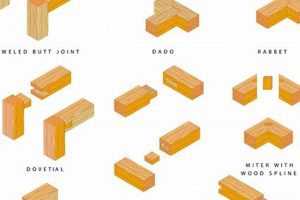
Tip 2: Maximize Surface Area: Increase the contact area between joining surfaces. Larger surface areas provide more space for adhesive bonding, enhancing the overall strength and stability of the connection. The dovetail joint exemplifies this by interlocking the components across a significant area.
Tip 3: Precision Cuts: Employ accurate and precise cutting techniques when creating joint components. Ensure tight fits to eliminate gaps, which reduce the effectiveness of the adhesive and weaken the connection. A well-fitting mortise and tenon, for example, minimizes play.
Tip 4: Adhesive Selection: Utilize appropriate adhesives for the wood species and application. Different adhesives offer varying levels of strength, water resistance, and gap-filling capabilities. Polyurethane adhesives are suitable for exterior applications requiring moisture resistance.
Tip 5: Reinforcement with Mechanical Fasteners: Consider incorporating mechanical fasteners, such as screws or dowels, to supplement adhesive bonding. Fasteners provide added strength, particularly in areas subjected to high stress or impact forces. Screws can be used alongside glue to increase the holding power of a butt joint.
Tip 6: Joint Design for Specific Loads: Design joints to withstand the specific types of loads they will encounter. Different joint types are better suited for resisting tension, compression, or shear forces. A scarf joint is effective for lengthening boards subjected to bending forces.
Tip 7: Clamping Techniques: Employ proper clamping techniques during glue-up to ensure tight and uniform contact between joining surfaces. Adequate clamping pressure facilitates optimal adhesive bonding and minimizes the risk of voids.
Implementing these strategies will lead to more reliable woodworking joints, enhancing the overall quality and lifespan of woodworking projects.
Further sections will explore specific joint types and their applications in greater detail.
1. Load-bearing capacity

Load-bearing capacity is a primary determinant in assessing the effectiveness of woodworking joints. It quantifies the amount of force a joint can withstand before failure, directly influencing the structural integrity and longevity of woodworking projects. Selecting an appropriate joint necessitates understanding its load-bearing capabilities relative to the anticipated stresses.
- Tensile Strength
Tensile strength refers to a joint’s ability to resist forces that pull it apart. Dovetail joints, for instance, are inherently strong in tension due to their interlocking geometry which prevents separation. In furniture construction, this translates to drawers that can repeatedly be opened and closed without the front detaching from the sides. A poorly designed or executed joint lacking tensile strength may fail under minimal stress.
- Compressive Strength
Compressive strength defines a joint’s resistance to forces that compress or crush it. Mortise and tenon joints, particularly when reinforced with pegs, exhibit high compressive strength, making them suitable for supporting heavy loads in structural applications such as tables or building frameworks. The end-grain-to-end-grain compression of a simple butt joint offers limited compressive strength.
- Shear Strength
Shear strength measures a joint’s ability to resist forces that cause one part to slide relative to another. Lap joints and properly executed mortise and tenon joints can effectively resist shear forces, especially when secured with adhesives and fasteners. Shelving units frequently rely on shear strength to prevent shelves from detaching under weight. A joint with low shear strength will be prone to displacement or collapse under lateral forces.
- Torsional Strength
Torsional strength is a joint’s ability to withstand twisting forces. Box joints and certain configurations of mortise and tenon joints, where the tenon wraps around the mortise, can provide significant resistance to torsion. This is essential in structures like chair legs or table supports, where twisting forces are common. Insufficient torsional strength may result in instability or structural failure.
The interplay of these strength characteristics dictates a joint’s overall load-bearing capacity and relevance. While a dovetail joint excels in tensile strength, a mortise and tenon joint is often preferred for applications requiring high compressive strength. Proper assessment of anticipated loads and careful selection of joint design are critical for achieving durable and reliable woodworking structures.
2. Surface area of bond
The strength of a woodworking joint is directly proportional to the surface area available for bonding. A larger bonding surface area allows for a more substantial application of adhesive, creating a stronger connection between the joined components. This relationship explains why certain joints, such as the dovetail or finger joint, exhibit superior strength compared to simpler joints like a butt joint. The dovetail’s interlocking tails and pins significantly increase the gluing surface, distributing stress more evenly across the joint. In contrast, a butt joint relies solely on the end grain’s limited surface area, making it prone to failure under stress. For instance, consider two identical wooden boxes, one assembled with dovetail joints and the other with butt joints. The dovetail-jointed box will withstand significantly more weight and stress before failing, directly attributable to its enhanced bonding surface.
The practical significance of understanding this principle extends to joint selection and execution. When designing woodworking projects, particularly those requiring substantial load-bearing capacity, prioritizing joints with larger bonding surfaces becomes critical. Furthermore, attention to detail during the gluing process is paramount. Ensuring proper glue coverage across the entire surface, applying adequate clamping pressure, and allowing sufficient curing time maximizes the effectiveness of the available bonding area. Projects involving dense or oily woods may necessitate surface preparation, such as sanding or degreasing, to enhance adhesive penetration and adhesion, thereby fully utilizing the bonding potential.
In summary, the surface area of bond represents a foundational factor in determining joint strength. By maximizing the bonding surface and employing proper adhesion techniques, woodworkers can significantly enhance the durability and reliability of their projects. However, challenges persist in uniformly applying adhesive to complex joint geometries and ensuring adequate clamping pressure across all surfaces. Continuous refinement of techniques and advancements in adhesive technology contribute to overcoming these limitations, leading to even stronger and more dependable woodworking joints.
3. Adhesive properties

Adhesive properties exert a significant influence on the overall strength and durability of woodworking joints. The choice and application of an adhesive are critical factors that can either enhance or diminish the performance of even the most skillfully crafted joint. The intrinsic characteristics of an adhesive, including its bond strength, viscosity, and resistance to environmental factors, directly affect the joint’s capacity to withstand stress and strain.
- Bond Strength
Bond strength quantifies the force required to separate two surfaces joined by an adhesive. Higher bond strength indicates a greater resistance to tensile, shear, and compressive forces. For example, epoxy resins generally exhibit superior bond strength compared to polyvinyl acetate (PVA) adhesives, making them suitable for high-stress applications. In woodworking, structural joints in furniture or timber framing benefit from adhesives with exceptional bond strength to ensure long-term stability.
- Viscosity and Gap-Filling Capability
Viscosity describes the thickness of the adhesive, while gap-filling capability refers to its ability to bridge gaps between imperfectly mating surfaces. An adhesive with moderate viscosity is typically preferred for woodworking as it allows for easy application and sufficient penetration into the wood fibers. Adhesives with good gap-filling properties are essential when dealing with joints that are not perfectly flush. Polyurethane adhesives, known for their expanding foam action, are often used when creating joints with slight imperfections.
- Open Time and Curing Time
Open time refers to the period during which an adhesive remains workable after application, while curing time is the duration required for the adhesive to achieve its full strength. Different adhesives have varying open times and curing times, which must be considered during the assembly process. Contact cement, for instance, has a short open time, requiring precise alignment of the joining surfaces. In contrast, PVA adhesives allow for a longer working time, enabling adjustments before clamping.
- Environmental Resistance
Environmental resistance encompasses an adhesive’s ability to withstand exposure to moisture, temperature fluctuations, and ultraviolet radiation. Adhesives used in outdoor woodworking projects, such as decks or garden furniture, must possess high water resistance to prevent joint failure due to moisture penetration. Epoxy and polyurethane adhesives are generally more water-resistant than PVA adhesives. Likewise, projects subjected to extreme temperature variations require adhesives with adequate thermal stability.
In conclusion, the selection of an adhesive with appropriate properties is critical for optimizing the strength and durability of woodworking joints. Bond strength, viscosity, open and curing times, and environmental resistance must all be carefully considered in relation to the specific application and anticipated stresses. Selecting the right adhesive not only complements the chosen joint design but also significantly contributes to the longevity and structural integrity of the final product.
4. Wood grain direction

Wood grain direction, the orientation of wood fibers, significantly impacts the strength and stability of woodworking joints. Understanding and accounting for grain direction is crucial when designing and executing joinery to maximize resistance against splitting, warping, and overall failure. This knowledge is essential for determining appropriate joint selection for specific applications.
- Parallel Grain Alignment
Aligning the grain direction of mating surfaces in a parallel manner enhances the overall strength of the joint. This configuration minimizes the risk of stress concentration and potential splitting, particularly when subjected to tensile forces. For example, in a well-executed mortise and tenon joint, ensuring the grain runs parallel through both the mortise and tenon increases the joint’s resistance to pulling apart. Conversely, attempting to join pieces with perpendicular grain directions often results in a weaker connection susceptible to fracture along the grain.
- End Grain Exposure
End grain, the exposed surface of wood perpendicular to the direction of the fibers, presents a weaker bonding surface compared to long grain. Adhesive penetration into end grain is limited, resulting in a less robust bond. Therefore, joints that rely heavily on end grain adhesion, such as simple butt joints, are generally less strong. Mitigating this weakness involves employing mechanical fasteners or selecting joint designs that minimize end grain exposure.
- Wood Movement Considerations
Wood naturally expands and contracts in response to changes in humidity. Failure to account for wood movement during joint design can lead to stress buildup and subsequent joint failure. Orienting grain direction to accommodate predictable wood movement patterns is essential, especially in larger assemblies. Frame and panel construction, for instance, allows the panel to expand and contract within the frame without compromising the integrity of the surrounding structure.
- Joint Design Optimization
Strategic joint design can leverage grain direction to enhance strength and stability. Interlocking joints like dovetails and finger joints inherently benefit from grain orientation, distributing stress along the grain lines and resisting separation. Conversely, poorly designed joints that ignore grain direction, even with strong adhesives, are prone to failure under minimal stress.
In summary, consideration of wood grain direction is integral to achieving robust and durable woodworking joints. Recognizing the properties of long grain versus end grain, accounting for wood movement, and aligning grain direction strategically within joint designs are critical factors in maximizing the strength and longevity of wooden structures. Ignoring these principles often results in weakened joints and premature failure, regardless of the joint type selected or adhesive employed.
5. Precision of fit

Precision of fit constitutes a critical determinant in the overall strength and performance of any woodworking joint. The degree to which mating components align and interface directly impacts the stress distribution, adhesive effectiveness, and mechanical stability of the assembled connection. Joints lacking precise fitting are inherently weaker and more prone to failure, regardless of the joint type or materials employed.
- Minimized Stress Concentrations
Accurate joinery minimizes stress concentrations by ensuring uniform load transfer across the joint. Gaps or misalignments create points of increased stress, which can lead to premature failure under load. A precisely fitted mortise and tenon joint, for example, distributes force evenly along the entire surface of the tenon, while a loosely fitted joint concentrates stress on edges, potentially causing splitting or detachment. The absence of precision undermines the intended structural behavior of the joint.
- Enhanced Adhesive Bonding
Precision of fit optimizes the effectiveness of adhesives by promoting intimate contact between joining surfaces. Gaps between components reduce the surface area available for bonding and introduce voids that weaken the adhesive bond. A well-fitted dovetail joint, with its tight interlocks, maximizes the area of adhesive contact, resulting in a significantly stronger connection compared to a poorly fitted joint with gaps. Gaps disrupt the continuity of the adhesive layer, diminishing its ability to resist stress.
- Improved Mechanical Interlock
In joints relying on mechanical interlock, such as dovetails or finger joints, precision of fit is paramount. A tight fit ensures that the interlocking elements engage fully, providing mechanical resistance against separation. Loose-fitting interlocking joints offer minimal mechanical advantage, rendering them susceptible to failure under tensile or shear forces. The integrity of the mechanical interlock is directly dependent on the accuracy and precision of the cuts.
- Reduced Risk of Joint Movement
Precise joints minimize movement between joined components. Joints with gaps or poor alignment are more prone to shifting and loosening over time, especially under dynamic loads or fluctuating environmental conditions. This movement can compromise the structural integrity of the assembly and lead to instability. A tightly fitted miter joint in a picture frame, for example, maintains its angle and prevents gaps from forming over time, ensuring a visually appealing and structurally sound connection. Reduced movement enhances the longevity and stability of the joint.
In conclusion, precision of fit is an indispensable factor in achieving strong and durable woodworking joints. It affects stress distribution, adhesive bonding, mechanical interlock, and joint stability. Prioritizing accurate cutting and assembly techniques is essential for maximizing the strength potential of any joint design. While selecting an inherently strong joint design is important, its full potential cannot be realized without meticulous attention to the precision of fit. Achieving a tight, accurate fit represents a cornerstone of robust and reliable woodworking joinery.
6. Joint geometry
Joint geometry, the physical shape and configuration of a woodworking joint, exerts a fundamental influence on its strength and resistance to stress. The arrangement of surfaces, angles, and interlocking elements directly dictates how loads are distributed within the joint and its ability to resist separation. Strong joint designs inherently feature geometries that maximize surface contact, provide mechanical interlocking, and minimize stress concentrations. For example, the dovetail joint achieves remarkable tensile strength through its splayed geometry, which converts pulling forces into compressive forces within the joint, effectively preventing the tails from being withdrawn from the pins. Conversely, a simple butt joint, lacking any specialized geometry, relies solely on adhesive bond strength and is inherently weaker.
Variations in joint geometry allow for optimization based on the specific loading conditions and material properties involved. Mortise and tenon joints, with their rectangular tenons fitting snugly into corresponding mortises, excel in resisting compressive forces. The geometry of a scarf joint, with its angled and overlapping surfaces, creates a long grain-to-grain bond ideal for lengthening boards under bending stress. The selection of an appropriate joint geometry requires a thorough understanding of the forces acting upon the structure and the inherent strengths and weaknesses of different geometric configurations. A poorly chosen geometry can negate the benefits of even the highest-quality materials and adhesives.
Ultimately, joint geometry serves as a foundational element in determining the overall strength of a woodworking joint. It dictates how stress is distributed, how effectively adhesives can bond surfaces, and how mechanical interlocking can resist separation. Careful consideration of joint geometry during the design phase is crucial for achieving durable and reliable woodworking structures. While factors such as adhesive selection, precision of fit, and wood grain direction are undeniably important, they are secondary to the fundamental role of geometry in establishing the joint’s inherent strength and resilience. In conclusion, a robust joint is inextricably linked to a strategically designed joint geometry.
7. Fastener integration

Fastener integration, the strategic incorporation of mechanical fasteners such as screws, nails, or dowels, represents a critical technique for enhancing the strength and reliability of woodworking joints. While certain joints, such as dovetails, possess inherent structural robustness due to their interlocking geometry, fastener integration provides an added layer of security and resistance, particularly against specific types of stress. The addition of screws to a mortise and tenon joint, for instance, reinforces the joint’s resistance to racking forces, minimizing the likelihood of deformation or failure under lateral loads. Furthermore, fasteners can compensate for imperfections in joint fit or adhesive bonding, ensuring a more consistent and predictable performance. The proper selection and application of fasteners are therefore essential considerations in achieving optimal joint strength.
The choice of fastener is directly related to the type of joint and the anticipated loading conditions. Screws, with their superior holding power, are well-suited for joints subjected to tensile forces, while nails are often employed in shear-resistant applications. Dowels, cylindrical wooden pins, offer both mechanical reinforcement and increased surface area for adhesive bonding. In timber framing, large wooden pegs (dowels) are frequently used to secure mortise and tenon joints, providing exceptional resistance to both tensile and compressive forces. Effective fastener integration requires careful planning, including appropriate fastener spacing, depth, and orientation relative to the wood grain. Overdriving fasteners can damage the surrounding wood fibers, compromising the joint’s integrity.
In summary, fastener integration serves as a valuable strategy for maximizing the strength and durability of woodworking joints. By strategically incorporating mechanical fasteners, woodworkers can enhance the joint’s resistance to specific types of stress, compensate for imperfections, and ensure a more consistent performance. However, it is crucial to consider the choice of fastener, proper application techniques, and the potential for wood damage. While the inherent strength of the joint design is paramount, thoughtful fastener integration can significantly increase the overall robustness and longevity of woodworking projects.
Frequently Asked Questions
This section addresses common inquiries regarding joint strength in woodworking, offering definitive answers and clarifying prevalent misconceptions.
Question 1: Is there a single joint universally recognized as possessing the most strength?
No singular joint holds the title of “strongest” in all circumstances. Strength is contingent on loading conditions, wood species, adhesive selection, and execution precision. While certain joints, such as the dovetail or mortise and tenon, exhibit superior strength in specific applications, the optimal choice depends on a comprehensive analysis of these factors.
Question 2: How does wood grain direction influence joint strength?
Wood grain direction significantly impacts joint strength. Aligning grain direction between mating surfaces typically enhances tensile strength, while joining end grain to long grain inherently creates a weaker bond. Joint designs that account for wood movement due to humidity fluctuations are essential for long-term stability.
Question 3: What role does adhesive play in determining joint strength?
Adhesive selection and application are critical determinants of joint strength. Different adhesives offer varying bond strengths, viscosities, and environmental resistances. The adhesive must be appropriate for the wood species, loading conditions, and intended use of the project. Proper surface preparation and clamping techniques are also essential for maximizing adhesive effectiveness.
Question 4: Can mechanical fasteners compensate for a poorly executed joint?
Mechanical fasteners, such as screws or dowels, can augment the strength of a joint, but they cannot entirely compensate for fundamental flaws in its design or execution. Fasteners primarily enhance resistance to specific types of stress, such as shear or tension. A well-executed joint with appropriate adhesive typically outperforms a poorly fitted joint heavily reliant on fasteners.
Question 5: Does joint size directly correlate with joint strength?
While increasing joint size can enhance strength by providing a larger bonding surface area, it is not the sole determinant. Joint geometry, precision of fit, and wood grain direction all play critical roles. A smaller, well-designed and executed joint can often outperform a larger, poorly executed one.
Question 6: How important is precision in creating strong woodworking joints?
Precision of fit is paramount for achieving robust and durable joints. Gaps or misalignments create stress concentrations and reduce the effectiveness of adhesives. A tightly fitted joint ensures uniform load transfer and maximizes the mechanical interlock between components.
The strength of a woodworking joint is a multifaceted consideration requiring careful attention to design, materials, and execution. Understanding the interplay of these factors is crucial for creating reliable and enduring structures.
The following section delves into advanced techniques for enhancing joint stability and resistance to specific loading conditions.
Determining Optimal Woodworking Joint Strength
The examination of woodworking joints reveals that no singular connection universally qualifies as the strongest. Rather, the optimal choice necessitates a rigorous assessment of intended load, material properties, joint geometry, adhesive characteristics, and execution precision. Factors such as wood grain direction, surface area of bond, and the integration of mechanical fasteners significantly influence a joint’s overall resistance to stress and potential for long-term structural integrity.
Mastery of joinery principles demands a commitment to informed decision-making and meticulous craftsmanship. Continued exploration of advanced techniques and materials will undoubtedly refine our understanding of joint behavior and enhance the durability of wooden structures. Prudent selection and skillful execution remain paramount in achieving robust and enduring woodworking outcomes, contributing to the longevity and functional excellence of crafted objects.