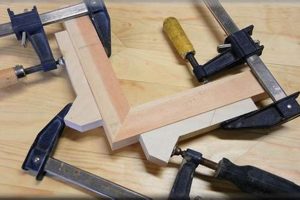
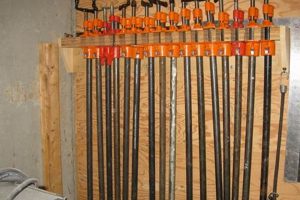
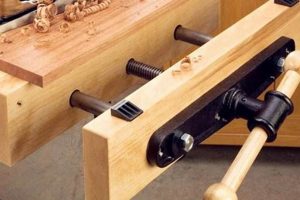
These tools are designed to secure workpieces during assembly, gluing, and finishing in woodworking projects. They apply pressure to hold materials firmly in place, ensuring accurate alignment and strong bonds. Ranging from small spring clamps to large bar clamps, they accommodate various project sizes and material thicknesses. A common application is holding together pieces of wood while adhesive dries.
Their role in woodworking is critical for achieving precise and durable results. Properly secured workpieces prevent slippage and movement, leading to cleaner joints and stronger constructions. Historically, woodworking relied on makeshift clamping solutions; however, advancements in materials and design have led to the development of more efficient and reliable clamping systems, improving accuracy and reducing project completion time.
The following sections will delve into the specific types available, considerations for selecting the appropriate model, and best practices for utilizing these devices to maximize efficiency and project quality in woodworking applications.
Essential Usage Strategies
Effective application of these devices enhances woodworking precision and project stability. The following strategies outline best practices for optimal utilization.
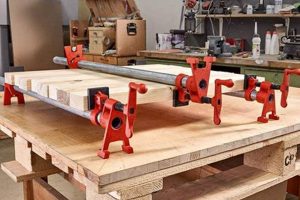
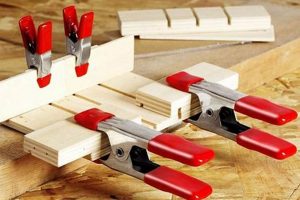
Tip 1: Select Appropriate Type: Employ bar clamps for larger surface areas requiring substantial pressure, while spring clamps are suitable for lighter tasks and quick fixes. Consider pipe clamps for extensive lengths and projects demanding exceptionally strong holding force.
Tip 2: Distribute Pressure Evenly: Utilize multiple tools to distribute force uniformly across the joint. This prevents warping or uneven pressure, which could compromise the integrity of the assembled piece.
Tip 3: Protect Work Surface: Employ protective pads or cauls between the clamp jaws and the wood surface. This safeguard prevents indentation and marring of the workpiece’s finish.
Tip 4: Avoid Over-Tightening: Excessive force can damage both the workpiece and the clamp itself. Apply sufficient pressure to secure the materials without crushing or deforming them. Evaluate the wood density during force implementation.
Tip 5: Proper Alignment: Ensure the materials are properly aligned before applying pressure. Misalignment can lead to structural weakness and visual imperfections in the final product.
Tip 6: Consistent Maintenance: Regularly clean and lubricate the threads of adjustable models to maintain smooth operation and prevent corrosion. Inspect pads for wear and replace as needed.
Tip 7: Consider Jaw Depth: Select models with sufficient jaw depth to accommodate the thickness of the materials being joined. Insufficient depth reduces holding strength and stability.
These strategies, when consistently applied, will contribute significantly to improving the quality and durability of woodworking projects. Proper application not only secures components effectively, but also preserves material integrity.
The subsequent sections will explore selection considerations in greater detail, addressing the specific factors to evaluate when choosing the ideal system for various woodworking applications.
1. Clamping Force

Clamping force is a critical factor determining the effectiveness of these tools in woodworking. It refers to the amount of pressure a clamp can exert on a workpiece, directly influencing the strength and stability of the resulting joint or assembly.
- Joint Integrity
Insufficient clamping force can lead to weak or compromised joints. When pressure is inadequate, adhesive bonds may not form properly, resulting in gaps or movement within the joint. An example includes a loosely-clamped mortise and tenon joint failing under stress, whereas a properly clamped joint maintains its structural integrity. These tools with higher force capabilities are preferred for critical joints.
- Material Deformation
Conversely, excessive clamping force can cause material deformation or damage. Softwoods are particularly susceptible to crushing under high pressure, leading to visible indentations or structural weakening. Appropriate selection involves assessing the material’s density and matching it with the devices force capabilities to prevent damage.
- Clamp Design and Mechanism
The clamping force generated is dependent on the design and mechanism of the specific tool. Bar clamps, for instance, typically offer greater force than spring clamps due to their lever-action design. The screw mechanism or ratchet system contributes significantly to the amount of pressure that can be applied. Models with enhanced mechanisms allow for more controlled and precise force application.
- Application Specificity
The necessary clamping force varies depending on the specific woodworking application. Gluing large panels requires a uniform and substantial force to ensure complete adhesion across the entire surface. Securing intricate carvings may only require light force to avoid damaging delicate features. Therefore, the chosen tool must align with the demands of the task at hand.
In summary, optimizing clamping force involves selecting the appropriate tool based on material properties, joint requirements, and clamp design. Accurate application of force ensures strong, stable joints without causing material damage, underscoring the significance of understanding the relationship between clamping force and desired woodworking outcomes.
2. Jaw Capacity
Jaw capacity, a fundamental attribute, dictates the maximum workpiece dimension that a clamping tool can accommodate. This specification directly influences the versatility and applicability of these clamping devices in woodworking scenarios. A mismatch between workpiece size and tool jaw capacity renders the tool ineffective, hindering project execution. For example, attempting to clamp a wide tabletop with a clamp possessing insufficient capacity would prevent secure assembly, potentially leading to misalignment and structural instability. Accurate evaluation of project dimensions prior to clamp selection is therefore paramount.
The available range of jaw capacities across product lines addresses varying project needs. Models designed for small-scale crafts, such as picture frames or jewelry boxes, exhibit limited capacity. Conversely, heavy-duty options designed for furniture construction or cabinetry possess extended jaw capacities to handle larger components. An illustrative application involves furniture building, where long bar clamps with substantial jaw capacities are essential for joining table legs to aprons or securing cabinet frames during assembly. Selecting clamps with appropriate capacity ensures secure and accurate workpiece fixation.
In summary, jaw capacity serves as a primary determinant of a tool’s suitability for a given woodworking task. Correct assessment of workpiece dimensions and judicious selection of tools with corresponding capacities are critical for achieving secure clamping, accurate alignment, and structurally sound results. Failure to consider jaw capacity can impede project progress and compromise the quality of the finished piece. This understanding forms a cornerstone of effective tool selection in woodworking.
3. Material Quality
The effectiveness and longevity of these devices are intrinsically linked to the quality of materials used in their construction. The selection of materials directly impacts the ability to withstand repeated stress, resist corrosion, and maintain clamping force over extended periods. Consequently, inferior material quality leads to premature failure, reduced clamping performance, and potential damage to workpieces. For example, clamps constructed from low-grade steel are susceptible to bending or breaking under pressure, compromising their ability to securely hold materials and potentially causing misalignment or instability during woodworking operations.
Critical components, such as the threaded rods, swivel heads, and clamp bars, benefit significantly from high-quality materials. Heat-treated steel, for instance, offers enhanced strength and durability, resisting deformation and ensuring consistent clamping force. Protective coatings, such as zinc plating or powder coating, mitigate the risk of corrosion, extending the lifespan of the tools in various environmental conditions. The implementation of robust materials also contributes to the tool’s resistance to wear and tear, especially in professional settings where frequent use and demanding applications are the norm. Utilizing these models ensures reliability in demanding environments.
In conclusion, material quality is a paramount consideration when evaluating the overall value and performance of these tools. Selecting a model constructed from durable, corrosion-resistant materials translates to enhanced reliability, extended lifespan, and ultimately, improved woodworking outcomes. Investing in quality materials reduces the likelihood of premature failure and minimizes the risk of workpiece damage, thus representing a strategic investment for woodworking professionals and hobbyists alike.
4. Ergonomic Design
Ergonomic design in woodworking clamps significantly impacts user experience and efficiency. Poorly designed handles, awkward adjustment mechanisms, or excessive weight can lead to fatigue, reduced precision, and potential injuries. Ergonomic considerations, therefore, are integral to the effective and safe operation of these tools. For example, a clamp with a handle that is difficult to grip or requires excessive force to tighten can cause hand strain and reduce the user’s ability to apply consistent pressure, potentially compromising the quality of the woodworking joint. Similarly, clamps with uncomfortable or sharp edges can cause discomfort and increase the risk of cuts or abrasions during extended use.
Ergonomic features in clamps aim to mitigate these risks and enhance usability. Examples include handles with contoured grips that conform to the shape of the hand, reducing strain and providing better control. Quick-release mechanisms that allow for rapid adjustments and clamp removal minimize downtime and improve workflow efficiency. Lightweight materials, such as aluminum or composite polymers, reduce the overall weight of the tool, making it easier to handle and maneuver, particularly during large-scale projects. Furthermore, strategically positioned handles and adjustment points enhance leverage and reduce the force required to apply clamping pressure, minimizing user fatigue.
In conclusion, ergonomic design is a critical component of these clamping tools, influencing user comfort, safety, and productivity. Prioritizing ergonomic features translates to reduced strain, improved control, and enhanced efficiency in woodworking applications. Investing in tools with well-designed ergonomic features is therefore a practical investment for both professional woodworkers and hobbyists, promoting long-term well-being and maximizing the quality of woodworking projects.
5. Versatility
The versatility inherent in woodworking clamping tools directly correlates to their adaptability across diverse projects. This attribute extends beyond mere size adjustability, encompassing the ability to conform to various shapes, materials, and clamping requirements. The absence of versatile features limits the range of applications and necessitates a larger inventory of specialized tools, increasing both expense and storage demands. Models that offer interchangeable jaws, adjustable pressure settings, or the ability to function in multiple orientations exemplify versatility. These attributes enable a single tool to perform multiple functions, reducing the need for numerous specialized clamps.
Consider the construction of a complex curved furniture piece as an illustrative example. A clamp with limited versatility may struggle to conform to the irregular contours, potentially leading to uneven pressure distribution and a compromised joint. Conversely, a versatile model, equipped with pivoting jaws or flexible clamping arms, can adapt to the curvature, ensuring uniform pressure and a secure bond. Similarly, a clamp that can function as both a standard bar clamp and a pipe clamp expands its utility, allowing it to accommodate projects of varying scale and complexity. Such adaptability not only simplifies the workflow but also reduces the risk of project delays due to tool limitations.
In summary, the versatility of woodworking clamping tools is a key determinant of their overall value and applicability. This attribute facilitates adaptability to diverse project demands, reduces the need for specialized tools, and ultimately enhances efficiency and cost-effectiveness in woodworking operations. Prioritizing versatility during tool selection ensures a broader range of project capabilities and maximizes the return on investment, contributing to improved workflow and overall project quality.
6. Durability
Durability is a crucial characteristic directly influencing the long-term performance and value proposition of woodworking clamps. As tools subjected to repetitive stress and force, these clamps require robust construction to withstand the demands of woodworking applications. The durability of these devices, therefore, dictates their ability to maintain clamping force, resist deformation, and withstand environmental factors over time. The practical effect of a durable model includes minimal degradation from usage with sustained performance of the tool.
The materials and manufacturing processes employed in the construction of woodworking clamps are central to their durability. High-strength steel alloys, heat-treated components, and protective coatings contribute to resistance against bending, breaking, and corrosion. An example is a bar clamp with a hardened steel bar that maintains its straightness under heavy pressure, ensuring consistent and reliable clamping force. Conversely, models constructed from weaker materials are prone to premature failure, reducing their lifespan and increasing the need for replacement.
In conclusion, the emphasis on durability within the design and manufacturing of these tools is essential for ensuring long-term performance and value. Selecting models constructed from high-quality materials and employing robust manufacturing processes mitigates the risk of premature failure and contributes to a longer lifespan. This investment in durability translates to improved reliability and reduced long-term costs for woodworking professionals and hobbyists alike, underscoring the practical significance of prioritizing durability when selecting woodworking clamping tools.
7. Adjustment Speed
Adjustment speed is a critical factor influencing efficiency and productivity when utilizing woodworking clamps. It denotes the rapidity with which a user can modify clamp settings, such as jaw opening or clamping pressure, to accommodate varying workpiece dimensions or project requirements. In woodworking, where time is often a constraint, adjustment speed directly impacts project completion rates and overall workflow optimization.
- Thread Pitch and Mechanism
Thread pitch and the associated mechanism dictate adjustment speed. Clamps employing a coarse thread pitch allow for faster linear movement of the jaws per revolution of the adjustment handle compared to fine thread pitches. However, fine thread pitches often provide greater precision in pressure application. The choice between speed and precision depends on the specific task and user preferences. Quick-release mechanisms represent an alternative approach, enabling rapid clamp opening and closing with minimal rotational adjustments.
- Handle Design and Ergonomics
Handle design and ergonomics also influence adjustment speed. Large, easily gripped handles facilitate quicker and more comfortable adjustments, especially when applying significant clamping force. Smooth, non-slip handle surfaces ensure a secure grip even with sweaty or gloved hands. Conversely, small or awkwardly shaped handles can impede adjustment speed and increase user fatigue, especially during repetitive clamping operations.
- Clamp Type Considerations
Adjustment speed varies across different clamp types. Bar clamps typically offer faster adjustment speeds than screw clamps due to their sliding jaw design, which allows for rapid repositioning along the bar. Spring clamps offer the fastest adjustment for temporary holding, but their clamping force is limited. Pipe clamps, while offering substantial clamping force, often require more time for adjustment due to the threading along the pipe length. Understanding the inherent adjustment speed characteristics of each clamp type is crucial for selecting the appropriate tool for a given task.
- Impact on Project Workflow
Streamlined adjustment speed facilitates efficient workflow management. When tasks require frequent modifications to jaw spacing or tension, a clamp with smooth and rapid adjustment capabilities becomes indispensable. It supports quicker transitions between project stages, enabling operators to adapt rapidly to evolving demands, ultimately optimizing productivity and meeting critical project timelines.
In conclusion, adjustment speed is a significant determinant of efficiency in woodworking applications. The interplay between thread pitch, handle design, clamp type, and their combined impact on workflow efficiency underscores the importance of considering adjustment speed during tool selection. Prioritizing adjustment speed optimizes the user experience and enhances overall productivity in woodworking projects.
Frequently Asked Questions About Woodworking Clamps
The following section addresses common inquiries regarding woodworking clamps. It aims to provide clear, concise answers to assist in selecting and utilizing these tools effectively.
Question 1: What is the optimal clamping force for securing softwood without causing damage?
Optimal clamping force varies depending on the specific softwood species and thickness. A general guideline is to apply sufficient pressure to close the joint firmly without visibly compressing the wood fibers. Test clamping on scrap material is recommended to determine the appropriate force.
Question 2: How frequently should woodworking clamps be inspected for wear and tear?
Regular inspection is essential for maintaining clamp safety and performance. It is recommended to inspect clamps before each use, paying particular attention to threaded rods, swivel heads, and clamp pads for signs of damage or wear. Clamps exhibiting significant wear should be repaired or replaced.
Question 3: What are the benefits of using cauls with woodworking clamps?
Cauls distribute clamping pressure evenly across the workpiece surface, preventing localized indentations and ensuring a uniform bond. They are particularly useful when clamping thin or delicate materials that are susceptible to damage from concentrated pressure.
Question 4: How does jaw capacity affect the selection of a woodworking clamp?
Jaw capacity determines the maximum workpiece dimension that a clamp can accommodate. Selecting a clamp with sufficient jaw capacity ensures that the tool can securely hold the materials being joined, preventing slippage and misalignment.
Question 5: What is the proper procedure for cleaning and lubricating woodworking clamps?
To maintain smooth operation and prevent corrosion, clamps should be cleaned regularly with a dry cloth to remove dust and debris. Threaded rods should be lubricated periodically with a light machine oil. Avoid using abrasive cleaners or solvents, as these can damage the clamp’s finish.
Question 6: Are there specific safety precautions to observe when using woodworking clamps?
Safety is paramount when using woodworking clamps. Always wear safety glasses to protect against flying debris. Avoid over-tightening clamps, as this can damage the workpiece or the clamp itself. Never use clamps that exhibit signs of damage or malfunction.
This FAQ section serves as a resource for addressing fundamental concerns. Proper application of these practices will result in safer, more effective clamping operations.
The subsequent section will address advanced techniques for specialized woodworking applications, discussing how to get the most out of these tools.
Concluding Remarks
This exposition has examined the characteristics, usage strategies, selection considerations, and frequently asked questions pertaining to woodworking clamps. A comprehensive understanding of clamping force, jaw capacity, material quality, ergonomic design, versatility, durability, and adjustment speed contributes to informed decision-making and optimized woodworking outcomes. The strategies outlined for effective application will enhance precision and project stability, facilitating improved results in various woodworking tasks.
The appropriate selection and diligent maintenance of these tools represent a commitment to quality craftsmanship and project longevity. Continued adherence to best practices in clamping techniques will invariably lead to superior woodworking outcomes. The pursuit of excellence in woodworking necessitates a thorough understanding of its fundamental tools, including these models, and their judicious application.
![Top-Rated: Best Quick Clamps for Woodworking Projects [2024] | Step-by-Step Guides, Tools & Inspiration to Build Beautiful Wooden Decor on a Budget](https://woodfromhome.com/wp-content/uploads/2026/04/th-264-300x200.jpg "Top-Rated: Best Quick Clamps for Woodworking Projects [2024] Step-by-Step Guides, Tools & Inspiration to Build Beautiful Wooden Decor on a Budget")