



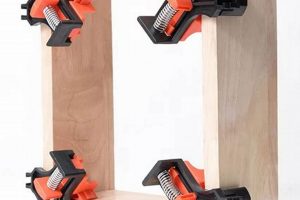
These specialized tools, crucial for joinery, hold workpieces at a precise 90-degree orientation. They ensure corners are square during fastening, enabling the creation of robust and accurate assemblies. For example, they are used to secure cabinet frames while glue dries or to align drawer boxes for screwing.
Achieving perpendicularity in woodworking is often vital for both structural integrity and aesthetic appeal. The use of these devices expedites this process, reducing the likelihood of errors and improving overall project quality. Their historical prevalence demonstrates the enduring need for accurate corner alignment across diverse woodworking projects, from simple boxes to complex furniture.
The subsequent sections will delve into the diverse types available, the materials from which they are constructed, selection criteria, and proper usage techniques for these essential workshop aids.
Essential Usage Considerations
Optimal performance requires understanding and applying certain principles. The following guidance promotes accurate and efficient woodworking outcomes.
Tip 1: Ensure Compatibility: Evaluate the material thickness and joint configuration before selecting a particular clamp. Overly large or small models may fail to apply appropriate pressure or properly align workpieces.
Tip 2: Even Pressure Distribution: Distribute clamping force uniformly across the joint. Uneven pressure can distort the pieces, compromising the squareness of the corner.
Tip 3: Protective Measures: Utilize pads or shims between the clamp faces and the workpiece surfaces. This minimizes the risk of marring or denting the wood, especially with softwoods or delicate finishes.
Tip 4: Avoid Overtightening: Apply sufficient pressure to hold the joint securely, but avoid excessive tightening. Overtightening can damage the wood fibers or the clamp itself.
Tip 5: Verify Squareness: Before the adhesive sets or fasteners are driven, use a reliable square to confirm the 90-degree angle. Make necessary adjustments while the assembly is still flexible.
Tip 6: Consider Multiple Clamps: For larger or more complex assemblies, employ multiple tools to maintain consistent alignment and pressure throughout the joint.
Tip 7: Regular Maintenance: Inspect regularly for wear, damage, and cleanliness. Clean threads and moving parts to ensure smooth operation and longevity. Lubricate as needed according to the manufacturer’s recommendations.
Adhering to these guidelines enhances the precision, stability, and longevity of woodworking projects. Consistent application of these techniques leads to improved craftsmanship and reduced errors.
The subsequent discussion will focus on troubleshooting common issues encountered during their utilization.
1. Squareness Accuracy

The precision of these devices hinges fundamentally on their capacity to maintain squareness. This characteristic directly influences the structural integrity and visual appeal of finished woodworking projects. A clamp that deviates from a true 90-degree angle introduces cumulative errors, leading to misaligned corners and compromised assemblies.
- Manufacturing Tolerance
The manufacturing process dictates the inherent accuracy of the clamp. Variations in materials, machining, and assembly can introduce slight deviations from a perfect right angle. Higher-quality clamps typically undergo stricter quality control to minimize these tolerances. For example, a clamp manufactured with a +/- 0.1-degree tolerance will offer superior squareness compared to one with a +/- 0.5-degree tolerance.
- Jaw Parallelism
The faces of the clamping jaws must be precisely parallel to ensure uniform pressure distribution across the joint. Non-parallel jaws can cause uneven stress, leading to distortion of the workpieces and inaccurate squareness. Regular inspection and adjustment are crucial to maintain jaw parallelism over time. An example is observing that one side of a miter joint is tighter than the other, this indicates an issue with jaw parallelism.
- Frame Rigidity
The structural integrity of the clamp’s frame is vital. A flexible or weak frame can deflect under pressure, compromising the 90-degree angle. Clamps constructed from robust materials, such as cast iron or hardened steel, exhibit greater rigidity and maintain squareness under load. For example, clamping a heavy frame together with a clamp that has a bend in the arm will cause that frame to be off-square as the arm flexes.
- Calibration and Adjustment
Some models feature mechanisms for fine-tuning the angle. These adjustment features allow users to compensate for minor manufacturing imperfections or wear over time. Regular calibration against a precision square ensures consistent accuracy. An example is to make slight adjustments to the clamp to ensure that the workpiece is perfectly square.
In summary, the effectiveness of these clamps depends on achieving and maintaining exceptional squareness accuracy. Manufacturing tolerance, jaw parallelism, frame rigidity, and calibration mechanisms directly contribute to this essential characteristic. Selecting a high-quality clamp and implementing regular maintenance protocols are crucial for achieving consistently square corners in woodworking projects.
2. Clamping Force
The efficacy of specialized woodworking tools is significantly determined by the magnitude and distribution of the force they exert. Insufficient clamping force compromises joint integrity, while excessive force can damage workpieces. Therefore, selecting a model with appropriate capacity is paramount.
- Joint Strength
Adequate force is essential for achieving optimal adhesion in glued joints. The applied pressure forces adhesive into the wood fibers, creating a strong, durable bond. Insufficient force results in weak joints prone to failure under stress. For example, a frame with poorly glued corners may separate under its own weight. The magnitude of the necessary force is material dependent.
- Material Deformation
Excessive clamping force can induce undesirable deformation in workpieces, particularly those constructed from softwoods. This deformation can compromise the accuracy of the assembly and create visible imperfections. It is crucial to select a tool capable of delivering sufficient force without exceeding the material’s compressive strength. As an example, over-tightening a clamp on spruce may leave indentations.
- Clamp Design and Mechanism
The design and operational mechanism directly influence the force generated. Screw-type clamps typically offer greater adjustability, allowing for precise force application. Quick-release models prioritize speed and convenience, but may offer less granular control over pressure. The mechanical advantage of the clamp design will ultimately determine the clamping force that can be applied.
- Force Distribution
Uniform pressure across the joint surface is as important as the overall magnitude. Uneven force distribution can lead to localized stress concentrations, increasing the risk of deformation or joint failure. Models with broad, flat jaws are generally better at distributing pressure evenly. An example would be a clamp with small pads concentrates force to a small area.
The interplay between these factors underscores the critical role of clamping force in achieving robust, accurate, and aesthetically pleasing woodworking results. Selecting a specialized tool that provides adequate and evenly distributed force is essential for maximizing project success. Proper clamping force distribution ensures square corners during woodworking projects.
3. Jaw Capacity
Jaw capacity, in the context of specialized woodworking tools, dictates the maximum thickness of material the tool can effectively accommodate. This specification directly influences the range of projects for which a particular clamp is suitable. A clamp with insufficient capacity cannot securely hold the workpieces being joined, resulting in inaccurate assemblies or joint failure. Conversely, excessive capacity, while not detrimental to functionality, may add unnecessary bulk and cost.
Selection must align with the typical material dimensions employed in specific woodworking applications. Cabinet makers, frequently working with sheet goods such as plywood, require models that accommodate thicknesses of inch or greater. Frame makers, on the other hand, may require greater capacity to handle thicker stock. Ignoring jaw capacity can lead to project compromises, such as modifying designs to fit available tools, or the unsafe practice of using clamps beyond their intended limits. The impact of this parameter extends beyond simple dimensions. Deeper jaws provide greater reach, which is crucial when assembling larger structures.
In conclusion, the relationship between jaw capacity and project suitability is a fundamental consideration when selecting specialized woodworking tools. Careful assessment of typical material thicknesses and project requirements is essential for ensuring both the accuracy and safety of woodworking operations. Proper tool selection based on jaw capacity minimizes the risk of project failure and promotes efficient workflow.
4. Material Durability

Material durability is a critical factor influencing the longevity, reliability, and overall value of woodworking clamps. The materials used in their construction directly impact their ability to withstand repeated use, resist corrosion, and maintain accuracy under pressure. Selecting clamps constructed from durable materials is essential for ensuring long-term performance and minimizing replacement costs.
- Cast Iron Construction
Cast iron is a common material used in the frames and jaws of woodworking clamps due to its high compressive strength and vibration-dampening properties. Clamps constructed from high-quality cast iron are less prone to deformation under load and offer superior resistance to wear and tear. As an example, a cast iron clamp can withstand the repeated tightening and loosening cycles required for production woodworking without experiencing significant distortion. Low-quality cast iron, however, may be brittle and prone to cracking under stress.
- Steel Components
Steel is frequently used in the threaded spindles, handles, and other critical components of woodworking clamps due to its high tensile strength and resistance to bending. Hardened steel alloys are particularly desirable, as they offer increased durability and resistance to wear. For example, the spindle of a steel clamp can withstand thousands of tightening cycles without stripping or losing its ability to generate clamping force. Corrosion resistance coatings are also important for preventing rust and extending the lifespan of steel components.
- Protective Coatings
Surface treatments and coatings play a vital role in protecting woodworking clamps from corrosion and environmental damage. Powder coating, zinc plating, and other protective finishes create a barrier that prevents moisture and other corrosive agents from reaching the underlying metal. This is particularly important for clamps used in humid environments or exposed to wood adhesives and cleaning solvents. For example, a clamp with a powder-coated finish will resist rust and maintain its appearance even after prolonged exposure to moisture.
- Handle Materials
The materials used in clamp handles influence both the comfort and durability of the tool. Wooden handles offer a traditional aesthetic and provide a comfortable grip, but they are susceptible to cracking and splintering over time. Plastic handles are more resistant to damage, but they may not provide the same level of comfort. Ergonomic handles made from durable synthetic materials offer a balance of comfort and longevity, improving user experience and reducing fatigue.
The choice of materials significantly influences the overall performance and lifespan of right angle clamps used in woodworking. Clamps constructed from durable materials, such as high-quality cast iron and hardened steel, offer superior resistance to wear, corrosion, and deformation. Protective coatings further enhance durability by preventing rust and environmental damage. Investing in clamps made from durable materials is a worthwhile investment for any woodworker seeking reliable and long-lasting tools.
5. Adjustment Mechanisms

Adjustment mechanisms within woodworking clamps are critical components, influencing accuracy and efficiency in achieving 90-degree angles. These mechanisms allow for fine-tuning and compensation for variations in material thickness or minor imperfections in the clamp itself. Without effective adjustment, achieving precise right angles becomes significantly more challenging, increasing the likelihood of errors in woodworking projects. For example, a clamp with a micro-adjustment screw permits compensating for slight deviations, guaranteeing a perfectly square corner in a cabinet frame, which would otherwise be compromised.
Practical applications highlight the significance of these mechanisms. In frame construction, where dimensional accuracy is paramount, adjustment features enable woodworkers to correct for small discrepancies in lumber dimensions or miter cuts. These refinements ensure the frame remains square and true. Moreover, adjustable mechanisms extend the versatility of the clamp, allowing it to accommodate a wider range of material thicknesses. The absence of such adaptability forces dependence on shims or other makeshift solutions, increasing setup time and the potential for inaccuracies. Clamps lacking adjustment functions are better suited to rough work where precision is less essential.
In summary, adjustment mechanisms are essential for high-precision woodworking using 90-degree clamps. The capacity to fine-tune and compensate for irregularities directly impacts accuracy, versatility, and overall efficiency. The presence of reliable adjustment features elevates the clamp from a simple holding device to a precision instrument, essential for achieving professional-quality results. A clamp with fine adjustment lowers project risks.
6. Ease of Use
The operational simplicity of right angle clamps directly impacts woodworking efficiency and accuracy. User-friendly design minimizes setup time and reduces the potential for errors, resulting in more consistent and professional results. The following aspects delineate critical factors contributing to ease of use.
- Quick Adjustment Mechanisms
Rapid and intuitive adjustment mechanisms facilitate swift adaptation to varying material thicknesses and joint configurations. Clamps with single-handed operation or quick-release levers minimize downtime and streamline workflow. For example, a clamp employing a rapid-action spindle allows for near-instantaneous adjustment, while more cumbersome threaded designs require significantly more manual effort.
- Ergonomic Design
The physical design of the clamp should promote comfortable and efficient operation. Ergonomic handles and intuitive controls minimize strain and fatigue, particularly during prolonged use. A clamp with a poorly designed handle may cause discomfort, reducing the woodworker’s focus and increasing the risk of mistakes.
- Clear Markings and Scales
Clamps featuring clear markings and scales enable precise positioning and repeatable setups. These visual aids facilitate accurate alignment and minimize the need for guesswork. For instance, a clamp with a clearly marked scale allows for rapid adjustment to a specific material thickness, improving consistency across multiple joints.
- Minimal Setup Complexity
Straightforward design reduces the learning curve and minimizes the likelihood of errors. Clamps with complex assemblies or intricate adjustment procedures require more training and increase the risk of misconfiguration. A clamp with a simple, intuitive design is more accessible to woodworkers of all skill levels.
These elements underscore that operational simplicity is a key determinant of effective clamp selection. User-friendly designs translate directly into reduced setup times, improved accuracy, and enhanced overall workflow. Selecting clamps prioritizing ease of use empowers woodworkers to focus on craftsmanship rather than wrestling with cumbersome tools, which overall promotes better work and more precise and accurate assembly.
7. Corner Alignment
Corner alignment is a fundamental aspect of woodworking, directly impacting the structural integrity and aesthetic quality of finished projects. Specialized woodworking tools are instrumental in achieving and maintaining accurate corner alignment throughout the assembly process. Their proper utilization minimizes errors and ensures consistent results.
- Precise Angular Orientation
These tools maintain a precise 90-degree orientation between joined pieces. This ensures that corners are square and that the overall structure is geometrically sound. Deviations from a right angle can lead to weakened joints and visually unappealing results. For example, using these tools to assemble a cabinet frame guarantees that the sides are perfectly perpendicular to the top and bottom, resulting in a stable and visually harmonious structure.
- Equalized Clamping Pressure
Achieving optimal corner alignment necessitates the application of even clamping pressure across the entire joint surface. Uneven pressure can distort the workpieces, compromising the squareness of the corner. Clamps with adjustable pressure settings and wide clamping surfaces distribute force uniformly, minimizing the risk of distortion. An example is a clamp with adjustable knobs that ensures the pressure applied to both sides of a corner joint is equal, preventing one side from being pulled out of alignment.
- Mitigation of Cumulative Errors
Woodworking projects often involve multiple joints, and even minor alignment errors can accumulate, resulting in significant discrepancies in the final assembly. These tools minimize the propagation of errors by ensuring that each corner is square before proceeding to the next. For example, accurately aligning each corner of a multi-drawer cabinet minimizes the risk of drawers binding or misaligning within the frame.
- Enhanced Joint Strength
Proper corner alignment promotes optimal glue adhesion and fastener engagement, resulting in stronger and more durable joints. When corners are accurately aligned, the mating surfaces are in full contact, maximizing the bonding area for adhesives and ensuring that fasteners are properly seated. An example is a miter joint that, when accurately aligned, offers the maximum surface area for glue adhesion, resulting in a stronger and more visually seamless corner.
The facets above demonstrate the crucial relationship between corner alignment and specialized woodworking tools. These tools, when used correctly, promote accurate angular orientation, distribute clamping pressure evenly, mitigate cumulative errors, and enhance joint strength, ultimately contributing to the creation of high-quality, structurally sound woodworking projects. Using these tools during corner assembly boosts overall project strength and integrity.
Frequently Asked Questions
This section addresses common inquiries regarding these clamps, offering clarifications on their usage, selection, and maintenance.
Question 1: What is the recommended method for cleaning adhesive residue from clamps?
Cured adhesive can be removed using a plastic scraper to avoid damaging the clamp surface. Solvent-based cleaners designed for adhesive removal are also effective. Ensure adequate ventilation when using solvents.
Question 2: Can these clamps be used on materials other than wood?
While primarily designed for woodworking, these tools can be used on other materials, such as metal or plastic, provided appropriate protective measures are taken. Protective padding is recommended to prevent marring or damage to the workpiece.
Question 3: What is the typical lifespan of a woodworking clamp?
The lifespan varies based on material quality, frequency of use, and maintenance practices. High-quality clamps, properly maintained, can last for many years. Regular inspection for wear or damage is advisable.
Question 4: How does one determine the appropriate clamping force for a given project?
Clamping force depends on factors such as wood species, joint type, and adhesive used. Sufficient force is necessary to ensure tight joint closure, but excessive force can damage the wood fibers. Experimentation on scrap material is recommended.
Question 5: Are there alternatives to these clamps for achieving right angles in woodworking?
Alternatives include using jigs, fixtures, or specialized measuring tools to align workpieces. However, clamps provide direct and consistent pressure, which is often essential for strong, accurate joints.
Question 6: How should these clamps be stored when not in use?
Store clamps in a dry location to prevent corrosion. Cleaning and light lubrication of moving parts before storage is recommended to maintain smooth operation.
Proper utilization and maintenance practices enhance the longevity and effectiveness of these essential woodworking tools. Selecting the appropriate type and applying proper techniques are crucial for achieving accurate results.
The subsequent section will provide a comparative analysis of different clamp models available on the market.
Conclusion
The preceding discussion has elucidated the critical role of right angle clamps for woodworking in achieving accurate and robust joinery. Key considerations, including squareness accuracy, clamping force, jaw capacity, material durability, adjustment mechanisms, and ease of use, have been examined. These elements directly influence the selection of appropriate tools and their effective application in diverse woodworking contexts. The importance of proper maintenance and usage techniques has also been underscored, promoting both longevity and optimal performance.
The mastery of these specialized tools remains fundamental to the creation of high-quality woodworking projects. Consistent adherence to established principles and a discerning approach to tool selection ensures the realization of both structural integrity and aesthetic excellence in woodworking endeavors. Therefore, a continued focus on refining skills and understanding the nuances of clamping techniques is essential for continued progress and achieving consistently superior results in the craft.
![Top-Rated: Best Quick Clamps for Woodworking Projects [2024] | Step-by-Step Guides, Tools & Inspiration to Build Beautiful Wooden Decor on a Budget](https://woodfromhome.com/wp-content/uploads/2026/04/th-264-300x200.jpg "Top-Rated: Best Quick Clamps for Woodworking Projects [2024] Step-by-Step Guides, Tools & Inspiration to Build Beautiful Wooden Decor on a Budget")