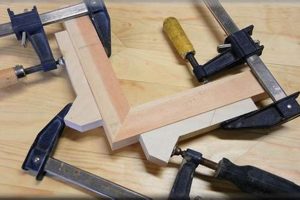
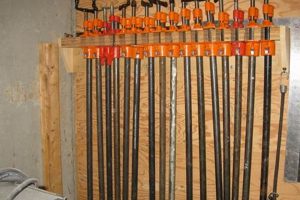
Selecting appropriate fastening tools is critical in woodworking, enabling secure workpiece positioning during assembly and glue-up. These tools ensure consistent pressure distribution, facilitating strong and accurate joints. Consider, for example, a scenario where cabinet face frames are being assembled; the choice of these tools directly impacts the squareness and durability of the final product.
The utilization of effective fastening methods offers multiple advantages, including improved efficiency, reduced error margins, and enhanced project stability. Historically, advancements in clamp design and materials have significantly contributed to the refinement of woodworking techniques, empowering artisans to execute complex designs with precision. The selection of these tools has moved from solely functional to incorporating ergonomic design and specialized application features.
The subsequent discussion will delve into various types of clamping mechanisms, addressing their specific applications, advantages, and disadvantages within the woodworking domain. Detailed examination will also be given to factors such as clamping pressure, throat depth, and material compatibility, to provide a comprehensive overview of selecting the right tool for the job.
Effective Clamping Practices
Optimizing woodworking projects requires strategic employment of fastening devices. The following tips offer guidance on maximizing the benefits derived from these tools, ensuring secure and precise assembly.
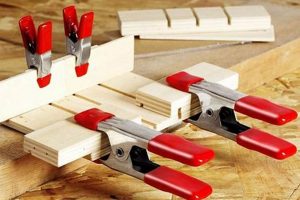
Tip 1: Selecting the Appropriate Type: Different projects demand specific clamping mechanisms. Bar clamps are suitable for larger assemblies, while spring clamps are ideal for light-duty tasks and quick adjustments. Choose according to the project’s size, complexity, and material.
Tip 2: Even Pressure Distribution: Inadequate or uneven pressure can compromise joint integrity. Employ cauls or clamping blocks to distribute pressure uniformly across the workpiece surface. This minimizes the risk of deformation and ensures a consistent glue line.
Tip 3: Protecting Workpiece Surfaces: Direct contact with clamp jaws can mar the wood surface. Use protective pads, such as cork or leather, between the jaws and the workpiece to prevent indentations and scratches. This is particularly important when working with softwoods or finished surfaces.
Tip 4: Maintaining Clamp Integrity: Regular inspection and maintenance are crucial. Ensure that threads are clean and lubricated, and that jaws are free from rust and corrosion. Damaged clamps can slip or fail, posing a safety hazard and compromising the project’s quality.
Tip 5: Understanding Clamping Pressure: Excessive pressure can damage the wood, while insufficient pressure can result in weak joints. Determine the appropriate clamping force based on the wood species, glue type, and joint design. Experimentation on scrap material is advisable.
Tip 6: Utilizing a Clamping Plan: For complex assemblies, develop a clamping plan before applying glue. This plan should outline the sequence and positioning of clamps, ensuring that all critical joints are adequately secured. A well-executed plan minimizes stress and maximizes efficiency.
Tip 7: Avoiding Over-tightening: The temptation to over-tighten clamps should be resisted. Excessive force can squeeze out too much glue, resulting in a starved joint. Tighten clamps only to the point where the joint is closed and secure.
Adherence to these guidelines promotes efficient and accurate woodworking, yielding robust and aesthetically pleasing results. Proper selection and application of clamping devices are foundational to achieving professional-grade craftsmanship.
The subsequent sections will explore specific fastening mechanisms in greater detail, analyzing their performance characteristics and optimal applications.
1. Clamping Pressure

Clamping pressure represents a crucial parameter in woodworking, significantly affecting joint strength and overall structural integrity. Selecting appropriate fastening devices necessitates careful consideration of their pressure capabilities to achieve optimal results.
- Achieving Optimal Joint Integrity
Insufficient clamping pressure results in weakened glue bonds, leading to joint failure. Conversely, excessive force can compress wood fibers, starving the joint of adhesive and compromising its structural integrity. The determination of the ideal clamping pressure hinges on factors such as wood species, adhesive type, and joint geometry.
- Material Properties and Deformation
Different wood species exhibit varying compressive strengths. Applying excessive clamping pressure to softer woods, such as pine, can result in deformation or indentation. Harder woods, such as maple, require higher clamping pressures to achieve proper adhesion. The selection of fastening solutions should therefore align with the material properties of the workpiece.
- Adhesive Characteristics and Open Time
Various woodworking adhesives possess differing requirements for clamping pressure. Polyurethane adhesives, for instance, require lower clamping pressures compared to polyvinyl acetate (PVA) adhesives. Additionally, clamping pressure must be maintained throughout the adhesive’s open time to facilitate optimal bonding. The clamping mechanism should allow for consistent pressure application over the duration specified by the adhesive manufacturer.
- Clamp Design and Force Distribution
Clamp design significantly influences pressure distribution. Bar clamps, for example, distribute pressure across a wider area compared to spring clamps. Variations in jaw shape and padding materials further impact force distribution. The ideal fastening tool evenly distributes pressure across the joint surface, minimizing stress concentrations and ensuring uniform adhesion.
Therefore, careful calibration of clamping pressure, informed by material properties and adhesive characteristics, is paramount when selecting appropriate fastening solutions. Understanding these interrelated factors contributes significantly to achieving strong, durable, and aesthetically pleasing woodworking projects.
2. Jaw Capacity

Jaw capacity represents a fundamental constraint in woodworking fastening solutions, dictating the maximum dimension of a workpiece that can be securely held. Proper evaluation of jaw capacity is crucial for selecting tools suitable for specific project requirements. The utility of these instruments is inherently limited by their ability to accommodate the dimensions of the materials being joined.
- Project Scalability and Limitations
Insufficient jaw capacity restricts the scope of projects that can be undertaken. For instance, assembling large cabinet carcasses necessitates bar clamps with substantial jaw openings, while smaller joinery tasks can be accomplished with hand-screw clamps offering limited capacity. Choosing the right tool with appropriate jaw capacity allows greater project scalability and reduces the reliance on multiple clamping setups.
- Material Thickness and Assembly Complexity
The thickness of the materials being joined directly impacts the required jaw capacity. Assembling thick wooden beams demands clamps capable of spanning a significant distance. Furthermore, complex assemblies involving multiple components require clamps with sufficient jaw capacity to accommodate the cumulative dimensions of all pieces being joined simultaneously. Consideration of material thickness and assembly complexity informs the selection process.
- Clamp Type and Jaw Design
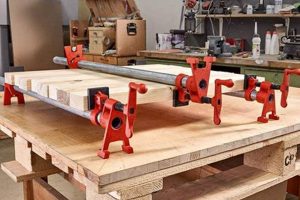
Different clamp types offer varying jaw capacities. Pipe clamps, for example, provide adjustable jaw capacity determined by the length of the pipe, making them suitable for a wide range of projects. Conversely, spring clamps possess limited and fixed jaw capacities, restricting their application to smaller, simpler tasks. The design of the jaws themselves, including their shape and depth, also influences the effective capacity of the tool.
- Efficient Workflow and Time Management
Using clamps with inadequate jaw capacity necessitates time-consuming workarounds, such as repositioning clamps multiple times or employing makeshift solutions. This leads to inefficiencies and increased potential for errors. Selecting clamps with sufficient jaw capacity streamlines the workflow, reduces handling time, and contributes to efficient project management.
The selection of optimal fastening instruments therefore hinges on a clear understanding of project dimensions and material characteristics. Choosing devices with appropriate jaw capacity ensures secure and efficient assembly, while avoiding limitations that compromise project quality and workflow.
3. Throat Depth
Throat depth, a critical specification of a fastening device, denotes the distance from the clamping bar or frame to the clamping face. In woodworking, inadequate throat depth restricts the ability to apply pressure near the center of large workpieces, necessitating reliance on edge clamping, which may prove insufficient for creating consistent, strong joints. For example, consider constructing a tabletop. Insufficient throat depth will limit the ability to exert pressure along the central glue lines, resulting in potential warping or weak points in the finished surface. Clamps exhibiting greater throat depth provide versatility in addressing diverse project requirements. Their selection directly affects the ability to construct stable, aesthetically acceptable final products.
Throat depth significantly impacts the effectiveness of assembling complex woodworking structures. Picture assembling a cabinet door with a raised panel. Adequate throat depth permits clamping the stiles and rails to the panel’s center, guaranteeing a secure, flat assembly during adhesive curing. Conversely, shallow-throated clamps may only reach the edges, increasing the risk of panel movement or distortion, ultimately diminishing the door’s quality. Consequently, the choice of suitable instruments significantly influences the feasibility and precision of intricate projects.
Therefore, throat depth assumes prominence among the essential characteristics of woodworking fastening mechanisms. It impacts the user’s ability to execute a range of projects correctly and professionally. While other clamp attributes, such as clamping pressure and jaw capacity, are critical, disregarding throat depth can impede a craftsman’s ability to apply clamping force where required, leading to structural and aesthetic deficiencies in woodworking creations. The effectiveness of any clamping device is fundamentally linked to its capacity to reach and secure the intended area, highlighting the significance of appropriate throat depth.
4. Material Strength
Material strength in woodworking fastening devices directly affects their capacity to withstand the forces generated during assembly. The constituent material’s tensile strength, yield strength, and hardness dictate the clamp’s resistance to deformation and failure under load. Higher material strength allows for greater clamping pressure without risking damage to the clamp itself. For instance, a clamp constructed from hardened steel will predictably outperform one made from cast iron when subjected to similar stress. This consideration is paramount when working with dense hardwoods or assembling large components requiring substantial clamping force. The device’s integrity is essential for maintaining consistent pressure and ensuring secure joints during the adhesive curing process. Material selection has a cause-and-effect relationship with the long-term reliability of fastening mechanisms in a woodworking context.
Practical applications underscore the importance of material strength. Bar clamps used for edge-gluing wide panels exert significant force over extended periods. If the bar or screw mechanism lacks sufficient material strength, it may bend or strip, resulting in uneven pressure distribution or complete failure. Similarly, spring clamps used for holding trim pieces in place must maintain adequate spring tension over numerous cycles. A spring made from low-grade steel will lose its tension quickly, rendering the clamp ineffective. Understanding the material properties of a given clamp enables informed decisions regarding its suitability for specific tasks and environments. Resistance to corrosion and environmental degradation also fall under the broader scope of material strength. Prolonged exposure to moisture or chemicals can weaken clamps, leading to premature failure.
In summary, material strength constitutes a crucial, yet often overlooked, attribute of quality woodworking fastening implements. It governs their ability to withstand stress, maintain precision, and endure demanding applications. By acknowledging the relationship between material composition and clamp performance, woodworkers can optimize their tool selection, minimizing risks associated with equipment failure and maximizing the quality and longevity of their projects. The challenges associated with subpar material strength highlight the need for prioritizing quality instruments that deliver consistent and reliable performance over time.
5. Ergonomic Design
Ergonomic design, referring to the adaptation of tools to fit the human body and its movements, assumes considerable importance when evaluating clamping mechanisms. A well-designed clamp minimizes strain, enhances efficiency, and reduces the risk of repetitive stress injuries, ultimately affecting the quality and duration of woodworking activities. Consideration of ergonomic factors differentiates professional-grade instruments from commodity offerings.
- Handle Design and Grip
Handle design significantly impacts comfort and control. Handles constructed from non-slip materials, shaped to fit the contours of the hand, and sized appropriately for the intended application enhance grip strength and reduce fatigue. For example, a bar clamp with an over-molded handle provides a more secure and comfortable grip compared to a clamp with a bare metal handle, particularly during prolonged use. Improper handle design can lead to hand strain, impacting precision and potentially causing long-term discomfort.
- Weight Distribution and Balance
The weight and balance of a fastening device contribute to ease of use and maneuverability. Clamps with balanced weight distribution are less likely to tip or become unwieldy during operation. For instance, a front-heavy clamp requires more effort to maintain its position, increasing the risk of slippage and inaccurate placement. Ergonomically designed tools distribute weight evenly, minimizing strain on the user’s wrist and arm. Proper balance facilitates precise placement and reduces the potential for errors.
- Adjustment Mechanisms and Ease of Use
The ease of adjusting clamping pressure is a critical ergonomic consideration. Quick-release mechanisms, smooth-operating threads, and easily accessible levers contribute to efficient and effortless operation. A clamp with a stiff or cumbersome adjustment mechanism requires more force and time to set, potentially leading to frustration and reduced productivity. User-friendly adjustment mechanisms facilitate accurate and consistent clamping pressure with minimal effort.
- Minimizing Repetitive Motions and Strain
Prolonged woodworking activities often involve repetitive motions, which can lead to cumulative trauma disorders. Ergonomic fastening devices are designed to minimize these repetitive motions and reduce strain on joints and muscles. For example, a ratcheting bar clamp requires fewer rotations to achieve the desired clamping pressure compared to a traditional screw clamp, thereby reducing the risk of hand and wrist fatigue. Careful attention to ergonomic design mitigates the potential for long-term injuries.
In conclusion, the incorporation of ergonomic principles into the design of clamping mechanisms represents a crucial element when evaluating their utility and effectiveness in woodworking. A focus on handle design, weight distribution, adjustment mechanisms, and minimizing repetitive motions contributes significantly to enhancing user comfort, improving efficiency, and reducing the risk of injuries. These factors underscore the importance of prioritizing ergonomically designed instruments for professional and hobbyist woodworkers alike.
6. Adjustment Mechanism

The adjustment mechanism within woodworking fastening devices directly impacts the efficiency, precision, and overall utility of the tool. Its design and functionality determine how easily and accurately clamping pressure can be applied and maintained, differentiating superior models from less effective alternatives.
- Thread Pitch and Clamping Force
Thread pitch, measured as the distance between threads, dictates the relationship between the turning force applied and the resulting clamping force. A finer thread pitch allows for greater clamping force with less effort, offering enhanced control, particularly beneficial when working with delicate materials prone to damage from over-tightening. Conversely, a coarser pitch may provide faster adjustments but sacrifice fine control and potential clamping force.
- Quick-Release Mechanisms and Efficiency
Quick-release mechanisms, commonly found on bar and speed clamps, expedite the clamping and unclamping process. These mechanisms allow for rapid adjustments, increasing workflow efficiency, particularly in situations requiring frequent repositioning or multiple clamping operations. The reliability and durability of the quick-release mechanism directly influence its long-term value.
- Ergonomic Handles and User Comfort
The design and material of the handle directly affect user comfort and control during adjustment. Ergonomic handles, constructed from non-slip materials and shaped to fit the hand, reduce fatigue and improve grip strength. An easily manipulated handle enables precise adjustments with minimal effort, particularly important when working for extended periods.
- Locking Mechanisms and Pressure Maintenance
Secure locking mechanisms are essential for maintaining consistent clamping pressure over time. These mechanisms prevent slippage or loosening of the clamp, ensuring that the applied force remains constant throughout the adhesive curing process. The reliability of the locking mechanism is paramount for achieving strong and durable joints.
The attributes of the adjustment mechanism, therefore, serve as a defining characteristic when evaluating the performance of woodworking fastening devices. Superior mechanisms provide precise control, efficient operation, and reliable pressure maintenance, contributing significantly to the overall effectiveness and value of the clamp.
7. Durability
Durability in woodworking fastening tools reflects their capacity to withstand repeated use and exposure to demanding workshop conditions without significant degradation in performance. This attribute constitutes a crucial factor in evaluating the overall value and long-term cost-effectiveness of such instruments. Instruments with robust durability ratings contribute to productivity and reduce replacement frequencies.
- Material Composition and Resistance to Fatigue
The composition of the clamping device profoundly impacts its resistance to fatigue. High-carbon steel components, for instance, exhibit superior fatigue resistance compared to cast iron, thereby maintaining clamping pressure over extended periods. Fatigue, the weakening of a material due to repeated stress, is a primary cause of clamp failure. The selection of robust materials minimizes the risk of fatigue-related failures.
- Corrosion Resistance and Environmental Factors
Workshops often expose tools to moisture, adhesives, and wood treatments, which can corrode metallic components. Protective coatings, such as zinc plating or powder coating, enhance corrosion resistance, extending the lifespan of the tool. Corrosion compromises structural integrity and affects smooth operation, increasing friction and reducing clamping force. Consideration of environmental factors is important.
- Thread Quality and Wear Resistance
For clamps employing threaded spindles, the quality of the threads directly affects adjustment precision and wear resistance. Precision-cut threads minimize backlash and provide smooth, consistent clamping force. Low-quality threads are prone to stripping and seizing, rendering the clamp unusable. High-quality threads made from hardened steel ensure longevity.
- Joint Integrity and Structural Stability
The manner in which individual components are joined affects the overall structural stability of the clamp. Welded joints should exhibit high strength and resistance to cracking. Riveted joints should be tight and secure, preventing loosening and wobble. Weak joints create points of failure, reducing the clamp’s ability to withstand stress. Emphasis on joint integrity enhances robustness.
The aforementioned facets underscore the interconnectedness between durability and effective fastening in woodworking. Clamps exhibiting high-quality materials, corrosion resistance, precise threads, and robust joint construction contribute significantly to project success and offer long-term value, aligning with the characteristics defining superior woodworking tools. Long-term utility hinges on material endurance.
Frequently Asked Questions
The subsequent questions address common inquiries related to the selection and application of appropriate fastening devices in woodworking.
Question 1: What constitutes the primary distinction between a bar clamp and a pipe clamp?
A bar clamp employs an integrated bar for length, whereas a pipe clamp utilizes a user-supplied pipe, offering variable length capabilities. Pipe clamps allow for greater customization in clamping length, but bar clamps are generally more rigid.
Question 2: What factors influence the selection of appropriate clamping pressure for a given woodworking project?
Wood species, adhesive type, and joint geometry primarily influence clamping pressure. Softer woods require less pressure than hardwoods. Specific adhesives may have recommended pressure ranges. Complex joints may require higher pressure for proper adhesion.
Question 3: How does throat depth impact the effectiveness of a clamp in securing a workpiece?
Throat depth determines the distance from the clamp’s bar to the clamping point. Greater throat depth allows for clamping further from the edge of a workpiece, which is particularly important when joining wide panels or assembling large components.
Question 4: What are the advantages and disadvantages of quick-release mechanisms in woodworking clamps?
Quick-release mechanisms expedite clamping and unclamping, enhancing efficiency. However, they may be less durable than traditional screw mechanisms and may not provide the same level of clamping force.
Question 5: How does material selection affect the long-term durability of woodworking clamps?
High-quality materials, such as hardened steel, enhance resistance to fatigue, corrosion, and wear. Clamps constructed from inferior materials are more prone to failure and require more frequent replacement.
Question 6: What strategies mitigate the risk of marring wood surfaces when using clamps?
Employing protective pads, such as cork or leather, between the clamp jaws and the workpiece minimizes the risk of indentation and scratches. Applying even clamping pressure also reduces the likelihood of surface damage.
These answers provide insights into the multifaceted considerations involved in selecting and utilizing suitable woodworking fastening mechanisms. Proper application extends tool life and enhances project quality.
The discussion now transitions to a summary of key considerations for determining the optimal fastening devices.
Concluding Observations on Woodworking Fastening Solutions
The preceding analysis has illuminated the multifaceted characteristics defining effective woodworking fastening implements. Evaluation encompasses clamping pressure, jaw capacity, throat depth, material strength, ergonomic design, adjustment mechanism, and overall durability. Each parameter contributes significantly to the instrument’s ability to securely hold workpieces, ensuring accurate assembly and robust joints. Selecting appropriately optimized tools directly affects project quality and efficiency.
Careful consideration of the discussed attributes facilitates informed decision-making when acquiring woodworking fastening mechanisms. Recognizing the interplay between material properties, clamping requirements, and user needs enables craftsmen to optimize their tool selection. Further exploration of specialized fastening technologies and adaptive clamping strategies promises continued advancements in woodworking precision and efficiency.
![Top-Rated: Best Quick Clamps for Woodworking Projects [2024] | Step-by-Step Guides, Tools & Inspiration to Build Beautiful Wooden Decor on a Budget](https://woodfromhome.com/wp-content/uploads/2026/04/th-264-300x200.jpg "Top-Rated: Best Quick Clamps for Woodworking Projects [2024] Step-by-Step Guides, Tools & Inspiration to Build Beautiful Wooden Decor on a Budget")