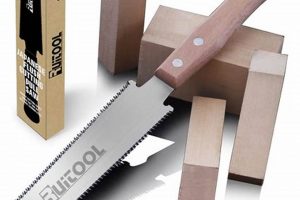
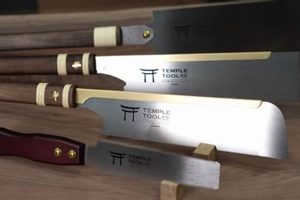
Specialized hand tools facilitate the creation of interlocking joints commonly used in cabinet making and other woodcraft. These implements, characterized by their fine teeth and thin blades, enable precise cuts essential for tight-fitting, strong connections. For example, producing clean, accurate lines in both hard and soft materials is critical to achieving aesthetically pleasing and structurally sound joints.
The resulting joinery offers significant advantages in terms of durability and visual appeal. It’s robust nature stems from the mechanical bond created by the interlocking shape. Furthermore, the traditional method connects pieces with a visible beauty that machine-cut alternatives often lack. Historically, this type of construction represents a hallmark of quality craftsmanship, demonstrating attention to detail and a commitment to excellence.
The remainder of this discussion will delve into the selection criteria for these tools, proper usage techniques, and maintenance procedures to ensure optimal performance and longevity. Subsequent sections will also cover common problems encountered during the process and effective solutions for achieving consistently high-quality results.
Essential Guidance for Precise Joinery
Achieving optimal results requires meticulous attention to detail and adherence to established techniques. The following guidelines outline key considerations for successful execution.
Tip 1: Blade Selection: The appropriate blade pitch and kerf are crucial. Finer pitches (more teeth per inch) are better suited for hardwoods, while coarser pitches can be used for softwoods. A thin kerf minimizes material removal and facilitates a tighter fit.
Tip 2: Proper Stance and Grip: Maintain a stable stance and grip the tool firmly, yet comfortably. Avoid excessive pressure; let the sharpness of the blade do the work.
Tip 3: Establishing the Baseline: Precisely marking the baseline is paramount. Use a sharp marking knife and a precision square to ensure accuracy.
Tip 4: Angled Cuts and Sawing Technique: When cutting on an angle, pay close attention to the orientation. Maintain a consistent sawing angle throughout the cut to avoid deviations.
Tip 5: Waste Removal: Efficient waste removal is essential. Use a chisel or coping saw to remove the bulk of the waste material before refining the joint with a chisel.
Tip 6: Sharpening and Maintenance: Regular sharpening is vital for maintaining optimal performance. A dull blade requires more force, leading to inaccuracies and fatigue. Proper storage and cleaning also prolong the tool’s lifespan.
Tip 7: Practice and Patience: Mastering this craft requires dedicated practice and patience. It is advisable to practice on scrap material before tackling a final project.
Implementing these techniques will contribute significantly to achieving strong, aesthetically pleasing, and precisely fitted joints. The resulting increase in quality and precision justifies the time and effort invested.
The subsequent sections will address common challenges encountered during the cutting process and effective strategies for mitigating these issues.
1. Blade Geometry

Blade geometry is a critical determinant in the effectiveness of tools used to create interlocking joints. The design of the blade, including its rake angle, fleam angle, and tooth shape, directly impacts the cutting efficiency, precision, and overall quality of the joint. Improper blade geometry can lead to tear-out, excessive friction, and inaccurate cuts, thereby compromising the structural integrity and aesthetic appeal of the finished piece. For instance, a blade with an inadequate rake angle may struggle to cut through hardwoods, resulting in a rough surface and increased effort from the user.
The interplay between blade geometry and material selection is also significant. Softer woods may tolerate a more aggressive tooth design, while harder woods require a finer, more precisely shaped tooth to achieve clean cuts. The specific blade geometry required for creating tight-fitting and visually appealing joints necessitates careful consideration. A steeper fleam angle, for example, can aid in producing a cleaner shoulder cut, a critical element in joint construction. The selection of the correct blade geometry directly affects the ease and success of the joint-making process, influencing not only the speed but also the accuracy with which one can execute the cuts.
In summary, blade geometry forms an indispensable component of quality woodcraft. Understanding the nuanced relationship between blade design and material properties is paramount for achieving consistently high-quality results. While mastering cutting techniques is vital, the fundamental importance of appropriately selected and maintained blade geometries cannot be overstated. This understanding is crucial for overcoming challenges in joint construction and realizing the full potential of specialized woodworking tools.
2. Tooth Pitch

Tooth pitch, measured as teeth per inch (TPI), constitutes a critical parameter in tool selection for precision joinery. It directly influences the cutting speed, smoothness, and overall quality of the finished joint.
- Material Hardness and TPI Selection
Harder wood species demand a higher TPI to achieve clean cuts with minimal tear-out. Conversely, softer woods can accommodate a lower TPI, allowing for faster material removal. Employing an inappropriate TPI can result in ragged edges, inaccurate joinery, and increased effort.
- Impact on Cutting Speed and Efficiency
Lower TPI values equate to fewer teeth engaging the wood at any given time, thus enabling faster cutting speeds in softer materials. Higher TPI values, while slower, provide greater control and precision in dense hardwoods. Selecting the appropriate TPI balances cutting speed with the desired level of accuracy.
- Influence on Joint Tightness and Fit
The tooth pitch contributes significantly to the width of the kerf, or the material removed during cutting. A finer pitch (higher TPI) produces a narrower kerf, facilitating a tighter fit in the finished joint. A coarser pitch (lower TPI) results in a wider kerf, potentially leading to a looser, less structurally sound joint.
- Relationship to Saw Design and Functionality
Specialized hand tools designed for precision joinery typically feature a high TPI to accommodate the demands of intricate cuts and dense hardwoods. The tooth pitch is often paired with specific blade geometries and handle designs to optimize performance for particular woodworking tasks.
The successful application of specialized hand tools hinges on a thorough understanding of tooth pitch and its interplay with various factors. Careful consideration of the TPI is essential for achieving high-quality, structurally sound, and visually appealing joints, showcasing meticulous craftsmanship.
3. Kerf Width

Kerf width, the amount of material removed by a saw blade during a cut, plays a crucial role in achieving precise and tight-fitting joints. Specifically, in fine woodworking, where accuracy is paramount, the kerf width directly influences the final dimensions of the joint components. If the kerf is too wide, the resulting joint may be loose and structurally unsound. Conversely, a kerf that is too narrow can lead to difficulties in assembling the joint or require excessive force, potentially damaging the wood. Achieving the desired aesthetic and structural integrity hinges on carefully managing the kerf width during the cutting process. An example illustrates this point: creating precisely fitting drawers requires each joints components, including tails and pins, to interlock with minimal gaps. A consistent and appropriately sized kerf facilitates this alignment.
The type of saw employed directly impacts the kerf width. Specialized hand tools, designed for this purpose, often feature thin blades to minimize material loss. The blade thickness, tooth set (the extent to which the teeth are bent outwards), and the sharpness of the teeth all contribute to the kerf’s dimensions. Skillful technique also mitigates potential issues arising from variations in kerf width. Precise marking of the joint’s layout lines, combined with careful sawing that follows these lines accurately, helps to ensure a consistent cut, even if the kerf is slightly wider than initially intended. This demonstrates the importance of the woodworker’s skill in compensating for unavoidable variations and further highlighting the role of the kerf.
In summary, kerf width stands as a fundamental consideration in fine woodworking. By understanding its impact on joint fit and accounting for its variations through careful tool selection and technique, woodworkers can achieve the level of precision necessary for creating strong, aesthetically pleasing, and enduring woodcraft. Overcoming challenges associated with inconsistent kerf widths requires a combination of knowledge, skill, and appropriate tool maintenance, factors that collectively contribute to the quality of the final product.
4. Handle Ergonomics
Handle ergonomics directly influence the accuracy, control, and overall efficiency of utilizing specialized hand tools in fine woodworking. The design of the handle, including its shape, size, and material, dictates the user’s grip, hand position, and the distribution of force applied during the cutting process. An ill-designed handle can lead to discomfort, fatigue, and reduced precision, ultimately compromising the quality of the joinery. Conversely, a well-engineered handle promotes a secure and comfortable grip, allowing for greater control and minimizing strain. For example, a handle contoured to fit the natural curve of the hand reduces the risk of slippage and enables the user to maintain a consistent sawing angle, vital for accurate cuts. The selection of a handle material that provides sufficient grip, even when hands are sweaty, further enhances control and reduces the potential for errors.
The benefits of optimized handle ergonomics extend beyond immediate user comfort. Prolonged use of tools with poorly designed handles can contribute to repetitive strain injuries, such as carpal tunnel syndrome. Therefore, investing in tools with ergonomic handles represents a proactive measure to protect the woodworker’s long-term health and well-being. Furthermore, improved ergonomics can translate into increased productivity and reduced waste. By minimizing fatigue and discomfort, the user can maintain focus and precision for extended periods, resulting in fewer mistakes and a higher yield of usable components. An instance of this involves a craftsman who, by switching to a tool with an ergonomically designed handle, experienced a noticeable reduction in hand fatigue, enabling him to complete intricate joinery projects with greater speed and accuracy.
In summary, handle ergonomics represents a critical yet often overlooked aspect of specialized hand tool design and usage. Optimizing handle design for comfort, control, and safety is essential for achieving high-quality results in fine woodworking. Understanding the interplay between handle ergonomics, user experience, and long-term health enables informed tool selection and promotes sustainable craftsmanship. Addressing the challenges associated with poorly designed handles requires a commitment to ergonomic principles and a focus on user feedback, fostering continuous improvement in tool design and manufacturing.
5. Sawing Technique

Effective sawing technique constitutes a fundamental component of achieving quality results with specialized hand tools in fine woodworking. The precision and control afforded by appropriate methods directly impact the accuracy of cuts and the overall integrity of the resulting joint. A consistent sawing motion, combined with controlled pressure, minimizes the risk of blade wandering or tear-out, both of which can compromise the fit and strength of the joint. For example, when cutting the tails of a joint, a smooth, deliberate stroke guided by a precise layout line is crucial for achieving a clean, accurate cut. Deviations from the established line can lead to gaps or misalignments, necessitating corrective measures that often weaken the joint.
Proper sawing technique extends beyond the basic mechanics of the cut. It encompasses aspects such as stance, grip, and body positioning, all of which contribute to stability and control. A balanced stance allows the woodworker to apply force evenly and maintain a consistent sawing angle. Similarly, a firm but relaxed grip minimizes hand fatigue and allows for subtle adjustments during the cut. The angle at which the tool is held relative to the workpiece also influences the cutting action. A slight tilt can reduce friction and improve visibility, particularly when cutting along angled lines. Precise sawing technique leads to minimal effort, a testament to efficient force application and optimal control. Poor sawing technique inevitably results in more rework.
In summary, sawing technique represents a pivotal factor in realizing the potential of specialized hand tools. Mastering the fundamentals of stance, grip, and stroke control is essential for achieving consistently accurate and structurally sound joints. Addressing the challenges associated with improper sawing technique requires dedicated practice and a keen attention to detail. The benefits of refined sawing technique are evident in the quality, precision, and longevity of the finished woodcraft.
6. Material Hardness

Material hardness presents a significant consideration in fine woodworking, particularly when employing specialized hand tools for creating intricate joints. The inherent resistance of the wood species dictates the tool selection, cutting technique, and the overall approach to the task. Different wood species, ranging from softwoods like pine to hardwoods like maple and oak, exhibit varying degrees of hardness, each requiring tailored methods for achieving optimal results. Understanding material hardness ensures precision and prevents damage to the wood and the tool.
- Tool Selection and Blade Configuration
Harder woods necessitate tools with correspondingly harder and more durable blades. The tooth geometry, specifically the rake angle and tooth pitch, must be optimized for cutting through dense fibers without excessive force or premature dulling. For instance, a saw designed for softwoods may struggle to effectively cut through hardwoods, resulting in tear-out or an uneven surface. The correct tool selection preserves tool life and optimizes cutting efficacy. The tool type also matters. Hardwoods requires the use of japanese dovetail saws for finer and more accurate cutting.
- Impact on Cutting Technique and Pressure
The cutting technique must adapt to the material’s resistance. Harder woods require a slow, deliberate approach with consistent pressure to avoid binding or chatter. Applying excessive force can lead to inaccurate cuts and increase the risk of damaging the workpiece or the tool. With softer woods, a more aggressive cutting action may be appropriate, but care must be taken to prevent splintering or crushing the fibers. Proper use of handsaws prevents inaccuracies on any surfaces.
- Sharpening and Maintenance Considerations
Tools used on harder woods require more frequent sharpening to maintain optimal cutting performance. The abrasive nature of dense wood fibers accelerates blade wear, necessitating regular maintenance to preserve the tool’s edge. Neglecting sharpening can lead to increased cutting effort, reduced accuracy, and premature tool failure. Using the right materials for tool maintainance reduces the possible damage of any hand tools.
- Joint Design and Structural Integrity
Material hardness influences the joint design and its ability to withstand stress. Harder woods generally create stronger and more durable joints, capable of withstanding greater loads. However, they may also be more prone to splitting or cracking if the joint is improperly designed or executed. Consideration of material hardness is essential for ensuring the long-term structural integrity of the finished piece. This can be prevented through strategic construction tactics on difficult wood types.
The interplay between material hardness and the techniques employed in fine woodworking dictates the quality and longevity of the finished product. Addressing the challenges posed by varying material hardness requires a comprehensive understanding of tool selection, cutting technique, maintenance practices, and joint design principles. By carefully considering these factors, woodworkers can achieve exceptional results, regardless of the wood species used. In fine woodworking, material hardness is always an attribute to consider. Using softwoods for joinery is usually avoided.
7. Joint Accuracy
Joint accuracy, a cornerstone of fine woodworking, dictates the structural integrity and aesthetic appeal of finished pieces. Specifically, in the context of techniques involving specialized hand tools, the precision with which joints are executed directly correlates with the overall quality and longevity of the construction. Achieving high levels of joint accuracy demands meticulous attention to detail, precise tool handling, and a thorough understanding of wood properties. The relationship is causal: inaccuracies in the cut, even minute deviations, propagate into compromised structural performance and visual imperfections. A real-world example is a poorly fitted joint in a cabinet door, which may lead to sagging, misalignment, and eventual failure. This underscores the necessity of accurate cuts to maintain integrity. Furthermore, achieving joint accuracy demonstrates woodworker skills, where consistent execution of all aspects of woodworking are necessary.
The implementation of specialized hand tools contributes significantly to achieving and maintaining joint accuracy. The fine teeth and controlled cutting action of the tool allow for precise removal of material, minimizing the risk of tear-out or overcutting. Correct sawing methods, including the tool and the workpiece, are critical factors in the accuracy of any workpiece. Proper sharpening and maintenance further ensure that these tools perform optimally, consistently delivering clean, accurate cuts. A tight-fitting joint not only enhances the strength of the construction but also reduces the need for excessive adhesives or fasteners, resulting in a cleaner, more refined appearance. In high-end furniture making, for instance, the seamless integration of components is a hallmark of quality craftsmanship, achieved through precise execution and a commitment to accuracy.
In summary, joint accuracy is an indispensable element of fine woodworking, intrinsically linked to the capabilities and application of specialized hand tools. Its attainment requires a combination of skill, knowledge, and attention to detail, resulting in structurally sound and aesthetically pleasing pieces. The challenges associated with achieving joint accuracy can be overcome through consistent practice, proper tool maintenance, and a deep understanding of wood behavior. This emphasis on precision not only elevates the quality of the finished product but also reflects a commitment to excellence and enduring craftsmanship.
Frequently Asked Questions about Dovetail Saws in Fine Woodworking
This section addresses common inquiries regarding the application and selection of specialized hand tools for creating precision joints.
Question 1: What distinguishes a dovetail saw from other saws used in woodworking?
A tool intended for crafting these joints possesses distinct characteristics, including a thin blade, fine teeth (typically 14-20 TPI), and often a stiffening rib along the back. These features enable precise, controlled cuts necessary for creating tight-fitting joints. Other saws lack this refinement, making them unsuitable for intricate joinery.
Question 2: How does blade thickness affect the accuracy of cuts?
Thinner blades, typically found on tools for fine woodworking, remove less material, resulting in a narrower kerf. This facilitates greater accuracy when following layout lines, contributing to tighter, more precise joints. Thicker blades can obscure the lines and introduce inaccuracies.
Question 3: What role does tooth pitch play in achieving clean cuts?
Finer tooth pitches, with a higher number of teeth per inch, are better suited for hardwoods as they produce smoother cuts with minimal tear-out. Coarser pitches are more appropriate for softer woods, but can result in ragged edges in denser materials.
Question 4: Why is handle ergonomics important in a dovetail saw?
A comfortable and well-designed handle promotes better control, reduces fatigue, and minimizes the risk of hand strain. This is particularly crucial during prolonged use, allowing the woodworker to maintain precision and accuracy throughout the cutting process.
Question 5: How frequently should a dovetail saw be sharpened?
The frequency of sharpening depends on the type of wood being cut and the extent of use. Regular sharpening is essential for maintaining optimal cutting performance. A dull saw requires more force, leading to inaccuracies and increased effort.
Question 6: Can a dovetail saw be used for other woodworking tasks?
While primarily designed for creating interlocking joints, this fine woodworking tool can also be used for other precision cutting tasks that require fine detail and accuracy. However, its specialized design makes it less efficient for general-purpose sawing.
In summary, selecting and maintaining the appropriate tool is crucial for achieving quality, structurally sound, and visually appealing joints. Understanding the interplay between these factors is essential for successful woodworking.
The subsequent section will delve into advanced techniques for employing these specialized tools, further refining joinery skills.
Conclusion
The preceding discussion has explored the nuanced application of specialized hand tools in fine woodworking. It has emphasized the critical interplay between tool selection, technique, and material properties in achieving precise and structurally sound joints. A thorough understanding of blade geometry, tooth pitch, kerf width, handle ergonomics, sawing technique, and material hardness is paramount for successful execution.
The pursuit of excellence in fine woodworking necessitates a continuous commitment to honing skills and refining techniques. Embracing this dedication to craft ensures not only the creation of enduring and aesthetically pleasing pieces, but also the preservation of a time-honored tradition.
![Best Types of Electric Saws for Woodworking [Guide] | Step-by-Step Guides, Tools & Inspiration to Build Beautiful Wooden Decor on a Budget](https://woodfromhome.com/wp-content/uploads/2026/04/th-207-300x200.jpg "Best Types of Electric Saws for Woodworking [Guide] Step-by-Step Guides, Tools & Inspiration to Build Beautiful Wooden Decor on a Budget")