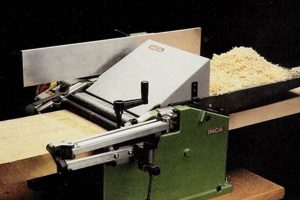
This power tool, typically found in woodworking shops, is designed to smooth and flatten the surfaces of lumber. It achieves this by removing thin layers of wood from a board’s face. For instance, a warped or uneven piece of timber can be passed through this tool to create a level and uniform surface suitable for construction or finishing.
Its significance lies in its ability to prepare raw lumber for precise joinery and finishing, guaranteeing accurate dimensions and smooth textures. Historically, these tasks were performed manually using hand planes, but the introduction of the powered version greatly increased efficiency and precision. This advancement allowed for the mass production of accurately sized components, benefitting industries ranging from furniture making to construction.
The following sections will explore the various types available, focusing on their mechanisms, common applications, and the crucial safety considerations associated with their operation, alongside best practices for maintenance and optimal performance.
Woodworking Planer Machine
Optimizing the performance and lifespan of this equipment requires adherence to specific procedures and best practices. The following tips provide guidance on achieving accurate results while ensuring operator safety.
Tip 1: Grain Direction Awareness: Always feed stock into the cutterhead with the grain to minimize tear-out. Examine the board beforehand to determine the optimal feed direction.
Tip 2: Depth of Cut Management: Avoid removing excessive material in a single pass. Gradual depth adjustments result in smoother finishes and reduce strain on the motor.
Tip 3: Consistent Feed Rate: Maintain a uniform feed rate to prevent snipe at the beginning and end of the board. Practice and controlled pressure are crucial.
Tip 4: Proper Support Systems: Utilize infeed and outfeed supports, such as rollers or extension tables, particularly when working with long or heavy stock. This prevents dipping and ensures a consistent plane.
Tip 5: Sharp Blade Maintenance: Dull blades compromise cut quality and increase the risk of kickback. Regularly inspect and sharpen or replace blades according to manufacturer specifications.
Tip 6: Dust Collection Implementation: Connect to a dedicated dust collection system to maintain a clean and safe working environment. This minimizes airborne particles and improves visibility.
Tip 7: Safety Gear Usage: Always wear appropriate personal protective equipment, including eye protection and hearing protection. Ensure machine guards are in place and functioning correctly.
By implementing these recommendations, operators can maximize the effectiveness of this equipment, consistently producing high-quality results while minimizing risks.
The subsequent sections will delve into specific applications and the selection criteria for different models, ensuring a comprehensive understanding of this essential woodworking tool.
1. Surface Smoothing

Surface smoothing represents a fundamental aspect of woodworking, often serving as a primary reason for employing a woodworking planer machine. The creation of a level, uniform, and aesthetically pleasing surface is frequently essential for subsequent finishing, joinery, and overall structural integrity of a woodworking project.
- Dimensional Accuracy and Subsequent Operations
A smooth surface ensures dimensional accuracy, vital for precise joinery. Without a planed surface, measurements can be skewed by irregularities, leading to misaligned joints and compromised structural integrity. This directly impacts the fit and finish of assembled components.
- Optimized Finishing and Adhesion
Smooth surfaces provide an ideal substrate for finishes such as paint, varnish, and stain. Rough or uneven surfaces can cause uneven absorption of finishes, resulting in blotchy appearances. A planed surface allows for uniform application and improved adhesion, enhancing the durability and aesthetics of the final product.
- Aesthetic Enhancement and Tactile Quality
Beyond functional considerations, a smooth surface enhances the overall aesthetic appeal of woodworking projects. It creates a sense of quality and craftsmanship, elevating the perceived value of the finished piece. Furthermore, smooth surfaces improve the tactile experience, making the object more pleasant to handle and use.
- Removal of Imperfections and Defects
The planing process effectively removes surface imperfections such as saw marks, blemishes, and minor warps. This allows for the restoration of weathered or damaged wood, preparing it for new applications. This process maximizes material utilization and reduces waste.
These facets underscore the pivotal role of surface smoothing in woodworking. The woodworking planer machine, therefore, serves as a crucial tool in achieving these objectives efficiently and accurately, enabling woodworkers to produce high-quality and aesthetically pleasing projects.
2. Thickness Control
Thickness control, a critical function in woodworking, relies extensively on precision and consistency. The woodworking planer machine provides a mechanism to achieve and maintain specific dimensions of lumber, ensuring uniformity across multiple pieces. This capability is crucial for various woodworking applications, impacting both the structural integrity and aesthetic appeal of the final product.
- Achieving Consistent Stock Thickness
The primary function is to reduce and standardize the thickness of wood. For instance, if a project requires multiple boards of precisely -inch thickness, the planer machine accurately removes excess material until that dimension is met. This is indispensable for building furniture, cabinets, or any project requiring uniform components.
- Facilitating Precise Joinery
Accurate joinery relies heavily on consistent material thickness. When constructing mortise and tenon or dovetail joints, variations in thickness can lead to gaps or misalignment. The machine ensures that mating surfaces are precisely dimensioned, resulting in strong and visually appealing joints.
- Optimizing Material Utilization
By allowing the controlled removal of material, it allows woodworkers to utilize rough-sawn lumber more effectively. Boards that are initially too thick can be planed down to the desired dimension, reducing waste and maximizing the yield from a given piece of wood. Furthermore, it allows re-purposing and consistent dimensions for materials.
- Enabling Laminations and Complex Assemblies
Laminating thin layers of wood allows for the creation of curved or complex shapes. It plays a vital role in ensuring that each lamination is of a uniform thickness, resulting in a smooth and consistent final product. Applications range from architectural millwork to musical instrument construction.
In conclusion, it is essential for achieving dimensional accuracy, facilitating joinery, and maximizing material utilization. Its capabilities are indispensable for producing high-quality woodworking projects across a wide range of applications. Ensuring correct settings and operational procedures for these machines remains of utmost importance.
3. Wood Grain

Wood grain, the visual texture derived from the arrangement of wood fibers, significantly impacts the planing process. Understanding grain orientation is essential for achieving smooth surfaces and minimizing defects during machining.
- Grain Direction and Tear-out
Planing against the grain, often referred to as “climbing cut,” can cause the wood fibers to tear out, resulting in a rough and uneven surface. This occurs because the blade lifts and fractures the fibers rather than cleanly slicing them. Observing the grain pattern and feeding the wood in the direction that supports the fibers is crucial to prevent tear-out and achieve a smooth finish.
- Figure and Appearance
Different species of wood exhibit unique grain patterns, often referred to as figure. These patterns, such as curly, quilted, or birdseye, can be accentuated or marred depending on the planing technique. Selective planing, where the angle and depth of cut are adjusted to enhance the figure, requires a skilled operator and a well-tuned machine.
- Hardness and Density Variations
Wood grain reflects variations in hardness and density within a board. Earlywood, formed during periods of rapid growth, is typically softer and less dense than latewood, which forms during slower growth periods. These differences in density can cause uneven planing if the machine is not properly adjusted, leading to a washboard effect on the surface.
- Species-Specific Considerations
Different wood species respond differently to planing. Softwoods, such as pine and fir, are generally easier to plane but are also more susceptible to tear-out. Hardwoods, such as oak and maple, require sharper blades and slower feed rates to achieve a smooth finish. Understanding the characteristics of the wood species is essential for selecting the appropriate planing technique and machine settings.
The interaction between wood grain and the planing process necessitates careful observation, precise machine adjustments, and a thorough understanding of wood properties. Ignoring grain direction, figure, and density variations can lead to substandard results, highlighting the importance of operator skill and knowledge in achieving optimal outcomes when using this equipment.
4. Blade Sharpness
Blade sharpness constitutes a pivotal factor influencing the performance and safety of woodworking planer machines. The condition of the cutting edges directly impacts the quality of the finished surface, the efficiency of material removal, and the overall operational integrity of the tool.
- Cut Quality and Surface Finish
A keen cutting edge cleanly severs wood fibers, resulting in a smooth and consistent surface. Conversely, a dull blade tears rather than cuts, leading to a rough, uneven surface often characterized by tear-out. Optimal surface preparation for subsequent finishing processes relies upon maintaining sharp blades.
- Motor Load and Machine Stress
Sharp blades require less force to remove material, reducing the load on the motor and mechanical components. Dull blades necessitate increased feed pressure, placing undue stress on the machine and potentially leading to premature wear or failure. Efficient operation mandates sharp cutting edges.
- Feed Rate and Productivity
The rate at which material can be fed through this power tool is directly related to blade sharpness. Sharp blades allow for a consistent feed rate, enhancing productivity. Dull blades require a slower feed rate to avoid excessive force and potential damage to the machine or workpiece.
- Safety and Kickback Prevention
Sharp blades minimize the risk of kickback. When blades are dull, the machine requires increased force to remove material. When this force overcomes the grip and friction, the wood will abruptly thrust back towards the operator. Sharp blades minimize the chance of this occurrence and related injuries.
The operational efficiency, output quality, and operator safety of a woodworking planer machine are intrinsically linked to the condition of its blades. Regular maintenance, including sharpening or replacement, is crucial to maximizing the tool’s potential and ensuring a safe working environment. Consistent blade maintenance minimizes operational risks and guarantees a reliable service life for the equipment.
5. Feed Rate

Feed rate, the speed at which material advances through a woodworking planer machine, represents a critical operational parameter. Its careful management significantly influences the quality of the finished surface, the lifespan of the blades, and the overall safety of the process.
- Surface Finish Quality
A slower feed rate typically yields a smoother surface finish. By allowing the blades more time to interact with the wood fibers, irregularities are minimized. Conversely, an excessively fast feed rate can result in a rougher surface with potential tear-out, particularly when planing against the grain or with certain wood species. Optimal feed rate is crucial for achieving a desired smoothness.
- Blade Wear and Heat Generation
An inappropriately high feed rate forces the blades to remove material at an accelerated pace, increasing friction and heat generation. This accelerated wear can dull the blades more quickly, requiring more frequent sharpening or replacement. Maintaining a moderate feed rate reduces strain on the blades and extends their useful life.
- Motor Load and Power Consumption
An excessive feed rate places a greater load on the motor of the woodworking planer machine. The motor must work harder to maintain the required cutting speed, resulting in increased power consumption. Sustained overloading can lead to motor overheating and premature failure. Adjusting the feed rate to match the machine’s capabilities and the wood’s density is critical.
- Snipe Formation and Dimensional Accuracy
Snipe, the unwanted depression at the leading and trailing edges of a planed board, is often exacerbated by improper feed rate. Maintaining consistent pressure and employing infeed/outfeed supports are crucial, but an excessively high feed rate amplifies the effect. A controlled feed rate, combined with proper technique, minimizes snipe and contributes to more accurate dimensional control.
Therefore, appropriate feed rate selection is indispensable for efficient and safe operation. Its influence spans surface quality, tool longevity, energy consumption, and dimensional precision, necessitating careful consideration and adjustment based on wood species, machine capabilities, and desired outcome.
6. Dust Collection

The operation of a woodworking planer machine inherently generates substantial volumes of airborne particulate matter. This dust, composed of fine wood shavings and particles, poses significant health and operational hazards if not effectively managed. Dust collection systems are integral components of modern woodworking environments, mitigating these risks and ensuring a safer, more efficient workflow.
The primary connection lies in the direct cause-and-effect relationship between the machine’s operation and the creation of dust. As the planer’s rotating blades remove material from the wood, fine particles are ejected into the surrounding air. Without a dedicated dust collection system, these particles can accumulate on surfaces, impair visibility, and, most importantly, enter the respiratory systems of personnel. Examples include woodworking shops where inadequate dust extraction has led to respiratory ailments among workers, highlighting the critical need for effective dust management. In commercial settings, failure to control dust levels can also violate environmental regulations, resulting in fines and operational shutdowns. The machine is therefore more practical and efficient due to the system of dust collection to avoid dusts accumulating to the air and floor.
Effective dust collection involves several key elements: a properly sized dust collector capable of generating sufficient airflow to capture particles at the source; ductwork strategically positioned to minimize airflow resistance; and collection bags or filters designed to efficiently trap fine dust. Furthermore, regular maintenance of the dust collection system, including filter cleaning and ductwork inspection, is essential to ensure optimal performance. The integration of dust collection with the planer machine transforms it from a potentially hazardous tool into a controlled and safe piece of equipment, enabling woodworkers to focus on their craft without compromising their health or the cleanliness of their workspace. This essential addition underscores its importance in maintaining a productive and health-conscious woodworking environment.
7. Safety Protocols

The operation of a woodworking planer machine introduces inherent risks necessitating strict adherence to safety protocols. The high-speed rotating blades, powerful motor, and potential for workpiece kickback create a hazardous environment if proper precautions are not implemented. These protocols serve as a critical safeguard, minimizing the likelihood of injury and promoting a safe working environment. For instance, the failure to use push sticks when planing shorter stock has resulted in numerous hand injuries, emphasizing the importance of this basic safety measure. Similarly, neglecting to wear appropriate eye protection can lead to severe eye damage from flying debris, underscoring the necessity of personal protective equipment. Therefore, integrating established guidelines and practical measures is necessary.
Effective protocols encompass several key areas: pre-operational machine inspection, proper personal protective equipment (PPE) usage, safe operating procedures, and emergency response planning. Before each use, the machine must be inspected for any signs of damage or malfunction, including blade sharpness, guard functionality, and dust collection system integrity. Proper PPE includes safety glasses or a face shield, hearing protection, and appropriate work attire. Safe operating procedures involve using push sticks or push blocks for feeding stock, maintaining a safe distance from moving parts, and avoiding loose clothing or jewelry that could become entangled in the machinery. Emergency response planning should include knowledge of the machine’s shut-off switch location and basic first aid procedures. Documented instances of reduced injury rates in woodworking shops that have implemented comprehensive safety training programs illustrate the tangible benefits of a proactive approach.
In summary, safety protocols are not merely an ancillary consideration but an integral component of responsible woodworking planer machine operation. Their effective implementation mitigates inherent risks, safeguards operator well-being, and ensures a productive and sustainable work environment. While challenges may arise in consistently enforcing these protocols, particularly in smaller workshops or among less experienced operators, the potential consequences of negligence underscore the paramount importance of prioritizing safety at all times.
Frequently Asked Questions
This section addresses common inquiries regarding the operation, maintenance, and safety aspects of woodworking planer machines. The information provided aims to enhance understanding and promote safe and effective usage.
Question 1: What factors determine the optimal feed rate for a woodworking planer machine?
The optimal feed rate depends on several variables, including wood species, blade sharpness, and desired surface finish. Harder woods generally require slower feed rates to prevent excessive motor load. Sharper blades allow for faster feed rates without compromising surface quality. Achieving a smooth finish often necessitates a slower feed rate to minimize tear-out.
Question 2: How frequently should blades be sharpened or replaced?
Blade sharpness degrades over time due to friction and wear. The frequency of sharpening or replacement depends on usage intensity and the type of wood being planed. Inspect the blades regularly for nicks, dullness, or signs of damage. Replace or sharpen when a reduction in cut quality or increased motor strain is observed.
Question 3: What safety precautions are essential when operating a woodworking planer machine?
Essential safety precautions include wearing appropriate personal protective equipment (PPE), such as safety glasses and hearing protection. Ensure all machine guards are in place and functioning correctly. Use push sticks or push blocks to feed stock, keeping hands away from the blades. Never attempt to plane material that is shorter than the manufacturer’s recommended minimum length. Immediately disconnect power source before maintenance.
Question 4: How does one minimize snipe when using a woodworking planer machine?
Snipe, the indentation at the beginning and end of a board, can be minimized by several techniques. Maintain consistent pressure on the stock throughout the cut. Utilize infeed and outfeed supports to prevent the board from dipping as it enters and exits the machine. Consider slightly over-lengthening the stock and trimming off the snipe after planing.
Question 5: What type of dust collection system is recommended for a woodworking planer machine?
A dedicated dust collection system is highly recommended to manage the significant dust volume generated by a woodworking planer machine. A system with sufficient CFM (cubic feet per minute) rating is essential to effectively capture dust at the source. Consider a two-stage dust collector to separate larger chips from finer dust, prolonging filter life and improving overall system performance.
Question 6: Can a woodworking planer machine be used to plane materials other than wood?
Woodworking planer machines are designed specifically for planing wood. Attempting to plane other materials, such as metal or plastic, can damage the blades and potentially the machine itself. Refer to the manufacturer’s recommendations regarding suitable materials for planing.
These FAQs represent common inquiries. Always consult the machine’s manual and seek professional guidance for specific operational needs.
The subsequent section will address the selection process.
Conclusion
This article has comprehensively explored the woodworking planer machine, emphasizing its definition, historical context, operational tips, and critical elements governing its performance. Key aspects such as surface smoothing, thickness control, and understanding wood grain have been thoroughly examined. The essential roles of blade sharpness, appropriate feed rate, effective dust collection, and stringent safety protocols have also been underlined, supplemented by frequently asked questions to enhance user understanding.
Ultimately, the successful application of woodworking planer machines requires a synthesis of knowledge, skill, and adherence to safety guidelines. The information presented aims to empower woodworkers to maximize efficiency, achieve precision, and prioritize safety. Continued diligence in maintaining equipment and remaining informed on best practices will ensure that the woodworking planer machine remains an invaluable tool for generations to come.
![Best Wood Turning Machine [Guide] For Woodworking | Step-by-Step Guides, Tools & Inspiration to Build Beautiful Wooden Decor on a Budget](https://woodfromhome.com/wp-content/uploads/2026/04/th-9-300x200.jpg "Best Wood Turning Machine [Guide] For Woodworking Step-by-Step Guides, Tools & Inspiration to Build Beautiful Wooden Decor on a Budget")