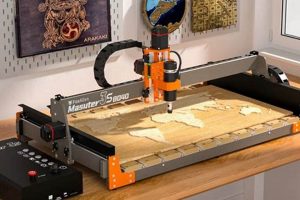
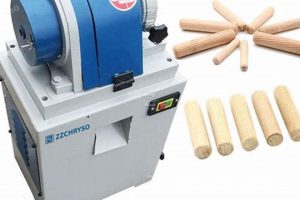
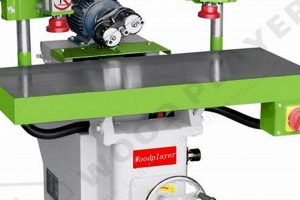
This equipment, fundamental to woodworking, is designed to rotate a piece of wood against a cutting tool. This allows for the creation of symmetrical, cylindrical, or decorative forms. Examples include table legs, spindles for staircases, and bowls.
Its importance lies in its ability to produce precisely shaped components quickly and consistently, enabling mass production of furniture elements and artistic wood turning. Historically, this apparatus enabled craftspeople to move beyond purely functional items to incorporating intricate designs in everyday objects. It enabled the widespread use of detailed woodworking across construction and decoration, shaping the aesthetics of numerous historical periods.
The following sections will detail specific types, operational techniques, safety protocols and considerations for selection of this type of equipment.
Operational Pointers for Wood Turning Equipment
Optimal utilization of wood turning equipment necessitates adherence to established best practices. The following are aimed at improving efficiency, accuracy, and safety during operation.
Tip 1: Select Appropriate Speed: Speed selection is crucial; excessive speed can cause workpiece instability, while insufficient speed hinders efficient cutting. Wood density and workpiece diameter should guide speed adjustments.
Tip 2: Maintain Sharp Cutting Tools: Dull tools demand excessive force, increasing the risk of “catches” and negatively impacting finish quality. Regular sharpening of gouges, skews, and parting tools is essential.
Tip 3: Utilize Correct Tool Rest Position: The tool rest should be positioned close to the workpiece, minimizing the unsupported area of the cutting tool. Frequent adjustments are needed as the workpiece diameter decreases.
Tip 4: Employ Proper Stance and Grip: Operators should maintain a balanced stance, providing stability and control. A firm grip is essential, but excessive force should be avoided to prevent fatigue.
Tip 5: Execute Gradual Cuts: Avoid aggressive cutting depths. Gradual material removal minimizes stress on both the workpiece and the machine, producing a cleaner finish and reducing the likelihood of splintering.
Tip 6: Implement Dust Collection Systems: Wood dust poses a significant health hazard. Effective dust collection systems are crucial for maintaining a clean and safe working environment.
Tip 7: Regularly Inspect Equipment: Routine inspections of the drive belt, bearings, and other mechanical components can prevent breakdowns and ensure safe operation. Lubricate moving parts as recommended by the manufacturer.
By implementing these operational pointers, users can enhance the precision, safety, and longevity of their wood turning projects and equipment.
The subsequent sections will explore specific project applications and troubleshooting techniques related to the operation of turning machines.
1. Material Compatibility

Material compatibility is a crucial consideration when operating wood-turning equipment. The properties of the wood being turned significantly influence the equipment settings, cutting techniques, and achievable results. Matching the equipment capabilities to the specific characteristics of the material is essential for safe and efficient operation.
- Hardness and Density
Hardwoods like maple and oak require slower speeds and sharper tools due to their density. Conversely, softwoods such as pine and cedar can be turned at higher speeds but require careful attention to prevent splintering. The machine’s motor power must be sufficient to handle the resistance of the chosen wood species.
- Grain Orientation
Grain direction dictates the cutting strategy. Turning with the grain often yields smoother results, while turning against the grain can lead to tear-out, especially in woods with interlocking grain patterns. Adjustments to tool angle and feed rate are necessary to compensate for grain orientation.
- Moisture Content
Wood moisture content dramatically impacts machinability and stability. Green wood, with high moisture content, is easier to turn initially but susceptible to warping and cracking as it dries. Kiln-dried wood, with lower moisture content, offers greater stability but can be more challenging to cut cleanly.
- Presence of Defects
Knots, checks, and other imperfections influence material compatibility. These defects can cause tool “catches” or workpiece failure if not addressed strategically. Operators must carefully inspect the wood prior to turning and adjust their approach to accommodate these variations.
These facets of material compatibility directly affect the success and safety of turning operations. Understanding these relationships and adjusting techniques accordingly is crucial for producing quality work using wood-turning equipment.
2. Rotational Speed Control

Rotational speed control is a critical feature governing the performance and versatility of wood-turning equipment. It directly impacts the quality of the finished product, the efficiency of the operation, and the safety of the user. Precise management of spindle speed allows for adaptation to varying wood types, tool sizes, and turning techniques.
- Material Hardness and Density Adaptation
Different wood species require distinct rotational speeds for optimal cutting. Softer woods, such as pine or basswood, typically allow for higher speeds, whereas denser hardwoods like maple or walnut necessitate slower speeds to prevent burning and ensure cleaner cuts. Variable speed control enables the operator to adjust the equipment to the specific material being worked.
- Tool Size and Type Considerations
The size and type of cutting tool employed also influence the ideal rotational speed. Larger tools, such as roughing gouges, used for initial shaping, generally require slower speeds to maintain control and prevent vibration. Smaller, more delicate tools, like spindle gouges or detail tools, may benefit from higher speeds for finer work.
- Workpiece Diameter and Balance
The diameter of the workpiece significantly affects the required rotational speed. Larger diameters necessitate slower speeds to maintain stability and prevent the workpiece from becoming unbalanced, which can lead to dangerous vibrations. Conversely, smaller diameter workpieces can be safely turned at higher speeds.
- Surface Finish and Cutting Efficiency
Rotational speed directly impacts the quality of the surface finish. Optimal speed allows for clean, efficient cutting, minimizing tear-out and producing a smooth surface. Too high or too low of a speed can lead to rough finishes, requiring more sanding and potentially compromising the integrity of the workpiece. Experimentation and adjustment of speed are often necessary to achieve the desired finish.
Therefore, effective rotational speed control is not merely a feature but an essential component for maximizing the potential of wood-turning equipment. The ability to finely tune the speed based on material, tool, and workpiece characteristics is paramount for achieving precision, safety, and optimal results in wood-turning projects.
3. Cutting Tool Variety

The operational capacity of a wood-turning device is directly determined by the availability and selection of cutting tools. These tools, interacting with the rotating workpiece, are instrumental in shaping and refining wood into desired forms. The effect of employing varied tool types manifests in the creation of intricate profiles, smooth surfaces, and specialized features, each requiring a specific cutting edge and operational technique.
The significance of cutting tool variety resides in the machine’s adaptability. A limited tool selection restricts the scope of possible projects. For instance, roughing gouges are used for initial shaping, spindle gouges for refining cylindrical forms, bowl gouges for hollowing concave shapes, parting tools for creating separations, and skew chisels for producing smooth, angled surfaces. Each tool, designed for a particular task, contributes to the comprehensive potential of the machine. The craftsman, equipped with a diverse set of tools, can execute complex designs, incorporating curves, tapers, and decorative elements.
In conclusion, the range of available cutting tools functions as a critical determinant of the woodworking device’s utility. Challenges in tool selection stem from the need to balance cost, quality, and specific project requirements. Ultimately, a comprehensive understanding of tool function and appropriate application is vital for achieving optimal results in wood-turning projects, connecting directly to the core capabilities of the machine itself.
4. Workpiece Securing Methods

The effectiveness of a wood-turning lathe hinges significantly on the method used to secure the workpiece. This process directly influences stability, precision, and safety during operation. Inadequate securing can lead to workpiece slippage, vibration, or complete ejection, causing damage to the workpiece, the machine, and potentially, injury to the operator. Various securing methods exist, each suited to specific workpiece geometries and operational requirements.
For spindle turning, where the workpiece is mounted between centers, the drive center, typically a spur center, is pressed into one end of the wood, providing rotational force. The tailstock center, usually a live center with a rotating point, supports the opposite end, maintaining axial alignment. This method is common for creating long, slender objects like table legs or spindles. Faceplate turning, used for bowls or platters, involves attaching the workpiece to a metal faceplate, which is then screwed onto the headstock spindle. This provides a rigid connection for turning larger diameter objects. Chucks, offering versatile gripping options, enable secure holding of irregular shapes or objects requiring internal hollowing. Examples include jaw chucks with expandable or contractible jaws and vacuum chucks that use suction to hold the workpiece. These methods facilitate intricate work and allow for easy removal and reattachment of the workpiece for different operations.
Selecting the appropriate securing method requires careful consideration of the workpiece dimensions, material properties, and intended turning operations. Correct installation and regular inspection of securing mechanisms are essential for maintaining safe and accurate turning processes. Ultimately, mastery of these techniques is indispensable for maximizing the potential of this machinery and achieving desired results.
5. Vibration Damping Capacity

Vibration damping capacity, as it pertains to wood-turning equipment, is the characteristic of the machine to minimize or dissipate oscillations that arise during operation. This trait directly influences precision, surface finish, and operational safety. Suboptimal damping can result in inaccuracies, increased tool wear, and potential hazards.
- Frame Rigidity and Material Composition
The inherent stiffness of the lathe frame, alongside its material makeup, fundamentally contributes to its damping capability. Cast iron, due to its density and internal structure, exhibits superior vibration absorption compared to lighter materials like steel tubing. A robust frame minimizes deflection under load, thereby reducing the amplitude and duration of vibrations. Examples include vintage lathes, known for their heavy cast iron construction and exceptional stability, contrasting with modern, lightweight models that may require additional damping measures.
- Headstock and Tailstock Design
The design and construction of the headstock and tailstock assemblies play a critical role in mitigating vibration. Precise machining and rigid mounting of these components are essential. Play or looseness in bearings or clamping mechanisms amplifies oscillations. Lathes with well-engineered, heavy-duty headstocks and tailstocks demonstrate reduced vibration and improved turning accuracy.
- Machine Mounting and Base Support
The manner in which the lathe is mounted and supported significantly affects its vibration damping capacity. Direct contact with a rigid floor is preferable. Vibration-isolating pads or mounts can further reduce the transmission of external vibrations into the machine. Inadequate support can exacerbate existing vibrations, leading to instability and inaccuracies. Professional workshops often utilize specialized mounting systems to optimize vibration damping.
- Workpiece Balancing and Speed Selection
While not inherent to the machine itself, proper workpiece balancing and appropriate speed selection are crucial for minimizing vibration. An unbalanced workpiece generates significant forces that can induce vibrations throughout the machine. Selecting the correct rotational speed, based on the workpiece diameter and material, reduces these forces. Prioritizing balanced workpieces and managing speed appropriately effectively reduces vibration.
The cumulative effect of these factors determines the overall vibration damping capacity of the wood-turning lathe. Addressing each aspect is essential for achieving optimal performance, ensuring precision, and maintaining a safe operating environment. Ignoring any one factor can compromise the entire system, limiting the equipment’s potential and increasing the risk of errors.
Frequently Asked Questions
The following section addresses common inquiries regarding this specialized equipment, providing clear and concise answers to assist in understanding its functionality and application.
Question 1: What are the primary safety considerations when operating this machinery?
Eye protection is paramount to guard against flying debris. Hearing protection is advisable to mitigate noise exposure. Loose clothing and jewelry should be avoided to prevent entanglement. Proper dust collection is crucial for respiratory health. Regular inspection and maintenance of the equipment are essential for safe operation.
Question 2: What is the difference between variable speed and fixed-speed models?
Variable speed models offer adjustable rotational speeds, adapting to diverse wood types, tool sizes, and project requirements. Fixed-speed models operate at a single speed, limiting their versatility. The adjustability of variable-speed devices enhances control and precision, particularly when working with hardwoods or delicate projects.
Question 3: What is the expected lifespan of a typical device?
The lifespan is contingent upon factors such as frequency of use, maintenance practices, and the quality of materials used in construction. Routine lubrication, belt adjustments, and replacement of worn parts can significantly extend the operational life. Models constructed with heavy-duty components tend to exhibit greater longevity.
Question 4: What types of wood are most suitable for use with this equipment?
Various wood species are compatible. Hardwoods, like maple and oak, require slower speeds and sharper tools. Softwoods, such as pine and cedar, can be turned at higher speeds, but demand careful attention to prevent splintering. The selection should align with the project goals and the equipment’s capabilities.
Question 5: How frequently should the cutting tools be sharpened?
The sharpening frequency hinges on the wood hardness, tool steel quality, and cutting technique. Dull tools necessitate excessive force and increase the risk of “catches.” Regular honing and sharpening are recommended to maintain optimal cutting performance and safety. Visual inspection of the cutting edge is a reliable indicator of sharpness.
Question 6: What are the common causes of vibration during operation?
Common causes encompass unbalanced workpieces, loose machine components, improper tool rest positioning, and inadequate machine mounting. Addressing these issues through balancing, tightening, adjusting, and securing can effectively mitigate vibration and enhance operational stability.
These FAQs offer a foundational understanding of key aspects related to this specific type of woodworking equipment, aiding in informed decision-making and safe operational practices.
The following section will delve into advanced techniques and specialized applications, expanding upon the concepts introduced thus far.
Conclusion
This exploration has presented a comprehensive overview of the equipment, encompassing its operational principles, essential components, safety protocols, and diverse applications. The capability to produce intricate forms with precision and repeatability underscores its lasting value within the woodworking domain. Mastery of its operation requires a combination of technical proficiency and an understanding of material properties.
The continued evolution of designs and technologies suggests a promising future for applications across both artistic and industrial sectors. Further advancements in automation and precision will likely expand its role in manufacturing, while renewed interest in craftsmanship will preserve its significance within artistic woodworking. Proper utilization, maintenance, and ongoing education regarding its capabilities are essential to maximize its potential and ensure its continued relevance.