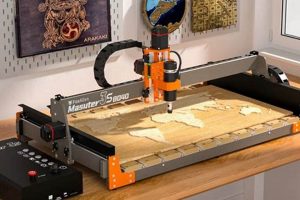
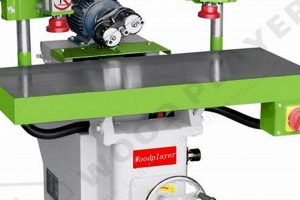
Equipment employing Computer Numerical Control in the realm of wood processing represents a significant advancement in manufacturing technology. These systems utilize pre-programmed software to dictate the movement and operation of tools, enabling the precise cutting, shaping, and finishing of wood components. For example, a device might be programmed to carve intricate designs into furniture panels or to accurately mill parts for cabinetry.
The adoption of these automated solutions offers numerous advantages, including enhanced accuracy, increased production speed, and reduced material waste. Their ability to consistently replicate complex designs also minimizes the need for manual intervention, lowering labor costs and improving overall efficiency. Historically, the integration of computer-controlled machinery has revolutionized woodworking practices, moving from traditional handcrafting to sophisticated, automated manufacturing processes.
The following sections will delve into the specific applications, operational principles, and economic considerations associated with these advanced systems. Focus will be given to the impact these technologies have on various sectors of the woodworking industry, along with an examination of emerging trends and future developments.
Tips for Optimizing the Use of CNC Woodworking Machines
The effective utilization of computer-controlled woodworking equipment demands a strategic approach to programming, maintenance, and operational workflows. The following guidelines are intended to maximize productivity and ensure consistent output quality.
Tip 1: Invest in Comprehensive Operator Training: The proficiency of machine operators directly impacts performance and safety. Thorough training on machine functionality, software interfaces, and safety protocols is essential. For example, operators should understand G-code programming fundamentals and be adept at troubleshooting common errors.
Tip 2: Prioritize Regular Maintenance Schedules: Preventative maintenance is crucial for extending machine lifespan and preventing costly downtime. Regularly inspect and lubricate moving parts, clean debris from cutting areas, and ensure proper calibration of sensors. Consistent adherence to maintenance schedules reduces the risk of mechanical failures.
Tip 3: Optimize Cutting Tool Selection: The choice of cutting tools significantly influences the quality and speed of woodworking operations. Select tools that are appropriate for the specific wood species and cutting parameters. For instance, using spiral flute bits for hardwoods can improve chip evacuation and reduce the risk of burning.
Tip 4: Implement Efficient Material Handling Procedures: Streamlined material handling processes minimize delays and optimize workflow. Develop clear procedures for loading and unloading materials, staging components, and managing waste. Efficient material flow enhances overall throughput.
Tip 5: Leverage Simulation Software for Program Verification: Before executing a program on the machine, utilize simulation software to verify toolpaths and identify potential collisions. Simulation helps prevent errors and ensures that the machining process aligns with design specifications.
Tip 6: Establish a Standardized Program Library: Creating a repository of pre-programmed routines for common tasks can streamline repetitive operations and reduce programming time. This standardized library promotes consistency and allows for rapid deployment of proven programs.
Tip 7: Monitor Machine Performance Metrics: Track key performance indicators (KPIs) such as cycle time, material usage, and error rates. Monitoring these metrics provides valuable insights into machine performance and identifies areas for optimization. Analysis of KPIs can drive continuous improvement efforts.
Adhering to these guidelines can significantly enhance the efficiency, precision, and longevity of computer-controlled woodworking equipment. A proactive and informed approach to operation and maintenance ensures optimal performance and return on investment.
The subsequent sections will address advanced programming techniques and explore the integration of these machines within a broader manufacturing ecosystem.
1. Precision Cutting Capabilities

The term ‘precision cutting capabilities,’ when considered in relation to computer-controlled woodworking machinery, denotes the ability of these systems to execute cuts with a high degree of accuracy and repeatability. This is achieved through the utilization of servo motors and encoders that provide feedback on the position of the cutting tool, enabling precise movements along programmed toolpaths. For instance, in the manufacturing of complex cabinet doors, deviations of even a fraction of a millimeter can compromise the overall aesthetic and functional integrity. Consequently, the precision offered by these machines is not merely a desirable attribute but a fundamental requirement for producing high-quality woodworking products.
The attainment of precision cutting is directly influenced by several factors, including the rigidity of the machine frame, the quality of the cutting tools employed, and the accuracy of the control software. Moreover, environmental conditions, such as temperature fluctuations, can affect the dimensional stability of materials and impact cutting accuracy. Calibration routines, executed regularly, are critical to maintaining the system’s precision over time. A practical example is the creation of interlocking joinery, where precise cuts are essential for achieving strong and seamless connections.
In summary, precision cutting capabilities are an indispensable characteristic of computer-controlled woodworking machinery. The accuracy afforded by these systems enables the efficient production of complex and high-quality woodworking components. Challenges remain in maintaining consistent precision across varied materials and operational conditions, necessitating continuous monitoring, maintenance, and calibration. The link between precision cutting and these machines underscores the importance of investing in robust, well-maintained systems to meet the demands of modern woodworking applications.
2. Automated Design Replication
Automated design replication, when incorporated into computer-controlled woodworking machines, represents a critical function for consistent and scalable production. The machines, programmed with specific designs via CAD/CAM software, execute identical cuts and patterns across multiple pieces, eliminating the inconsistencies inherent in manual woodworking processes. This capability allows for the efficient mass production of furniture components, architectural moldings, and other intricate wood products. For example, a furniture manufacturer might use this to replicate identical chair legs, ensuring uniformity across a large product line, which can significantly reduce the assembly time.
The importance of automated design replication extends beyond mere efficiency. It also facilitates the creation of complex and intricate designs that would be exceedingly difficult or impossible to reproduce manually. The precision inherent in these systems ensures that design specifications are met consistently, regardless of the quantity produced. Practical applications are evident in the production of musical instruments, where exacting dimensions and symmetrical forms are crucial for optimal acoustic performance. Without automated replication, achieving the required level of precision would be highly challenging and expensive. This has dramatically enhanced the development of better products in the market and is the leading technology used now.
In summary, automated design replication is a core competency of computer-controlled woodworking machines, offering benefits in terms of consistency, efficiency, and the ability to produce complex designs. Challenges related to programming complexity and the initial investment in CAD/CAM software exist, but the long-term advantages of this technology in terms of production throughput and product quality are substantial. Understanding this function is essential for businesses seeking to leverage the capabilities of these advanced woodworking systems. This technology has enhanced the woodworking industry, and is the tool needed to push it into the future.
3. Material Optimization Strategies

Efficient resource utilization is paramount in modern woodworking, and material optimization strategies, when integrated with computer-controlled machinery, play a crucial role in minimizing waste and maximizing yield. These strategies leverage software and advanced machine capabilities to improve material usage, thereby reducing costs and enhancing sustainability.
- Nesting Software Integration
Nesting software analyzes part geometries and arranges them on a sheet of material in a way that minimizes waste. This process, automated and optimized by algorithms, can yield significant material savings compared to manual layout methods. For example, in cabinet manufacturing, differently sized components can be arranged on a plywood sheet to minimize unusable areas, reducing material costs by as much as 10-15%. The software then generates toolpaths directly usable by the machine, further streamlining the process.
- Toolpath Optimization
Efficient toolpaths can reduce material waste by minimizing the number of cuts required and optimizing the sequence in which parts are cut. By strategically sequencing cuts, the machine can minimize material movement and prevent the creation of small, unusable scrap pieces. For instance, “common line cutting,” where a single cut separates two adjacent parts, can significantly reduce material usage in high-volume production runs. The toolpath must be compatible with the machine to function properly.
- Material Defect Recognition
Advanced systems can incorporate sensors and cameras to detect defects in raw materials, such as knots or cracks in lumber. This information is then used to adjust the nesting layout or cutting paths to avoid these defects, preventing the production of flawed parts and reducing material waste. An example is a system that scans a wooden plank, identifies a large knot, and then adjusts the cutting plan so that the knot falls into an area that will be discarded as waste, rather than ending up in a finished component. This requires sophisticated sensor tech.
- Multi-Material Processing
Certain computer-controlled woodworking machines are capable of processing multiple types of materials, such as wood, plastic, and composites. This flexibility allows manufacturers to optimize material usage by selecting the most appropriate material for each component of a product. For instance, a furniture manufacturer might use solid wood for structural components and composite materials for decorative elements, reducing the consumption of valuable hardwoods and minimizing costs. A large market segment to take into consideration.
These interconnected strategies demonstrate the comprehensive approach to material optimization achievable through the integration of computer-controlled woodworking machinery and advanced software solutions. By implementing these techniques, manufacturers can reduce material costs, minimize waste, and improve the overall sustainability of their operations, while using advanced technologies.
4. Programming Language Proficiency

Proficiency in programming languages is a foundational requirement for the effective operation and utilization of computer-controlled woodworking machines. These machines, while possessing advanced mechanical capabilities, rely on precise instructions encoded in programming languages to execute their tasks. The operator’s ability to understand, interpret, and modify these instructions directly impacts the machine’s performance and the quality of the final product. For example, G-code, a widely used numerical control programming language, dictates the toolpath, cutting speed, and spindle speed of the machine. Inadequate proficiency in G-code can lead to errors in the machining process, resulting in material waste, damaged tools, or improperly machined components. A deep understanding of coding is imperative.
The practical significance of programming language proficiency extends to advanced applications such as parametric design and custom toolpath generation. Parametric design allows for the creation of designs based on mathematical equations and variables, enabling rapid modification and adaptation of designs. Custom toolpath generation involves creating specialized cutting paths that optimize material removal rates and minimize machining time. These advanced techniques require a thorough understanding of programming principles and the ability to write or modify code to suit specific requirements. Software like AutoCAD and Fusion 360 has helped in this area.
In conclusion, programming language proficiency is inextricably linked to the successful operation of computer-controlled woodworking machines. It empowers operators to control the machine’s functions, optimize machining processes, and adapt to evolving design requirements. Although the learning curve associated with programming languages can be steep, the benefits in terms of precision, efficiency, and design flexibility are substantial, contributing directly to the competitiveness and profitability of woodworking operations. As machining operations become more complex, the demand for operators with advanced programming skills will undoubtedly increase. A necessity for future woodworking.
5. Integrated Safety Protocols

The incorporation of comprehensive safety measures is not merely an adjunct to computer-controlled woodworking machines; it is an integral component of their design, operation, and maintenance. These machines, capable of high-speed and automated material processing, present inherent risks that necessitate rigorously implemented safety protocols. Failure to adhere to these protocols can result in severe injury to operators, damage to equipment, and disruption of production. Real-world examples include accidents involving improperly guarded cutting tools, leading to lacerations and amputations, or instances where malfunctioning sensors fail to halt machine operation, resulting in collisions and material ejection. The practical significance of understanding these risks lies in the proactive implementation of preventative measures. The safety features help prevent work place accidents from happening.
These integrated safety systems typically encompass a range of features, including emergency stop buttons, light curtains, interlocked guards, and automated shutdown mechanisms. Emergency stop buttons, strategically positioned around the machine, enable immediate cessation of operation in the event of a malfunction or imminent hazard. Light curtains create a virtual barrier around the working area, automatically stopping the machine if the barrier is breached. Interlocked guards prevent access to hazardous areas while the machine is in operation, and automated shutdown mechanisms ensure that the machine shuts down safely in the event of power failure or other critical system errors. The effectiveness of these systems depends not only on their technical design but also on the diligence of operators in following safety procedures and undergoing thorough training. Without the safety features, the work place would not be safe.
In summary, integrated safety protocols are indispensable for the safe and effective operation of computer-controlled woodworking machines. The combination of robust engineering controls, comprehensive training programs, and diligent adherence to safety procedures is essential for mitigating the inherent risks associated with these powerful machines. Challenges remain in maintaining the effectiveness of these protocols over time, requiring ongoing monitoring, maintenance, and adaptation to new technologies and operational environments. The continued emphasis on safety is crucial to ensuring a safe and productive working environment. This ensures that workers will always be safe in the work place.
Frequently Asked Questions
This section addresses common inquiries and concerns regarding the implementation and operation of computer-controlled woodworking machines. The information provided aims to offer clarity and guidance on key aspects of these advanced systems.
Question 1: What is the typical Return On Investment (ROI) timeframe for computer-controlled woodworking machines?
The ROI timeframe is contingent upon factors such as machine cost, production volume, material savings, and labor cost reduction. Generally, a well-managed implementation can achieve ROI within 3-5 years. A detailed cost-benefit analysis is recommended before investment.
Question 2: What level of technical expertise is required to operate computer-controlled woodworking machines?
Operation requires a foundational understanding of CAD/CAM software, G-code programming, and machine maintenance. While advanced programming skills are beneficial, basic operation can be learned through training programs. However, troubleshooting and optimization necessitate a higher level of technical proficiency.
Question 3: How does the precision of computer-controlled woodworking machines compare to traditional woodworking methods?
Computer-controlled woodworking machines offer significantly higher precision compared to traditional methods. These systems can achieve tolerances within fractions of a millimeter, enabling the creation of intricate and consistent designs that are difficult or impossible to replicate manually.
Question 4: What are the primary maintenance requirements for computer-controlled woodworking machines?
Maintenance includes regular lubrication of moving parts, inspection and replacement of worn cutting tools, cleaning of debris from the work area, and calibration of sensors and encoders. A preventative maintenance schedule is essential for ensuring optimal performance and longevity.
Question 5: Can computer-controlled woodworking machines process different types of wood and materials?
Yes, these machines can process a wide range of wood species, as well as plastics, composites, and other materials. However, tool selection and cutting parameters must be adjusted based on the specific material being processed to ensure optimal results and prevent damage.
Question 6: What safety precautions should be observed when operating computer-controlled woodworking machines?
Strict adherence to safety protocols is crucial. This includes wearing appropriate personal protective equipment (PPE), ensuring that safety guards are in place and functioning correctly, and undergoing thorough training on machine operation and emergency procedures. Regular safety inspections are also essential.
In summary, computer-controlled woodworking machines offer substantial advantages in terms of precision, efficiency, and design flexibility. However, successful implementation requires careful planning, adequate training, and adherence to safety protocols.
The following section will explore emerging trends and future developments in computer-controlled woodworking technology.
Conclusion
This exploration has illuminated the capabilities and implications of computer-controlled woodworking machines. It has identified core operational aspects, including precision cutting, automated design replication, material optimization strategies, programming language proficiency, and integrated safety protocols. Furthermore, it addressed frequently asked questions related to ROI, technical expertise, maintenance, and material processing, offering practical insights for potential adopters and current users.
The ongoing evolution of these technologies presents both opportunities and challenges for the woodworking industry. Continued investment in research, development, and training will be essential to harnessing their full potential and ensuring a sustainable and competitive future. The responsible adoption of these systems, with a focus on safety, efficiency, and environmental stewardship, will define the trajectory of woodworking practices in the years to come.