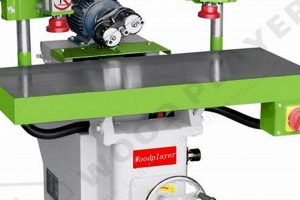
A device utilized to capture particulate matter generated during processes involving wood manipulation, such as sawing, sanding, and routing. This equipment employs suction to draw airborne debris away from the work area, channeling it into a collection receptacle for disposal. The primary function is to maintain a cleaner and healthier environment in workshops and manufacturing facilities.
The implementation of such systems yields several advantages. Air quality is significantly improved, reducing the risk of respiratory ailments and other health issues associated with prolonged exposure to wood dust. Efficiency of operations is enhanced as the workspace remains clearer, affording better visibility and reducing the need for frequent cleaning. Historically, rudimentary forms of extraction have existed; however, modern iterations provide far superior performance and filtration capabilities.
The subsequent discussion will delve into various aspects of these systems, encompassing types of equipment available, factors influencing selection, maintenance procedures, and considerations for optimal performance within a woodworking environment. Understanding these elements is crucial for ensuring a safe, efficient, and productive woodworking operation.
Optimizing Performance and Longevity
Maximizing the effectiveness and lifespan of particulate extraction equipment requires careful attention to several critical factors. Adherence to the following guidelines will contribute to a safer, cleaner, and more efficient woodworking operation.
Tip 1: Correct Sizing is Paramount. Undertaking a comprehensive evaluation of airflow requirements within the workspace is essential. The equipment’s cubic feet per minute (CFM) rating must adequately accommodate the volume of dust generated by all connected machinery. Insufficient airflow results in inadequate capture and diminished air quality.
Tip 2: Implement Proper Ductwork Design. Employing smooth, rigid ductwork with minimal bends optimizes airflow efficiency. Flexible hoses introduce significant resistance and should be utilized sparingly, ideally for short connections directly to the equipment. Gradual transitions in duct diameter reduce turbulence and maintain consistent air velocity.
Tip 3: Employ Appropriate Filtration. The selection of filtration media directly impacts the system’s ability to remove fine particulate matter. Consider the use of filters with a high Minimum Efficiency Reporting Value (MERV) rating to capture dust particles smaller than 1 micron. Regular filter inspection and replacement are critical to maintaining optimal performance.
Tip 4: Implement a Regular Maintenance Schedule. Periodic inspection of hoses, clamps, and ductwork for leaks or blockages is essential. Emptying the collection receptacle before it becomes overly full prevents backpressure and reduces the risk of motor overload. Lubricate moving parts according to the manufacturer’s recommendations.
Tip 5: Consider Pre-Separation Techniques. Integrating a cyclone separator upstream of the primary filtration unit can significantly extend filter life and reduce the frequency of emptying the collection receptacle. Cyclone separators remove a large proportion of heavier debris before it reaches the filter, increasing overall system efficiency.
Tip 6: Ensure Adequate Grounding. Static electricity can accumulate in ductwork, particularly when handling dry wood. Grounding the entire system mitigates the risk of static discharge and potential fire hazards. Consult with a qualified electrician to ensure proper grounding techniques are employed.
Tip 7: Optimize Machine Placement. Position the equipment as close as practically possible to the primary sources of dust generation. Shorter duct runs minimize airflow resistance and improve capture efficiency at the point of origin. Consider strategically locating machinery to facilitate efficient dust collection.
Adhering to these principles ensures efficient operation, prolongs equipment lifespan, and promotes a healthier and safer environment. Consistent monitoring and proactive maintenance are key to realizing the full benefits of this equipment.
The following sections will address specific equipment types and considerations for particular woodworking applications, providing further insights into optimal system design and implementation.
1. Airflow (CFM)

Cubic Feet per Minute (CFM) is a critical specification for particulate extraction equipment used in woodworking. It quantifies the volume of air the system moves per minute, directly impacting its ability to capture dust and debris at the source. Insufficient airflow results in inadequate capture, allowing particulate matter to disperse into the workspace. Conversely, excessive airflow may be inefficient and necessitate a larger, more power-intensive system than required.
The required CFM is determined by several factors, including the types of tools used, the frequency of their operation, and the ductwork configuration. A table saw, for example, requires a higher CFM than a small sanding station due to the volume of material it removes. Ductwork length and the number of bends create resistance, necessitating a higher CFM rating to maintain adequate suction at the tool. Proper duct design is thus integral to optimizing system performance. Real-world scenarios demonstrate that failure to account for these variables leads to compromised air quality and potential health risks for woodworking personnel.
In summary, CFM is not merely a technical specification; it is a determinant of the equipment’s effectiveness in safeguarding health and maintaining a clean workspace. Selecting an appropriately sized unit based on a thorough assessment of tools, ductwork, and operating conditions is essential. Ongoing monitoring of airflow, coupled with regular maintenance, ensures continued optimal performance and a reduction in airborne particulate matter within the woodworking environment.
2. Filtration Efficiency
Filtration efficiency is a crucial attribute of particulate extraction equipment used in woodworking, directly impacting air quality and worker health. This efficiency dictates the system’s capability to capture and retain airborne particles of varying sizes generated during woodworking processes. Higher filtration efficiency results in the removal of smaller particles, minimizing their reintroduction into the workspace. The Minimum Efficiency Reporting Value (MERV) rating is a common metric used to assess this, with higher MERV values indicating greater capture of finer particulate matter.
The selection of filtration media is a critical decision, influencing the system’s overall effectiveness. Cartridge filters, for example, offer higher filtration efficiency compared to basic bag filters, capturing a larger percentage of fine dust. The presence of a high-efficiency particulate air (HEPA) filter guarantees the removal of at least 99.97% of particles 0.3 microns in diameter, providing superior air purification. In woodworking environments handling hardwoods or composite materials, which produce particularly fine and potentially hazardous dust, prioritizing high filtration efficiency is imperative. Inadequate filtration compromises air quality, increasing the risk of respiratory ailments and other health issues.
Ultimately, filtration efficiency is not merely a specification but a determinant of a particulate extraction system’s ability to protect worker health and maintain a clean, safe environment. The appropriate selection and regular maintenance of filters are essential elements in achieving optimal air quality within a woodworking facility. Understanding the relationship between filtration efficiency and its real-world impact is key to ensuring responsible and effective dust management in woodworking.
3. Dust Containment

Dust containment, in the context of woodworking, refers to the controlled management and prevention of the dispersal of particulate matter generated during wood processing. It is a critical function inextricably linked to the effectiveness of particulate extraction equipment. A properly functioning system effectively minimizes the spread of fine wood dust, preventing its accumulation on surfaces, in the air, and within workers’ respiratory systems. The absence of effective containment compromises air quality and presents significant health hazards.
The design and functionality of particulate extraction equipment directly influence the degree of dust containment achieved. Key factors include the efficiency of the intake hood design, the air velocity at the point of dust generation, and the integrity of the seals and connections within the ductwork and collection unit. For example, a poorly designed intake hood on a sander will allow a significant amount of dust to escape into the environment, regardless of the system’s overall CFM rating. Similarly, leaks in ductwork compromise suction and contribute to dust accumulation. Industrial facilities often employ sophisticated, centralized systems with multiple collection points to ensure comprehensive dust containment across various woodworking operations.
Effective dust containment is not simply a matter of regulatory compliance; it is a fundamental aspect of responsible woodworking practices. It directly impacts worker health, reduces the risk of fire hazards associated with combustible dust accumulation, and minimizes the need for extensive cleaning and maintenance. By prioritizing effective containment as a primary design criterion, woodworking operations can create safer, healthier, and more efficient working environments.
4. System Design

System design is integral to the performance of particulate extraction equipment used in woodworking. An effective design considers the interplay of various components to optimize dust capture, conveyance, and filtration. The success of a system hinges on a holistic approach that addresses source capture, ductwork layout, equipment placement, and filtration requirements. A poorly conceived design can result in inadequate dust collection, even with high-capacity equipment, leading to compromised air quality and potential health risks.
Practical examples illustrate the importance of thoughtful system design. Consider a woodworking shop with multiple machines, each generating different quantities and types of dust. A centralized system with appropriately sized ductwork connected to each machine is preferable to individual units if space allows. The ductwork should be designed with smooth transitions and minimal bends to reduce airflow resistance. The selection of appropriate blast gates at each machine allows for efficient allocation of suction only to active equipment. A pre-separator, such as a cyclone, can remove larger debris before it reaches the filter, extending filter life and reducing maintenance. Without such integrated design elements, a particulate extraction system is likely to underperform, requiring frequent maintenance and failing to effectively remove airborne dust.
In summary, system design represents a critical element in achieving efficient and reliable particulate extraction. Optimizing the interplay between source capture, ductwork, equipment placement, and filtration leads to improved air quality, reduced maintenance costs, and a safer working environment. Addressing the complex interactions within the system is crucial for maximizing the effectiveness and longevity of the investment. The initial planning and design phase determines the long-term success and utility of the particulate extraction infrastructure.
5. Motor Power

Motor power represents a fundamental determinant of the operational effectiveness of particulate extraction equipment in woodworking applications. It directly dictates the system’s capacity to generate the necessary airflow and suction to capture airborne dust and debris. Insufficient motor power translates to inadequate dust collection, compromising air quality and worker health. The selection of a motor with appropriate power output is, therefore, paramount in ensuring the system meets the demands of the woodworking environment.
- Airflow Generation
Motor power directly correlates with the system’s ability to generate airflow, measured in cubic feet per minute (CFM). Higher motor power enables the creation of greater suction force, allowing the system to effectively draw particulate matter from the point of origin. For example, a high-volume woodworking shop with large machinery requires a motor with sufficient horsepower to maintain adequate CFM across multiple collection points. Without adequate power, the system will fail to capture dust effectively, leading to its dispersal into the workspace.
- Static Pressure Capacity
Motor power influences the system’s capacity to overcome static pressure, the resistance to airflow within the ductwork. Longer duct runs and more complex ducting configurations increase static pressure, necessitating a more powerful motor to maintain adequate suction. A motor with insufficient power will struggle to overcome this resistance, resulting in diminished airflow and reduced dust collection efficiency. Understanding the ductwork layout and its impact on static pressure is critical in selecting a motor with adequate power.
- System Load and Duty Cycle
The expected system load and duty cycle influence motor power requirements. If the equipment is intended for continuous operation or is frequently subjected to heavy loads, a more robust motor is necessary to prevent overheating and premature failure. Overloading a motor can lead to reduced performance, increased energy consumption, and a shortened lifespan. Selecting a motor rated for the anticipated duty cycle ensures reliable operation and minimizes downtime.
- Energy Efficiency Considerations
While motor power is essential for performance, energy efficiency is also a critical factor. Higher horsepower motors consume more electricity, impacting operational costs. Selecting an energy-efficient motor with appropriate power output balances performance requirements with energy conservation. Modern motors often incorporate features such as variable frequency drives (VFDs) to optimize energy consumption based on real-time demand, providing significant cost savings over time.
These considerations underscore the intricate relationship between motor power and the overall performance of particulate extraction equipment. Careful evaluation of airflow requirements, static pressure, system load, and energy efficiency is essential in selecting a motor that effectively addresses the demands of the woodworking environment, safeguarding air quality, and ensuring long-term operational reliability.
6. Collector Volume
Collector volume is a fundamental parameter in the design and selection of particulate extraction equipment used in woodworking. It quantifies the holding capacity of the system’s receptacle for accumulated dust and debris. This parameter directly influences the frequency of emptying required and impacts the overall efficiency and convenience of the equipment’s operation within a woodworking setting.
- Capacity and Operational Frequency
Collector volume directly correlates with the frequency with which the collection receptacle must be emptied. A larger volume necessitates less frequent emptying, reducing downtime and improving operational efficiency. Conversely, a smaller volume requires more frequent attention, potentially interrupting workflow. For example, a hobbyist woodworker using a small benchtop sander may find a small collector volume adequate, while a professional operating a large planer will require a significantly larger volume to avoid constant interruptions for emptying.
- Impact on Suction Performance
As the collection receptacle fills, the system’s suction performance can be affected. An overfilled container can create backpressure, reducing airflow and diminishing the system’s ability to effectively capture dust. Larger collector volumes mitigate this effect, maintaining consistent suction performance over longer periods. Regular emptying, regardless of volume, remains crucial to prevent performance degradation. A clear window or fill-level indicator allows for timely emptying, ensuring optimal system operation.
- Physical Space and Portability
Collector volume impacts the physical size and portability of the equipment. Larger volumes typically necessitate larger collection units, potentially limiting maneuverability and requiring more floor space. Smaller volumes offer greater portability but necessitate more frequent emptying. The selection of an appropriate volume requires balancing the need for operational efficiency with the constraints of the woodworking environment. Portable units with smaller volumes are well-suited for small shops or on-site work, while stationary systems with larger volumes are better suited for larger, fixed workshops.
- Material and Construction
The material and construction of the collector directly influence its durability and ease of maintenance. Collection receptacles are typically constructed from plastic, metal, or fabric. Metal receptacles offer greater durability and resistance to punctures, while plastic receptacles are lighter and easier to clean. Fabric bags are commonly used in smaller, portable units, but they require periodic replacement. The chosen material should be resistant to the abrasion and potential corrosiveness of different types of wood dust.
In summary, collector volume is an essential consideration in selecting particulate extraction equipment for woodworking. Its impact on operational frequency, suction performance, physical space, and material durability underscores its importance in optimizing system efficiency and convenience. Balancing these factors ensures the equipment meets the specific needs of the woodworking operation, contributing to a cleaner, safer, and more productive work environment.
7. Maintenance Needs

The operational effectiveness and longevity of particulate extraction equipment in woodworking are directly contingent upon consistent and diligent maintenance. Neglecting routine maintenance tasks invariably leads to reduced performance, increased energy consumption, potential equipment failure, and compromised air quality within the woodworking environment. Therefore, understanding and adhering to recommended maintenance protocols represents a critical component of responsible woodworking practice.
Regular filter replacement exemplifies the cause-and-effect relationship between maintenance and performance. Clogged filters impede airflow, forcing the motor to work harder, increasing energy consumption, and reducing the system’s dust capture efficiency. Timely replacement, adhering to the manufacturers guidelines, restores optimal airflow and maintains the equipment’s designed performance levels. Similarly, neglecting to empty the collection receptacle allows it to overfill, obstructing airflow and potentially damaging the motor. Routine inspection and cleaning of ductwork are essential to prevent blockages that diminish suction and increase static pressure. Industrial facilities often implement preventative maintenance schedules, including regular inspections of motor bearings, seals, and electrical connections, to minimize downtime and extend equipment lifespan. Ignoring these tasks leads to costly repairs and operational disruptions.
In conclusion, the connection between maintenance needs and woodworking particulate extraction equipment is undeniable. Prioritizing regular maintenance procedures, including filter replacement, receptacle emptying, ductwork cleaning, and component inspection, ensures efficient and reliable operation, promotes a healthier working environment, and extends the equipment’s lifespan. Consistent attention to these tasks represents a sound investment in long-term performance and safety within the woodworking operation.
Frequently Asked Questions
The following addresses commonly encountered inquiries regarding particulate extraction equipment utilized in woodworking environments, offering concise and authoritative responses.
Question 1: What constitutes an adequate CFM rating for a woodworking dust collection system?
The appropriate CFM rating is contingent upon the types of machinery employed and the dimensions of the ductwork. As a general guideline, planers and jointers require a minimum of 700 CFM, while table saws benefit from at least 400 CFM. Consult machinery manuals for specific recommendations.
Question 2: How frequently should filters be replaced in a woodworking dust collector?
Filter replacement frequency depends on usage intensity and the type of material processed. Inspect filters regularly and replace them when visibly clogged or when a reduction in suction is observed. Cartridge filters may last several months with moderate use, while bag filters typically require more frequent replacement.
Question 3: Is it necessary to ground the ductwork of a woodworking dust collection system?
Grounding the ductwork is strongly recommended to mitigate the risk of static electricity buildup and potential discharge, which can ignite combustible dust. Employ metal ductwork with continuous grounding straps connected to a grounded electrical outlet.
Question 4: What are the primary benefits of incorporating a cyclone separator in a woodworking dust collection system?
A cyclone separator pre-separates larger debris, preventing it from reaching the filter and extending filter life. This reduces the frequency of filter replacement and maintains consistent suction performance.
Question 5: Can a standard shop vacuum be used as a substitute for a dedicated woodworking dust collector?
While a shop vacuum can provide some level of dust collection, it is not an adequate substitute for a dedicated system. Shop vacuums typically lack the CFM and filtration capacity required for effective dust management in woodworking environments.
Question 6: What are the essential safety precautions to observe when operating woodworking dust collection equipment?
Always wear appropriate respiratory protection, such as a dust mask or respirator, when working with wood. Ensure all equipment is properly grounded and that the collection receptacle is emptied regularly to prevent overfilling. Follow manufacturer instructions for operation and maintenance.
The preceding responses offer concise guidance on common concerns regarding particulate extraction equipment in woodworking. Adherence to these recommendations will contribute to a safer and more efficient woodworking environment.
The subsequent discussion will delve into specific equipment types and considerations for particular woodworking applications, providing further insights into optimal system design and implementation.
Conclusion
This exploration has underscored the critical role of the dust collector machine for woodworking in maintaining a safe and efficient workshop environment. The comprehensive overview encompassed airflow requirements, filtration efficiencies, system design considerations, motor power implications, collector volume management, and essential maintenance protocols. A nuanced understanding of these interconnected elements is paramount for optimizing the performance and longevity of particulate extraction systems.
The effective implementation of these systems represents a tangible investment in worker health, regulatory compliance, and operational productivity. Woodworking professionals must prioritize informed equipment selection and diligent maintenance practices to realize the full benefits of dust collection technology. Continued advancements in filtration and automation offer opportunities for further refinement of dust control strategies, fostering safer and more sustainable woodworking practices in the future.