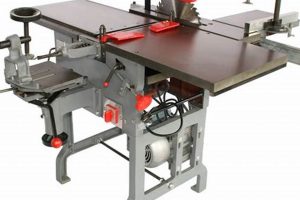
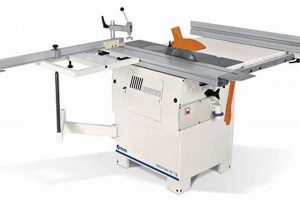
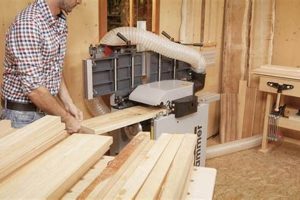
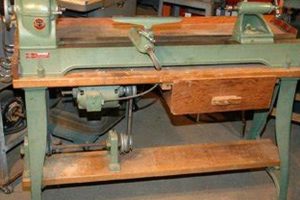
The Shopsmith is a versatile piece of equipment consolidating several essential woodworking tools into a single unit. Typically, it functions as a drill press, lathe, disc sander, horizontal boring machine, and table saw. This combination allows a user to perform a wide array of woodworking operations without requiring multiple, dedicated machines.
The primary advantage of such a system lies in its space-saving design and potential cost-effectiveness. For hobbyists or those with limited workshop space, combining multiple functions into one footprint is particularly beneficial. Historically, this type of multi-purpose tool offered an entry point into woodworking, providing a comprehensive set of capabilities for a relatively lower initial investment compared to purchasing individual machines.
Considering the compact nature and multiple functionalities inherent in this type of woodworking center, subsequent discussion will delve into specific operational aspects, maintenance considerations, and its relevance in modern woodworking environments.
Operational Tips for the Shopsmith System
Optimal utilization of the multi-functional woodworking system requires a thorough understanding of its various modes and appropriate operating procedures. The following tips aim to enhance performance, safety, and longevity.
Tip 1: Regular Calibration: Prior to initiating any operation, verify the accuracy of settings for each function, particularly the table saw’s blade alignment and the drill press’s perpendicularity. Deviations can compromise accuracy and safety.
Tip 2: Secure Workpiece Clamping: Regardless of the selected function, ensure the workpiece is firmly secured using appropriate clamps or fixtures. This minimizes the risk of slippage or ejection, contributing to both precision and operator safety.
Tip 3: Speed Adjustment According to Material: The variable speed control requires careful adjustment based on the material being worked. Softer materials generally require higher speeds, while hardwoods and metals necessitate slower speeds to prevent overheating and tool damage.
Tip 4: Dust Collection Integration: Connecting a dust collection system is critical, irrespective of the function being used. Wood dust can pose a health hazard and impede the operation of the machine. Regular cleaning of internal mechanisms is also recommended.
Tip 5: Lubrication of Moving Parts: Periodically lubricate all moving parts as specified in the manufacturer’s manual. Proper lubrication reduces friction, extends component lifespan, and ensures smooth operation across all functions.
Tip 6: Blade and Bit Selection: Use only blades and bits specifically designed for the intended application and material. Incorrect selection can lead to substandard results, equipment damage, and potential injury. Inspect blades and bits for sharpness and integrity prior to use.
Tip 7: Gradual Depth of Cut: When using the table saw or other cutting functions, avoid attempting to remove excessive material in a single pass. Employing multiple, shallower cuts reduces strain on the motor and yields a cleaner, more precise result.
Effective implementation of these operational guidelines contributes to the prolonged functionality and reliability of the Shopsmith, maximizing its utility across its diverse woodworking applications. Prioritizing safety and precision in all operations is paramount for achieving professional-quality results.
These guidelines provide a foundation for safe and effective operation. Continued learning and adherence to the manufacturer’s recommendations are essential for mastering the diverse capabilities of the Shopsmith system.
1. Versatility

Versatility constitutes a cornerstone of the Shopsmith’s design and functionality. As a multi-tool system, it inherently aims to consolidate the capabilities of several single-purpose woodworking machines into one unit. This integration stems from the desire to provide a broader range of woodworking options within a limited footprint. A direct consequence of this approach is an increased adaptability in project scope; a user can theoretically execute a project from raw material to finished product without requiring separate, dedicated stations for sawing, drilling, sanding, and turning.
The Shopsmith’s versatility manifests practically in its ability to function as a table saw for ripping and crosscutting, a drill press for precise drilling operations, a lathe for turning spindles and other cylindrical forms, a disc sander for smoothing surfaces, and a horizontal boring machine for creating precise mortises or dowel holes. This functionality can be used for creating cabinets, furniture, or other woodworking projects that require multiple processes. The Shopsmith can also adapt to a range of woodworking projects and also be modified or upgraded with aftermarket parts to enhance its performance. This modularity contributes to the longevity of the tool and potentially extends its usefulness as a workshop grows or requirements evolve.
However, the Shopsmith’s versatility presents challenges. Mastery of each individual function necessitates focused learning and practice. The machine’s integrated nature also requires careful configuration and adjustment when switching between modes, which can be time-consuming and potentially impact workflow efficiency. It balances the trade-off between comprehensive functionality and ease of use. Users must critically evaluate whether the breadth of functionality aligns with the complexity of operation for the needs of their woodworking practice.
2. Space Efficiency

The concept of space efficiency is intrinsically linked to the Shopsmith woodworking machine. Its primary design objective is to consolidate multiple woodworking functions, typically requiring separate, dedicated machines, into a single unit. This aggregation directly addresses the spatial constraints often encountered in home workshops or smaller commercial settings. The machine’s footprint is significantly smaller than the combined area required to accommodate a stand-alone table saw, drill press, lathe, disc sander, and horizontal boring machine. This allows users to perform a range of woodworking tasks within limited confines.
Real-world examples demonstrate the practical significance of this space-saving attribute. An apartment dweller with a small balcony or a homeowner with a limited garage area can potentially engage in a wider range of woodworking activities due to the compact nature of the Shopsmith. Furthermore, its space efficiency contributes to improved workshop organization and workflow by reducing clutter and facilitating easier movement around the workspace. The ability to store the functionality of multiple tools in one machine promotes a more streamlined and efficient working environment, which is particularly beneficial for those with spatial limitations. A user in a small shop can effectively perform different tasks by switching to a different mode. This will enable him to use the limited space effectively.
While the Shopsmith addresses space limitations, users must also consider the space required for maneuvering materials and storing accessories associated with each function. Despite these factors, the machine’s inherent space-efficient design delivers a compelling advantage for individuals or businesses operating within confined spaces. The integration of diverse functions into a compact form factor remains a central characteristic of the Shopsmith and a key determinant of its value in specific woodworking scenarios.
3. Cost Considerations

Evaluating the economic aspects of the Shopsmith woodworking machine necessitates a comprehensive analysis extending beyond the initial purchase price. The multifaceted nature of the machine introduces several cost-related factors that influence its overall value proposition.
- Initial Investment vs. Stand-Alone Machines
The Shopsmith typically presents a lower upfront cost compared to acquiring individual, dedicated versions of a table saw, drill press, lathe, disc sander, and horizontal boring machine. This initial savings can be significant, particularly for hobbyists or individuals with budget constraints. However, one must factor in the potential trade-offs in performance or specialized features that dedicated machines might offer.
- Maintenance and Repair Costs
Due to its complex, integrated design, maintenance and repair of the Shopsmith can present unique challenges. Sourcing replacement parts might be more difficult or expensive compared to common stand-alone machines. Furthermore, the specialized knowledge required for certain repairs may necessitate professional servicing, incurring additional costs. Regular maintenance, including lubrication and calibration, is critical to minimizing these expenses.
- Operational Efficiency and Material Costs
The efficiency with which the Shopsmith can perform various woodworking tasks directly impacts material costs. Precise cuts and accurate joinery, facilitated by a well-maintained Shopsmith, can minimize material waste. Conversely, inaccuracies or operational inefficiencies may lead to increased material consumption and associated expenses. The operator’s skill and experience with the machine also play a role in optimizing material usage.
- Long-Term Value and Resale Potential
The long-term value of the Shopsmith is influenced by its durability, reliability, and the continued availability of replacement parts. Well-maintained machines tend to retain their value more effectively. The resale potential of the Shopsmith depends on its condition, age, and the prevailing market demand for multi-functional woodworking equipment. Prospective buyers often consider the availability of support and accessories when assessing the resale value.
In summary, the economic assessment of the Shopsmith requires a nuanced approach that encompasses initial investment, maintenance costs, operational efficiency, and long-term value. Evaluating these factors in relation to individual woodworking needs and financial considerations enables informed decision-making.
4. Functional Integration

The Shopsmith system embodies functional integration as its core design principle. The machine’s architecture merges the distinct operations of a table saw, drill press, lathe, disc sander, and horizontal boring machine into a single, unified platform. This integration is not merely a spatial arrangement of disparate tools; rather, it involves a shared power source, control mechanisms, and worktable configuration that allow for seamless transitions between different woodworking functions. A direct consequence of this integration is a reduction in required floor space and a potential streamlining of workflow, particularly in environments where space is a premium.
The importance of functional integration within the Shopsmith design is that it allows one motor to power several tools. An example is converting from a table saw function to a disc sander, the work table will shift to horizontal configuration. The user then changes the cutting blade to a sanding disc. And it’s good to go. Functionality is not diminished in any manner. Without the functional integration, the user is required to purchase each of the tools, find the real estate in his shop to house the tools, and pay to maintain the tools separately. Functional integration enables users to move through stages of woodworking with having to purchase the multiple tools to do so.
In conclusion, functional integration is the defining characteristic of the Shopsmith, enabling its versatility and space-saving design. However, it also introduces complexities in operation and maintenance. Successful utilization of the Shopsmith requires a thorough understanding of its integrated functions and the proper procedures for transitioning between them. The value of functional integration is maximized when the machine is used to its full potential, providing a comprehensive woodworking solution in a compact and efficient package.
5. Operational Complexity
The Shopsmith woodworking machine, owing to its multi-functional design, presents a heightened degree of operational complexity compared to single-purpose tools. The consolidation of table saw, drill press, lathe, disc sander, and horizontal boring functionalities into a single unit necessitates a detailed understanding of each mode’s specific setup, adjustments, and safety protocols. Cause and effect are directly linked; increased functionality leads to a more intricate operational learning curve.
The importance of understanding this operational complexity cannot be overstated. Improper setup or operation in one mode can have cascading effects on the machine’s performance in other modes or, more critically, pose a significant safety risk to the operator. For instance, failure to properly calibrate the table saw blade can not only result in inaccurate cuts but also compromise the stability of the workpiece when used as a lathe. A practical example is the need to reconfigure the machine completely when changing from a saw function to a sanding function. Another example is the multiple speed range on the Shopsmith. The speeds must match the process (i.e. sanding, drilling) or serious damage to the machine and the material will occur.
Consequently, users of the Shopsmith must invest time in comprehensive training, diligently studying the owner’s manual, and practicing each function independently before attempting complex projects. While the machine offers space-saving and cost-effective advantages, these benefits are contingent on the operator’s ability to navigate its inherent operational complexities. Failure to acknowledge and address this complexity can negate the machine’s advantages and increase the potential for errors, material waste, and, most importantly, accidents.
6. Maintenance Requirements
The operational lifespan and performance consistency of the Shopsmith woodworking machine are directly correlated with adherence to a structured maintenance regimen. The machine’s multi-functional design necessitates a holistic approach to maintenance, encompassing mechanical, electrical, and lubrication aspects.
- Lubrication of Moving Components
Regular lubrication of moving parts is paramount to minimizing friction, reducing wear, and ensuring smooth operation across all functions. This includes lead screws, bearings, and sliding surfaces. Specific lubricants, as recommended by the manufacturer, should be applied at prescribed intervals to maintain optimal performance and prevent premature component failure. Failure to adequately lubricate these components can result in increased power consumption, reduced accuracy, and accelerated wear.
- Belt Inspection and Tensioning
The Shopsmith typically employs a belt-driven system to transmit power from the motor to various operating functions. Regular inspection of the drive belt for wear, cracks, or fraying is essential. Proper belt tension is critical for efficient power transfer and preventing slippage, which can compromise accuracy and lead to motor overheating. Adjustment of belt tension should be performed according to the manufacturer’s guidelines to ensure optimal performance and longevity.
- Electrical System Inspection
Periodic inspection of the electrical system, including wiring, switches, and motor connections, is vital for ensuring safe and reliable operation. Worn or damaged wiring can pose a fire hazard or compromise the machine’s performance. Switches should be checked for proper function and replaced if they exhibit signs of wear or malfunction. Motor brushes, if applicable, should be inspected and replaced as needed to maintain optimal motor performance.
- Calibration and Alignment Verification
Maintaining the Shopsmith’s accuracy requires regular calibration and alignment checks across all functions. This includes verifying the table saw’s blade alignment, the drill press’s perpendicularity, and the lathe’s spindle alignment. Deviations from specified tolerances can compromise the quality of work and increase the risk of accidents. Calibration procedures should be performed using appropriate measuring tools and according to the manufacturer’s instructions.
Neglecting these maintenance requirements can substantially shorten the lifespan of the Shopsmith, decrease its operational efficiency, and potentially create hazardous operating conditions. A proactive approach to maintenance, grounded in adherence to the manufacturer’s recommendations, ensures the longevity, reliability, and safe operation of this multi-functional woodworking machine.
7. Safety Protocols

Operating any woodworking machinery necessitates strict adherence to safety protocols. This is particularly crucial for the Shopsmith, given its multi-functional nature and the potential hazards associated with each individual operating mode. The following outlines essential safety considerations for the Shopsmith.
- Eye and Ear Protection
The Shopsmith, regardless of its operating mode, generates dust, debris, and noise levels that pose risks to eyesight and hearing. Safety glasses or a face shield should be worn at all times to protect against flying particles. Earplugs or earmuffs are essential to mitigate prolonged exposure to high noise levels, which can cause irreversible hearing damage. Failure to employ appropriate eye and ear protection can lead to immediate injury or long-term health problems.
- Workpiece Securing
Securely clamping or fixturing the workpiece is paramount to preventing movement or ejection during operation. Regardless of whether the Shopsmith is configured as a table saw, drill press, or lathe, inadequate workpiece securing can result in loss of control, material damage, and potential injury to the operator. Use appropriate clamps, vises, or jigs that are specifically designed for the intended operation and material being worked. Regular inspection of clamping devices for wear or damage is also crucial.
- Safe Clothing and Personal Protective Equipment
Loose clothing, jewelry, and long hair pose entanglement hazards when operating the Shopsmith. Close-fitting clothing should be worn, and long hair should be tied back or contained under a cap. Gloves are generally discouraged when operating rotating machinery, as they can increase the risk of entanglement. Appropriate footwear, such as closed-toe shoes, is essential for protecting feet from dropped objects or sharp debris. Remove drawstrings and jewelry.
- Awareness of Machine Settings and Function
Before initiating any operation, the operator must thoroughly understand the machine’s settings and function. This includes verifying blade alignment, speed settings, and fence positions. Failure to properly configure the machine for the intended operation can result in inaccurate cuts, material damage, and potentially hazardous situations. Consult the owner’s manual for detailed instructions on setup and operation for each function.
These safety protocols are not merely guidelines; they are imperative for the safe and responsible operation of the Shopsmith. Adherence to these measures minimizes the risk of accidents and ensures a safe working environment. A comprehensive understanding of these protocols is a prerequisite for effectively utilizing the Shopsmith.
Frequently Asked Questions About the Shopsmith 5 in 1 Woodworking Machine
This section addresses common inquiries concerning the capabilities, limitations, and operational aspects of the Shopsmith, providing objective and factual responses based on established principles.
Question 1: Is the Shopsmith 5 in 1 Woodworking Machine suitable for professional use?
The suitability for professional use depends largely on the specific demands of the professional setting. While capable of performing numerous woodworking tasks, the Shopsmith may not match the speed, power, or specialized features of dedicated, industrial-grade machines. Its compact size and versatility may be advantageous in some professional environments, particularly those with limited space, but a thorough assessment of workload requirements is advised.
Question 2: What are the primary limitations of the Shopsmith 5 in 1 Woodworking Machine compared to individual tools?
The Shopsmith, by design, prioritizes versatility over specialization. Consequently, individual functions may not offer the same level of performance, precision, or advanced features found in dedicated machines. Furthermore, the time required to switch between functions can impact workflow efficiency in production environments.
Question 3: How frequently does the Shopsmith 5 in 1 Woodworking Machine require maintenance?
Maintenance frequency depends on usage intensity and environmental conditions. However, routine lubrication of moving parts, inspection of belts and electrical components, and calibration of settings are recommended at least quarterly for average use. High-volume or heavy-duty applications may necessitate more frequent maintenance intervals. Refer to the manufacturer’s manual for specific recommendations.
Question 4: Can the Shopsmith 5 in 1 Woodworking Machine be used with any type of wood?
The Shopsmith is generally compatible with a wide range of wood species, from softwoods to hardwoods. However, the appropriate speed settings, blades, and cutting techniques must be employed based on the specific wood being worked. Dense or abrasive hardwoods may require slower speeds and specialized blades to prevent overheating and ensure clean cuts.
Question 5: What is the typical lifespan of a Shopsmith 5 in 1 Woodworking Machine?
The lifespan is influenced by factors such as usage frequency, maintenance practices, and operating conditions. With proper care and maintenance, a Shopsmith can provide decades of reliable service. However, neglecting routine maintenance or subjecting the machine to excessive strain can significantly reduce its lifespan.
Question 6: Are replacement parts readily available for the Shopsmith 5 in 1 Woodworking Machine?
The availability of replacement parts may vary depending on the specific model and age of the Shopsmith. While the manufacturer typically maintains a supply of common replacement parts, sourcing components for older or less common models may require additional effort. Online retailers and specialized woodworking equipment suppliers may also offer replacement parts.
In summary, the Shopsmith presents a versatile woodworking solution, but its suitability and longevity depend on prudent operation, diligent maintenance, and realistic expectations regarding its limitations.
The subsequent section will analyze case studies demonstrating how woodworking shops utilize multi-functional tools to accomplish complex projects.
Conclusion
The preceding analysis has explored the multifaceted nature of the Shopsmith 5 in 1 woodworking machine, encompassing its operational capabilities, maintenance requirements, safety considerations, and economic implications. Its defining characteristic lies in the functional integration of multiple woodworking tools into a single platform, offering both space efficiency and versatility.
However, prospective users must acknowledge the operational complexities and inherent limitations associated with a multi-functional system. A judicious evaluation of individual woodworking needs, coupled with a commitment to diligent maintenance and adherence to safety protocols, is paramount for maximizing the Shopsmith 5 in 1 woodworking machine’s value and ensuring its longevity within any woodworking environment.