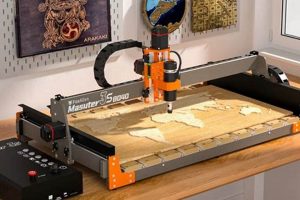
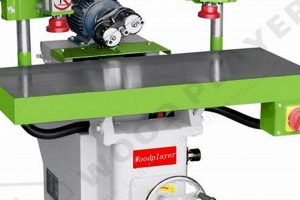
Computer Numerical Control (CNC) machining applied to woodworking represents a significant advancement in fabrication processes. It uses pre-programmed computer software to dictate the movement of factory tools and machinery. For example, a design created in CAD software is translated into machine code, which then guides a cutting tool to precisely shape a wooden workpiece.
This automated approach offers several benefits, including enhanced precision, increased efficiency, and the ability to produce complex designs consistently. Historically, intricate woodworking relied heavily on manual skill and was often time-consuming. The introduction of this technology has revolutionized the industry, enabling mass production of components while maintaining high levels of accuracy and repeatability.
Subsequent sections will delve into the specific applications, advantages, and considerations involved in implementing automated cutting technology within a woodworking environment, exploring topics such as software, tooling, and material selection to provide a thorough understanding of the field.
Essential Tips for Effective Automated Wood Fabrication
The following guidelines provide crucial insights for optimizing outcomes in computer-controlled woodworking operations. Adherence to these principles can significantly improve precision, efficiency, and the overall quality of finished products.
Tip 1: Material Selection is Paramount: The properties of the wood being processed directly impact cutting parameters and tool longevity. Softer woods require different speeds and feed rates compared to hardwoods. Always consult material datasheets and conduct test cuts to determine optimal settings.
Tip 2: Invest in Robust CAM Software: The CAM software translates design files into machine-readable code. Choose software that offers advanced features like toolpath optimization, collision detection, and simulation capabilities. Regularly update the software to benefit from new features and bug fixes.
Tip 3: Tooling Maintenance is Critical: Sharp, well-maintained cutting tools are essential for clean cuts and efficient material removal. Inspect tools regularly for wear and tear. Sharpen or replace tools as needed to prevent splintering and inaccurate cuts. Consider investing in a tool management system.
Tip 4: Secure Workpiece Clamping: Proper clamping ensures that the workpiece remains stable during the cutting process. Use clamps that are appropriate for the size and shape of the workpiece. Avoid over-tightening clamps, as this can distort the wood. Vacuum clamping systems can be effective for larger, flatter pieces.
Tip 5: Implement a Rigorous Calibration Schedule: CNC machinery requires regular calibration to maintain accuracy. Follow the manufacturer’s guidelines for calibration procedures. Use precision measuring tools to verify the machine’s alignment and squareness. Log all calibration activities.
Tip 6: Prioritize Dust Extraction: Woodworking generates significant dust. Implement an effective dust extraction system to protect the machine, the operators, and the surrounding environment. A well-designed dust collection system also improves visibility and reduces the risk of fire.
Tip 7: Monitor Machine Performance: Track machine performance metrics such as spindle speed, feed rate, and cutting time. Analyze these metrics to identify potential problems early on. Establish a preventative maintenance program to address common issues and minimize downtime.
By integrating these tips into operational protocols, users can maximize the potential of computer-controlled woodworking systems and achieve superior results. Attention to detail in these areas ensures consistent quality and minimizes costly errors.
The following section will explore common challenges encountered during computer-controlled wood fabrication and offer strategies for overcoming them.
1. Precision Cutting

Precision cutting is a foundational element within the realm of computer numerical control (CNC) woodworking. It directly impacts the quality, complexity, and efficiency of the final product, making it a critical area of focus for both designers and manufacturers.
- Dimensional Accuracy
Dimensional accuracy refers to the adherence of the finished component to specified measurements. In CNC woodworking, this is achieved through precise toolpath programming and calibrated machine movements. For example, producing furniture components that fit together seamlessly requires accuracy within fractions of a millimeter. Failure to achieve this accuracy leads to assembly issues and structural instability.
- Surface Finish Quality
The quality of the surface finish is crucial for aesthetic appeal and functional performance. CNC machines equipped with appropriate tooling and optimized cutting parameters can produce smooth, clean surfaces that minimize the need for post-processing. A fine surface finish is essential for applications such as cabinetry, musical instruments, and decorative moldings, where visual appeal is paramount.
- Complex Geometry Realization
Precision cutting enables the creation of intricate and complex geometries that would be difficult or impossible to achieve manually. CNC machines can execute complex curves, angles, and contours with high accuracy. This capability is particularly important for architectural millwork, artistic woodworking, and the production of custom designs, expanding design possibilities and aesthetic freedom.
- Material Utilization Efficiency
Precise cutting minimizes material waste by optimizing the layout of parts on a sheet of wood. CNC software can nest parts efficiently to reduce scrap, contributing to cost savings and environmental sustainability. Accurate cutting also prevents defects that could render a piece unusable, further enhancing material utilization efficiency and reducing overall production costs.
These facets of precision cutting collectively highlight its significance in CNC woodworking. By leveraging the capabilities of automated cutting systems, manufacturers can consistently produce high-quality components with intricate designs and minimal waste, enabling greater efficiency, improved product quality, and expanded design possibilities. The ongoing advancements in CNC technology continue to push the boundaries of what is possible in woodworking, making precision cutting an indispensable aspect of the modern woodworking industry.
2. Design Complexity

Design complexity, in the context of computer numerical control (CNC) machining for woodworking, refers to the intricacy and sophistication of geometric forms that can be produced. The inherent capabilities of CNC machines enable the realization of designs that would be impractical or impossible to achieve through traditional woodworking methods. A primary driver for adopting CNC technology is its capacity to translate complex digital designs directly into physical components with high precision and repeatability. This capacity allows for the creation of furniture, architectural elements, and artistic pieces featuring elaborate carvings, contoured surfaces, and intricate joinery.
The relationship between design complexity and CNC woodworking is symbiotic. Complex designs necessitate the precision and control offered by CNC machines, while the availability of this technology encourages designers to explore more intricate and innovative forms. For example, consider the creation of a curved staircase banister. Traditional woodworking would require extensive manual shaping and fitting, a process that is time-consuming and prone to error. A CNC machine, programmed with a 3D model of the banister, can precisely cut and shape the wood, ensuring a consistent curve and accurate dimensions. This capability extends to the production of decorative panels with relief carvings, custom moldings with complex profiles, and interlocking components for modular furniture systems. The practical significance lies in the ability to produce high-value, customized products that meet specific design requirements and aesthetic preferences.
Successfully harnessing the potential of CNC for complex designs, however, necessitates a comprehensive understanding of both the design process and the machine’s capabilities. Challenges include the need for sophisticated CAD/CAM software, skilled operators who can program and maintain the equipment, and careful consideration of material properties and cutting parameters. Despite these challenges, the ability to translate complex designs into tangible objects with precision and efficiency represents a significant advantage for woodworking businesses seeking to differentiate themselves and offer unique products. The exploration of design complexity through CNC technology is therefore a crucial aspect of modern woodworking, driving innovation and expanding the boundaries of what is possible within the craft.
3. Material Efficiency
Material efficiency, defined as minimizing waste and maximizing the yield from raw materials, is a critical consideration within computer numerical control (CNC) machining of wood. Optimized material usage not only reduces costs but also contributes to sustainable manufacturing practices. This efficiency is realized through several key facets of CNC technology application in woodworking.
- Nesting Optimization
Nesting refers to the arrangement of parts on a sheet of material to minimize waste. CNC software algorithms efficiently position components, taking into account their shapes, sizes, and grain direction. This intelligent arrangement reduces the amount of scrap material generated during cutting. For example, complex geometric shapes are strategically placed to fill voids, thus increasing the number of usable parts obtained from a single sheet. Improved nesting directly translates to lower material costs and reduced disposal requirements.
- Kerf Compensation
Kerf is the width of the cut produced by the cutting tool. CNC programming allows for kerf compensation, which adjusts the toolpath to account for the material removed by the cutting blade. By accurately compensating for the kerf, the dimensions of the final parts remain precise, even with material loss. Failure to compensate for kerf results in undersized parts and increased scrap. This level of precision ensures that raw materials are converted into usable components with minimal deviation from design specifications.
- Toolpath Optimization
Toolpath optimization focuses on minimizing the distance the cutting tool travels, thereby reducing cutting time and material waste. CNC software can generate efficient toolpaths that avoid unnecessary movements and optimize the sequence of cuts. For instance, the toolpath may be designed to cut through multiple parts in a single pass or to minimize the number of tool changes required. Optimized toolpaths enhance productivity, reduce energy consumption, and decrease the likelihood of defects, all contributing to improved material efficiency.
- Defect Reduction
The precision and consistency of CNC machining minimize the occurrence of defects in the final product. Manual woodworking is often subject to human error, leading to miscuts, inconsistencies, and unusable parts. CNC automation, on the other hand, produces parts with greater accuracy and repeatability, reducing the number of defective components and minimizing the need for remakes. This reduction in defects significantly improves material efficiency by ensuring that more of the raw material is converted into sellable products.
Collectively, these facets highlight the significant role of CNC technology in enhancing material efficiency within woodworking. By employing sophisticated software algorithms, compensating for material removal, optimizing cutting paths, and minimizing defects, CNC machining enables manufacturers to maximize the yield from raw materials, reduce costs, and promote sustainable practices. These benefits underscore the importance of integrating CNC technology into woodworking operations for achieving both economic and environmental goals.
4. Automated Production

Automated production is intrinsically linked to computer numerical control (CNC) woodworking, functioning as a direct consequence of its implementation. The use of CNC machinery in woodworking fundamentally shifts the manufacturing paradigm from manual operation to computer-controlled processes. This transition introduces a level of automation that directly impacts production volume, consistency, and labor requirements. For example, a furniture manufacturer employing CNC routers can consistently produce identical components at a rate significantly exceeding that achievable through manual methods. The integration of automated material handling systems further streamlines production, reducing the need for manual loading and unloading of workpieces.
The importance of automated production within CNC woodworking extends beyond mere speed enhancement. The reduction of human intervention minimizes the potential for error, leading to higher quality and more uniform products. Consider the production of complex architectural moldings. Manually crafting such moldings requires highly skilled artisans, resulting in variable outcomes and limited production capacity. A CNC machine, once programmed, can repeatedly produce identical moldings with exceptional precision. This capability is particularly advantageous for large-scale projects requiring numerous identical components, ensuring uniformity and reducing the likelihood of costly rework. Furthermore, automated production enables the creation of intricate designs that would be prohibitively difficult or impossible to execute manually.
In conclusion, the implementation of CNC woodworking directly facilitates automated production, yielding significant improvements in efficiency, quality, and design possibilities. Challenges remain in areas such as initial investment costs and the need for specialized programming skills. However, the transformative impact of automation on woodworking manufacturing is undeniable. Understanding the connection between CNC technology and automated production is crucial for businesses seeking to optimize their operations, enhance product quality, and remain competitive in an evolving market. The integration of CNC automation presents a pathway towards increased productivity, reduced labor costs, and the ability to meet the demands of modern manufacturing environments.
5. Scalable Manufacturing

Scalable manufacturing, the ability to increase production volume without a proportional increase in cost or decrease in quality, is intrinsically linked to CNC machine woodworking. The adoption of CNC technology directly enables manufacturers to expand their production capacity, allowing them to respond to increased demand without the limitations inherent in manual woodworking processes. A primary cause of this scalability lies in the inherent precision and repeatability of CNC machines. Once a design is programmed, the machine can produce identical components consistently and efficiently, regardless of the quantity required. This contrasts sharply with manual woodworking, where variations in skill and technique can lead to inconsistencies in product quality, and increasing production volume often necessitates hiring and training additional skilled labor. For example, a cabinet manufacturer utilizing CNC routers can fulfill large orders for custom-designed cabinets with consistent dimensions and finishes, a feat that would be difficult and costly to achieve through purely manual means.
The integration of CNC woodworking into manufacturing operations allows for several practical applications that support scalable production. Automated material handling systems, coupled with CNC machinery, reduce the manual labor required for loading and unloading workpieces, further increasing throughput. Optimized toolpath generation minimizes cutting time and material waste, enhancing efficiency. Additionally, CNC machines can operate for extended periods with minimal supervision, allowing for continuous production and maximizing machine utilization. A real-world example is the mass production of flat-pack furniture, where CNC routers are used to precisely cut and shape components that can be easily assembled by consumers. This scalable approach allows manufacturers to meet the demands of a global market while maintaining competitive pricing. The practical significance of understanding this scalability lies in the ability to strategically plan for future growth, optimize production processes, and capitalize on market opportunities.
In summary, CNC machine woodworking is a key enabler of scalable manufacturing within the woodworking industry. The technology’s inherent precision, repeatability, and automation capabilities allow manufacturers to increase production volume, maintain consistent quality, and optimize resource utilization. Challenges in implementing CNC technology, such as initial investment costs and the need for skilled operators, are often outweighed by the long-term benefits of increased scalability and competitiveness. The integration of CNC into woodworking operations is essential for businesses seeking to adapt to evolving market demands and achieve sustained growth in the modern manufacturing landscape.
6. Reduced Labor

The integration of computer numerical control (CNC) machine woodworking into manufacturing environments significantly alters labor requirements, primarily by automating tasks previously performed manually. This shift has profound implications for workforce composition, skill demands, and overall operational efficiency.
- Automation of Repetitive Tasks
CNC machinery excels at performing repetitive tasks with consistent precision. Activities such as cutting, shaping, and drilling, which traditionally require significant manual effort, are automated through pre-programmed instructions. For instance, producing identical cabinet doors, a task that once demanded hours of skilled labor, can now be accomplished with minimal human intervention, freeing up personnel for other responsibilities.
- Decreased Reliance on Highly Skilled Artisans
While skilled artisans remain valuable for design and intricate craftsmanship, CNC technology reduces the dependence on such expertise for mass production. A CNC machine can execute complex designs with precision, even when operated by individuals with less specialized training. This allows companies to allocate skilled artisans to more challenging or bespoke projects, optimizing the use of specialized talent.
- Enhanced Operator Efficiency
Instead of directly manipulating tools and materials, CNC machine operators oversee the automated process, monitoring machine performance and making adjustments as needed. This role requires a different skill set, focusing on computer literacy, problem-solving, and machine maintenance. One operator can often manage multiple machines simultaneously, significantly increasing overall productivity.
- Minimized Material Handling
Many CNC woodworking systems incorporate automated material handling features, further reducing labor requirements. Automatic loading and unloading mechanisms, coupled with conveyor systems, streamline the flow of materials through the production process, minimizing the need for manual lifting, moving, and positioning of workpieces.
The overall effect of CNC machine woodworking is a fundamental reshaping of the labor landscape within the industry. While certain manual skills become less critical, new skills related to machine operation, programming, and maintenance become essential. The result is a more efficient and streamlined production process, with reduced reliance on direct labor and increased emphasis on technical expertise. The reduction in labor costs is often a significant factor in the adoption of CNC technology, driving competitiveness and enabling businesses to offer products at more competitive prices.
Frequently Asked Questions About CNC Machine Woodworking
The following addresses common inquiries regarding the implementation, operation, and benefits of computer numerical control (CNC) machining in woodworking applications.
Question 1: What specific types of wood are most suitable for processing on CNC machines?
Both hardwoods and softwoods can be processed using CNC machines. Hardwoods such as oak, maple, and cherry offer greater durability and finer finishes, but require slower cutting speeds and sharper tools. Softwoods like pine, fir, and cedar are easier to machine, but may be more prone to splintering. The choice of wood depends on the desired properties of the final product and the capabilities of the CNC machine.
Question 2: What level of technical expertise is required to operate and program a CNC machine for woodworking?
Operating and programming CNC machines requires a combination of technical skills. Operators need proficiency in computer-aided design (CAD) and computer-aided manufacturing (CAM) software, as well as a solid understanding of machine operation, tooling, and material properties. Formal training programs and certifications are available to develop these skills.
Question 3: What are the primary safety considerations when working with CNC machines in a woodworking environment?
Safety is paramount. Adherence to established safety protocols is essential, including the use of personal protective equipment (PPE) such as safety glasses and hearing protection. Proper machine guarding, dust extraction systems, and emergency stop mechanisms are critical. Regular machine maintenance and inspections are also necessary to prevent accidents.
Question 4: What is the typical return on investment (ROI) for implementing CNC technology in a woodworking business?
ROI varies based on factors such as initial investment, production volume, labor costs, and material efficiency. CNC machines typically increase production speed, reduce material waste, and minimize labor requirements, leading to significant cost savings. A thorough cost-benefit analysis is recommended to determine the potential ROI for a specific application.
Question 5: How does CNC woodworking compare to traditional woodworking methods in terms of precision and accuracy?
CNC woodworking offers significantly higher precision and accuracy compared to traditional methods. CNC machines can execute complex designs with tolerances within fractions of a millimeter, ensuring consistent results. Traditional woodworking relies heavily on manual skill and is subject to human error, resulting in greater variability in product dimensions and quality.
Question 6: What are the common challenges associated with CNC woodworking and how can they be addressed?
Common challenges include initial investment costs, the need for skilled operators, software compatibility issues, and the potential for machine downtime. These challenges can be addressed through careful planning, comprehensive training, regular maintenance, and selecting appropriate software and hardware solutions.
The adoption of CNC technology represents a significant advancement in woodworking, offering enhanced precision, efficiency, and design possibilities. Addressing these frequently asked questions provides a foundational understanding for successful implementation.
The following section will explore case studies demonstrating the successful application of CNC machine woodworking in various industries.
Conclusion
This exploration of computer numerical control (CNC) machine woodworking has elucidated its multifaceted impact on the woodworking industry. The increased precision, efficiency, design complexity, and automation capabilities offer significant advantages over traditional methods. Material efficiency and reduced labor requirements further contribute to the economic benefits of adopting this technology. The scalability afforded by CNC machinery enables manufacturers to meet fluctuating market demands and optimize production processes.
Successful implementation of CNC machine woodworking requires a thorough understanding of its technical aspects, a commitment to safety, and a strategic approach to workforce training. As technology continues to evolve, the potential for innovation in CNC woodworking remains substantial. Continued investment in research and development, coupled with a commitment to best practices, will ensure the continued growth and advancement of this transformative technology within the woodworking sector.