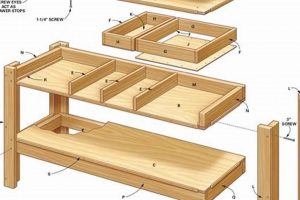
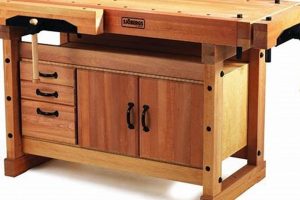
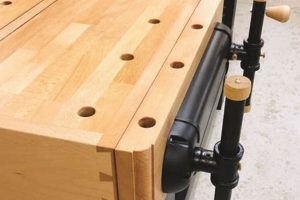
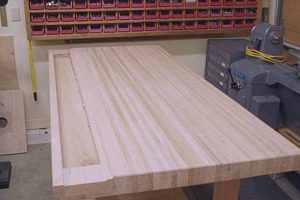
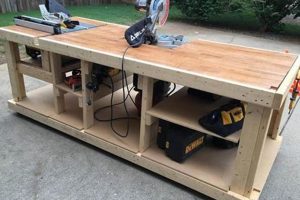
This particular workbench design, originating from France, is characterized by a robust construction, typically featuring a thick, solid wood top. Often incorporating both a shoulder vise and a leg vise, it allows for versatile workpiece clamping. The inclusion of a tool tray or well along the back edge of the surface is another common attribute, providing accessible storage for frequently used implements.
The robust nature of this woodworking station allows for demanding tasks, such as heavy planing and joinery, to be performed with stability and accuracy. Its vise configuration facilitates secure holding of various wood dimensions and shapes, increasing efficiency and precision. Historically, such stations were essential in cabinetmaking and furniture production, reflecting a tradition of fine craftsmanship and durable construction designed for generations of use.
The following sections will delve into the specific features, optimal uses, and maintenance considerations applicable to a quality constructed woodworking station. Detailed descriptions of vise mechanisms, ideal wood types, and techniques for surface preservation will be provided, enabling informed decisions for both prospective buyers and existing owners.
Practical Considerations for the Woodworking Station
This section offers key insights into maximizing the utility and longevity of a traditionally designed woodworking station.
Tip 1: Material Selection: Opt for hardwoods such as beech or maple for the benchtop construction. These species exhibit high density and resistance to wear, essential for a durable work surface.
Tip 2: Vise Maintenance: Regularly lubricate the vise screws and mechanisms with a dry lubricant. This prevents rust and ensures smooth, consistent clamping pressure. Avoid oil-based lubricants, which can attract dust and grime.
Tip 3: Benchtop Flattening: Periodically flatten the benchtop using a hand plane or a specialized flattening jig. A level surface is critical for accurate joinery and assembly.
Tip 4: Tool Storage: Utilize the tool tray or well to store frequently used hand tools. This minimizes clutter and promotes efficient workflow. Consider adding custom-fitted dividers to organize tools effectively.
Tip 5: Leg Vise Optimization: Employ a parallel guide when using the leg vise to ensure consistent clamping pressure across the workpiece. This prevents racking and distortion, particularly when working with larger boards.
Tip 6: Finish Application: Apply a durable finish, such as oil-based varnish or polyurethane, to protect the benchtop from moisture and spills. Regular reapplication will prolong the life of the surface.
Tip 7: Avoiding Over-Clamping: Exercise caution to avoid over-tightening the vises. Excessive clamping pressure can damage the workpiece or the vise mechanism itself.
Adhering to these guidelines will promote both the precision of woodworking projects and the sustained performance of the essential station.
The following sections will summarize the key features and uses of this station.
1. Solid Wood Construction
Solid wood construction is fundamental to the design and functionality of this particular woodworking bench. The choice of material dictates the bench’s stability, longevity, and suitability for demanding tasks. The inherent characteristics of solid wood directly influence the precision and efficiency of woodworking operations performed on such a bench.
- Stability and Mass
Solid wood provides significant mass and stability, essential for absorbing vibrations generated during planing, sawing, and chiseling. This stability allows for more accurate and controlled cuts, reducing the risk of errors and improving the overall quality of the finished product. Denser hardwoods like beech or maple contribute to even greater stability compared to softer woods.
- Durability and Longevity
Solid wood, properly maintained, offers exceptional durability and longevity. A well-constructed workbench built from solid hardwood can withstand decades of use, often becoming a treasured heirloom. This contrasts with benches constructed from engineered wood products, which may be more susceptible to damage from moisture, impact, and wear.
- Workholding Capacity
The structural integrity of solid wood is critical for effective workholding. Vises, dogs, and other clamping mechanisms rely on the benchtop’s ability to resist deformation under pressure. Solid wood minimizes racking and ensures that workpieces are held securely in place, enabling precise joinery and assembly.
- Surface Planing and Flattening
A solid wood benchtop can be repeatedly planed and flattened to maintain a perfectly level work surface. This is essential for accurate woodworking, as an uneven surface can compromise the precision of cuts and measurements. The ability to resurface the benchtop as needed contributes to its long-term usability.
The attributes of solid woodstability, durability, workholding capacity, and surface maintenanceare intrinsically linked to the effectiveness and value of this type of woodworking bench. The selection of appropriate solid wood species and construction methods is crucial for realizing the full potential of this essential woodworking tool. The use of solid wood further honors the traditional craftsmanship associated with these workbenches, reflecting a commitment to quality and enduring performance.
2. Shoulder & Leg Vises

The integration of shoulder and leg vises is a defining characteristic of the traditional woodworking bench. Their presence is not merely decorative but rather essential to the bench’s functionality and versatility. The shoulder vise, typically located on the front of the bench, excels at clamping wide boards flat against the benchtop. This is crucial for tasks such as planing or sanding large surfaces. The leg vise, positioned at one end of the bench, provides exceptional clamping force for holding long boards vertically. The design of these vises, often featuring wooden screws and jaws, provides a controlled and powerful grip without marring the workpiece.
The effectiveness of these vises stems from their ability to distribute clamping pressure evenly, minimizing the risk of distortion or slippage. The shoulder vise, with its broad jaws, provides a stable platform for working on wide panels. The leg vise, owing to its mechanical advantage, can exert considerable force for tasks such as dovetailing or mortise-and-tenon joinery. Both vises are integral to various woodworking operations, and their combined capabilities significantly enhance the bench’s utility.
The presence of both a shoulder and leg vise exemplifies a comprehensive approach to workholding. The ability to clamp workpieces in various orientations is paramount for executing a wide range of woodworking tasks. Understanding the specific strengths of each vise and employing them appropriately is essential for achieving precision and efficiency in woodworking projects. Consequently, these vises are fundamental aspects for its design and functionality.
3. Integrated Tool Tray
The presence of an integrated tool tray along the rear of the surface is a frequently observed feature of the woodworking bench. This element serves a functional purpose: to provide immediate access to commonly used hand tools. The cause of this integration stems from a need to streamline workflow and minimize interruptions during project execution. Without an easily accessible storage solution, the woodworker would be required to repeatedly reach for tools stored elsewhere, adding time and inefficiency to the process. The tool tray, therefore, directly contributes to improved productivity. For instance, during dovetailing operations, chisels, marking gauges, and mallets can be readily available, eliminating the need for the woodworker to leave the bench to retrieve them.
The tool tray’s design typically involves a shallow channel or well running the length of the bench. The dimensions are generally sufficient to accommodate a selection of essential tools without obstructing the primary work surface. In some instances, the tool tray may incorporate dividers or compartments to further organize the tools and prevent them from rolling around. This organizational aspect reduces the risk of damage to the tools themselves, as well as preventing potential hazards to the woodworker. The inclusion of a tool tray represents a practical consideration born from the demands of efficient woodworking practices.
In summary, the integrated tool tray, an integral component of this woodworking station, addresses the practical needs of a woodworker by providing immediate access to essential tools. This feature contributes to increased efficiency, minimized disruptions, and enhanced organization within the workspace. The consistent presence of this tool tray underscores its significance as a standard element for a design that prioritizes functionality and workflow optimization.
4. Benchtop Thickness

The benchtop thickness in a woodworking station design directly impacts stability, workholding capacity, and overall durability. As such, this dimension constitutes a critical design element, influencing the efficacy and longevity of the bench.
- Vibration Dampening
A thicker benchtop provides greater mass, which effectively dampens vibrations generated during tasks such as planing, chiseling, and hammering. Reduced vibration translates to improved accuracy and control, leading to cleaner cuts and more precise joinery. A thinner benchtop, conversely, is more prone to transmitting vibrations, potentially compromising the quality of the work.
- Workholding Stability
The integrity of workholding mechanisms, such as vises and holdfasts, is directly correlated to benchtop thickness. A thicker top offers greater resistance to deflection and distortion when clamping pressure is applied. This stability is crucial for securely holding workpieces during demanding operations like dovetailing or mortise-and-tenon joinery. A thinner benchtop may flex or bend under pressure, potentially leading to inaccuracies and workpiece slippage.
- Long-Term Durability
A substantial benchtop thickness contributes to the bench’s overall structural integrity and resistance to wear. A thicker top can withstand years of heavy use, including repeated planing and resurfacing, without compromising its structural integrity. A thinner benchtop is more susceptible to damage from impact, moisture, and general wear and tear, potentially shortening its lifespan.
- Flatness and Resurfacing
A thicker benchtop retains its flatness over time and provides ample material for resurfacing when necessary. Over the course of use, benchtops may develop imperfections or become uneven due to wear or environmental factors. A thicker top allows for repeated flattening using hand planes or other resurfacing methods, maintaining a level and accurate work surface. A thinner benchtop offers less material for resurfacing, limiting its long-term usability.
The facets of vibration dampening, workholding stability, long-term durability, and resurfacing capacity collectively underscore the significance of benchtop thickness in woodworking station design. The dimension functions as a critical factor in a bench’s performance and longevity. The benchtop thickness reflects a balance between material cost, weight, and functional requirements. The final thickness chosen is a reflection of the intended use and desired level of performance.
5. Joint Strength
Joint strength is a pivotal factor in the performance and lifespan of a woodworking bench. The robust construction inherent in the woodworking bench design necessitates that all joinery be executed with precision and care, employing techniques that maximize structural integrity. Weak joints compromise the bench’s ability to withstand the stresses of daily use, including heavy planing, hammering, and clamping. For example, consider a bench with poorly executed mortise-and-tenon joints connecting the legs to the benchtop. Under load, these joints may loosen or fail, leading to instability and reduced workholding capacity. Conversely, properly fitted and glued dovetail joints provide exceptional resistance to racking forces, ensuring a stable and durable connection between components.
The choice of joinery techniques directly impacts the overall strength and rigidity of the frame. Dovetails, mortise-and-tenon, and lap joints are commonly employed, each offering varying degrees of strength and complexity. The selection of appropriate joint styles is based on the specific stresses that each connection will encounter. For instance, breadboard ends, often attached using a combination of mortise-and-tenon joints and sliding dovetails, prevent cupping and warping of the benchtop while allowing for seasonal wood movement. This exemplifies how strategic joint design contributes to the longevity and usability of the bench.
In summary, the long-term performance of any woodworking bench is intrinsically linked to the quality and strength of its joints. Weak or poorly executed joinery will inevitably lead to instability and premature failure, undermining the bench’s utility and value. Therefore, meticulous attention to joint design and execution is paramount in the construction of a woodworking bench. The longevity and reliability expected in this class of bench relies on the robustness and structural integrity afforded by strong, well-crafted joints.
Frequently Asked Questions about the French Woodworking Bench
This section addresses common inquiries regarding this type of woodworking bench, aiming to clarify misconceptions and provide informed guidance.
Question 1: What distinguishes this station from other workbench designs?
The defining characteristics include the use of solid wood construction, the integration of both a shoulder vise and a leg vise, and the presence of an integrated tool tray. These features collectively contribute to stability, workholding versatility, and efficient workflow.
Question 2: Is hardwood essential for benchtop construction?
While softwood may be used, hardwood, such as beech or maple, offers superior durability and resistance to wear. Hardwood is highly recommended for benchtops subjected to heavy use and demanding woodworking tasks.
Question 3: How frequently should the benchtop be flattened?
The frequency of flattening depends on usage and environmental conditions. Periodic inspection is recommended. Any noticeable unevenness or cupping warrants immediate flattening to maintain a level and accurate work surface.
Question 4: What is the purpose of the leg vise?
The leg vise is designed to provide strong vertical clamping pressure, particularly useful for holding long boards during operations such as dovetailing or mortise-and-tenon joinery. Its mechanical advantage allows for substantial clamping force.
Question 5: How should the vises be maintained?
Vise screws and mechanisms should be regularly lubricated with a dry lubricant to prevent rust and ensure smooth operation. Avoid oil-based lubricants, which can attract dust and grime.
Question 6: Is the integrated tool tray a necessary feature?
While not strictly essential, the tool tray enhances efficiency by providing immediate access to frequently used tools. It reduces clutter and minimizes interruptions during project execution. The presence of such a tray is a hallmark of a well-designed woodworking station.
These answers aim to provide a clearer understanding of the attributes and considerations associated with this classic station design.
The following section will address bench customization.
French Woodworking Bench
This exploration has underscored the defining characteristics of the French woodworking bench: robust solid wood construction, the integrated shoulder and leg vises, the inclusion of a tool tray, strategic benchtop thickness, and durable joint strength. These attributes collectively contribute to a stable, versatile, and enduring workspace capable of supporting a wide range of woodworking endeavors. The bench represents a convergence of design and function, prioritizing precision, efficiency, and longevity. It is essential to be known in woodworking and furniture production
The enduring appeal of the French woodworking bench lies in its proven functionality and adaptability. It serves as a tangible link to woodworking traditions. Its design has withstood the test of time. Whether restoring antique furniture or creating new designs, the principles embodied by the traditional design remain applicable. Future generations of woodworkers can build on its legacy for years to come.