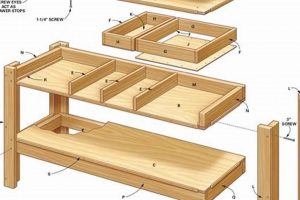
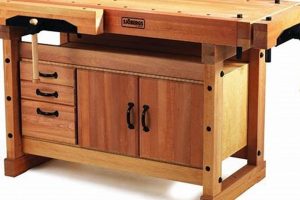
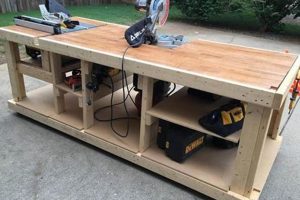
The process detailed encompasses the design and construction of a robust, stable platform used primarily for the manual processing of timber. This typically involves assembling a sturdy frame, incorporating a work surface, and potentially integrating features such as vises or storage solutions. Examples range from simple, portable designs to elaborate, stationary work stations.
A well-constructed surface of this kind is fundamental to efficient and accurate craftsmanship. It provides a secure and level area, which is crucial for tasks like sawing, planing, and assembly. Historically, these platforms have served as the cornerstone of workshops, evolving over centuries to meet the changing demands of the craft. The reliability and adaptability inherent in its design render it an indispensable tool for both amateur and professional woodworkers.
The subsequent sections will elaborate on the key elements of design, material selection, and assembly techniques, providing guidance for creating a functional and durable surface suitable for a wide range of projects.
Essential Construction Recommendations
The following recommendations aim to optimize the construction process, leading to a more robust and functional final product.
Tip 1: Material Selection is Paramount: Prioritize hardwoods such as maple, beech, or oak for the frame due to their inherent strength and stability. Softwoods may be used for non-structural components, but careful consideration should be given to wear and tear.
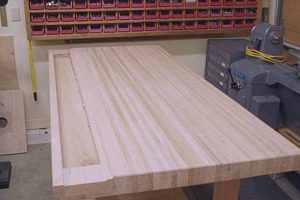
Tip 2: Ensure a Flat and Stable Work Surface: Employ laminated timber or solid wood for the top, ensuring it is properly jointed and flattened. A level surface is critical for accurate woodworking operations.
Tip 3: Incorporate a Robust Leg Joinery: Mortise and tenon joints, reinforced with wedges or drawbore pins, provide superior strength and rigidity for the leg assembly. Avoid relying solely on screws or nails.
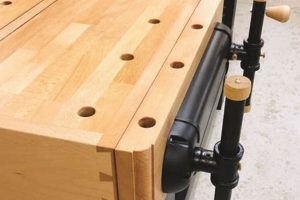
Tip 4: Implement Vise Placement Strategically: Position vises to accommodate a variety of workholding needs. Consider both face and end vises, and ensure they are securely mounted to the frame.
Tip 5: Account for Wood Movement: Design the top attachment to the frame to allow for seasonal expansion and contraction of the wood. Failure to do so can lead to cracking or warping.
Tip 6: Consider Integrated Storage Solutions: Incorporate drawers or shelves to store frequently used tools and materials. Optimize the layout for accessibility and efficiency.
Tip 7: Prioritize Ergonomics: Adjust the height to suit the user’s stature and working preferences. A comfortable working height reduces strain and improves efficiency.
Adhering to these recommendations will enhance the durability, functionality, and overall quality of the finished product, ensuring a long-lasting and reliable workspace.
The subsequent section will offer a detailed conclusion, summarizing key points and providing directions for further exploration.
1. Stable Base Construction

Stable base construction forms a critical component in building a woodworking platform. It directly influences the platform’s overall rigidity and its ability to withstand the forces generated during woodworking operations. A lack of stability can lead to inaccuracies in cuts, difficulty in securing workpieces, and premature wear on the platform itself. The connection between a stable base and the success of any woodworking project undertaken upon it is direct and unequivocal.
Several factors contribute to a stable base. Material selection plays a significant role. Dense hardwoods such as maple or oak provide greater resistance to flexing and twisting than softwoods. Joint construction is equally vital. Mortise and tenon joints, properly executed and reinforced with wedges or drawbore pins, offer superior strength compared to simpler joinery methods like screws or nails. Furthermore, the overall design of the base, including the size and placement of stretchers and aprons, contributes to its ability to resist racking forces. For example, a platform utilizing mortise and tenon joinery with thick, well-braced legs will exhibit significantly more stability than one constructed with thin legs and simple screw connections.
In conclusion, stable base construction is not merely a desirable feature but an essential prerequisite for an effective platform. Addressing this aspect with careful attention to material selection, joint construction, and overall design will contribute significantly to the platform’s performance and longevity, ultimately enhancing the quality of woodworking projects. A robust and immobile foundation ensures consistent and accurate results, enabling the woodworker to focus on the craft rather than compensating for deficiencies in the platform itself.
2. Surface Material Selection
Surface material selection directly affects the utility, durability, and longevity of the resulting structure. The chosen material dictates its resistance to wear, its flatness over time, and its overall suitability for various woodworking tasks. Therefore, careful consideration of material properties is paramount.
- Hardwood Selection and Durability
Hardwoods, such as maple, beech, and birch, exhibit superior resistance to dents and scratches compared to softwoods. This inherent durability ensures the surface remains relatively smooth and flat even after prolonged use. A hardwood surface minimizes the risk of imperfections being transferred to the workpiece, preserving accuracy and quality.
- Softwood Alternatives and Considerations
Softwoods, like pine or fir, offer a more economical alternative. However, their susceptibility to damage necessitates greater care during use. A softwood surface may require frequent resurfacing to maintain flatness and remove imperfections. The economic advantage may be offset by the increased maintenance and reduced lifespan.
- Engineered Materials and Stability
Engineered materials, such as laminated veneer lumber (LVL) or butcher block, provide enhanced stability and resistance to warping. These materials mitigate the effects of moisture and temperature fluctuations, ensuring the surface remains flat and true over time. Stability is critical for accurate measurements and consistent results.
- Surface Treatment and Protection
Regardless of the chosen material, surface treatment is crucial for protection against moisture and contaminants. Applying a durable finish, such as polyurethane or oil-based varnish, seals the wood pores and prevents absorption of liquids. This protects the surface from stains, warping, and fungal growth, extending its lifespan.
The choice of surface material ultimately depends on a balance of factors, including budget, intended use, and desired lifespan. Hardwoods and engineered materials offer superior performance and longevity but come at a higher cost. Softwoods represent a more affordable option but require greater care and maintenance. Proper surface treatment is essential for all materials to ensure long-term protection and performance, integral for the creation of a reliable station for woodworking pursuits.
3. Effective Joint Execution

Effective joint execution represents a cornerstone in the successful creation. The strength, stability, and longevity of the platform hinge directly upon the quality and appropriateness of the joinery employed. Substandard or improperly executed joints can compromise the structural integrity, leading to instability, premature failure, and ultimately, a workspace unfit for purpose.
- Mortise and Tenon Joints: Structural Integrity
Mortise and tenon joints offer exceptional strength and resistance to racking forces, making them well-suited for connecting legs to the frame. A properly fitted mortise and tenon, secured with glue and potentially wedges or drawbore pins, creates a robust connection capable of withstanding significant stress. Inadequately sized or poorly fitted mortise and tenon joints, conversely, can result in a weak and unstable structure.
- Dovetail Joints: Resistance to Pull-Out Forces
Dovetail joints excel at resisting pull-out forces, making them ideal for drawer construction and connecting aprons to legs. The interlocking shape of the dovetail joint mechanically locks the pieces together, preventing separation under tension. Poorly cut dovetails, characterized by gaps or loose fits, diminish the joint’s strength and aesthetic appeal.
- Lap Joints: Surface Area and Glue Bond
Lap joints offer a simple and effective method for joining boards edge-to-edge or end-to-end, increasing surface area for glue adhesion. A well-executed lap joint, with a precisely milled overlap and a tight glue line, provides a strong and stable connection for tabletop construction. Gaps or uneven surfaces in a lap joint compromise the glue bond and weaken the overall structure.
- Bridle Joints: A Balance of Strength and Simplicity
Bridle joints offer a compromise between the strength of a mortise and tenon and the simplicity of a lap joint, suitable for connecting rails to legs. The bridle joint provides a substantial glue surface and mechanical interlocking, contributing to a strong and stable connection. Sloppy or ill-fitting bridle joints diminish the joint’s strength and can lead to instability.
In summary, effective joint execution is not merely an aesthetic consideration but a critical determinant of the workspace’s structural soundness and performance. The selection of appropriate joinery techniques, combined with precise execution and attention to detail, ensures a durable and reliable foundation for woodworking endeavors. Failure to prioritize joint quality can undermine the entire project, resulting in a platform that is both unsafe and ineffective. A craftsman’s choice for robust joinery is a testament to their commitment for durable, reliable structure.
4. Optimal Vise Placement
Effective vise placement is integral to the functional design. The location and orientation of vises on the work surface directly impact the ability to secure workpieces of various shapes and sizes, thereby influencing the efficiency and precision of woodworking tasks.
- Face Vise Positioning: Versatility and Accessibility
The face vise, typically mounted on the front edge, offers versatility in securing workpieces for operations such as planing, sawing, and joinery. Its placement should allow for unobstructed access to the workpiece from multiple angles. A strategically positioned face vise accommodates both small and large items, enhancing the overall adaptability of the workbench. For example, a face vise located near a leg provides additional support for long workpieces.
- End Vise Integration: Lengthy Workpiece Management
The end vise, typically integrated into one end, excels at securing long boards for edge jointing or planing. Its placement must consider the overall length of the workbench to maximize its utility. An end vise, coupled with bench dogs, provides a secure clamping system for lengthy workpieces, enabling efficient and accurate processing. The incorporation of a parallel guide ensures even clamping pressure across the entire length of the board.
- Leg Vise Considerations: Vertical Clamping and Support
The leg vise, mounted directly to a leg, offers exceptional clamping force for vertical workpieces. Its positioning must account for the leg’s structural integrity and the desired clamping range. A leg vise is particularly useful for tasks such as mortising or dovetailing. The addition of a chop, or movable jaw, allows for accommodating workpieces of varying thicknesses.
- Dog Hole Alignment: Systematized Clamping Solutions
The strategic placement of dog holes, in conjunction with the vises, creates a comprehensive clamping system. Dog holes, aligned parallel to the vise jaws, allow for the use of bench dogs to secure workpieces of irregular shapes or sizes. Precise alignment of dog holes ensures consistent clamping pressure and prevents slippage. Integrating dog holes into both the work surface and the vise jaws maximizes the clamping options available.
In summary, optimal vise placement requires careful consideration of the types of woodworking tasks to be performed, the dimensions of typical workpieces, and the overall layout. A well-planned vise system, incorporating a combination of face, end, and leg vises, along with strategically positioned dog holes, enhances the versatility and efficiency. The strategic decisions related to the integration of these features underscores their status as a critical step during the construction.
5. Ergonomic Height Consideration

Ergonomic height consideration plays a pivotal role in the design and construction of a woodworking station. The vertical dimension of the work surface directly influences posture, reducing strain and improving workflow. A station of inappropriate height induces musculoskeletal discomfort, diminished precision, and reduced efficiency over prolonged use. The impact of ergonomic height extends beyond mere comfort; it affects the quality of the finished product and the long-term well-being of the craftsman.
The selection of an appropriate height necessitates an understanding of the tasks to be performed. For tasks requiring downward force, such as planing or chopping, a lower work surface is optimal, allowing for the utilization of body weight and leverage. Conversely, for tasks demanding fine motor skills and visual acuity, such as carving or detail work, a higher work surface is preferable, promoting an upright posture and minimizing back strain. A station constructed without consideration for these variables will inevitably compromise the user’s ability to perform certain tasks effectively. For example, a surface too low for detail work will force the user to hunch over, leading to back pain and reduced visibility, while a surface too high for planing will diminish the user’s ability to apply sufficient force.
Therefore, the construction of a woodworking platform must prioritize ergonomic height. This may involve incorporating adjustable legs or designing a modular system that allows for height modification as needs evolve. Failure to adequately address this aspect represents a significant oversight, transforming a potentially productive workspace into a source of discomfort and inefficiency. The integration of ergonomic principles transforms a basic structure into a tool specifically tailored to the user’s physical needs, optimizing both productivity and long-term health.
6. Integrated Tool Storage

Integrated tool storage, as a component of constructing a woodworking platform, addresses the need for organization and accessibility within the workspace. The inclusion of drawers, shelves, or other storage solutions directly impacts workflow efficiency and safety. A platform lacking dedicated storage can lead to cluttered work surfaces, increasing the risk of misplaced tools, accidental damage, and potential injury. The relationship between integrated storage and workbench functionality is therefore one of direct cause and effect: effective storage contributes to a more organized and productive working environment.
The practical significance is observed across various workbench designs. A basic platform might feature simple shelves beneath the work surface, providing storage for frequently used hand tools and materials. More elaborate designs incorporate drawers of varying sizes, catering to specific tool types and accessories. Some feature built-in racks for saws, planes, or other specialized equipment. In each instance, the core principle remains the same: providing a dedicated and readily accessible location for tools, minimizing disruption and maximizing workflow efficiency. The choice of storage solutions should align with the frequency of tool use and the available space beneath the work surface.
In summary, integrated tool storage represents a vital aspect of woodworking platform construction. Its inclusion promotes organization, enhances safety, and improves overall workflow efficiency. The selection of appropriate storage solutions should reflect the specific needs of the woodworker and the available space, ensuring that the platform functions not only as a work surface but also as an organized and efficient tool management system. A properly implemented storage system ensures the tools and materials needed are readily available, optimizing the efficacy of the work space.
Frequently Asked Questions
The following addresses common inquiries and misconceptions related to building a woodworking platform, providing concise, factual responses.
Question 1: What is the minimum acceptable size for a woodworking platform?
The minimum acceptable size depends on the intended use. However, a surface measuring approximately 60 inches in length and 24 inches in width is generally considered a practical starting point for many woodworking tasks. Smaller surfaces may restrict the size of projects that can be accommodated.
Question 2: Is it necessary to use hardwood for the entire platform?
While hardwood is recommended for the frame and work surface due to its durability, softwood may be used for non-structural components such as drawer boxes or shelving. However, the primary load-bearing elements should be constructed from a dense hardwood species.
Question 3: How can one ensure that the work surface is perfectly flat?
Achieving a perfectly flat work surface typically involves jointing and planing the boards to a uniform thickness, followed by careful assembly and leveling. The use of a reliable straightedge and a leveling plane is essential for this process.
Question 4: What type of finish is recommended for protecting the work surface?
A durable, oil-based finish, such as boiled linseed oil or tung oil, provides adequate protection against moisture and wear while also being relatively easy to repair. Polyurethane finishes offer greater protection but are more difficult to repair if damaged.
Question 5: How should one address wood movement in the platform’s design?
Wood movement should be accommodated by allowing the work surface to expand and contract independently of the frame. This can be achieved through the use of elongated bolt holes or slotted aprons.
Question 6: What is the optimal height for a woodworking platform?
The optimal height is subjective and depends on the individual’s height and working style. A general guideline is to set the height so that the knuckles are level with the work surface when standing upright. Adjustments may be necessary to accommodate specific tasks.
In conclusion, successful woodworking platform construction requires careful attention to material selection, joinery techniques, and ergonomic considerations. Addressing these factors will contribute to a durable, functional, and comfortable workspace.
The subsequent section will provide a final summary and closing statements.
Conclusion
The preceding analysis has detailed essential aspects of the process. Emphasis was placed on stable base construction, appropriate surface material selection, effective joint execution, optimal vise placement, ergonomic height consideration, and integrated tool storage. Adherence to these principles directly impacts the functionality, longevity, and overall utility of the resulting structure.
Competent construction of this woodworking implement requires commitment to sound design principles, careful material selection, and precise execution. It serves as a foundational element for serious woodworking endeavors. Those undertaking this project should consider it an investment in the future quality and efficacy of their craft.