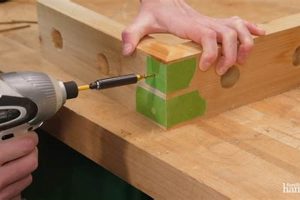
A fundamental undertaking in woodworking serves as an introduction to the craft. This type of endeavor typically involves simple designs, minimal tools, and readily available materials, enabling beginners to learn basic techniques and gain confidence. A birdhouse, small shelf, or simple box exemplifies such an activity.
Embarking on such an activity offers numerous advantages. It fosters skill development, including measuring, cutting, joining, and finishing wood. The successful completion of a tangible item provides a sense of accomplishment and encourages further exploration of woodworking. Historically, apprenticeships often began with similarly elementary tasks, laying the groundwork for more complex projects.
Subsequent sections will delve into specific project ideas suitable for novices, outline necessary tools and materials, and provide step-by-step instructions to facilitate a successful and enjoyable introduction to woodworking.
Guidance for a Woodworking Novice
The following suggestions aim to optimize the initial woodworking experience, enhancing both the learning process and the final product. These guidelines are structured to provide a framework for success, emphasizing safety, planning, and precision.
Tip 1: Prioritize Safety: Eye protection and appropriate respiratory equipment are essential before commencing any cutting or sanding operation. A safe workspace minimizes the risk of injury and promotes focused work.
Tip 2: Select Simple Designs: A basic square or rectangular form requires fewer complex cuts and joints, reducing potential errors and simplifying the construction process. This focus allows for mastery of fundamental techniques.
Tip 3: Choose Softwoods: Pine or poplar are more easily worked with hand tools and require less force for cutting and shaping compared to hardwoods. The softer nature of these materials is more forgiving for beginners.
Tip 4: Master Accurate Measurement: Precise measurements are critical for ensuring proper fit and alignment of components. Double-checking dimensions before cutting prevents costly mistakes and material waste.
Tip 5: Practice Jointing Techniques: Simple butt joints or lap joints, secured with glue and screws, offer a strong and straightforward method for connecting pieces. Practicing these joints on scrap wood develops proficiency.
Tip 6: Utilize Sandpaper Strategically: Start with a coarser grit sandpaper to remove imperfections and gradually progress to finer grits for a smooth finish. Consistent sanding enhances the appearance and feel of the completed project.
Tip 7: Apply Finish Sparingly: Thin coats of varnish or paint, applied with a brush or spray, provide protection and enhance the wood’s natural beauty. Multiple thin coats are preferable to a single thick coat, preventing runs and drips.
Adherence to these recommendations will significantly improve the probability of successfully completing an initial woodworking project. Each step contributes to the development of essential skills and a deeper understanding of woodworking principles.
The ensuing segments will elaborate on specific project plans, offering detailed instructions and visual aids to further facilitate the learning experience.
1. Simple Project Selection

Simple project selection is a crucial determinant in a positive initial woodworking experience. The complexity of the initial project directly impacts the ease of learning and the likelihood of successful completion, thus serving as a foundational aspect.
- Reduces Skill Requirements
A simple project demands fewer advanced techniques. Straight cuts, basic joinery like butt joints, and minimal finishing requirements lower the barrier to entry. This allows the beginner to focus on mastering fundamental skills rather than struggling with overly complex processes, aligning directly with the goal of an undertaking intended for woodworking novices.
- Minimizes Tool Dependency
Complex projects often necessitate specialized tools, increasing the initial investment and adding a layer of complexity. A straightforward project typically requires only basic hand tools or a small number of power tools, reducing the financial burden and simplifying the workspace. This is important for ensuring accessibility and affordability, essential for drawing newcomers to the craft.
- Enhances Completion Probability
A manageable project scope increases the likelihood of completion. A quick and successful outcome provides a sense of accomplishment and motivates further exploration of woodworking. Conversely, an overly ambitious project can lead to frustration, abandonment, and a negative perception of woodworking as a whole. Therefore, a simple project choice is imperative for fostering confidence and encouraging continued engagement.
- Facilitates Focused Learning
By limiting the scope of the project, beginners can concentrate on mastering essential techniques without being overwhelmed by a multitude of processes. This focused learning approach allows for deeper understanding and better retention of skills, laying a solid foundation for future, more complex projects. It supports the core objective of building competence and encouraging a progressive learning curve.
These facets of project selection highlight its vital role in creating a accessible, rewarding, and educational introduction to woodworking. By prioritizing simplicity and manageability, the beginner is positioned for success, ensuring that the initial endeavor fosters a lasting appreciation for the craft.
2. Basic Tool Acquisition

The correlation between basic tool acquisition and a suitable introductory woodworking task is fundamentally causal. A successful initial project often hinges upon possessing the appropriate tools, thereby impacting the project’s feasibility and educational value. The absence of necessary tools can transform a potentially straightforward endeavor into a frustrating and ultimately unsuccessful experience. For instance, attempting to build a small box without a saw capable of making straight cuts almost certainly guarantees unsatisfactory results. Likewise, inadequate measuring tools compromise the accuracy of dimensions, leading to construction flaws and a diminished sense of accomplishment. Therefore, a strategic approach to tool acquisition is an integral component of any genuinely accessible beginning woodworking venture.
The scope of tool acquisition should be directly proportional to the project’s complexity. A simple project, such as constructing a birdhouse, typically requires a limited set of basic tools: a saw (hand saw or circular saw), a measuring tape, a combination square, a hammer, sandpaper, and perhaps a drill for pilot holes. Prioritizing quality over quantity is crucial; a few well-made, versatile tools are far more effective than a collection of inexpensive, unreliable ones. Consider, for example, investing in a durable measuring tape with clear markings and a reliable locking mechanism, or selecting a hand saw with hardened teeth for clean and efficient cuts. The long-term utility and performance of these tools will significantly enhance the woodworking experience.
In summary, the careful selection and acquisition of basic tools are indispensable prerequisites for an introductory woodworking project. This ensures feasibility, accuracy, and a positive learning experience. Furthermore, the investment in quality tools translates to long-term benefits, enabling future projects and fostering a sustainable interest in woodworking. The connection is undeniable; appropriate tools are not merely accessories, but integral components that enable a novice to transform raw materials into a tangible, rewarding result.
3. Essential Safety Practices

The correlation between essential safety practices and a successful, basic woodworking undertaking is direct and consequential. A novice, embarking on a simple project, often lacks the experience to intuitively recognize potential hazards. Therefore, the rigorous adherence to safety protocols becomes not merely a recommendation, but a necessity. A seemingly innocuous task, such as sanding, can pose respiratory risks if proper dust control measures are not implemented. Similarly, the misuse of a power drill, even in the context of a straightforward project, can lead to serious injury if appropriate safety glasses and secure workpiece clamping are neglected. Thus, essential safety practices are not peripheral considerations, but integral components that directly influence the safety and success of any introductory woodworking endeavor.
Concrete examples serve to illustrate the practical significance of this connection. The application of wood finishes often involves volatile organic compounds, necessitating adequate ventilation to prevent respiratory distress. Similarly, failure to properly secure a workpiece during cutting operations can result in kickback, potentially causing severe injury. Furthermore, the improper use of hand tools, such as chisels, can lead to lacerations if appropriate hand protection is not employed. In each instance, the absence of essential safety practices transforms a potentially manageable task into a hazardous situation. Consequently, comprehensive safety training and the consistent implementation of safety protocols are paramount, regardless of project simplicity. This includes a thorough understanding of tool operation, material safety data sheets, and the proper use of personal protective equipment.
In conclusion, the effective integration of essential safety practices into any elementary woodworking activity is non-negotiable. It mitigates risk, prevents injury, and fosters a safe learning environment. The challenge lies in instilling a culture of safety from the outset, ensuring that these practices become second nature. Ultimately, the successful completion of a woodworking project is intrinsically linked to the conscientious application of essential safety practices, reflecting a broader commitment to responsible craftsmanship.
4. Accurate Measurement Techniques

The attainment of a satisfactory outcome in any introductory woodworking undertaking relies heavily on the application of accurate measurement techniques. This facet is not merely ancillary; it is foundational. Precision in measurement directly dictates the fit, finish, and structural integrity of the completed piece. Even with simplified designs, inaccuracies in measurement can compound, leading to misalignment, instability, and an overall diminished aesthetic quality.
- Dimensional Stability
Precise measurements ensure that all components of a project adhere to the intended dimensions. For example, constructing a simple box requires that each side be cut to an exact length and width. Deviations, even small ones, can result in a skewed or misshapen box. This underscores the critical role of accurate measurement in maintaining dimensional stability, which is paramount for both structural integrity and visual appeal.
- Joint Alignment
Many basic woodworking projects incorporate simple joints, such as butt joints or lap joints. Accurate measurements are essential for ensuring that these joints fit together correctly. If the dimensions of the joining pieces are not precise, gaps or overlaps can occur, compromising the strength and aesthetic of the joint. This highlights the significance of meticulous measurement in achieving proper joint alignment, a key factor in the overall quality of the finished project.
- Material Optimization
Accurate measurement enables the efficient utilization of materials. By precisely determining the dimensions of each component, it is possible to minimize waste and optimize material yield. This is particularly important in woodworking, where material costs can be significant. Furthermore, reducing waste aligns with sustainable practices and promotes responsible resource management. Therefore, precise measurement contributes to material optimization, a valuable skill for any woodworker.
- Error Reduction
The application of accurate measurement techniques inherently reduces the likelihood of errors. By carefully measuring and double-checking dimensions before cutting, it is possible to prevent costly mistakes and material waste. This proactive approach minimizes the need for corrections and rework, saving time and resources. Consequently, accurate measurement is a crucial strategy for error reduction, contributing to a more efficient and successful woodworking experience.
The facets delineated above underscore the indispensable role of accurate measurement techniques in the realm of beginning woodworking ventures. A commitment to precision fosters skill development, enhances project quality, and promotes efficient resource management. Thus, accurate measurement is not merely a technical skill; it is a foundational principle that underpins the success of any introductory woodworking project.
5. Patient Skill Development

The development of woodworking skills, when approached with patience, is a critical determinant in the successful completion of an introductory project. Rushing through the learning process often results in errors, frustration, and a diminished appreciation for the craft. Therefore, fostering patience is essential for maximizing the educational value and enjoyment derived from a rudimentary woodworking endeavor.
- Technique Mastery
Patient skill development allows for the thorough understanding and mastery of fundamental woodworking techniques. Rushing can lead to incomplete knowledge and improper execution, resulting in flawed joinery, uneven finishes, and potential safety hazards. For example, attempting to cut a straight line with a saw without proper technique or practice can lead to inaccurate cuts and material waste. Allowing sufficient time to learn and refine each technique fosters confidence and competence, both vital for successful project completion and continued skill development.
- Error Mitigation
A patient approach provides ample opportunity to identify and correct errors before they become major problems. Woodworking inherently involves the possibility of mistakes, particularly for beginners. A hurried approach often overlooks these errors, leading to compounded problems later in the project. Conversely, a patient approach allows for careful inspection, correction, and adjustment, minimizing the impact of errors and promoting a higher quality outcome. This ability to identify and correct mistakes is a valuable skill in itself, fostered by a patient mindset.
- Material Appreciation
Patient skill development cultivates a deeper appreciation for the properties of wood and other materials used in woodworking. Rushing through a project often reduces the materials to mere means to an end, overlooking their unique characteristics and potential. A patient approach, however, allows for careful observation and understanding of wood grain, density, and workability. This deeper understanding enhances the ability to select appropriate materials for a given project and to work with them effectively, contributing to a more refined and sustainable woodworking practice.
- Problem-Solving Enhancement
Patient skill development encourages the development of problem-solving abilities. Woodworking invariably presents challenges, whether it be dealing with knots in the wood, aligning misaligned joints, or achieving a smooth finish. A rushed approach often leads to frustration and abandonment when faced with these challenges. A patient approach, however, fosters a willingness to experiment, adapt, and find creative solutions. This problem-solving capacity is a valuable skill not only in woodworking but also in other areas of life.
These facets collectively highlight the critical role of patient skill development in the context of an introductory woodworking undertaking. By fostering patience, beginners can cultivate technical proficiency, mitigate errors, appreciate materials, and enhance problem-solving abilities, leading to a more rewarding and sustainable engagement with the craft. The simple project then becomes a vehicle for developing these essential qualities.
Frequently Asked Questions About Introductory Woodworking
The following questions address common concerns and misconceptions surrounding accessible woodworking projects, offering guidance for prospective craftspeople.
Question 1: What constitutes a suitable simple woodworking task?
An appropriate activity should involve straight cuts, basic joinery, and minimal finishing. Small boxes, simple shelves, and basic birdhouses often meet these criteria.
Question 2: Is specialized equipment required to initiate basic woodworking?
Specialized equipment is not necessarily required. A saw, measuring tape, combination square, hammer, and sandpaper are often sufficient to begin. As skills progress, additional tools can be acquired.
Question 3: What types of wood are recommended for a novice?
Softwoods, such as pine or poplar, are generally recommended due to their ease of workability. These materials are more forgiving than hardwoods and require less force to cut and shape.
Question 4: How can one ensure accurate measurements in woodworking?
Accurate measurements can be ensured by using a reliable measuring tape and combination square. Double-checking all dimensions before cutting is also crucial to minimize errors.
Question 5: What safety precautions should be observed during a woodworking activity?
Essential safety precautions include wearing eye protection, using appropriate respiratory equipment when sanding or finishing, and securing workpieces before cutting.
Question 6: What is the best approach to finishing a woodworking project?
A suitable approach involves applying thin coats of varnish, paint, or other finishes, allowing each coat to dry thoroughly before applying the next. This prevents runs and drips and produces a smoother, more durable finish.
Successfully navigating introductory woodworking relies on selecting appropriate projects, acquiring basic tools, adhering to safety protocols, and patiently developing essential skills. These efforts will contribute to a positive and rewarding experience.
Subsequent sections will provide detailed instructions for specific woodworking projects suitable for beginners, further facilitating skill development and project completion.
Conclusion
This discourse has underscored the crucial elements of an easy first woodworking project, emphasizing simple designs, basic tools, safety practices, accurate measurement techniques, and patient skill development. Mastering these foundational principles provides a solid base for further exploration within the craft.
Embracing an easy first woodworking project provides an accessible entry point into a fulfilling and practical skill. The tangible results yield immediate satisfaction and offer the impetus for continued learning and creative expression within woodworking.