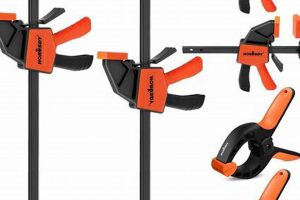
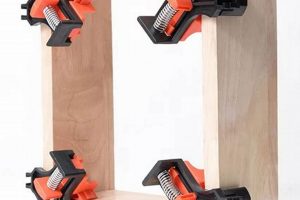
A fastening device designed to hold wooden workpieces at a specific angular relationship, typically 90 degrees, is a crucial tool in woodworking. These devices ensure accuracy and stability during assembly processes such as gluing, screwing, or nailing. For example, they facilitate the construction of square corners in boxes, frames, and cabinets.
The utilization of these clamping mechanisms offers several advantages. They enhance precision in joinery, leading to stronger and more aesthetically pleasing finished products. Historically, achieving accurate angles in woodworking relied on complex jigs and meticulous manual measurement. The advent of specialized clamping devices has significantly streamlined the process, increasing efficiency and reducing the potential for error. Furthermore, they free the user’s hands, allowing for more effective manipulation of materials and tools.
The subsequent sections will delve into the various types available, materials used in their construction, selection criteria based on project requirements, and best practices for their effective and safe operation within a woodworking environment.
Effective Usage Strategies
The following recommendations offer guidance on maximizing the functionality and longevity of angular workholding solutions within a woodworking context.
Tip 1: Material Compatibility: Ensure the selected clamping apparatus is appropriate for the type of wood being worked. Hardwoods may require greater clamping pressure than softwoods to achieve secure engagement.
Tip 2: Proper Alignment: Verify the device is accurately aligned before applying pressure. Misalignment can result in skewed joints and structural weaknesses.
Tip 3: Pressure Regulation: Avoid over-tightening the clamp. Excessive force can damage delicate workpieces or strip threads on the clamp itself.
Tip 4: Surface Protection: Use protective pads or shims between the clamp jaws and the workpiece to prevent marring or indentation of the wood surface.
Tip 5: Consistent Application: Employ multiple clamps to distribute pressure evenly across the joint. This is particularly important for larger or more complex assemblies.
Tip 6: Routine Maintenance: Regularly inspect and clean the clamps to remove sawdust and adhesive residue. Lubricate moving parts as needed to ensure smooth operation.
Tip 7: Storage Considerations: Store angular clamping tools in a clean, dry environment to prevent rust and corrosion. Proper storage will extend their lifespan.
Adherence to these strategies will contribute to increased accuracy, efficiency, and durability in woodworking projects.
The next section will conclude this comprehensive overview, providing a final summary of the critical aspects discussed.
1. Accuracy

Accuracy represents a fundamental requirement in woodworking, directly influencing the structural integrity and aesthetic quality of finished products. The ability to consistently achieve and maintain precise angles during assembly is crucial, and the efficacy of angular clamping devices is intrinsically linked to their capacity to facilitate this precision.
- Angle Deviation
The primary determinant of accuracy is the extent to which a clamping device deviates from the intended angle, typically 90 or 45 degrees. Minimal angle deviation is essential for creating square and aligned joints. Even slight inaccuracies can compound over multiple joints, leading to significant structural compromises or visual imperfections. Accurate angle-holding reduces the need for post-assembly corrections, saving time and minimizing material waste.
- Clamping Surface Parallelism
The parallelism of the clamping surfaces directly impacts the distribution of pressure and the consistency of the resulting joint. Non-parallel surfaces can induce stress concentrations, potentially causing deformation of the workpiece or weakening of the bond. Ensuring parallelism contributes to uniform pressure distribution, leading to stronger and more reliable joints.
- Stability Under Pressure
A clamping device’s ability to maintain its set angle under applied pressure is critical. Devices that flex or shift during tightening compromise accuracy. The structural rigidity of the clamp, coupled with its locking mechanism, determines its stability under pressure. A stable clamp translates to consistent and predictable joint angles.
- Calibration and Adjustability
The presence of calibration markings or adjustable features allows for fine-tuning and verification of the clamping angle. Calibration enables users to verify the clamp’s accuracy and make necessary adjustments to compensate for wear or manufacturing tolerances. Adjustable features provide the flexibility to accommodate non-standard angles or to correct for minor imperfections in the workpiece.
The facets outlined above collectively define the accuracy of an angular clamping device. By minimizing angle deviation, ensuring clamping surface parallelism, maintaining stability under pressure, and providing calibration or adjustability, these tools contribute significantly to the precision and quality of woodworking projects.
2. Durability
Durability, as it pertains to angular clamping devices, directly influences their longevity, reliability, and overall value within a woodworking context. The inherent forces exerted during clamping, coupled with the potential for exposure to environmental factors and repetitive use, necessitate robust construction and material selection. A lack of durability in an angular clamping mechanism can lead to premature failure, compromised accuracy, and increased operational costs due to frequent replacements.
The materials used in manufacturing these devices significantly impact their resilience. High-strength steels, such as those treated with hardening processes, exhibit greater resistance to deformation and wear under stress. Conversely, clamps constructed from lower-grade materials or subjected to inadequate manufacturing processes are more susceptible to bending, cracking, or stripping of threads, resulting in inaccurate angle holding and reduced clamping force. For example, a corner clamp used daily in a professional cabinet-making shop would require a significantly higher level of durability than one used occasionally for hobbyist projects.
Ultimately, the durability of an angular clamping mechanism directly corresponds to its ability to withstand the rigors of repeated use while maintaining its intended functionality. Investing in high-quality, durable clamps translates to long-term cost savings, increased efficiency, and a reduced risk of project failure due to equipment malfunction.
3. Clamping Force
Clamping force, the pressure exerted by an angular clamping device to hold workpieces together, represents a critical factor in woodworking applications. Insufficient clamping force compromises joint integrity, while excessive force can damage materials. Therefore, understanding and appropriately managing clamping force is crucial for achieving optimal results.
- Joint Integrity
Adequate clamping force is necessary to ensure a strong bond between wooden components during adhesive curing. Insufficient pressure can result in gaps or voids in the glue line, leading to weakened joints prone to failure under stress. Conversely, consistent and controlled clamping force promotes uniform adhesive distribution and optimal contact between surfaces, maximizing joint strength. For example, edge-gluing boards for a tabletop requires substantial and consistent clamping force across the entire joint line.
- Material Deformation
The clamping force must be carefully calibrated to avoid deforming the workpieces being joined. Excessive pressure can cause compression or indentation of softer woods, altering their dimensions and compromising the accuracy of the assembly. Protective padding or shims can mitigate this risk by distributing the clamping force over a larger surface area. Properly distributing clamping force is very important in preventing wood damage when using angle woodworking clamp.
- Clamp Stability
The structural integrity of the clamping device itself must be sufficient to withstand the applied force without deformation or slippage. A poorly constructed clamp may flex or shift under pressure, resulting in inaccurate angles and compromised joint alignment. The material and design of the clamp must be carefully considered to ensure stability under the expected clamping load. For example, an angle woodworking clamp intended for heavy-duty applications should have a robust frame and a secure locking mechanism.
- Thread and Fastener Strength
The clamping force applied to the workpieces is directly related to the strength of the clamp’s threads and fasteners. Stripped threads or broken fasteners can lead to a sudden release of pressure, posing a safety hazard and compromising the joint. Regular inspection and maintenance of the clamp’s components are essential to ensure its continued reliability. Selecting a higher-quality angle woodworking clamp with durable threads is very important when clamping force is a main concern for woodworkers.
The application of appropriate clamping force, balanced with considerations for material properties and clamp integrity, is essential for achieving strong, accurate, and durable joints in woodworking projects. The careful selection and proper use of angular clamping devices, with attention to their clamping force capabilities, directly contribute to the overall success and quality of woodworking endeavors.
4. Material Compatibility
Material compatibility represents a critical consideration when selecting and utilizing angular clamping devices in woodworking. The interaction between the clamp’s construction materials and the workpieces being joined can significantly impact the outcome of a project, influencing factors such as surface integrity, joint strength, and the overall aesthetic appeal of the finished product. Therefore, a thorough understanding of material properties and their potential interactions is essential for achieving optimal results.
- Hardness Discrepancies
A significant difference in hardness between the clamping surfaces and the workpiece can lead to undesirable consequences. When clamping softwoods, a clamp with overly hard jaws may leave indentations or compress the wood fibers, resulting in surface damage. Conversely, attempting to clamp hardwoods with a clamp constructed from a softer material may result in the clamp itself deforming or failing to provide adequate holding force. For example, clamping a piece of balsa wood with a steel angle woodworking clamp without proper padding is likely to damage the balsa wood.
- Chemical Reactivity
Certain combinations of materials can exhibit chemical reactivity, particularly in the presence of moisture or adhesives. For instance, some metals can stain certain types of wood, leading to discoloration or unsightly blemishes. Similarly, certain adhesives may react adversely with the clamp’s finish, causing it to degrade or transfer to the workpiece. Careful consideration of the chemical properties of both the clamp and the materials being joined is essential for preventing such reactions. The use of a brass angle woodworking clamp on wood that reacts badly with other metals can reduce discoloration.
- Surface Texture
The surface texture of the clamping jaws plays a crucial role in maintaining a secure grip on the workpiece without causing damage. Smooth, polished surfaces may lack sufficient friction, leading to slippage, while overly rough surfaces can scratch or mar delicate materials. The ideal surface texture provides a balance between grip and protection, ensuring a firm hold without compromising the integrity of the wood surface. This could include a textured, non-slip surface on an angle woodworking clamp.
- Coefficient of Thermal Expansion
Differences in the coefficient of thermal expansion between the clamp and the workpiece can pose challenges, particularly when working in environments with fluctuating temperatures. As materials expand and contract with temperature changes, the clamping force may vary, potentially loosening the joint or causing stress concentrations. Selecting materials with similar thermal expansion properties can help to mitigate these effects. In situations where large temperature fluctuations are unavoidable, alternative clamping methods or materials may be necessary. Understanding this is crucial when clamping materials of different coefficients of thermal expansion with angle woodworking clamps.
These considerations are critical in ensuring the proper selection and use of angular clamping devices. Ignoring material compatibility can lead to compromised joint integrity, surface damage, and ultimately, a less-than-desirable finished product. Therefore, careful attention to the material properties of both the clamp and the workpieces being joined is essential for achieving optimal results in woodworking projects.
5. Joint Stability

The stability of a woodworking joint, its capacity to resist deformation or failure under load, is intrinsically linked to the proper application of an angular clamping device. An angle woodworking clamp ensures that components are held at the designated angle, typically 90 degrees, during the assembly and curing phases. Insufficient or inconsistent clamping pressure leads to gaps in the joint, weakened adhesive bonds, and ultimately, a reduction in overall stability. This is because consistent pressure from angle woodworking clamps ensure optimal surface contact.
Consider the construction of a cabinet. If the corner joints are not accurately aligned and firmly clamped during the gluing process, the resulting structure will exhibit racking, a tendency to deform under lateral stress. This compromise in joint stability not only affects the cabinet’s structural integrity but also its aesthetic appeal, as doors may not align properly and the overall form may appear skewed. In contrast, the precise alignment and uniform pressure afforded by appropriate clamping techniques ensure a robust and dimensionally stable structure, prolonging its functional lifespan. In the context of picture framing, corner joints are the most obvious use-case for demonstrating joint stability under load.
In summary, the proper selection and utilization of an angle woodworking clamp significantly influences joint stability. Its purpose extends beyond mere alignment; it directly contributes to the longevity, structural integrity, and aesthetic quality of woodworking projects. Poor clamping practices undermine the strength and durability of joints, while meticulous attention to clamping techniques reinforces the overall quality of the finished product.
6. Ease of Use
The practicality and efficiency of woodworking processes are significantly influenced by the operational simplicity of tools. The “Ease of Use” characteristic of an angle woodworking clamp directly affects project completion time, accuracy, and the overall user experience, especially for those with limited experience. The complexity of a clamp’s design can either facilitate or impede the creation of precise, stable joints.
- Quick Adjustment Mechanisms
Rapid and intuitive adjustment mechanisms allow for swift adaptation to varying workpiece thicknesses and angles. Clamps with cumbersome or imprecise adjustment systems increase setup time and the likelihood of misalignment. A practical example is a quick-release mechanism that permits rapid removal of the clamp after the adhesive has cured, reducing the overall assembly time. Ease of adjustment in an angle woodworking clamp directly correlates with project efficiency.
- Ergonomic Design
The ergonomic design of an angle woodworking clamp impacts user comfort and reduces fatigue during extended use. Handles that are comfortable to grip and require minimal force to operate enhance control and precision. Clamps with poorly designed handles or awkward configurations can lead to hand strain and decreased accuracy, especially in repetitive tasks. A well-designed angle woodworking clamp minimizes physical strain and enhances user productivity.
- Clear Markings and Instructions
Clearly visible markings and comprehensive instructions facilitate accurate setup and operation of the clamp. Graduated scales indicating angles or dimensions enable precise positioning of workpieces. Well-written instructions that explain the clamp’s features and usage techniques minimize errors and ensure proper application. The availability of clear documentation significantly contributes to the “Ease of Use” factor in an angle woodworking clamp.
- Weight and Portability
The weight and portability of the clamp are important considerations, especially for woodworkers who frequently work in different locations or require mobility within the workshop. Lightweight clamps that are easy to transport and maneuver enhance flexibility and efficiency. Overly heavy or bulky clamps can be cumbersome and limit their practicality in certain applications. The weight and dimensions of the angle woodworking clamp directly affect its portability and versatility.
These facets collectively contribute to the “Ease of Use” of angle woodworking clamps. Clamps that incorporate these design elements streamline woodworking processes, reduce errors, and enhance the overall user experience. The correlation between operational simplicity and project success underscores the importance of selecting angle woodworking clamps that prioritize user-friendliness.
7. Size Range
The available size range of an angle woodworking clamp dictates its applicability to various woodworking projects. This characteristic is not merely a feature but a fundamental determinant of the tool’s versatility. A limited size range restricts the types of workpieces that can be effectively clamped, while a more extensive selection allows for adaptation to a wider array of dimensions and configurations. The size range determines the maximum material thickness that the device can accommodate and often dictates the overall footprint of the assembled joint. An angle woodworking clamp with a smaller range only works with slim materials. This restricts the user’s flexibility.
For instance, constructing a small picture frame necessitates an angular clamp capable of securely holding thin pieces of wood at a 90-degree angle. Conversely, building a large cabinet requires a clamp with a significantly greater capacity to accommodate thicker stock. Failing to select an appropriate clamp size can lead to inadequate clamping pressure, misalignment, or even damage to the workpiece. Angle woodworking clamps that do not fit the needs of the project can reduce accuracy or require the user to purchase multiple sizes.
In summary, the size range of an angle woodworking clamp is not an ancillary detail but a core component of its functionality. The appropriate selection of a clamp size directly influences the success of woodworking projects. A comprehensive understanding of available sizes and their corresponding applications is essential for achieving accurate, stable, and aesthetically pleasing results in a woodworking environment.
Frequently Asked Questions About Angle Woodworking Clamps
This section addresses common inquiries regarding the selection, application, and maintenance of angular clamping devices in woodworking.
Question 1: What factors should be considered when selecting an angle woodworking clamp for a specific project?
The selection process should prioritize the clamp’s capacity to accommodate the workpiece’s dimensions, its accuracy in maintaining the desired angle (typically 90 degrees), the clamping force it can exert without damaging the material, and its overall durability for long-term use. Material compatibility is also paramount to avoid staining or deformation.
Question 2: How does one ensure accurate 90-degree angles when using these clamps?
Verification of the clamp’s inherent accuracy with a reliable square is essential. Ensure that the clamp’s jaws are parallel and that the workpiece is properly seated within the clamping mechanism. Apply even pressure to prevent distortion during tightening.
Question 3: What are common causes of joint failure when using angular clamping devices?
Inadequate clamping pressure, misalignment of the workpieces, the presence of contaminants on the mating surfaces, and the use of inappropriate adhesives are primary contributors to joint failure. Over-tightening, which may cause damage to the material being joined, is also a frequent cause.
Question 4: How should different types of wood affect clamping force applied?
Softer woods typically require less clamping pressure to achieve a secure bond, as excessive force can lead to compression and indentation. Hardwoods, conversely, may necessitate greater force to ensure intimate contact between the mating surfaces. Judicious application of pressure is essential to avoid damaging the wood fibers.
Question 5: What maintenance procedures are recommended to prolong the lifespan of an angle woodworking clamp?
Regular cleaning to remove sawdust and adhesive residue, lubrication of moving parts, and periodic inspection for wear or damage are essential. Avoid storing clamps in humid environments to prevent corrosion.
Question 6: Can these clamping devices be used for angles other than 90 degrees?
While primarily designed for 90-degree angles, some models offer adjustability to accommodate other angles. The specifications of each clamp should be consulted to determine its angular range and accuracy at non-standard settings.
Careful consideration of these questions will aid in the effective and safe utilization of angular clamping devices, contributing to higher-quality woodworking outcomes.
The concluding section will offer a summary of key insights.
Conclusion
The preceding exploration has illuminated the critical role of the angle woodworking clamp in achieving precision and stability within woodworking projects. The multifaceted considerations of accuracy, durability, clamping force, material compatibility, joint stability, ease of use, and size range have been thoroughly examined, highlighting their individual and collective impact on the quality of finished products. The information presented underscores the necessity of careful selection, appropriate application, and diligent maintenance of these essential tools.
The effective utilization of the angle woodworking clamp represents a fundamental element of sound woodworking practice. Mastery of its capabilities allows for enhanced precision, improved structural integrity, and ultimately, a higher standard of craftsmanship. Continued refinement of techniques and a commitment to understanding the nuances of clamping technology remain paramount for achieving enduring excellence in woodworking endeavors.

![Best Woodworking Clamps on Amazon: [Your Project] Ready! | Step-by-Step Guides, Tools & Inspiration to Build Beautiful Wooden Decor on a Budget](https://woodfromhome.com/wp-content/uploads/2026/04/th-87-300x200.jpg "Best Woodworking Clamps on Amazon: [Your Project] Ready! Step-by-Step Guides, Tools & Inspiration to Build Beautiful Wooden Decor on a Budget")