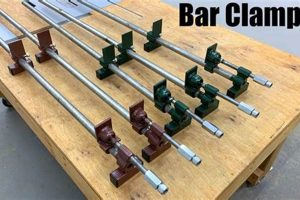
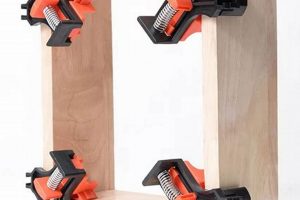
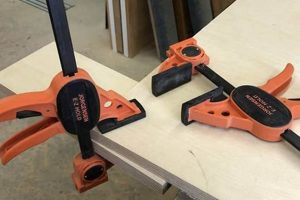
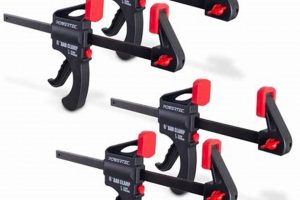
Corner clamps designed for woodworking are specialized tools engineered to hold wooden components at precise angles, typically 90 degrees, during assembly processes. These tools ensure accurate alignment and facilitate secure fastening, often through gluing, screwing, or other joining methods. An example includes securing two pieces of wood together to form a right-angled frame before driving screws into the joint.
The utilization of these clamping devices offers several advantages in woodworking projects. They improve the accuracy and stability of joints, contributing to the overall quality and longevity of the finished product. Historically, woodworkers relied on cumbersome jigs and manual techniques to achieve similar results, making corner clamps a significant advancement in efficiency and precision. Their employment minimizes errors, reduces material waste, and allows for the creation of more complex and intricate designs.
The subsequent discussion will delve into the various types of these indispensable woodworking aids, outlining their specific features, applications, and considerations for selection based on project requirements and budget. Emphasis will be placed on factors such as clamping force, adjustability, material construction, and user-friendliness to guide informed purchasing decisions.
Essential Guidance for Optimal Corner Clamping in Woodworking
Achieving precise and robust corner joints in woodworking requires careful consideration and proper technique. The following guidance aims to optimize the use of corner clamps for enhanced project outcomes.
Tip 1: Material Compatibility: Ensure the clamp material is suitable for the wood being used. Avoid using metal clamps directly on softwoods without protective padding, as this can cause indentations.
Tip 2: Consistent Clamping Pressure: Apply even pressure across the joint. Over-tightening can damage the wood fibers, while insufficient pressure can compromise the joint’s integrity.
Tip 3: Proper Alignment: Before tightening, meticulously align the wood pieces. Misalignment, even slight, will propagate through the entire project, resulting in structural weakness and visual defects.
Tip 4: Clamp Placement: Strategically position the clamps to avoid obstructing fastener placement. Consider using multiple clamps to distribute pressure evenly along longer joints.
Tip 5: Glue Application: When using adhesive, apply a thin, even layer to both surfaces. Excess glue can weaken the joint and complicate cleanup. Allow adequate drying time, as specified by the adhesive manufacturer, before removing the clamps.
Tip 6: Regular Maintenance: Clean and lubricate corner clamps regularly to ensure smooth operation and prevent corrosion. Inspect the clamps for wear and tear, replacing any damaged components promptly.
Tip 7: Test Joints: Before committing to a full project, conduct test joints using scrap wood to refine clamping techniques and ensure optimal results.
Adhering to these guidelines will contribute significantly to the creation of strong, accurate, and aesthetically pleasing corner joints in woodworking projects.
The subsequent sections will address the selection criteria for different types of corner clamps, providing a framework for choosing the most appropriate tool for specific applications.
1. Accuracy

Accuracy is a cornerstone of quality woodworking, and the selection of appropriate corner clamps is crucial for achieving this precision. The effectiveness of woodworking joints, the overall aesthetic appeal, and the structural integrity of a project are directly influenced by the accuracy with which corners are assembled. Corner clamps that maintain consistent angles and minimize deviation are essential tools for any woodworker aiming for professional results.
- Consistent Angle Maintenance
The primary function of a quality corner clamp is to maintain a precise 90-degree angle during the joining process. Variations from this ideal angle can lead to racking, instability, and visual imperfections in the finished product. Precision-engineered clamps minimize this deviation by providing a stable and unyielding framework during glue-up and fastening.
- Mitigating Joint Imperfections
Inaccurate corner clamping can exacerbate existing imperfections in the wood or in the cuts made during preparation. A clamp that fails to hold pieces flush can lead to gaps, uneven surfaces, and weakened joints. High-quality clamps are designed to align components accurately, compensating for minor irregularities and ensuring tight, seamless joints.
- Impact on Structural Integrity
The accuracy of corner joints directly affects the structural integrity of a woodworking project. A poorly aligned corner creates stress points that can lead to premature failure under load. Clamps that facilitate precise alignment contribute to stronger, more durable structures that can withstand the rigors of long-term use.
- Influence on Aesthetic Outcome
Visual appeal is a critical aspect of many woodworking projects. Inaccurate corner joints are immediately noticeable and detract from the overall aesthetic quality. Precise corner clamps ensure that corners are square, lines are clean, and the finished piece exhibits a professional level of craftsmanship.
In summary, accuracy in corner clamping is not merely a desirable attribute but a fundamental requirement for successful woodworking. Corner clamps that prioritize and deliver accuracy are indispensable for achieving professional-grade results in both structural integrity and visual appeal.
2. Durability

Durability, as it pertains to corner clamps for woodworking, is a paramount attribute influencing the tool’s longevity and consistent performance under repeated use. The capacity of a corner clamp to withstand clamping forces, resist wear, and maintain structural integrity directly correlates with its overall value and effectiveness in woodworking applications.
- Material Composition and its Impact
The materials employed in the clamp’s construction are fundamental to its durability. High-quality steel or hardened aluminum alloys, for example, offer superior resistance to bending, cracking, and deformation compared to less robust materials. The use of durable materials translates to a clamp that can reliably apply consistent clamping pressure over extended periods without compromising its structural integrity, thereby ensuring accurate and secure joints.
- Resistance to Corrosion and Environmental Factors
Corner clamps are frequently exposed to moisture, glue residue, and other potentially corrosive substances in a woodworking environment. A durable clamp will feature protective coatings or be constructed from materials inherently resistant to corrosion. This resistance is essential for preventing rust, which can weaken the clamp’s structure and impair its functionality. Protective measures extend the lifespan of the tool and maintain its precision over time.
- Mechanical Robustness of Moving Parts
Corner clamps often incorporate moving parts, such as threaded rods, pivots, and adjustment mechanisms. The durability of these components is crucial for ensuring smooth and reliable operation. High-quality clamps will utilize robust threads, hardened pivot points, and well-engineered locking mechanisms that can withstand repeated adjustments and high clamping forces without stripping, binding, or failing. The integrity of these moving parts directly impacts the clamp’s usability and lifespan.
- Joint Construction and Welding Quality
The method of joining different components of a corner clamp significantly impacts its overall durability. Welded joints, if properly executed, can provide exceptional strength and resistance to stress. However, poor welding can create weak points that are susceptible to cracking or failure. High-quality clamps will feature robust welds, strategically placed to distribute stress evenly, ensuring that the clamp can withstand significant clamping forces without structural compromise.
In conclusion, durability is a critical performance indicator of corner clamps for woodworking. The selection of clamps constructed from robust materials, resistant to environmental factors, featuring mechanically sound moving parts, and incorporating high-quality joint construction directly contributes to a tool’s longevity, reliability, and overall value in a woodworking setting.
3. Adjustability

Adjustability represents a crucial attribute in corner clamps for woodworking, directly influencing their versatility and effectiveness across diverse project requirements. A corner clamp’s capacity to accommodate varying material thicknesses, joint configurations, and clamping angles determines its suitability for a wide spectrum of woodworking tasks.
- Thickness Accommodation
Woodworking projects frequently involve materials of varying thicknesses. Corner clamps with limited adjustability may prove inadequate for securely holding thicker stock, while applying excessive pressure to thinner materials. Best corner clamps for woodworking feature mechanisms enabling users to adapt the clamp opening to match the material thickness precisely, preventing slippage and ensuring consistent clamping pressure.
- Angle Versatility
While 90-degree corners are common, certain woodworking projects demand angles other than right angles. Corner clamps with adjustable angle settings offer the flexibility to construct non-orthogonal joints accurately. The best corner clamps for woodworking incorporate calibrated angle scales and robust locking mechanisms to maintain the desired angle during the fastening process, improving project outcome in non-standard applications.
- Throat Depth and Reach
Throat depth, or the distance a clamp can reach from the edge of the material to the clamping point, is a crucial adjustability parameter. Insufficient throat depth can limit the clamp’s effectiveness when working with wider boards or assembling complex structures. Optimal corner clamps for woodworking provide adequate throat depth and sometimes feature extendable arms to maximize reach and facilitate clamping in confined spaces.
- Quick Adjustment Mechanisms
Efficient woodworking often necessitates rapid adjustments to clamping setups. Corner clamps equipped with quick-release mechanisms, ratcheting handles, or other user-friendly adjustment features can significantly expedite the workflow. These mechanisms allow for swift alterations to clamp settings without requiring cumbersome tools or time-consuming procedures, enhancing productivity and reducing project completion time.
The degree of adjustability inherent in a corner clamp directly translates to its overall utility in a woodworking shop. Prioritizing adjustability ensures that the clamp can adapt to a broad range of projects, enhancing its value and contributing to improved precision and efficiency.
4. Clamping Pressure
Clamping pressure, in the context of woodworking corner clamps, is the force exerted by the clamp to hold two or more workpieces together during the joining process. The applied force is a critical determinant of joint strength and overall structural integrity. Insufficient pressure may result in gaps within the joint, compromising adhesive bonds and creating weak points. Excessive pressure, conversely, can deform the wood fibers, leading to structural damage and aesthetically displeasing indentations. The ideal clamping pressure strikes a balance, ensuring intimate contact between the joining surfaces without causing material degradation. The selection of best corner clamps for woodworking hinges significantly on their capacity to deliver and maintain this optimal clamping pressure.
Different wood species and adhesive types necessitate variations in clamping pressure. Softer woods, such as pine, require less pressure than hardwoods like oak or maple to achieve a secure bond without crushing the fibers. Similarly, certain adhesives, such as epoxy resins, may demand higher clamping pressure compared to traditional wood glues to maximize their bonding strength. For example, when constructing a frame from hardwood using a high-strength epoxy, corner clamps capable of delivering substantial and consistent pressure are essential. Conversely, assembling a softwood box with standard wood glue requires clamps that allow for precise pressure control to avoid damaging the material. Furthermore, the design of the corner clamp itself influences pressure distribution. Clamps with wider clamping surfaces distribute pressure more evenly, minimizing the risk of localized stress concentrations.
In summation, the correlation between clamping pressure and corner clamp quality is undeniable. The best corner clamps for woodworking are those that offer both adequate pressure generation capabilities and fine-tuned control, tailored to the specific materials and adhesives used. Challenges in achieving optimal pressure include variations in wood density, the presence of surface imperfections, and the risk of over-tightening. Understanding these challenges and selecting clamps with appropriate pressure control mechanisms is essential for achieving strong, durable, and visually appealing woodworking joints.
5. Material Compatibility
Material compatibility, concerning corner clamps for woodworking, denotes the interaction between the clamp’s construction materials and the wood species being joined. The selection of suitable clamps necessitates consideration of potential adverse reactions, physical damage, or chemical contamination that may compromise the finished product. The alignment of material properties ensures the longevity, structural integrity, and aesthetic quality of the completed woodworking project.
- Clamp Material Hardness vs. Wood Hardness
The relative hardness of the clamp’s clamping surfaces compared to the wood being joined is a critical factor. Clamps constructed from excessively hard materials, such as hardened steel without protective padding, can easily dent or mar softer woods like pine or cedar, even under moderate pressure. Conversely, clamps made from overly soft materials may lack the necessary grip to hold hardwoods like oak or maple securely. The selection of clamps with appropriate surface hardness or the use of protective pads is essential to prevent surface damage and ensure consistent clamping pressure.
- Chemical Reactivity and Staining
Certain metals used in clamp construction, such as unprotected steel or iron, can react with tannins present in some wood species, particularly oak and walnut. This reaction can result in unsightly staining or discoloration of the wood surface, compromising the aesthetic appeal of the finished piece. The best corner clamps for woodworking should be constructed from non-reactive materials like stainless steel or aluminum, or feature protective coatings to prevent direct contact between the metal and the wood, thus avoiding potential staining issues.
- Clamp Finish and Adhesive Compatibility
The finish applied to the clamp’s surfaces can impact its compatibility with various wood adhesives. Some finishes may interfere with the adhesive’s ability to bond properly to the wood, resulting in a weakened joint. Furthermore, certain finishes may dissolve or degrade when exposed to specific solvents present in adhesives, potentially contaminating the joint. Careful consideration of the clamp finish and its compatibility with the chosen adhesive is necessary to ensure a strong and durable bond.
- Ergonomics and Material Influence
The materials used in constructing handles and adjustment mechanisms can influence the ergonomic properties of the clamp, particularly in relation to prolonged use. Clamps with handles made from comfortable, non-slip materials, such as rubber or textured plastic, reduce hand fatigue and improve grip, especially when working with oily or resinous woods. The material composition of the handle therefore indirectly contributes to the overall safety and efficiency of the clamping process.
The multifaceted interplay between clamp materials and wood properties underscores the importance of material compatibility in selecting optimal corner clamps. Addressing these considerations will enhance woodworking outcomes.
Frequently Asked Questions
The following addresses common inquiries regarding corner clamps used in woodworking, aiming to provide clarity and guidance on their selection and application.
Question 1: What distinguishes a high-quality corner clamp from a lower-quality alternative?
Distinguishing features include material composition, clamping force, adjustability, and precision. High-quality clamps utilize durable materials such as steel or hardened aluminum, offer consistent and controllable clamping force, provide a wide range of adjustability to accommodate varying material thicknesses, and maintain accurate angles during joint assembly. Conversely, inferior clamps often exhibit flimsy construction, inconsistent clamping pressure, limited adjustability, and compromised accuracy.
Question 2: How crucial is the material of the corner clamp in relation to the wood being worked?
Material compatibility is paramount. Direct contact between certain metals, such as iron, and tannin-rich woods, like oak, can result in discoloration or staining. Softwoods are susceptible to denting when clamped with excessive force using metal clamps without protective padding. Selecting clamps constructed from non-reactive materials or employing protective measures is essential to prevent adverse reactions and material damage.
Question 3: What is the optimal clamping pressure for various woodworking joints?
Optimal clamping pressure varies based on wood species and adhesive type. Softer woods require less pressure to avoid crushing, while hardwoods demand greater force for secure bonding. Likewise, certain adhesives necessitate higher pressure to achieve maximum bond strength. Determining the appropriate pressure for specific combinations of wood and adhesive is crucial for joint integrity.
Question 4: How does adjustability contribute to the versatility of a corner clamp?
Adjustability directly impacts the versatility of a corner clamp. Clamps with a wide range of adjustment accommodate varying material thicknesses, joint configurations, and clamping angles. This adaptability enhances the clamp’s utility across diverse woodworking projects, increasing its value as a workshop tool.
Question 5: What maintenance procedures prolong the lifespan of corner clamps?
Regular maintenance is essential for extending the lifespan of corner clamps. Cleaning glue residue, lubricating moving parts, and inspecting for wear or damage are critical. Promptly addressing any issues, such as replacing worn threads or repairing damaged clamping surfaces, will ensure consistent performance and prevent premature failure.
Question 6: Are specialized corner clamps necessary for specific woodworking applications?
Certain woodworking applications may benefit from specialized corner clamps. For example, frame clamps designed for assembling picture frames offer precise alignment and even pressure distribution. Miter clamps are optimized for securing angled joints, providing stability during fastening. While general-purpose corner clamps are suitable for many tasks, specialized clamps can enhance efficiency and accuracy in specific scenarios.
In summary, choosing corner clamps requires evaluating material compatibility, clamping pressure, adjustability, and maintenance. Understanding the nuances of these clamps ensures project success.
The subsequent discourse will explore the topic in further detail.
Concluding Remarks on Corner Clamps in Woodworking
This exploration of corner clamps designed for woodworking has underscored the critical role these tools play in achieving precision, strength, and aesthetic quality in joint construction. The selection of optimal corner clamps requires careful consideration of material compatibility, adjustability, clamping force, durability, and specific project requirements. A thorough understanding of these factors empowers woodworkers to make informed decisions, leading to enhanced project outcomes and professional-grade results. Best corner clamps for woodworking facilitate accurate alignment, secure fastening, and long-lasting structural integrity, thereby elevating the standard of craftsmanship in woodworking endeavors.
The ongoing advancement in woodworking technology promises continued innovation in corner clamp design and functionality. As materials science evolves and manufacturing processes refine, the availability of more versatile, durable, and precise clamping solutions is anticipated. Woodworkers are encouraged to stay abreast of these advancements, continually evaluating their clamping techniques and tool selections to optimize efficiency and maximize the potential of their craft. Investing in high-quality corner clamps represents a commitment to excellence in woodworking, ensuring the enduring value and structural soundness of every project.