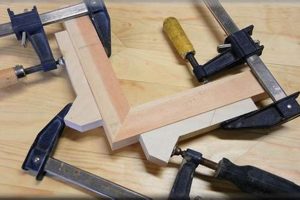
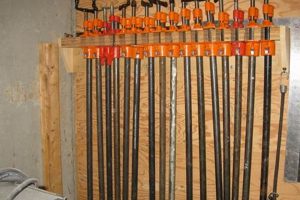
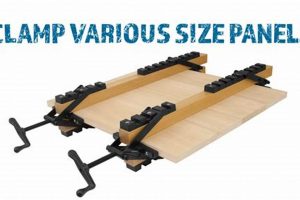
The selection of appropriate holding devices is crucial for secure and accurate wood assembly. These tools, designed to apply pressure and hold components firmly together, facilitate gluing, fastening, and shaping processes. For example, a bar-style implement is often utilized to secure large panels, while a spring-action tool is employed for lighter-duty tasks.
Utilizing effective holding devices enhances the precision and stability of woodworking projects. They ensure tight joints, minimize shifting during adhesive curing, and contribute to the overall structural integrity of finished pieces. Historically, advancements in materials and designs have led to a diverse range of specialized options to address various project requirements and complexity levels.
Evaluating the optimal clamping solution requires considering factors such as the size and shape of the workpiece, the required clamping force, and the specific task at hand. Subsequent sections will explore the different types available, focusing on their strengths, weaknesses, and ideal applications, to provide guidance in selecting the most suitable tools for a given woodworking task.
Essential Guidance on Holding Device Selection
Selecting the right holding implements is crucial for achieving professional-quality woodworking results. The following tips provide essential guidance for making informed decisions based on project requirements and desired outcomes.
Tip 1: Understand Clamping Force Requirements: Different wood species and joinery methods necessitate varying levels of pressure. Softwoods and delicate joints require lighter pressure to avoid damage, while hardwoods and complex joinery demand greater force for secure adhesion.
Tip 2: Consider the Workpiece Geometry: The shape and size of the material significantly influence the selection. Bar varieties are well-suited for large, flat surfaces, while pipe-style versions provide versatility for irregular shapes. Corner variations are indispensable for assembling boxes and frames.
Tip 3: Prioritize Parallel Clamping Jaws: Jaws that remain parallel throughout their range of motion distribute pressure evenly, minimizing the risk of racking or distortion. This is especially critical when gluing large panels or intricate assemblies.
Tip 4: Evaluate Throat Depth: Throat depth refers to the distance between the clamping screw and the bar. Deeper throats enable users to reach further into the workpiece, accommodating larger or more complex projects. Assess the typical dimensions of planned projects to determine the required depth.
Tip 5: Invest in Quality Materials: Durable construction ensures longevity and consistent performance. Look for tools constructed from hardened steel or cast iron to withstand repeated use and maintain accuracy over time. Avoid inexpensive, flimsy alternatives that are prone to failure.
Tip 6: Explore Specialized Clamping Solutions: For specific tasks, specialized types offer distinct advantages. Hand screw options provide precise control and adaptability for curved surfaces, while edge varieties ensure flush alignment of boards during edge gluing.
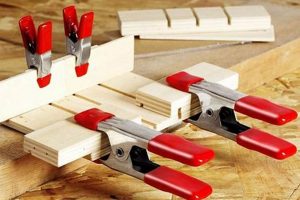
Tip 7: Don’t underestimate Spring Clamps: While they may not provide the strongest hold, spring-action models are invaluable for quick, temporary holding and light-duty tasks. Their ease of use and affordability make them a valuable addition to any woodworking arsenal.
Employing appropriate holding implements and techniques enhances project precision, minimizes errors, and ultimately contributes to the production of high-quality, professional woodworking. Careful consideration of these tips will lead to informed decisions and optimized results.
The following sections will delve into specific categories, providing in-depth analysis and recommendations for selecting the most effective tools for various applications.
1. Clamping Force

Clamping force, the pressure exerted by a holding device on workpieces, is a primary determinant of joint integrity and overall project stability. Selection of devices with adequate clamping force capabilities is crucial for successful woodworking outcomes.
- Wood Species and Density
Hardwood varieties necessitate significantly higher clamping force than softwoods. Insufficient pressure on hardwoods results in weak bonds and potential joint failure. Conversely, excessive force on softwoods can lead to material crushing and deformation. The ability to regulate clamping force ensures optimal pressure application for diverse wood types.
- Adhesive Type and Viscosity
Different adhesives require specific levels of sustained pressure for proper curing and bond formation. High-viscosity adhesives demand greater clamping force to ensure intimate contact between mating surfaces. Matching device clamping force with adhesive requirements is essential for maximizing joint strength and longevity.
- Joinery Method and Complexity
Intricate joinery, such as mortise and tenon or dovetail joints, benefits from increased clamping force to ensure tight fits and precise alignment. Simple butt joints may require less force, but still demand consistent pressure distribution. Holding devices with adjustable clamping force capabilities accommodate a wide range of joinery techniques.
- Workpiece Size and Geometry
Larger workpieces necessitate increased clamping force to maintain consistent pressure across the entire joint area. Irregular shapes may require specialized devices capable of applying force at specific points. Selection should consider the dimensions and contours of typical projects to ensure adequate and even pressure distribution.
Consideration of wood species, adhesive type, joinery method, and workpiece characteristics informs the selection of holding devices with appropriate clamping force capabilities. Balancing force application with material properties and project requirements is critical for achieving robust and aesthetically pleasing woodworking results.
2. Jaw Parallelism

Jaw parallelism represents a critical factor in evaluating the effectiveness of holding devices. When jaws remain parallel throughout their range of motion, pressure is distributed evenly across the clamping surface. Non-parallel jaws concentrate force at specific points, potentially causing workpiece damage, joint misalignment, or adhesive failure. The direct consequence of compromised parallelism is reduced joint strength and diminished project quality. In the context of discerning superior clamping solutions, consistent parallelism is an essential attribute.
Consider, for instance, assembling a large tabletop from multiple boards. Holding devices with non-parallel jaws will exert uneven pressure, leading to warping or gaps in the final surface. Conversely, those designed to maintain parallel clamping surfaces ensure uniform pressure, resulting in a flat, structurally sound tabletop. Similarly, during the gluing of a mitered picture frame, non-parallel jaws can distort the corners, resulting in a misaligned and aesthetically unappealing finished product. Parallel jaws guarantee accurate corner alignment and robust glue joints.
Therefore, jaw parallelism directly impacts the quality and longevity of woodworking projects. Clamping solutions incorporating mechanisms to maintain parallelism, such as Acme-threaded screws and robust frame construction, contribute significantly to professional results. While seemingly a subtle detail, consistent jaw parallelism is paramount in achieving precise, strong, and visually appealing woodworking outcomes, and serves as a key differentiator in the selection of effective holding devices.
3. Throat Depth

Throat depth, the distance from the clamping screw to the bar or arm, is a critical specification influencing the adaptability of holding devices in woodworking. Selecting solutions with appropriate throat depth directly correlates with the versatility and utility of these tools across diverse project types.
- Accessibility in Panel Gluing
Gluing wide panels often necessitates reaching beyond the edges of individual boards. Insufficient throat depth restricts the ability to apply clamping pressure to the center of the panel, potentially leading to uneven adhesion and warping. Holding devices with extended throat depth enable secure pressure application across the entire panel surface, ensuring a flat, stable result.
- Accommodation of Complex Assemblies
Projects involving intricate shapes or assembled components require the ability to apply clamping force in recessed areas. Shallow throat depth limits access to these areas, forcing reliance on less effective clamping techniques. Holding devices with deeper throats facilitate secure clamping of complex assemblies, promoting accurate alignment and strong joints.
- Effective Edge Clamping
Edge banding or edge gluing operations demand consistent pressure along the edge of the workpiece. Limited throat depth restricts the ability to position clamping devices effectively, resulting in uneven pressure distribution and potential adhesive failure. Devices with adequate throat depth ensure uniform edge clamping, promoting flush alignment and robust adhesion.
- Adaptability to Varying Stock Thickness
Woodworking projects commonly involve materials of varying thickness. Holding devices with adjustable throat depth or sufficient clearance accommodate changes in stock thickness without compromising clamping effectiveness. This adaptability enhances the versatility of the devices and reduces the need for specialized tools.
The optimal throat depth is determined by the typical dimensions and complexity of anticipated woodworking projects. Careful assessment of these factors ensures the selection of holding devices that provide adequate reach, adaptability, and consistent clamping pressure across a wide range of applications. This analysis directly influences the decision regarding superior holding devices for woodworking tasks.
4. Material Durability
The longevity and consistent performance of holding devices are intrinsically linked to the quality of materials used in their construction. Material durability dictates the capacity to withstand repeated use, resist deformation under pressure, and maintain operational integrity over extended periods, thus directly influencing the selection of superior tools for woodworking applications.
- Steel Composition and Hardening
The type and treatment of steel used in the bars, jaws, and screws significantly impact resistance to bending, cracking, and wear. Hardened steel alloys offer increased strength and longevity compared to softer, untreated steels. Holding devices fabricated from hardened steel maintain clamping force and accuracy under sustained use, extending their service life.
- Thread Design and Precision
The design and manufacturing precision of threaded components influence the smoothness of operation and resistance to stripping or binding. Acme threads, with their trapezoidal profile, provide greater surface contact and reduced friction compared to standard threads, translating to increased clamping force and durability. Precise machining minimizes play and ensures consistent performance over repeated adjustments.
- Handle Material and Ergonomics
The material used for handles and grips influences user comfort and resistance to wear and tear. Ergonomic designs enhance grip and reduce hand fatigue, while durable materials, such as hardwood or reinforced polymers, withstand repeated handling and exposure to workshop conditions. Properly designed and constructed handles contribute to the overall longevity and usability of holding devices.
- Protective Coatings and Finishes
Protective coatings, such as powder coating or plating, shield metal components from corrosion and environmental damage. These finishes extend the lifespan of holding devices by preventing rust and degradation, particularly in humid or corrosive environments. Durable coatings also enhance the aesthetic appeal of the tools and facilitate cleaning and maintenance.
The selection of superior woodworking tools hinges on a comprehensive evaluation of material durability. The composition and treatment of steel, the design of threaded components, the ergonomics of handles, and the application of protective coatings collectively determine the lifespan and consistent performance of holding devices, directly impacting their value and effectiveness in woodworking operations. A comprehensive understanding of these factors is essential for informed selection.
5. Versatility
The adaptability of holding devices to various woodworking tasks is a paramount consideration in determining optimal choices. A versatile device reduces the need for an extensive collection of specialized tools, thereby streamlining workflow and minimizing investment. The capacity to handle diverse workpiece geometries, clamping pressures, and application scenarios defines a truly versatile woodworking clamp.
- Adjustable Jaw Configurations
Holding devices equipped with adjustable or interchangeable jaws enhance their utility across a wider range of projects. Jaws that can be angled, rotated, or replaced with specialized pads accommodate irregular shapes, delicate surfaces, and specific joinery requirements. For example, the ability to switch from a standard flat jaw to a V-pad jaw enables the secure clamping of round or angled stock without slippage or damage. This adaptability eliminates the need for separate, dedicated clamps for each unique task.
- Variable Throat Depth Capacity
Some holding devices offer adjustable throat depth, either through extendable arms or modular designs. This feature allows a single clamp to be configured for both shallow and deep reach applications, increasing its versatility. For instance, a clamp with an extendable arm can be used for both edge gluing thin boards and clamping large panels with internal framing. This adaptability reduces the clutter of multiple tools with fixed throat depths.
- Convertible Clamping Orientation
Certain holding devices can be easily converted between different clamping orientations, such as from a traditional parallel clamp to a right-angle clamp. This conversion capability enables the same device to be used for both face-to-face and edge-to-edge clamping operations, providing significant versatility. An example of this is a clamp that can be reconfigured to function as a corner clamp for assembling boxes or frames, eliminating the need for a dedicated corner clamping tool.
- Compatibility with Accessory Systems
Holding devices designed with compatibility for accessory systems, such as clamping tables or track systems, offer expanded versatility. These systems allow for the integration of clamps into larger jigs and fixtures, enabling complex and repetitive clamping operations. For instance, a clamp that can be mounted onto a clamping table with adjustable stops allows for the precise and consistent clamping of multiple workpieces simultaneously. This integration capability significantly increases the range of tasks that can be accomplished with a single clamping solution.
The facets outlined above highlight the importance of versatility in holding devices. Those solutions exhibiting adaptability across diverse applications offer significant advantages in terms of cost-effectiveness, workflow efficiency, and space utilization. Evaluating holding devices based on their capacity to adapt to a wide array of woodworking tasks is crucial in determining optimal choices for the discerning woodworker.
6. Ergonomics

Ergonomics, the science of designing equipment and environments to fit the user, is a significant factor in evaluating woodworking holding devices. Well-designed holding devices minimize physical strain, reduce the risk of repetitive motion injuries, and enhance overall productivity. The ergonomic qualities of these tools directly contribute to the quality of work produced and the well-being of the woodworker.
- Handle Design and Grip
Handle design influences user comfort and control during clamping operations. Ergonomically designed handles conform to the hand’s natural contours, reducing strain and improving grip strength. For instance, handles with a non-slip coating or textured surface enhance grip, even with sweaty or gloved hands. Properly shaped handles distribute pressure evenly across the hand, minimizing fatigue and preventing blisters or calluses. The shape and size of the handle must accommodate a range of hand sizes to ensure universal usability.
- Weight and Balance
The weight and balance of a holding device affect maneuverability and ease of use, particularly during prolonged clamping sessions. Lightweight devices reduce strain on the arms and shoulders, while well-balanced designs minimize the effort required to maintain a secure grip. A device that is excessively heavy or poorly balanced can lead to muscle fatigue and decreased precision. Proper weight distribution also prevents the device from tipping or slipping during clamping operations.
- Adjustment Mechanisms
The ease of adjustment is crucial for efficient and comfortable clamping. Holding devices with smooth, easily adjustable mechanisms reduce the force required to apply and release pressure. Large, knurled knobs or levers provide a secure grip and facilitate precise adjustments. Mechanisms that require excessive force or awkward movements can lead to hand strain and reduced productivity. Quick-release mechanisms streamline the clamping process, enabling rapid repositioning and adjustments.
- Force Amplification
Holding devices that incorporate force amplification mechanisms, such as compound levers or ratcheting systems, reduce the effort required to achieve the desired clamping pressure. These mechanisms multiply the force applied by the user, enabling secure clamping with minimal exertion. Force amplification is particularly beneficial when working with hardwoods or large workpieces that require high clamping pressure. Devices that minimize the physical effort required to operate reduce the risk of strain injuries and improve overall comfort.
Ergonomics are intricately linked to the selection of optimal holding solutions. Prioritizing ergonomic considerations leads to increased productivity, reduced physical strain, and enhanced overall woodworking experiences. Holding devices designed with user comfort and safety in mind contribute significantly to the creation of high-quality, professional woodworking projects.
7. Ease of Adjustment
Ease of adjustment stands as a critical attribute in determining the overall utility and effectiveness of woodworking holding devices. The speed and simplicity with which clamping pressure can be applied, released, and regulated directly influences workflow efficiency and project precision. Devices requiring excessive time or effort for adjustment impede progress and increase the potential for errors. This quality is, therefore, integral to defining superior holding solutions.
Consider the task of assembling a multi-component cabinet. Frequent adjustments to clamping pressure are often necessary to accommodate variations in material thickness or joint tightness. Devices with quick-release mechanisms and easily manipulated adjustment screws enable swift repositioning and pressure calibration, minimizing downtime and maximizing productivity. Conversely, devices with cumbersome or stiff adjustment mechanisms slow down the process, increasing the risk of misalignment or over-tightening. This is particularly pertinent in situations demanding rapid assembly or delicate materials.
In conclusion, ease of adjustment is not merely a convenience feature but a fundamental aspect of effective woodworking holding device design. Tools that offer smooth, rapid, and precise adjustment capabilities contribute significantly to workflow efficiency, project accuracy, and user satisfaction. Difficulty in adjustment translates to lost time, increased potential for error, and diminished overall quality, underscoring its pivotal role in distinguishing optimal clamping solutions.
Frequently Asked Questions
The following addresses common inquiries regarding woodworking holding devices, providing clarity and guidance for optimal selection and utilization.
Question 1: What constitutes a “best” woodworking holding device?
The optimal holding device varies based on project requirements. Key considerations include clamping force, jaw parallelism, throat depth, material durability, versatility, ergonomics, and ease of adjustment. A device excelling in all areas may not exist; therefore, prioritize features aligned with typical project demands.
Question 2: How does clamping force influence joint strength?
Clamping force directly affects joint integrity. Insufficient pressure compromises adhesive bonding, while excessive force risks material damage. Matching clamping force to wood species, adhesive type, and joinery method is crucial for achieving robust and durable joints.
Question 3: Why is jaw parallelism important in holding devices?
Jaw parallelism ensures even pressure distribution across the clamping surface. Non-parallel jaws concentrate force at specific points, potentially causing workpiece distortion or joint misalignment. Devices with parallel jaws promote uniform pressure and prevent racking.
Question 4: How does throat depth affect the usability of a holding device?
Throat depth determines the ability to reach recessed areas or apply pressure to the center of wide panels. Insufficient throat depth limits access and compromises clamping effectiveness. Select devices with throat depth appropriate for typical project dimensions.
Question 5: What materials indicate a durable holding device?
Durable holding devices typically incorporate hardened steel components, precision-machined threads, and robust handle materials. Protective coatings enhance corrosion resistance. Prioritize devices constructed from high-quality materials to ensure longevity and consistent performance.
Question 6: Are specialized holding devices necessary, or can a few general-purpose options suffice?
While general-purpose holding devices offer versatility, specialized options provide distinct advantages for specific tasks. Corner varieties facilitate precise corner assembly, while edge solutions ensure flush board alignment during edge gluing. A combination of general-purpose and specialized devices optimizes clamping capabilities.
Careful consideration of these factors facilitates informed decision-making, enabling the selection of holding devices that effectively meet specific woodworking requirements.
The subsequent section will explore specific types of holding devices, providing detailed analyses and recommendations for selecting the most appropriate tools for diverse applications.
Determining Optimal Woodworking Holding Solutions
This exposition has meticulously examined the criteria defining effective woodworking holding devices, encompassing clamping force, jaw parallelism, throat depth, material durability, versatility, ergonomics, and ease of adjustment. These attributes collectively influence the precision, strength, and longevity of woodworking projects.
Selection of appropriate holding devices demands careful consideration of specific project requirements and operational demands. Continuous evaluation and adaptation of clamping strategies, informed by an understanding of these fundamental principles, represent a commitment to excellence in woodworking practice. This dedication will ensure consistently high-quality results and lasting structural integrity in crafted works.
![Top-Rated: Best Quick Clamps for Woodworking Projects [2024] | Step-by-Step Guides, Tools & Inspiration to Build Beautiful Wooden Decor on a Budget](https://woodfromhome.com/wp-content/uploads/2026/04/th-264-300x200.jpg "Top-Rated: Best Quick Clamps for Woodworking Projects [2024] Step-by-Step Guides, Tools & Inspiration to Build Beautiful Wooden Decor on a Budget")