



Devices designed to secure angled joints, specifically those cut at 45-degree angles, during adhesive setting are essential tools in woodworking. These tools apply pressure to mitered pieces, ensuring tight seams and preventing slippage while glue cures. A common application includes picture frames, where four pieces are joined to create a rectangular border.
Accurate joint construction is critical for both structural integrity and aesthetic appeal in numerous woodworking projects. Utilizing these clamping mechanisms ensures the resultant corner is square and robust. Their utilization spans centuries, with contemporary designs improving upon traditional methods for enhanced precision and ease of use. This contributes to project longevity and a professional appearance.
The following sections will delve into various types of these tools, explore their optimal applications, and provide guidance on selection criteria to maximize project outcomes. This will equip woodworkers with the knowledge necessary to confidently employ these tools in diverse scenarios.
Mitre Clamp Utilization
Effective employment of angled joint securing tools is crucial for achieving professional results in woodworking. The following tips outline key considerations for maximizing their functionality and ensuring project success.
Tip 1: Joint Preparation: Prior to clamping, ensure the mitered surfaces are clean and free of debris. A smooth, even surface promotes optimal adhesive bonding and a tight seam. Light sanding may be necessary to achieve a perfect fit.
Tip 2: Adhesive Application: Apply adhesive evenly to both mitered surfaces. Avoid excessive application, which can create squeeze-out and weaken the joint. A thin, consistent layer is generally preferable.
Tip 3: Clamping Pressure: Apply adequate clamping pressure to ensure the mitered pieces are held firmly together. Avoid over-tightening, which can distort the wood or damage the tool. Consistent pressure along the entire joint is desirable.
Tip 4: Alignment Verification: Before the adhesive sets, verify the alignment of the mitered joint. Use a square to confirm the accuracy of the angle. Minor adjustments can be made during the initial clamping phase.
Tip 5: Protective Measures: To prevent adhesive from bonding the device to the workpiece, utilize wax paper or masking tape between the clamp and the wood surface. This simplifies removal and prevents marring the finished piece.
Tip 6: Adhesive Selection: Choose an adhesive appropriate for the type of wood and the intended application. Consider factors such as drying time, strength, and water resistance.
Tip 7: Gradual Tightening: For larger or more complex assemblies, tighten the clamps gradually in an alternating pattern. This distributes pressure evenly and prevents warping or misalignment.
Adhering to these principles significantly enhances the strength and aesthetic quality of mitered joints. Precise application and careful consideration of these tips ultimately contribute to superior woodworking outcomes.
The subsequent sections will explore specific techniques and advanced applications, furthering the understanding of achieving impeccable mitered connections.
1. Joint Accuracy

Joint accuracy represents a critical determinant of structural integrity and aesthetic quality in woodworking, particularly where mitered joints are concerned. The efficacy of any angled joint securing device is contingent upon the precision of the cut and the subsequent maintenance of that precision during adhesive curing.
- Precise Angle Execution
The fundamental requirement for an accurate mitered joint lies in cutting the constituent pieces at precisely complementary angles. For a 90-degree corner, each piece must be cut at exactly 45 degrees. Deviations from this exactitude result in gaps or overlaps, compromising the joint’s strength and visual appeal. An angled joint securing tool can only mitigate, not eliminate, errors introduced at this stage. Examples include picture frames where even slight misalignments are immediately apparent.
- Surface Flatness and Smoothness
Beyond angular accuracy, the flatness and smoothness of the mating surfaces directly impact joint strength. Imperfections create voids, reducing the area of adhesive contact. These voids, in turn, introduce points of weakness. An angled joint securing device can apply pressure, but it cannot compensate for poorly prepared surfaces. A real-world example is furniture construction, where uneven surfaces lead to unstable joints.
- Dimensional Stability
Wood is hygroscopic, meaning it expands and contracts with changes in moisture content. These dimensional variations can compromise joint accuracy over time, even if initially perfect. While an angled joint securing device ensures initial alignment during assembly, it cannot prevent subsequent movement due to environmental factors. Climate-controlled environments and proper wood seasoning are crucial in mitigating this issue. Examples include exterior woodworking projects where exposure to varying humidity levels can lead to joint failure.
- Clamp Alignment
Even with precise cuts and surface preparation, improper tool alignment during clamping can introduce inaccuracies. If the clamping force is not applied evenly or if the clamp itself is misaligned, the joint can be pulled out of square. This necessitates careful attention to tool placement and pressure distribution. An angled joint securing device must be properly calibrated and applied to ensure accurate results. Cabinet construction provides a relevant example, where misalignment during clamping can lead to uneven door or drawer fronts.
In essence, while angled joint securing devices play a crucial role in maintaining alignment and applying pressure during adhesive curing, they are not a substitute for accurate initial cuts, careful surface preparation, and awareness of environmental factors. The ultimate success of a mitered joint depends on a holistic approach that addresses all these elements. These facets highlight the intersection of skill, technique, and appropriate tool selection in achieving durable and aesthetically pleasing results.
2. Clamping Pressure

Clamping pressure, the force exerted by angled joint securing devices on mitered joints, represents a critical factor in determining joint strength and overall project integrity in woodworking. The following explores key facets of clamping pressure and its implications for mitered connections.
- Adequate Force Application
Sufficient clamping pressure is necessary to ensure intimate contact between the mitered surfaces, facilitating optimal adhesive bonding. Insufficient pressure results in gaps or voids, diminishing joint strength. The required pressure varies depending on wood species, adhesive type, and joint size. Picture frames, for example, require moderate pressure to avoid crushing the delicate wood, while larger furniture components necessitate greater force to maintain alignment. The key is balanced and evenly distributed clamping pressure across the joint.
- Prevention of Joint Slippage
Clamping pressure counteracts forces that can cause joint slippage during the adhesive curing process. These forces may arise from internal stresses within the wood, adhesive shrinkage, or external vibrations. Angled joint securing devices maintain alignment, preventing movement that could compromise joint integrity. For instance, constructing a cabinet involves multiple mitered joints that must remain perfectly aligned to ensure proper door and drawer function. Maintaining consistent pressure prevents the components from shifting during the cure time of the adhesive.
- Distribution Uniformity
Unevenly distributed clamping pressure can lead to distorted or weakened joints. Areas subjected to excessive pressure may experience crushing or deformation, while areas with insufficient pressure remain poorly bonded. Uniform pressure distribution is achieved through proper device placement, alignment, and adjustment. Mitered picture frames commonly demonstrate the effects of uneven pressure, with visible gaps or misalignments at the corners. Ensuring even distribution of force through correct clamp placement is essential to produce a professional result.
- Tool-Induced Damage Mitigation
Excessive clamping pressure can damage the wood fibers, particularly in softer species. Over-tightening angled joint securing devices may result in indentations, crushing, or even splitting of the wood. Careful monitoring of the applied force and the use of protective pads between the tool and the wood surface are essential. Furniture construction, especially when using softer woods, demands careful application of pressure to avoid marring the finished surface. Knowing the properties of the wood and selecting appropriate pressure for that specific wood is very important.
Effective application of clamping pressure is thus a nuanced process, requiring careful consideration of wood species, adhesive characteristics, and device mechanics. Optimizing clamping pressure ensures robust, aesthetically pleasing mitered connections, underscoring its importance in woodworking.
3. Adhesive Choice
The selection of an appropriate adhesive significantly impacts the efficacy of mitered joints secured with angled joint securing devices. Adhesive properties, including bonding strength, drying time, and material compatibility, directly influence the structural integrity and longevity of the finished workpiece. Utilizing an incompatible or low-quality adhesive negates the benefits conferred by precise cuts and secure clamping, resulting in joint failure despite meticulous technique. For example, constructing outdoor furniture requires water-resistant adhesives to withstand environmental exposure, while interior trim may benefit from faster-setting formulations for efficient assembly. The adhesive choice, therefore, represents a critical component of the entire mitered joint process, directly impacting the effectiveness of securing tools.
Different adhesives exhibit varying degrees of suitability for specific wood species and joint types. Polyvinyl acetate (PVA) adhesives, commonly known as wood glues, are well-suited for general woodworking applications involving hardwoods and softwoods. Cyanoacrylate adhesives, or super glues, offer rapid bonding but lack the gap-filling capabilities of PVA glues and may not provide sufficient long-term strength for structural joints. Epoxy resins provide exceptional strength and gap-filling properties, making them ideal for demanding applications or bonding dissimilar materials. The choice is driven by the specific project requirements and the inherent properties of the materials involved. For instance, crafting a picture frame from lightweight balsa wood may warrant a fast-drying PVA glue, while constructing a mortise-and-tenon joint in oak requires a high-strength epoxy for lasting durability.
In conclusion, adhesive selection is inextricably linked to the success of mitered joints secured with clamping devices. The interplay between clamping pressure, accurate cuts, and appropriate adhesive choice determines the final strength, aesthetic appeal, and durability of the workpiece. Challenges arise in correctly assessing the adhesive properties and their suitability for specific project parameters. However, understanding the relationship between adhesive choice and clamping efficacy enables woodworkers to optimize their processes and achieve consistently high-quality results in their projects.
4. Alignment Control

Maintaining precise alignment during adhesive curing is paramount in achieving structurally sound and visually appealing mitered joints. Angled joint securing devices play a crucial role in this alignment process, mitigating the risk of shifting or distortion that can compromise the final product.
- Corner Squareness Preservation
Maintaining accurate 90-degree corners is essential for many woodworking projects involving mitered joints, such as picture frames or cabinet construction. Angled joint securing devices provide the necessary force to hold the pieces in place while the adhesive sets, preventing deviations from squareness. Without such devices, internal stresses within the wood or adhesive shrinkage can cause the joint to shift, resulting in a trapezoidal or rhomboid shape. Achieving precise angles ensures a professional and aesthetically pleasing outcome.
- Surface Coplanarity
Ensuring that the mitered surfaces remain flush and level during the curing process is critical for a seamless joint. Misalignment in this regard results in unsightly steps or ridges that detract from the finished product. Angled joint securing devices apply consistent pressure across the joint, minimizing the risk of one piece projecting above or below the adjacent piece. Maintaining coplanarity simplifies subsequent finishing operations, such as sanding or painting.
- Preventing Internal Stress Build-up
If mitered pieces are forced into an incorrect alignment and then clamped, internal stresses can build up within the wood. These stresses can lead to joint failure over time, as the wood attempts to return to its original shape. Angled joint securing devices facilitate accurate alignment from the outset, minimizing the need to force the pieces together. This reduces the likelihood of long-term joint instability, ensuring a more durable and reliable finished product.
- Facilitating Parallel Clamp Application
Certain designs allow for parallel application, ensuring even pressure and alignment. These devices hold the mitered pieces in precise alignment, facilitating the effective application of additional clamping force as needed. This is particularly useful in larger or more complex assemblies, where a single clamp may not provide sufficient control over alignment.
Therefore, “alignment control” is an integral function of angled joint securing devices, directly influencing the structural integrity and aesthetic quality of mitered joints. These facets demonstrate the interconnectedness of accurate cutting, secure clamping, and precise alignment in achieving superior woodworking outcomes.
5. Material Compatibility

Material compatibility, concerning angled joint securing devices, extends beyond the tool’s physical interaction with diverse wood species. It encompasses consideration of adhesive properties, potential for surface damage, and the ability of the securing device to maintain alignment without inducing undue stress based on the material’s inherent characteristics.
- Wood Density and Clamp Pressure
Denser hardwoods, such as oak or maple, require greater clamping pressure to achieve adequate adhesive bonding compared to softer woods like pine or balsa. Utilizing excessive force on less dense materials can result in crushing of wood fibers and compromised joint strength. The design of the securing device must permit controlled and adjustable pressure to accommodate this variability. For instance, an adjustable clamp allows for sufficient pressure on hardwood frames while preventing damage to delicate softwood components.
- Adhesive Reactivity with Material
Certain wood species contain extractives that can inhibit the curing or bonding strength of specific adhesives. Resinous woods, for example, may interfere with the bonding process of some water-based glues. Selecting an adhesive compatible with the chosen wood species ensures optimal joint strength and longevity. Epoxies often provide a more reliable bond with resinous woods due to their chemical resistance. Furthermore, specific adhesives may stain or discolor certain woods, further illustrating the requirement for careful consideration. It is beneficial to test and evaluate any adhesive and material combination, on a small scale, before applying in the final product.
- Surface Sensitivity and Clamp Padding
Some wood surfaces are more prone to scratching or indentation than others. Highly polished or figured woods require careful handling to prevent damage from the securing device. The use of protective padding, such as cork or felt, between the clamp and the workpiece mitigates this risk. The securing device should be designed to accommodate such padding without compromising its ability to maintain alignment. The absence of such precautions can lead to irreversible damage to the wood surface, diminishing the aesthetic appeal of the finished product.
- Dimensional Stability Considerations
Different wood species exhibit varying degrees of dimensional stability, meaning their propensity to expand or contract with changes in humidity. Securing devices must allow for slight movement during the curing process to prevent stress build-up within the joint. Rigidly clamping a highly unstable wood can lead to cracking or warping as the wood acclimatizes to its environment. Incorporating slight flexibility or using moisture-resistant adhesives can mitigate these issues. As a result, material compatibility directly impacts both short-term and long-term joint integrity.
These facets highlight the critical role of material compatibility in achieving successful mitered joints through the selection of suitable devices. Recognizing these considerations promotes optimal joint strength, aesthetic appeal, and durability in woodworking projects.
6. Clamp Types

The selection of appropriate securing tools constitutes a critical determinant in the successful execution of mitered joints. Diverse designs cater to varying project scales, wood species, and desired levels of precision. The subsequent section details several common types of clamping instruments employed in mitered joint construction.
- Corner Clamps
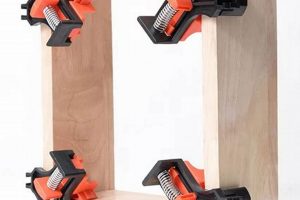
Corner clamps, specifically designed to hold workpieces at right angles, are frequently employed in mitered joint construction. These tools feature jaws or supports that align the mitered pieces, ensuring squareness during adhesive setting. Picture frames and small boxes exemplify applications where corner clamps offer significant advantages. Their ease of use and compact size render them suitable for smaller projects requiring precise corner alignment. The implication for joint integrity lies in their capacity to maintain consistent pressure at the mitered intersection, mitigating the risk of slippage or misalignment during the adhesive curing process. A well-executed application of corner clamps results in structurally sound and visually appealing corner joints.
- Band Clamps
Band clamps, utilizing a flexible band to apply uniform pressure around a mitered assembly, are particularly useful for irregularly shaped or larger workpieces. The band, typically constructed from nylon or metal, encircles the joint and is tightened using a ratcheting mechanism. Applications include furniture construction and polygonal frames, where traditional clamps may prove impractical. Band clamps exert consistent pressure around the entire circumference of the joint, ensuring uniform adhesive bonding and preventing distortion. The tension applied by the band mitigates the risk of gaps or misalignments, resulting in stronger and more aesthetically pleasing joints. For irregular or large mitered projects, these clamps are invaluable.
- Miter Vises
Miter vises, also known as miter clamps, specifically designed for mitered joints, apply pressure to hold mitered pieces together. Frequently featuring adjustable jaws that conform to the angled surfaces, they ensure precise alignment and consistent clamping force. They’re often utilized for picture frames or smaller box constructions. These vises provide rigid support, reducing the likelihood of joint movement. The capacity to adjust the clamping angle enhances precision, facilitating accurate mitered joints. Maintaining correct orientation prevents distortion or shifting. The solid construction allows for repeatable and consistent results.
- Spring Clamps
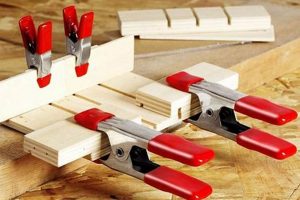
Spring clamps, characterized by their simple design and rapid application, provide a convenient means of securing mitered joints. Utilizing spring-loaded jaws to exert pressure, they are best suited for light-duty applications or temporary holding. Small picture frames and models exemplify scenarios where spring clamps offer advantages. However, their limited clamping force renders them unsuitable for high-stress applications or larger workpieces. The primary implication for joint integrity lies in their capacity to provide sufficient pressure during the initial stages of adhesive curing, preventing gross misalignment. While not a substitute for more robust clamps in critical structural joints, spring clamps offer speed and convenience for smaller projects.
The preceding overview highlights the diversity of tools available for securing mitered joints. The selection is contingent upon project size, material characteristics, and the desired level of precision. Thoughtful consideration of tool attributes ensures optimal joint strength and aesthetic quality.
7. Application Technique

The effectiveness of angled joint securing devices is intrinsically linked to the employed application technique. Skillful application ensures optimal joint integrity, minimizing potential for misalignment, insufficient clamping pressure, or surface damage. Proper technique enhances the functionality of the securing devices, resulting in robust and aesthetically pleasing mitered connections.
- Sequential Tightening
Achieving uniform pressure distribution across the mitered joint necessitates a sequential tightening approach. Tightening clamps in a random or haphazard manner can lead to localized stress concentrations and joint distortion. A recommended technique involves incrementally tightening each clamp in a circular pattern, gradually increasing pressure until the desired level is achieved. This approach ensures that the mitered pieces are drawn together evenly, preventing warping or misalignment. For instance, when constructing a picture frame, alternating between corner clamps ensures uniform pressure, resulting in a square and stable frame.
- Protective Barrier Implementation
Direct contact between the clamp jaws and the wood surface can result in indentations or marring, particularly on softer wood species or finely finished surfaces. To mitigate this risk, implementing a protective barrier between the clamp and the workpiece is crucial. Cork shims, felt pads, or even thin pieces of wood veneer can serve as effective barriers, distributing pressure evenly and preventing surface damage. When assembling delicate moldings, the strategic placement of protective pads safeguards the finish and preserves the aesthetic appeal of the joint.
- Alignment Verification During Curing
Despite meticulous preparation and clamping, minor shifts in alignment can occur during the adhesive curing process. Periodic verification of joint alignment is essential to detect and correct any deviations. Utilizing a square or other precision measuring instrument allows for timely adjustments, ensuring that the joint remains square and coplanar. When constructing a cabinet door, regular monitoring of corner alignment enables subtle adjustments, resulting in a professionally finished product.
- Clamp Removal Procedure
Premature or forceful removal of securing devices can disrupt the adhesive bond and compromise joint strength. A controlled and gradual removal procedure is recommended to minimize stress on the joint. Loosening each clamp incrementally, allowing the adhesive to gradually relieve tension, prevents sudden shock loads. For larger assemblies, allowing the adhesive to fully cure before clamp removal is advisable. This technique enhances joint stability and prevents potential setbacks.
These facets illustrate the significance of application technique in maximizing the effectiveness of angled joint securing devices. Thoughtful application, encompassing sequential tightening, protective barriers, alignment verification, and controlled removal, contributes to superior joint strength and aesthetic quality. These considerations demonstrate the interconnectedness of tool selection and skillful implementation in achieving consistently high-quality results.
Frequently Asked Questions
This section addresses common inquiries regarding the selection, utilization, and maintenance of angled joint securing devices. The information aims to provide clarity and enhance understanding of these tools.
Question 1: What clamping pressure is recommended for securing mitered joints in softwood compared to hardwood?
Softwoods necessitate reduced clamping pressure to prevent fiber compression. Excessive force can damage the wood. Hardwoods, conversely, generally require higher clamping pressures to ensure adequate adhesive bonding.
Question 2: How often should the alignment of angled joint securing devices be checked for accuracy?
Alignment should be verified prior to each use. Inaccurate alignment compromises joint squareness and overall project integrity. Periodic checks during extended clamping durations are also advisable.
Question 3: What types of adhesives are best suited for use with angled joint securing devices?
Polyvinyl acetate (PVA) adhesives are commonly employed for general woodworking. Epoxy resins are preferable for applications requiring increased strength or bonding dissimilar materials.
Question 4: Is it necessary to use protective padding between the angled joint securing device and the workpiece?
Protective padding is recommended, particularly when working with delicate surfaces. Padding mitigates the risk of indentation or marring caused by direct contact with the device’s clamping surfaces.
Question 5: How long should mitered joints remain clamped to ensure adequate adhesive curing?
Curing time depends on the adhesive type and environmental conditions. Consult the adhesive manufacturer’s recommendations for optimal clamping durations. Premature removal can compromise joint strength.
Question 6: Can angled joint securing devices be used on materials other than wood?
Certain designs are suitable for use with other materials, such as plastics or metals. However, caution must be exercised to avoid surface damage or material deformation. The securing device’s clamping surfaces must be compatible with the material’s characteristics.
These questions and answers provide a foundational understanding of angled joint securing devices. Proper selection and utilization are essential for achieving robust and aesthetically pleasing mitered connections.
The following section will offer practical considerations for choosing specific devices to enhance woodworking projects.
Conclusion
This exploration has detailed the essential aspects of angled joint securing devices. Proper selection, meticulous application, and a comprehensive understanding of associated factors including material compatibility, adhesive choice, and alignment control are critical for achieving consistently high-quality results. A nuanced approach significantly improves the structural integrity and aesthetic value of mitered joints in woodworking projects.
Therefore, a thorough grasp of the principles outlined is paramount for any woodworker seeking to produce durable and visually appealing workpieces. Continued vigilance in technique and an ongoing commitment to learning will ensure that angled joint securing devices are employed to their fullest potential, elevating the craft of woodworking.
![Top-Rated: Best Quick Clamps for Woodworking Projects [2024] | Step-by-Step Guides, Tools & Inspiration to Build Beautiful Wooden Decor on a Budget](https://woodfromhome.com/wp-content/uploads/2026/04/th-264-300x200.jpg "Top-Rated: Best Quick Clamps for Woodworking Projects [2024] Step-by-Step Guides, Tools & Inspiration to Build Beautiful Wooden Decor on a Budget")