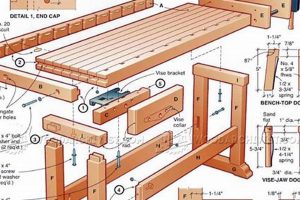
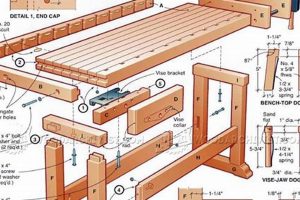
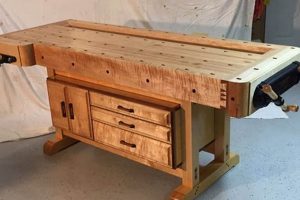
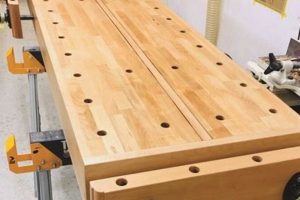
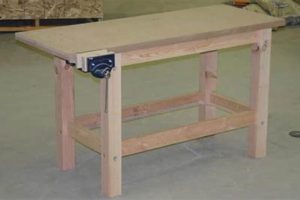
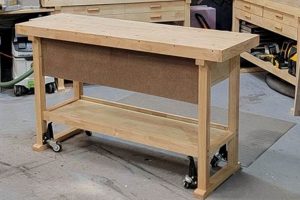
Detailed diagrams and instructions specifying the construction of a sturdy and stable surface intended for woodworking activities constitute a vital resource for both novice and experienced craftspeople. These resources outline the necessary materials, dimensions, and assembly processes required to create a dedicated workspace suitable for a variety of tasks, from cutting and shaping to joining and finishing.
The availability of documented assembly methods for such a structure significantly enhances the efficiency and safety of woodworking projects. A well-constructed workstation provides a stable platform, minimizing movement and vibration during demanding tasks. Historically, such dedicated spaces have been essential for artisans and tradespeople, contributing to the quality and precision of their work while also fostering organized and productive workshop environments.
The following discussion will delve into various types of structures, key design considerations, material selection, and construction techniques. Additionally, the availability of pre-designed options and custom modifications to suit individual needs and space constraints will be examined.
Essential Considerations for Workstation Design
Optimizing a woodworking workspace necessitates careful consideration of several key factors. The following tips offer guidance for developing a structure that maximizes efficiency and safety.
Tip 1: Material Selection: The choice of lumber significantly impacts the bench’s stability and longevity. Hardwoods such as maple or beech provide superior durability and resistance to wear, while softwoods like pine offer a more cost-effective alternative for lighter-duty applications.
Tip 2: Surface Flatness: A level and true surface is paramount for accurate woodworking. Ensure the top is meticulously flattened during construction using hand planes or a power planer. Regularly check for deviations and address any imperfections promptly.
Tip 3: Vise Placement: Strategically positioning vises both face and end vises expands the range of clamping options. Consider the most common project types and orient the vises accordingly for optimal accessibility and holding power.
Tip 4: Integrated Storage: Incorporating drawers, shelves, or cabinets into the base provides convenient storage for tools and supplies, reducing clutter and improving workflow. Plan the storage configuration based on the size and quantity of commonly used items.
Tip 5: Bench Height: The appropriate height promotes ergonomic posture and minimizes strain during extended work sessions. A general guideline is to position the bench at knuckle height when standing.
Tip 6: Joinery Strength: Utilize robust joinery techniques, such as mortise and tenon, dovetails, or sturdy screws and bolts, to ensure the bench’s structural integrity. Weak joints can compromise stability and reduce the lifespan of the structure.
Tip 7: Leg Design: The leg design plays a crucial role in stability. Tapered legs or splayed legs can enhance resistance to racking. Ensure the legs are securely fastened to the top and base frame.
Applying these considerations during the design and construction phases yields a workstation that provides a solid foundation for woodworking endeavors, enhancing precision, safety, and overall enjoyment of the craft.
The subsequent sections will address specific types of work surfaces and options for customization.
1. Dimensional Accuracy

Dimensional accuracy, within the context of documented assembly processes for woodworking surfaces, refers to the degree to which the final dimensions of the constructed structure align with the specified dimensions outlined in the documentation. This alignment is critical for ensuring functionality, stability, and overall quality of the finished product. Discrepancies in dimensions can lead to structural weaknesses, difficulties in assembly, and compromised performance.
- Impact on Surface Flatness
Inaccurate measurements and cuts during construction directly impact the flatness of the work surface. Deviations from specified dimensions can result in an uneven surface, hindering precision work such as joinery and finishing. For example, if the legs of the base frame are not cut to precisely the same length, the resulting surface will be out of plane, requiring corrective measures or compromising the bench’s utility.
- Influence on Joint Integrity
Precise dimensions are essential for achieving tight and secure joints. For instance, if a mortise and tenon joint is not cut to the specified dimensions, the joint will either be too loose, compromising its strength, or too tight, potentially causing damage during assembly. These discrepancies undermine the structural integrity of the work surface and reduce its lifespan.
- Contribution to Overall Stability
The stability of the structure relies on accurate dimensions of all components. If the dimensions of the base frame or legs deviate significantly from the documented assembly process, the resulting structure may be unstable and prone to racking or wobbling. This instability reduces the effectiveness of the work surface and poses a safety hazard.
- Facilitation of Accessory Integration
Accurate dimensions are crucial for seamless integration of accessories, such as vises and holdfasts. If the structure deviates from the specified dimensions, the mounting holes for these accessories may not align correctly, requiring modifications or compromising their functionality. This can lead to frustration and reduce the overall utility of the workstation.
In summary, dimensional accuracy is a fundamental requirement for the successful execution of detailed assembly instructions. Adhering to precise measurements and dimensions throughout the construction process ensures a stable, functional, and durable workstation that meets the intended design specifications. Deviation from these specifications invariably compromises the bench’s performance and longevity.
2. Material Strength

Material strength is a critical factor directly influencing the performance and longevity outlined in woodwork bench plans. The selection of materials with adequate strength characteristics is essential to withstand the static and dynamic loads encountered during woodworking operations. Insufficient material strength can lead to deformation, cracking, or complete failure of the bench, rendering it unusable and potentially hazardous. A plan incorporating a softwood frame subjected to the stresses of heavy planing, for example, will likely exhibit premature wear and instability compared to a bench built with a dense hardwood.
The specific types of wood used significantly impact the overall stability and durability of the finished workstation. Dense hardwoods like maple, beech, and oak offer superior resistance to wear, indentation, and racking forces. These materials maintain dimensional stability over time, preventing warping and ensuring a consistently flat work surface. Conversely, softwoods like pine or fir, while more cost-effective and easier to work with, possess lower density and are more susceptible to damage from impact or prolonged exposure to heavy loads. Therefore, careful material selection is crucial in meeting the requirements specified in detailed assembly guidelines.
In conclusion, a comprehensive understanding of material strength is paramount when considering a functional woodworking surface. The inherent properties of the chosen materials directly affect the bench’s ability to withstand the rigors of daily use and maintain its structural integrity over time. Woodwork bench plans should therefore prioritize materials with sufficient strength characteristics to ensure a safe, reliable, and long-lasting working platform. The lack of adequate material strength can render even the most meticulously designed plans ineffective.
3. Joint Integrity

Joint integrity constitutes a foundational element within the framework of robust woodwork bench plans. The effectiveness of any design is contingent upon the strength and stability of the connections between its individual components. These plans are only as reliable as the ability of their joints to resist forces generated during use. A failure in a critical joint can compromise the structural integrity of the entire workstation, leading to instability, inaccuracy, and potential safety hazards. For example, a tenon that is too loose within its mortise will not adequately resist racking forces, causing the bench to wobble and reducing the precision of tasks performed on its surface. Conversely, a poorly executed dovetail joint may shear under stress, jeopardizing the bench’s ability to withstand heavy loads.
Detailed assembly instructions emphasizing proper jointing techniques are thus crucial for ensuring the long-term viability of any woodworking surface. The selection of appropriate joint types, such as mortise and tenon, dovetail, or lap joints, must be informed by the specific loads and stresses anticipated during use. Furthermore, the execution of these joints requires precision and attention to detail. This includes accurate cutting, proper glue application, and secure clamping during the assembly process. A comprehensive assembly methodology should also address strategies for reinforcing critical joints, such as the use of wedges or dowels, to enhance their resistance to stress.
Ultimately, the integration of sound jointing principles within the structure not only guarantees the structural integrity of the workstation, but also contributes to its overall functionality and longevity. Challenges associated with achieving high joint integrity include the need for skilled craftsmanship and access to appropriate tools and equipment. However, the benefits of a well-constructed and durable surface far outweigh the initial investment of time and effort, ensuring a safe and productive woodworking environment for years to come. The pursuit of robust joint integrity, therefore, represents a critical investment in the quality and utility of any woodworking bench constructed from detailed assembly directions.
4. Stability Design

Stability design, within the context of woodwork bench plans, refers to the engineering principles and structural considerations implemented to ensure that the completed workstation remains steadfast and resistant to movement during various woodworking operations. A stable surface is paramount for accurate and safe execution of tasks, preventing vibrations and minimizing the risk of workpiece slippage. Woodwork bench plans must therefore prioritize features that enhance stability to maximize the bench’s effectiveness.
- Leg Configuration and Bracing
The arrangement and reinforcement of the legs directly impact a bench’s resistance to racking and tipping. Splayed legs, which angle outwards from the bench top, provide a wider base of support, increasing stability. Cross-bracing, implemented through stretchers or diagonals connecting the legs, further enhances rigidity and prevents lateral movement. A bench lacking adequate leg configuration and bracing is susceptible to wobbling, especially under heavy loads or during forceful operations.
- Weight Distribution and Mass
A significant factor in stability design is the distribution of weight and overall mass. A heavier bench is inherently more stable, as it requires more force to move. Low center of gravity also contributes to stability. Weight can be added strategically through the incorporation of dense materials, such as hardwood, or by filling voids in the base with sand or other ballast. Work surfaces with insufficient weight are prone to shifting during planing or sawing.
- Joinery Techniques and Rigidity
The joinery used to connect the various components of the bench significantly affects its overall rigidity and stability. Robust joinery methods, such as mortise and tenon or dovetail joints, provide strong and durable connections that resist movement and deformation. Weaker joinery, such as simple butt joints secured with screws, may fail under stress, compromising the bench’s stability. Properly executed joinery ensures that the bench remains a solid and cohesive unit.
- Surface Flatness and Support
Surface flatness and consistent support across the entire work area are also integral to stability. An uneven or warped surface can cause workpieces to rock or shift during operations, reducing accuracy and increasing the risk of accidents. Stable assembly instructions should include methods for flattening and reinforcing the work surface, such as the use of a torsion box design or the addition of internal framing. Consistent support ensures that the workpiece remains stable and secure throughout the woodworking process.
In conclusion, stability design is an indispensable aspect of comprehensive woodwork bench plans. The integration of robust leg configurations, strategic weight distribution, strong joinery, and a flat, well-supported surface ensures that the resulting structure provides a stable and reliable platform for a wide range of woodworking tasks. Without adequate attention to these stability factors, a bench may prove to be inadequate and potentially unsafe, undermining the effectiveness of even the most skilled craftsperson.
5. Vise Integration
Effective vise integration represents a critical component in the formulation and execution of comprehensive woodwork bench plans. The strategic placement and secure mounting of vises directly influence the functionality and versatility of the finished workstation, enabling a wide range of clamping and holding operations. Plans that fail to adequately address vise integration often result in a compromised work surface that limits the scope of potential projects.
- Vise Selection and Compatibility
The choice of vise must align with the intended use of the workbench and the types of projects anticipated. Face vises, end vises, leg vises, and shoulder vises each offer distinct advantages for specific clamping needs. Furthermore, the physical dimensions and mounting requirements of the vise must be carefully considered during the design phase to ensure compatibility with the overall structure of the bench. Incompatible vise selection undermines the utility of the workstation.
- Strategic Placement and Accessibility
The placement of vises on the bench should optimize accessibility and clamping range. Face vises are typically positioned near the front edge of the bench to facilitate holding workpieces for planing and edge work. End vises, often used in conjunction with bench dogs, provide clamping solutions for wider panels. The precise location must account for the user’s handedness and preferred working methods. Suboptimal vise placement hinders efficient workflow.
- Mounting Techniques and Stability
The method of mounting vises to the workbench directly impacts their stability and holding power. Robust mounting techniques, such as through-bolting with heavy-duty hardware and reinforcement of the surrounding bench structure, are essential to prevent movement or flexing during clamping. Insufficiently secured vises compromise the effectiveness of clamping operations and can lead to inaccurate results.
- Integration with Bench Dog Systems
Vise integration frequently involves incorporating bench dog systems to expand clamping capabilities. Bench dogs, inserted into holes in the bench top, provide adjustable clamping points for securing workpieces of varying sizes and shapes. The alignment and spacing of these holes must be carefully considered in relation to the vise placement to ensure compatibility and maximize clamping versatility. A well-integrated bench dog system enhances the functionality of the vise and extends the range of potential applications.
In summary, strategic vise integration is an indispensable element in comprehensive woodworking workbench design. Careful consideration of vise selection, placement, mounting techniques, and compatibility with bench dog systems is crucial for creating a functional and versatile workstation that meets the demands of a wide range of woodworking projects. The effectiveness of the bench is directly correlated to the thoroughness of vise integration planning and execution.
6. Storage Solutions

The integration of effective storage solutions within woodworking surfaces represents a critical consideration for maximizing efficiency and organization in the workshop environment. Woodwork bench plans that incorporate storage seamlessly contribute to a more productive and safer workspace by minimizing clutter and ensuring that essential tools and materials are readily accessible. The absence of integrated storage often leads to disorganization, wasted time searching for tools, and an increased risk of accidents.
- Drawer Systems for Tool Organization
Drawer systems provide a dedicated space for storing hand tools, measuring devices, and other small items, preventing them from cluttering the work surface or becoming lost. Drawers can be customized with dividers and inserts to create individual compartments for specific tools, promoting organization and preventing damage. For instance, a drawer dedicated to chisels might feature a custom-fitted insert to hold each chisel securely and prevent the blades from dulling. The successful design and placement of drawers within the structure enhance workflow and tool preservation.
- Shelf Configurations for Material Storage
Shelves offer a practical solution for storing larger items such as lumber, hardware, and finishing supplies. Adjustable shelving allows for customization to accommodate items of various sizes and shapes. A well-organized shelving system ensures that materials are easily accessible and prevents them from being damaged or misplaced. For example, shelves might be used to store different species of lumber separately, allowing for quick identification and selection. Implementing efficient shelf designs is important to optimizing shop space usage.
- Cabinet Integration for Dust Control and Security
Cabinets provide enclosed storage for tools and materials that require protection from dust or humidity. Cabinets can also be used to secure valuable tools and prevent theft. Integrating cabinets into the base of the woodwork surfaces provides a dedicated space for items such as power tools, finishing supplies, and precision instruments. Effective cabinet integration contributes to a cleaner, safer, and more secure workshop environment.
- Vertical Storage Options for Space Optimization
Vertical storage solutions, such as pegboards and tool racks, utilize wall space to store frequently used tools and accessories, freeing up valuable space on the workbench and in the surrounding area. Pegboards allow for flexible customization of tool storage, while tool racks provide designated spaces for specific items such as saws, planes, and clamps. Implementing vertical storage solutions maximizes the utilization of available space and promotes a more organized and efficient workflow.
In conclusion, the integration of strategic storage solutions represents a vital aspect of comprehensive woodwork bench plans. By incorporating drawers, shelves, cabinets, and vertical storage options, woodworkers can create a more organized, efficient, and safer workshop environment. The absence of thoughtfully designed storage can impede productivity and increase the risk of accidents, underscoring the importance of prioritizing storage considerations in workshop planning. The thoughtful design contributes to better space management and overall efficiency of the woodworking bench.
7. Ergonomic Height

Ergonomic height, within the context of woodwork bench plans, represents a critical design parameter directly influencing the user’s comfort, safety, and productivity. The dimension dictates the vertical distance between the floor and the work surface, and its optimization mitigates physical strain during prolonged woodworking tasks. Inadequate workbench height necessitates compensatory postures, such as hunching or reaching, leading to musculoskeletal discomfort and potential long-term injuries. A work surface that is too low requires excessive bending, placing undue stress on the lower back. Conversely, a work surface that is too high necessitates raised shoulders and extended arms, contributing to neck and shoulder pain. Woodwork bench plans that neglect ergonomic height considerations compromise the well-being and efficiency of the user. For instance, a woodworker spending several hours daily at a bench that is either too high or too low will develop chronic pain conditions, diminished productivity, and potentially require medical intervention. Therefore, the integration of ergonomic principles into the assembly diagrams is essential for creating a sustainable and healthy woodworking practice.
The determination of optimal ergonomic height often involves anthropometric measurements and considerations of individual user preferences. A commonly cited guideline suggests that the work surface should be positioned at knuckle height when the user is standing upright. This allows for comfortable planing and other tasks requiring downward force. However, individual variations in arm length and preferred working styles necessitate customization. Work surface designs may include adjustable legs or risers to accommodate users of different heights or to facilitate different types of woodworking operations. Furthermore, ergonomic height interacts with other aspects of workbench design, such as the placement of vises and the integration of storage. For example, a leg vise positioned too low relative to the work surface may require the user to bend excessively, negating the ergonomic benefits of a properly adjusted bench height. Consequently, woodworking bench plans should address ergonomic height in conjunction with other design elements to ensure a cohesive and effective workstation.
In summary, ergonomic height is a non-negotiable aspect of comprehensive woodwork bench plans. Proper attention to this dimension minimizes physical strain, promotes user comfort, and enhances productivity. Design considerations must account for individual variations and integrate ergonomic height with other workbench features. The long-term benefits of an ergonomically designed workstation far outweigh the initial effort required for careful planning and construction. Challenges related to ergonomic implementation include the need for accurate measurements, user input, and potentially, adjustable design elements. However, addressing these challenges contributes to a healthier and more sustainable woodworking practice. The integration of ergonomic principles within woodworking bench design represents a critical step towards promoting the well-being of woodworkers and ensuring the longevity of the craft.
Frequently Asked Questions About Woodwork Bench Plans
The following section addresses common inquiries regarding the selection, interpretation, and utilization of diagrams and instructions for constructing woodworking surfaces.
Question 1: What is the essential information contained within comprehensive documented assembly processes?
Comprehensive sets of instructions provide detailed specifications for dimensions, materials, joinery techniques, and assembly sequences. They often include diagrams, illustrations, and step-by-step procedures to guide the construction process.
Question 2: How does one choose a suitable documented assembly method for their skill level?
The selection should align with the individual’s woodworking experience and proficiency. Novice woodworkers may opt for simpler designs with basic joinery, while experienced craftspeople may undertake more complex and elaborate construction. Evaluate the complexity of the steps, joinery, and required tools.
Question 3: What are the common materials employed in workbench construction?
Hardwoods like maple, beech, and oak are frequently used for their durability and stability. Softwoods, such as pine and fir, provide a more cost-effective alternative for less demanding applications. Material selection should align with the anticipated load and usage of the bench.
Question 4: What are the key considerations for ensuring the stability of the finished workstation?
Stability is achieved through robust leg design, proper weight distribution, strong joinery, and a flat, rigid surface. Splayed legs, cross-bracing, mortise and tenon joints, and a torsion box construction contribute to stability.
Question 5: How does one integrate a vise effectively into documented assembly processes?
Vise integration involves selecting an appropriate vise type, strategically positioning it for optimal accessibility, and securely mounting it to the bench. Compatibility with bench dog systems should also be considered.
Question 6: What are the recommended strategies for incorporating storage solutions into the design?
Integrated storage can be achieved through drawers, shelves, cabinets, and vertical storage options. Storage solutions should be tailored to the specific tools and materials used by the woodworker, promoting organization and efficiency.
In summary, careful attention to design, material selection, construction techniques, and customization ensures the creation of a functional and durable structure.
The subsequent sections will discuss optimizing the workstation and maintenance practices.
The Significance of Woodwork Bench Plans
This exploration has illuminated the critical role that detailed assembly instructions play in crafting a functional and enduring woodworking station. From ensuring dimensional accuracy and material strength to emphasizing joint integrity, stability, ergonomic design, and strategic vise integration, the discussed elements are crucial for constructing a workspace that fosters precision, safety, and efficiency.
Diligent consideration of readily available assembly documents is an investment in the long-term success of woodworking endeavors. The adoption of well-defined strategies not only facilitates the construction process but also enhances the quality and enjoyment of the craft. Therefore, meticulous attention to documented woodwork bench plans is encouraged as a foundation for a thriving woodworking practice.