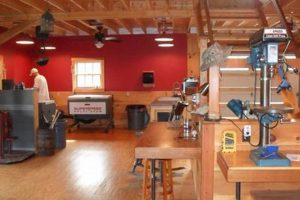
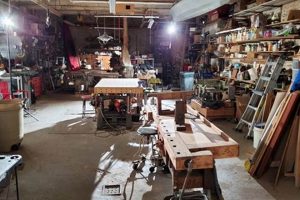
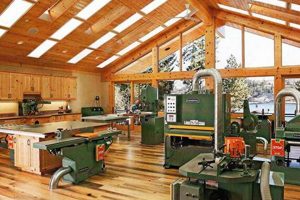
A dedicated workspace, often located within a repurposed agricultural structure, facilitates the creation of wood products. Such a setup commonly includes tools and equipment necessary for cutting, shaping, and assembling timber and related materials. A typical example is a renovated outbuilding equipped with a table saw, planer, and various hand tools for crafting furniture or decorative items.
The utilization of these spaces provides ample room for larger projects and storage of materials. Historically, barns offered a convenient and readily available location for rural artisans. This arrangement fosters a connection to traditional craftsmanship while providing opportunities for both professional woodworking and hobbyist pursuits. The expansive nature of these spaces is particularly advantageous for businesses involved in larger-scale woodworking operations.
The subsequent sections will delve into the specific considerations for designing a functional layout, selecting appropriate machinery, ensuring safety protocols, and addressing environmental factors within such environments. Furthermore, the unique challenges and advantages presented by the architectural characteristics of these converted structures will be examined.
Essential Guidelines for a Barn Woodworking Shop
Effective operation of a woodworking facility within a converted barn requires meticulous planning and execution. Prioritizing safety, organization, and environmental control is crucial for maximizing productivity and minimizing risks.
Tip 1: Structural Integrity Assessment: Conduct a thorough evaluation of the barn’s structural integrity. Reinforce the foundation, framing, and roof as needed to support heavy machinery and material storage.
Tip 2: Dust Collection System Implementation: Install a comprehensive dust collection system. Wood dust poses significant health and fire hazards; a properly designed system mitigates these risks effectively.
Tip 3: Adequate Electrical Capacity: Ensure sufficient electrical capacity to power all woodworking equipment. Consult with a qualified electrician to upgrade wiring and install dedicated circuits for high-demand tools.
Tip 4: Climate Control Considerations: Implement climate control measures to regulate temperature and humidity. Fluctuations can adversely affect wood stability and glue adhesion.
Tip 5: Optimized Layout Design: Design a logical workflow within the space. Position machinery strategically to minimize material handling and maximize efficiency.
Tip 6: Enhanced Natural and Artificial Lighting: Maximize natural light while supplementing with high-intensity artificial lighting. Adequate illumination is essential for precision woodworking and safety.
Tip 7: Secure and Organized Storage: Establish dedicated storage areas for lumber, hardware, and finished projects. This promotes organization and prevents material damage.
These guidelines emphasize the importance of safety, efficiency, and environmental control within a repurposed agricultural structure. By adhering to these principles, operators can establish a functional and productive environment.
The subsequent sections will elaborate on the specific equipment and techniques suited for this unique workshop setting, building upon the foundation of these essential guidelines.
1. Structural Reinforcement

The conversion of a barn into a woodworking shop necessitates careful consideration of structural reinforcement due to the increased demands placed on the original structure. Barns, typically designed for agricultural storage, often lack the load-bearing capacity required to support heavy woodworking machinery and substantial material stockpiles. Failure to address this deficiency can lead to structural instability, posing safety risks to occupants and potentially compromising the integrity of the building. For example, older barns with weakened floor joists may require reinforcement with steel beams or additional support columns to safely accommodate a large table saw or a lumber rack filled with hardwood. The weight of these items concentrated in a small area can easily exceed the barn’s original design limitations.
Furthermore, the vibrations produced by woodworking equipment can exacerbate existing structural weaknesses. Sanders, planers, and lathes generate significant forces that, over time, can loosen connections and weaken timber framing. Proper structural reinforcement mitigates these vibrations and distributes the load more evenly across the building’s framework. Techniques such as adding diagonal bracing, sistering joists, and reinforcing connections with metal fasteners are common solutions. The selection of appropriate reinforcement methods depends on the barn’s original construction, the type of equipment used, and the anticipated workload.
In conclusion, structural reinforcement is not merely an optional upgrade, but a fundamental prerequisite for establishing a safe and functional woodworking shop within a barn. Neglecting this aspect can lead to costly repairs, compromised safety, and potential structural failure. A thorough assessment by a qualified structural engineer is essential to determine the appropriate reinforcement measures and ensure the long-term stability of the converted structure. This proactive approach is vital for the successful and sustainable operation of any woodworking facility housed within a repurposed agricultural building.
2. Dust Mitigation

Woodworking operations inherently generate substantial volumes of dust, posing significant health and safety risks within any enclosed environment. The conversion of a barn into a woodworking shop amplifies these concerns due to the often-larger scale of projects, potential for increased machinery usage, and the inherent characteristics of barn structures. Barns, frequently built with porous materials and less-than-airtight construction, facilitate the accumulation and dispersal of dust throughout the workspace. Without effective dust mitigation strategies, operators face elevated risks of respiratory illness, allergic reactions, and potential fire hazards. The presence of combustible dust, particularly fine particles, can create explosive conditions under certain circumstances. Therefore, dust mitigation becomes an indispensable component of a functional and safe woodworking environment within a repurposed barn.
Effective dust mitigation in these settings typically involves a multi-faceted approach. Localized dust collection systems, attached directly to woodworking machinery, capture dust at the source. These systems often utilize high-efficiency particulate air (HEPA) filters to remove even the smallest dust particles from the air stream. In addition to localized collection, a central dust collection system serves to extract airborne dust from the overall workspace. Implementing adequate ventilation, through a combination of natural airflow and mechanical exhaust fans, further reduces dust concentrations. Regular cleaning practices, including the use of vacuum systems equipped with HEPA filters, are also essential to prevent dust accumulation on surfaces. One notable example is the installation of cyclone dust collectors, which efficiently separate larger wood chips from finer dust particles, improving the overall performance of the system and reducing the load on filters.
The implementation of comprehensive dust mitigation measures represents a crucial investment in the long-term health and safety of individuals working within a barn woodworking shop. Addressing the challenges posed by the structures inherent design and the nature of woodworking activities ensures a productive and compliant workspace. The absence of such measures not only increases health risks but also elevates the potential for regulatory non-compliance and workplace accidents. Therefore, prioritizing dust mitigation is a fundamental requirement for establishing a sustainable and responsible woodworking operation within a repurposed barn.
3. Electrical Capacity
Adequate electrical capacity is paramount for the safe and efficient operation of any woodworking shop, and its importance is amplified within the context of a barn conversion. Barns, originally designed for agricultural purposes, often possess electrical systems insufficient for the power demands of modern woodworking equipment. The successful transformation of a barn into a functional woodworking space necessitates a thorough assessment and potential upgrade of the existing electrical infrastructure.
- Power Tool Requirements
Woodworking machinery, such as table saws, planers, jointers, dust collectors, and air compressors, requires significant electrical power. Each machine operates at a specific voltage and amperage, and the cumulative demand can easily exceed the capacity of a typical residential or agricultural electrical service. Operating equipment on undersized circuits can result in tripped breakers, damaged equipment, and potential fire hazards. Therefore, a detailed inventory of all planned equipment is essential to calculate the total power requirements of the woodworking shop.
- Wiring and Circuitry
The existing wiring within a barn may be outdated, damaged, or inadequate for the intended use. Wiring may not be properly grounded, or the insulation may be deteriorated, posing a significant safety risk. Furthermore, the number of available circuits may be insufficient to accommodate the diverse electrical needs of a woodworking shop. Installing new wiring, dedicated circuits for high-demand equipment, and ground fault circuit interrupters (GFCIs) in wet or damp locations are critical steps in ensuring electrical safety and preventing potential hazards. The choice of wire gauge must also match the amperage load to prevent overheating and fire.
- Panel and Service Upgrades
In many cases, the existing electrical panel in a barn will be inadequate to handle the increased power demands of a woodworking shop. An upgrade to a larger panel with more circuits and higher amperage capacity may be necessary. Furthermore, the electrical service feeding the barn from the utility grid may also require upgrading to provide sufficient power. This involves increasing the size of the service entrance cable and potentially replacing the electrical meter. Consulting with a qualified electrician to assess the existing electrical system and determine the appropriate upgrades is crucial.
- Lighting and Climate Control
Adequate lighting is critical for safety and precision in woodworking. Barns often lack sufficient natural light, necessitating the installation of ample artificial lighting. High-bay LED fixtures provide bright, energy-efficient illumination. Similarly, climate control systems, such as heaters and dehumidifiers, are often necessary to maintain a stable environment for woodworking. These systems also require significant electrical power and must be factored into the overall electrical load calculation.
In conclusion, addressing electrical capacity is a non-negotiable aspect of converting a barn into a woodworking shop. A thorough assessment, followed by necessary upgrades to wiring, circuitry, panels, and service, is essential to ensure safety, prevent equipment damage, and support the efficient operation of woodworking machinery. Prioritizing electrical capacity ensures that the transformed barn provides a safe and productive environment for woodworking endeavors.
4. Equipment Layout

The effective arrangement of equipment within a barn woodworking shop directly impacts workflow efficiency, safety, and overall productivity. A poorly planned layout can lead to wasted movement, increased risk of accidents, and compromised material flow. Conversely, a well-designed equipment layout optimizes space utilization, reduces unnecessary steps, and enhances the ergonomic aspects of the workspace. In the context of a barn conversion, the unique architectural characteristics of the structure, such as existing posts, low ceilings, or uneven floors, present specific challenges and opportunities for equipment placement. For instance, orienting a long jointer parallel to the longest clear span in the barn minimizes material handling and allows for efficient processing of long boards.
Specific examples illustrate the practical significance of equipment layout within a barn woodworking shop. A central dust collection unit strategically positioned near multiple dust-generating machines minimizes the length of ductwork required, improving suction efficiency and reducing installation costs. Placing a lumber rack close to the initial material processing station streamlines the workflow, reducing the distance lumber must be carried. Conversely, obstructing walkways with machinery or materials creates tripping hazards and impedes the safe movement of personnel and materials. A properly configured layout also considers the sequence of operations, ensuring that materials flow logically from rough stock to finished product without unnecessary backtracking or bottlenecks. Clearances around machinery must adhere to safety guidelines, providing ample space for operators to maneuver and react in case of emergencies.
In conclusion, equipment layout is a critical component of establishing a functional and safe barn woodworking shop. Addressing the inherent constraints and opportunities presented by the barn’s structure, carefully considering workflow efficiency, and adhering to safety protocols are essential for optimizing the workspace. The investment in thoughtful equipment layout translates directly into increased productivity, reduced risk of accidents, and a more enjoyable and sustainable woodworking environment. This aspect must be considered as seriously as the dust collection or eletrical capacity.
5. Safety Procedures
The integration of comprehensive safety procedures is paramount within a barn woodworking shop. The inherent risks associated with woodworking machinery, combined with the unique structural characteristics of repurposed barns, necessitate stringent safety protocols to mitigate potential hazards and ensure the well-being of operators.
- Personal Protective Equipment (PPE)
The consistent use of appropriate PPE is a fundamental safety procedure. This includes, but is not limited to, safety glasses or face shields to protect against flying debris, hearing protection to mitigate noise exposure from machinery, and respiratory protection, such as dust masks or respirators, to safeguard against inhalation of wood dust. In a barn woodworking shop, where dust levels can be elevated due to porous construction and potential drafts, respiratory protection is especially critical. Gloves should be worn when handling rough lumber or applying finishes to protect the skin. Neglecting PPE can lead to preventable injuries and long-term health problems.
- Machine Guarding and Operational Protocols
All woodworking machinery must be equipped with properly functioning guards to prevent accidental contact with moving parts. Operators must be thoroughly trained on the safe operation of each machine and adhere to established protocols. This includes understanding the machine’s capabilities and limitations, using appropriate feed rates, and avoiding distractions while operating equipment. Regular inspection and maintenance of machinery are also crucial for ensuring that guards remain in place and that equipment functions safely. In a barn setting, which may have limited space or uneven floors, it is particularly important to maintain clear walkways and unobstructed access to machinery to prevent accidents.
- Fire Safety and Prevention
Woodworking shops are inherently at risk of fire due to the presence of combustible materials, such as wood dust, shavings, and finishes. Fire safety procedures should include the installation of smoke detectors and fire extinguishers, the implementation of a strict no-smoking policy, and the proper storage of flammable materials in approved containers. Regular cleaning to remove accumulated wood dust and shavings is essential to prevent fire hazards. A barn woodworking shop may present unique fire safety challenges due to its age, construction materials, and potential for limited access for emergency responders. Therefore, fire safety procedures must be tailored to the specific characteristics of the structure.
- Emergency Procedures and First Aid
A well-defined emergency response plan is essential for addressing accidents or injuries that may occur in a barn woodworking shop. This plan should include procedures for contacting emergency services, providing first aid, and evacuating the building if necessary. A fully stocked first aid kit should be readily accessible, and operators should be trained in basic first aid techniques. In a rural setting, where emergency response times may be longer, it is particularly important to be prepared to provide immediate care to injured individuals. Regular drills can help ensure that operators are familiar with emergency procedures and can respond effectively in the event of an incident.
The consistent enforcement and adherence to these safety procedures are critical for creating a safe and productive working environment within a barn woodworking shop. Neglecting safety protocols not only increases the risk of accidents and injuries but also compromises the long-term sustainability of the woodworking operation. Therefore, safety must be prioritized as an integral component of the overall management and operation of any woodworking facility housed within a repurposed barn.
Frequently Asked Questions
This section addresses common inquiries regarding the establishment and operation of a woodworking facility within a repurposed barn structure. The information provided aims to clarify key considerations and address potential concerns.
Question 1: What are the primary structural considerations when converting a barn into a woodworking shop?
Assessment of the foundation, framing, and roofing is paramount. Reinforcement may be necessary to support heavy machinery and lumber storage. Floor joists must be capable of bearing concentrated loads. Consultation with a structural engineer is recommended.
Question 2: How critical is dust collection in a barn woodworking shop environment?
Effective dust collection is crucial due to the potential health hazards and fire risks associated with wood dust. A comprehensive system, incorporating localized collection at machinery and a central dust collector, is highly recommended. Adequate ventilation is also essential.
Question 3: What level of electrical service is typically required for a barn woodworking shop?
The electrical demands of woodworking equipment necessitate careful assessment and potential upgrades. Adequate amperage and properly wired circuits are essential for safe and efficient operation. Consultation with a qualified electrician is strongly advised.
Question 4: How should equipment be arranged to maximize efficiency in a barn woodworking shop?
Equipment layout should prioritize workflow, minimizing material handling and maximizing space utilization. Consider the sequence of operations and ensure ample clearances around machinery. A logical arrangement enhances both productivity and safety.
Question 5: What are the essential safety procedures for operating a barn woodworking shop?
Strict adherence to safety protocols is imperative. This includes the consistent use of personal protective equipment (PPE), proper machine guarding, and adherence to fire safety procedures. Comprehensive training and regular safety inspections are also essential.
Question 6: Are there specific building code requirements that apply to a barn woodworking shop?
Local building codes and zoning regulations may apply, depending on the intended use and scale of the woodworking operation. Compliance with these regulations is crucial to avoid legal issues and ensure the safety of the structure and its occupants. Consultation with local authorities is recommended.
In summary, establishing a functional and safe woodworking facility within a repurposed barn requires careful planning, attention to detail, and adherence to relevant regulations. Addressing structural considerations, implementing effective dust collection, ensuring adequate electrical capacity, optimizing equipment layout, prioritizing safety procedures, and complying with building codes are essential for success.
The following section will provide additional insights into advanced techniques and specialized equipment for barn woodworking shops.
Barn Woodworking Shop
The preceding exploration has illuminated the multifaceted considerations involved in establishing and maintaining a functional barn woodworking shop. Emphasis has been placed on structural integrity, dust mitigation, electrical capacity, equipment layout, and comprehensive safety protocols. Each of these elements contributes directly to the productivity, safety, and long-term viability of woodworking operations within a repurposed agricultural structure.
The establishment of a barn woodworking shop represents a significant investment of resources and expertise. The successful integration of traditional craftsmanship with modern woodworking technology demands a commitment to responsible practices and continuous improvement. Therefore, prospective operators are urged to prioritize thorough planning, adhere to industry best practices, and remain vigilant in their pursuit of a safe and productive workspace. The longevity and success of any woodworking endeavor within a repurposed barn ultimately hinges on a dedication to excellence in both craftsmanship and operational management.