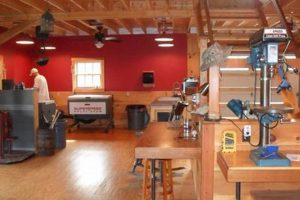
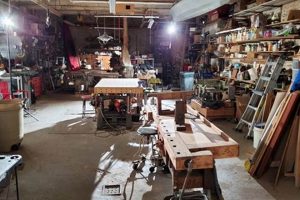
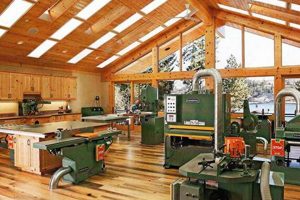
Essential equipment and tools constitute the foundation of any productive and safe woodworking environment. These items range from fundamental hand tools to advanced power machinery, each serving a specific purpose in the shaping, cutting, and finishing of wood. An example would be a table saw, a necessary piece of equipment for creating accurate cuts in sheet goods and lumber.
The selection of appropriate implements directly impacts project quality, efficiency, and operator safety. A well-equipped workspace minimizes the risk of injury and maximizes the potential for creating high-quality finished products. Historically, advancements in tool technology have continually shaped woodworking practices, allowing for greater precision and complexity in designs.
Subsequent sections will detail specific tools and equipment considered vital for a functional and versatile woodworking workspace. These will be categorized for clarity, encompassing tools for measuring, cutting, shaping, and finishing. Selection considerations such as budget, space constraints, and project types will also be addressed.
Essential Guidance for Workshop Outfitting
The following points offer critical guidance for assembling a comprehensive and functional woodworking space. Thoughtful consideration of these elements contributes to enhanced productivity, safety, and project quality.
Tip 1: Prioritize Safety Equipment. Invest in quality safety glasses, hearing protection, and a dust collection system. Consistent use of these items mitigates the risks associated with woodworking activities.
Tip 2: Acquire Accurate Measuring Tools. Precision is paramount. A quality combination square, measuring tape, and digital angle finder are essential for precise layouts and cuts.
Tip 3: Start with Fundamental Hand Tools. Develop proficiency with hand saws, chisels, and planes. These tools provide control and refinement often unattainable with power equipment.
Tip 4: Select a Versatile Table Saw. A table saw serves as the centerpiece for many woodworking operations. Research models with robust fences and adequate power for anticipated projects.
Tip 5: Invest in Effective Clamping Solutions. A diverse collection of clamps, including bar clamps, pipe clamps, and quick-release clamps, is crucial for secure workpiece assembly.
Tip 6: Establish a Proper Sharpening System. Sharp tools are safer and more efficient. Learn to sharpen chisels, plane irons, and saw blades using sharpening stones or a dedicated sharpening system.
Tip 7: Consider Dust Management Solutions. Effective dust collection is vital for respiratory health and a clean workspace. Evaluate options ranging from shop vacuums with cyclone separators to dedicated dust collectors.
Tip 8: Optimize Workspace Organization. Implement storage solutions for tools and materials. A well-organized workspace enhances efficiency and reduces the risk of accidents.
Adherence to these guidelines facilitates the creation of a practical and safe environment. Such an environment is conducive to both learning and executing intricate woodworking projects.
The subsequent section provides an exploration into advanced equipment and techniques.
1. Safety Protocols

Safety protocols represent an indispensable component within the framework of essential woodworking equipment and practices. The inherent risks associated with woodworking machinery and hand tools necessitate strict adherence to safety procedures. Failure to observe such protocols directly contributes to an elevated probability of injury, potentially resulting in permanent disability or fatality. A well-defined set of safety guidelines, encompassing aspects such as personal protective equipment usage, machine guarding, and proper ventilation, mitigates these risks. For instance, consistent utilization of safety glasses prevents eye injuries from flying debris, while the implementation of effective dust collection systems minimizes respiratory health hazards.
The acquisition of specific safety-related items constitutes a fundamental investment in workspace security. These items include, but are not limited to, hearing protection, respirators, push sticks, and first-aid kits. Regular inspection and maintenance of equipment, coupled with comprehensive training on safe operating procedures, further enhances workplace safety. The absence of these safeguards not only jeopardizes the well-being of the woodworker but also increases the likelihood of equipment damage and project defects. One example is the use of push sticks when working with a table saw; they keep hands away from the blade. Such incidents highlight the critical role of preventative measures.
In summation, the integration of comprehensive safety protocols within the woodworking workspace represents a non-negotiable imperative. The consistent application of safety procedures, coupled with the provision of appropriate safety equipment, cultivates a secure and productive environment. Addressing challenges involves continuous education, reinforcement of safety awareness, and adaptation to evolving industry best practices. Ignoring these considerations undermines the very essence of responsible woodworking and potentially leads to devastating consequences.
2. Precision Instruments

Accuracy is paramount in woodworking, and the attainment of precise measurements and angles is directly attributable to the employment of quality precision instruments. The presence of reliable measuring tools is, therefore, an indispensable characteristic of any adequately equipped woodworking space. Inaccurate measurements propagate errors throughout a project, leading to misalignment, structural weakness, and aesthetic imperfections. A simple example would be cutting lumber to the exact dimensions specified in a plan; without a precise measuring tape or digital caliper, the resulting piece might be too short, too long, or otherwise out of tolerance, rendering it unusable or requiring rework. This demonstrates the cause-and-effect relationship between precision instruments and project outcomes.
The selection of appropriate instruments depends on the scale and complexity of the woodworking tasks undertaken. For instance, a combination square is crucial for marking precise right angles and determining depth, while a digital angle finder facilitates the accurate setting of bevels and miters. Furthermore, a well-maintained marking gauge is essential for scribing consistent lines parallel to an edge, ensuring uniform joinery. The absence of any of these instruments necessitates reliance on less accurate methods, increasing the likelihood of errors and diminishing the overall quality of the finished piece. Consider the construction of a dovetail joint; the precision with which the pins and tails are laid out directly determines the strength and aesthetic appeal of the joint. Without accurate marking tools, achieving a tight-fitting, visually pleasing dovetail is exceedingly difficult.
In summary, the integration of precision instruments into a woodworking workspace is not merely a matter of convenience but a fundamental requirement for achieving professional-grade results. These tools serve as the foundation for accurate design, execution, and assembly, minimizing errors and maximizing the potential for producing high-quality, durable woodworking projects. The challenge lies in selecting instruments that offer the appropriate level of precision for the intended applications and ensuring their proper calibration and maintenance. The absence of reliable precision instruments effectively compromises the integrity and value of the entire woodworking endeavor.
3. Cutting Implements
Cutting implements constitute a critical category within essential woodworking tools. The ability to efficiently and accurately sever wood fibers is fundamental to nearly all woodworking operations. The selection of appropriate cutting tools dictates the speed, precision, and quality of cuts, directly influencing the overall outcome of a project. An inadequately equipped workspace, lacking a variety of cutting tools, severely restricts the range of achievable tasks and potentially compromises project integrity. Consider, for example, the need to create a perfectly square edge on a board; the availability of a sharp hand plane or a well-tuned jointer is essential for achieving this result. Without such tools, the resulting edge is likely to be uneven, hindering subsequent joinery operations.
The spectrum of cutting implements ranges from hand saws, chisels, and planes to power tools such as table saws, miter saws, and band saws. Each tool is designed for specific cutting tasks, offering varying degrees of precision and control. A table saw, for instance, facilitates ripping lumber and cutting sheet goods to precise dimensions, while a band saw excels at cutting curved shapes and resawing thicker stock. The effective integration of these diverse cutting implements into a woodworking shop enhances its versatility and capacity to tackle a wide array of projects. A common application involves using a miter saw to make precise angled cuts for picture frames or crown molding. Without a properly calibrated miter saw, achieving accurate and tight-fitting corners becomes exceedingly difficult, leading to visible gaps and an unprofessional appearance.
In summary, the inclusion of a comprehensive array of cutting implements represents an indispensable aspect of a functional woodworking workspace. These tools provide the means to shape and manipulate wood with precision and efficiency, contributing directly to the quality and success of woodworking endeavors. Challenges in selecting and maintaining cutting tools involve factors such as cost, space constraints, and the need for specialized training in their safe and effective operation. Overcoming these challenges requires careful planning, investment in quality equipment, and a commitment to continuous learning. The absence of adequate cutting implements fundamentally limits the potential of any woodworking shop and increases the likelihood of project failure.
4. Shaping Tools
Shaping tools form an essential category within woodworking environments, enabling the transformation of raw material into desired forms. Their presence directly influences the capacity to execute intricate designs and achieve precise contours. A well-equipped workshop necessitates a selection of shaping tools appropriate for the intended scope of work.
- Hand Planes: Control and Refinement
Hand planes offer unparalleled control in smoothing surfaces, creating precise edges, and refining joinery. A sharp plane, skillfully wielded, produces a finish often superior to that achievable with power tools. They are invaluable for fine-tuning the fit of joints and removing subtle imperfections. Historical examples include the use of smoothing planes to prepare surfaces for finishing on fine furniture, demonstrating their enduring relevance.
- Spokeshaves: Contoured Surfaces
Spokeshaves are specifically designed for shaping curved surfaces, such as chair spindles, table legs, and tool handles. They allow for the removal of material in controlled increments, enabling the creation of complex contours with precision. The use of spokeshaves in crafting traditional Windsor chairs exemplifies their importance in woodworking.
- Rasps and Files: Material Removal and Surface Refinement
Rasps and files serve as versatile tools for removing material quickly and refining surfaces that are difficult to access with other shaping tools. They are particularly useful for shaping intricate details and smoothing edges. Their application extends to tasks such as shaping guitar necks and refining carvings.
- Power Routers: Precision and Efficiency
Power routers offer a combination of precision and efficiency in shaping edges, creating grooves, and cutting decorative profiles. When equipped with appropriate bits and guides, they can produce complex shapes with repeatable accuracy. Routers are commonly used to create decorative edges on tabletops and to cut mortises for joinery.
These shaping tools, whether employed individually or in conjunction, represent indispensable elements of a functional woodworking space. Their effective utilization directly contributes to the quality, precision, and aesthetic appeal of finished woodworking projects. Skillful application of shaping tools allows transforming basic materials to a desired shape.
5. Assembly Solutions

Effective assembly solutions constitute a fundamental element within any functional woodworking environment. The ability to securely and accurately join wood components directly impacts the structural integrity, aesthetic appeal, and overall longevity of finished projects. A woodworking space lacking adequate assembly solutions is significantly limited in its capacity to produce durable and visually cohesive pieces. Clamps, for instance, provide the necessary pressure to ensure tight-fitting joints during glue-up. Without a sufficient range of clamp types and sizes, achieving consistent and reliable bonds becomes exceedingly difficult, potentially leading to joint failure over time.
Beyond clamps, assembly solutions encompass a range of tools and techniques, including joinery methods, fasteners, and adhesives. Different joint types, such as mortise and tenon, dovetail, and biscuit joints, each require specific tools and techniques for precise execution and secure assembly. The selection of appropriate fasteners, such as screws, nails, or dowels, also plays a critical role in ensuring the stability of assembled components. Furthermore, the choice of adhesive, whether it be wood glue, epoxy, or construction adhesive, must align with the specific wood species and application requirements to achieve optimal bonding strength. In cabinet making, for example, the use of pocket-hole joinery, combined with screws and glue, provides a quick and efficient method for assembling face frames and carcase components. The stability and alignment of these elements are directly dependent on the quality of the assembly solutions employed.
In summary, the integration of comprehensive assembly solutions into a woodworking workspace is essential for achieving durable, aesthetically pleasing, and structurally sound projects. The choice of appropriate tools, techniques, and materials directly influences the quality and longevity of finished pieces. Addressing challenges involves careful planning, investment in quality equipment, and a thorough understanding of different joinery methods and adhesive properties. Inadequate assembly solutions compromise the integrity of the woodworking endeavor, potentially leading to project failure and dissatisfaction.
6. Finishing Applications
Finishing applications represent the culminating stage in woodworking, significantly influencing the aesthetic appeal, durability, and protective qualities of completed projects. These processes necessitate specialized materials, tools, and techniques that, when integrated into the operational framework of a woodworking shop, substantially enhance its overall capabilities and value proposition.
- Surface Preparation: The Foundation for Quality
Surface preparation, including sanding, filling, and cleaning, establishes the foundation for successful finishing. Effective surface preparation ensures proper adhesion of subsequent coats, yielding a smooth, even, and visually appealing finish. Inadequate surface preparation may result in imperfections such as uneven sheen, visible scratches, or peeling finish. Sanding blocks, sandpaper of varying grits, and tack cloths are essential components. Sanding a table top prior to staining would remove any imperfections and allow for even stain penetration.
- Protective Coatings: Enhancing Durability
Protective coatings, such as varnishes, lacquers, and polyurethanes, provide a barrier against moisture, scratches, and UV damage, thereby extending the lifespan of wooden projects. The choice of coating depends on the intended use of the item and the desired level of protection. Applying a polyurethane finish to a wooden bar top protects it from spills and wear, ensuring its longevity in a high-traffic environment.
- Color Enhancement: Aesthetic Modification
Color enhancement techniques, including staining, dyeing, and glazing, modify the natural color of wood to achieve desired aesthetic effects. Stains penetrate the wood fibers, imparting color without obscuring the grain pattern, while dyes offer more vibrant and uniform color options. Applying a cherry stain to pine furniture can mimic the appearance of more expensive hardwoods, enhancing its visual appeal.
- Application Techniques: Achieving a Professional Result
The selection and mastery of application techniques, such as brushing, spraying, and wiping, are critical for achieving a professional-quality finish. Each technique offers distinct advantages and disadvantages, depending on the type of finish being applied and the size and complexity of the project. Spraying lacquer onto a guitar body allows for the application of a thin, even coat, resulting in a high-gloss finish.
These facets collectively underscore the integral role of finishing applications within the broader context of woodworking shop essentials. A well-equipped shop, capable of executing a range of finishing techniques, can deliver enhanced value to clients and produce projects of superior quality and durability. Effective finishing transforms a basic piece to a high end piece.
Frequently Asked Questions
The following addresses common inquiries concerning the selection and utilization of fundamental woodworking implements and machinery.
Question 1: What constitutes the absolute minimum set of equipment required to begin woodworking?
A foundational set includes a measuring tape, combination square, hand saw, chisels, a hand plane, a selection of clamps, safety glasses, and a sharpening stone. These tools enable basic cutting, shaping, and joinery tasks.
Question 2: How should one prioritize equipment purchases given a limited budget?
Prioritize safety equipment and accurate measuring tools first. Subsequently, invest in versatile hand tools before committing to expensive power machinery. Used tools, if in good condition, can be a cost-effective alternative.
Question 3: What safety precautions are paramount in a woodworking environment?
Consistent use of safety glasses, hearing protection, and a dust mask or respirator is non-negotiable. Understanding the operational characteristics and safety features of each tool is equally critical.
Question 4: How can one effectively manage dust generation within a small woodworking space?
A shop vacuum with a cyclone separator can significantly reduce airborne dust. Supplement this with regular sweeping and the use of dust collection attachments on power tools.
Question 5: What are the key considerations when selecting a table saw?
Assess motor power, fence quality, blade size, and safety features. A robust fence and adequate power are essential for accurate and safe operation.
Question 6: How does one maintain the sharpness of woodworking tools?
Regular sharpening with stones or a sharpening system is crucial. Dull tools are not only less efficient but also more dangerous to operate.
In summary, a strategic approach to equipment selection, coupled with a steadfast commitment to safety, fosters a productive and secure woodworking environment.
Subsequent discussions will explore specific projects and techniques, further illustrating the application of these tools and principles.
Conclusion
The preceding analysis has illuminated the critical role of woodworking shop must haves in establishing a productive, safe, and versatile workspace. From foundational safety protocols to precision instruments, cutting implements, shaping tools, assembly solutions, and finishing applications, each element contributes to the overall capacity to execute high-quality woodworking projects. Strategic investment and diligent maintenance of these resources are essential for success.
Therefore, continual education, rigorous safety adherence, and thoughtful equipment management are indispensable for realizing the full potential of a woodworking endeavor. The commitment to these principles translates directly into enhanced craftsmanship, project longevity, and a secure working environment, fostering a legacy of skill and quality for future generations of woodworkers.