



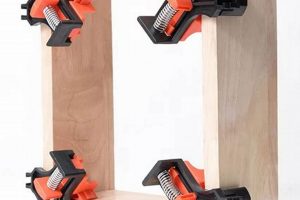
These tools are rigid, typically L-shaped, implements designed to ensure right angles during assembly processes. Fabricated from materials like aluminum or hardened plastic, they provide a reference surface against which workpieces are aligned and secured while adhesives cure or fasteners are installed. For example, these can ensure a cabinet face frame remains square during glue-up.
The employment of such implements significantly improves the accuracy and efficiency of joinery. Utilizing these tools reduces the potential for racking or misalignment, leading to stronger and more aesthetically pleasing finished products. Historically, woodworkers relied on cumbersome jigs or complex measuring techniques to achieve similar results, but advancements in manufacturing have made these precision aids readily accessible.
The subsequent sections will explore specific types, their optimal applications, and best practices for achieving professional-quality results. Understanding their nuanced capabilities will allow for efficient integration into varied projects, from furniture building to cabinet construction.
Essential Guidance for Achieving Accuracy
The following recommendations are designed to maximize the effectiveness of right-angle clamping devices, ensuring precise and consistent results in woodworking projects.
Tip 1: Material Compatibility: Verify the material of the devices is appropriate for the adhesive being used. Certain adhesives may react with or adhere to specific plastics or metals, compromising the tool’s integrity and the workpiece’s finish. Conduct a test on scrap material before applying to the final project.
Tip 2: Surface Preparation: Ensure surfaces of the workpieces are clean and free of debris before applying adhesive and securing the device. Particulates can introduce inaccuracies and weaken the joint. Wipe down surfaces with a tack cloth or appropriate solvent.
Tip 3: Balanced Pressure: Distribute clamping pressure evenly across the joint. Uneven pressure can distort the workpiece or cause misalignment, even with a square reference. Use multiple devices strategically placed along the joint.
Tip 4: Verify Alignment: Prior to adhesive setting, confirm the accuracy of the right angle using a separate measuring tool, such as a precision square or combination square. This provides a secondary check against potential discrepancies.
Tip 5: Prevent Adhesion: Apply a release agent, such as wax paper or Teflon tape, to the faces of the devices that contact the workpiece. This prevents unwanted adhesion between the tool and the project, ensuring easy removal.
Tip 6: Proper Storage: Store the devices in a clean, dry environment to prevent corrosion or deformation. Exposure to extreme temperatures or humidity can compromise their accuracy and longevity. A designated storage rack or container is recommended.
Tip 7: Regular Inspection: Periodically inspect the devices for damage or wear. Cracks, bends, or surface imperfections can affect their accuracy. Replace damaged devices promptly to maintain project quality.
Adhering to these guidelines will minimize errors and enhance the precision of woodworking projects. Consistent application of these techniques will result in stronger joints, improved aesthetics, and professional-quality craftsmanship.
The subsequent discussion will address advanced techniques and troubleshooting common issues encountered during usage.
1. Right-Angle Accuracy

Right-angle accuracy, a fundamental principle in woodworking, dictates that intersecting planes meet at a precise 90-degree angle. Deviations from this standard compromise structural integrity, aesthetic appeal, and functional performance. Clamping squares directly address this critical requirement by providing a rigid, calibrated reference against which components are aligned and secured during assembly. Without adherence to right-angle accuracy, cabinets may not sit flush, drawers may bind, and furniture may exhibit visible distortions. These inaccuracies compound over time, potentially leading to premature failure of the assembled product. The proper employment of these tools, therefore, serves as a preventative measure against such detrimental outcomes. For example, constructing a perfectly square frame for a mirror ensures that the glass fits correctly, the frame appears balanced, and stress points within the structure are minimized.
The practical significance of understanding this connection extends beyond mere assembly. Precise right angles are essential for creating complex joinery, such as dovetails or mortise-and-tenon joints. A skewed angle, even by a fraction of a degree, can prevent proper fit and compromise the strength of the joint. In architectural woodworking, achieving right angles is crucial for installing trim, molding, and wainscoting. Similarly, furniture making demands accurate angles for constructing legs, aprons, and drawers. In each scenario, these tools facilitate the achievement of these critical angles. This also enables replication of identical pieces consistently.
In summary, the connection between right-angle accuracy and these tools is causal: consistent application of these squares directly results in improved accuracy. The challenge, however, lies in selecting squares of sufficient quality and understanding their proper application. Recognizing this relationship is paramount for woodworkers aiming to achieve professional results, ensuring the structural soundness and aesthetic quality of their projects. They are essential to maintain alignment and make structures durable over extended periods.
2. Joint Reinforcement

Joint reinforcement within woodworking refers to techniques and strategies employed to enhance the structural integrity and longevity of connections between wooden components. These techniques often involve mechanical fasteners, adhesives, or specialized joinery methods, all of which benefit from precise alignment and sustained pressure during the assembly process. Clamping squares directly contribute to the efficacy of joint reinforcement by ensuring that components maintain their intended spatial relationship while bonding agents cure or fasteners are secured.
- Maximizing Adhesive Bond Strength
Clamping squares facilitate optimal contact between surfaces joined with adhesives. Proper alignment and sustained pressure during the curing process ensures a uniform bond line and prevents voids that could weaken the joint. An example is gluing a mortise and tenon joint. By holding the assembly at a precise right angle during glue-up, these tools maximize the surface area contact between the mortise and tenon, allowing the adhesive to form a stronger, more durable bond. This is superior to relying solely on gravity or hand pressure, which may lead to misalignment and a compromised bond. The implications are a more structurally sound piece, less prone to separation or failure under stress.
- Enhancing Mechanical Fastener Effectiveness
When using screws, nails, or other mechanical fasteners, these tools provide stability during installation. Maintaining a square orientation ensures that fasteners are driven at the correct angle, maximizing their holding power and minimizing the risk of splitting or damaging the wood. Imagine assembling a drawer box with screws. By aligning the sides with a square, each screw can be driven perpendicular to the joint, providing maximum grip and preventing the drawer from becoming racked or distorted over time. The alternative, driving screws freehand, often results in angled fasteners that weaken the joint and compromise the drawer’s functionality.
- Optimizing Joinery Techniques
Certain joinery techniques, such as dovetails or rabbets, require a high degree of precision to achieve a strong, interlocking connection. Clamping squares provide a stable reference during the glue-up of these joints, ensuring that the components fit together correctly and that the resulting assembly is square and true. For example, when assembling a dovetailed drawer front, clamping squares ensure that the sides are perfectly aligned with the front, creating a seamless and robust joint that can withstand repeated use. Without such alignment, the dovetails may not fully engage, leading to a weak and unsightly joint.
- Preventing Stress Concentrations
Misaligned joints can create stress concentrations that weaken the overall structure. By ensuring that components are joined at the correct angle, these tools help distribute stress evenly throughout the joint, reducing the risk of failure under load. Consider the construction of a table leg. If the leg is not attached perfectly perpendicularly to the table apron, the resulting stress will be concentrated at the point of attachment, potentially causing the leg to break or the apron to crack over time. Employing a square during assembly ensures that the load is distributed evenly, extending the life of the table.
In summary, the application of these tools is intrinsically linked to improved joint reinforcement. By promoting accurate alignment, consistent pressure, and optimized fastener or adhesive performance, these tools contribute directly to the strength, stability, and longevity of woodworking projects. Their usage mitigates common causes of joint failure, ensuring a higher quality finished product.
3. Material Stability
Material stability, in the context of woodworking, denotes the resistance of wood to dimensional changes induced by fluctuations in moisture content, temperature, or applied stress. These changes can manifest as warping, twisting, cupping, or bowing, directly affecting the structural integrity and aesthetic quality of a finished piece. The relationship with right-angle clamping tools lies in their ability to mitigate the effects of these instabilities during assembly. When components are held firmly in a square configuration while adhesives cure or fasteners are applied, the potential for distortion due to inherent stresses within the wood is minimized. The tool effectively constrains the material, forcing it to conform to the desired geometry before the joint is permanently established. For instance, consider the construction of a cabinet door using solid wood. Solid wood is naturally susceptible to expansion and contraction with seasonal humidity changes. If the door frame is not assembled perfectly square, these changes can exacerbate any existing stresses in the wood, causing the door to warp or bind within the cabinet opening. By employing clamping squares during glue-up, the wood is held rigidly in its intended shape, reducing the likelihood of subsequent distortion.
Further, the consistent application of clamping pressure across the joint surface contributes to uniform adhesive bonding. Uneven pressure can result in starved joints, where insufficient adhesive creates weak points prone to failure as the wood undergoes dimensional changes. The rigid structure provides a stable platform, ensuring the applied pressure remains consistent across the joint, optimizing the effectiveness of the adhesive. An example of practical application can be found in edge-gluing multiple boards to create a wider panel. Without proper clamping, the boards may shift during glue-up, resulting in an uneven surface that requires extensive sanding to correct. The use of the tools, coupled with cauls to distribute pressure, ensures that the boards remain aligned, minimizing the need for subsequent rework and preserving the panel’s stability.
In conclusion, these tools directly contribute to material stability in woodworking projects by providing a means of controlling dimensional changes and minimizing stress during assembly. Selecting appropriate species, understanding their moisture content, and subsequently using these tools promotes long term stability. These tools ensure optimal performance and longevity by counteracting the inherent tendencies of wood to warp, twist, or otherwise deform over time. Overcoming the challenges requires awareness of material properties, selection of appropriate adhesives, and consistent application of clamping techniques. This approach is critical for producing high-quality woodworking projects.
4. Versatile Applications
Versatile applications define the broad applicability of tools within woodworking, extending beyond singular, specialized tasks. The utility of right-angle clamping devices exemplifies this principle, finding application in numerous project types and construction phases.
- Cabinetry Construction
In cabinet making, these implements are indispensable for assembling face frames, carcases, and drawers. Maintaining precise right angles is crucial for ensuring proper door and drawer alignment, as well as structural integrity. For example, when assembling a cabinet face frame, these tools provide a stable reference, preventing racking and ensuring that the frame remains square during the glue-up process. The implications include improved functionality, aesthetic appeal, and long-term durability of the finished cabinet.
- Furniture Assembly
The creation of furniture, encompassing tables, chairs, and shelving units, necessitates accurate joinery and stable frameworks. These squares facilitate the construction of right-angled joints, which are essential for structural stability and visual harmony. Consider building a table with legs attached to an apron. Employing these tools guarantees that the legs are perpendicularly aligned, preventing wobbling and ensuring even weight distribution. Without such precision, the table’s stability and appearance would be compromised.
- Picture Framing
Constructing picture frames demands precise corner alignment to ensure a visually appealing and structurally sound finished product. These tools provide a reliable means of achieving accurate right angles during frame assembly. For instance, when joining the corners of a mitered picture frame, these clamps hold the pieces firmly in place, preventing slippage and ensuring a tight, seamless joint. The result is a professional-looking frame that properly supports and showcases the artwork.
- Jig and Fixture Fabrication
The creation of custom jigs and fixtures, often used to streamline repetitive tasks or improve accuracy in woodworking, benefits significantly from these tools. Building a jig requires precise right angles to ensure its proper function and reliability. As an example, constructing a mortising jig necessitates perfectly square corners to guide the router accurately and produce consistent mortises. Incorrect angles would render the jig useless or, worse, lead to inaccurate cuts.
The breadth of these applications underscores the value of right-angle devices as a fundamental woodworking tool. Their ability to enhance precision and stability across diverse projects, from large-scale cabinetry to intricate picture framing, makes them an invaluable asset to any woodworking shop. Additional applications include stair building, door frame construction, and model making, highlighting their adaptability to varying scales and project complexities.
5. Efficiency Enhancement

Efficiency enhancement, a core objective in woodworking, refers to the minimization of time, effort, and material waste required to complete a given task. The implementation of right-angle clamping devices contributes directly to this objective by streamlining assembly processes and reducing the incidence of errors that necessitate rework. Prior to the widespread availability of such tools, achieving accurate right angles often involved painstaking measurement, manual adjustments, and the use of cumbersome jigs. These methods were not only time-consuming but also prone to inaccuracies, leading to misaligned joints and compromised structural integrity. For instance, consider the traditional method of assembling a cabinet carcase. Without these squares, a woodworker would need to meticulously measure each corner, clamp the components together, and then re-measure to ensure squareness. This process could take a considerable amount of time and still result in slight deviations from the desired 90-degree angle. The consequences are gaps, uneven surfaces, and doors that do not close properly. These tools provide an immediate and reliable reference point, accelerating the assembly process and improving the consistency of results.
The practical significance of this efficiency gain extends beyond individual projects. In a production environment, where multiple units are being assembled, the time savings afforded by the squares are amplified. A reduction of even a few minutes per unit can translate into significant cost savings over the course of a production run. Furthermore, the reduced risk of errors minimizes material waste, as fewer components need to be discarded due to misalignment or incorrect cuts. Consider the assembly of multiple picture frames in a workshop. The squares allow workers to rapidly and accurately join the mitered corners, ensuring that each frame is perfectly square and that no material is wasted. This efficiency directly impacts the profitability of the business and its ability to meet customer demands. Efficiency is also improved through the ease of use of these devices. Compared to traditional methods, minimal training is needed to achieve consistent and accurate results.
In summary, the connection between these tools and efficiency enhancement is a direct one: the squares enable woodworkers to achieve accurate right angles more quickly and reliably than traditional methods, leading to reduced labor costs, minimized material waste, and improved overall productivity. The challenges lie in selecting tools of sufficient quality and durability and in employing them correctly to maximize their benefits. However, the rewards in terms of efficiency and quality make them an indispensable asset in any woodworking environment.
6. Durable Construction
Durable construction, referring to the capacity of right-angle clamping devices to withstand sustained use and maintain dimensional accuracy over extended periods, directly influences their effectiveness in woodworking applications. The materials and manufacturing processes employed in creating these squares determine their resistance to wear, impact, and environmental factors that can compromise their integrity. For example, implements fabricated from hardened aluminum or steel offer greater resistance to bending or deformation compared to those made from lower-grade materials or plastics. This inherent durability is essential for ensuring that the square provides a reliable and consistent reference point for achieving accurate right angles during assembly. Failure to maintain dimensional accuracy results in compromised joint integrity and structural instability within the woodworking project.
The connection between durable construction and the performance of these squares is causal. A robustly constructed implement maintains its precise 90-degree angle under clamping pressure and repeated use, whereas a poorly constructed one may deflect or distort, leading to inaccuracies in the assembled project. Consider a cabinetmaker repeatedly using a clamping square to assemble face frames. A durable square retains its shape and accuracy after numerous clamping cycles, consistently producing square and true frames. Conversely, a square made from flimsy material may bend or flex under pressure, resulting in frames that are slightly out of square, leading to problems with door alignment and overall cabinet aesthetics. The investment in high-quality, durably constructed squares, therefore, translates directly into improved accuracy and reduced rework in woodworking projects.
In summary, the long-term utility and precision of woodworking projects are intrinsically linked to the durable construction of right-angle clamping squares. Their role in resisting distortion and maintaining consistent accuracy underscores the necessity of selecting implements manufactured from high-quality materials and employing robust construction techniques. This focus on durability mitigates the risk of compromised joint integrity and structural instability, ensuring consistently high-quality finished products and a reliable shop environment.
7. Project Consistency

Project consistency in woodworking entails the production of identical components and assemblies across multiple iterations, minimizing variations in dimensions, angles, and overall quality. The direct causal link between using precision clamping squares and achieving consistency stems from their ability to enforce accurate right angles repeatedly. Without these tools, reliance on manual measurement and visual estimation introduces inherent human error, leading to variations in joint alignment and overall dimensions. For example, when building multiple identical cabinet doors, these implements ensure each frame is precisely square, guaranteeing uniform fit and appearance. A deviation in squareness, even by a fraction of a degree, accumulates across multiple doors, resulting in noticeable discrepancies and compromised aesthetics. The clamping square, therefore, is not merely an accessory but a critical component in ensuring uniform results.
Consider a scenario involving the fabrication of multiple identical shelving units. Each unit requires precisely aligned shelves to ensure stability and aesthetic appeal. Using a square during the assembly process ensures the shelves are consistently perpendicular to the vertical supports, preventing racking and maintaining uniform shelf spacing. Alternatively, freehand assembly or reliance on less accurate methods can lead to shelves that are slightly skewed, resulting in a visually unappealing and structurally unstable final product. The practical application extends to mass production settings where minimizing variation is paramount for efficient assembly and quality control. The investment in these tools not only improves the quality of the finished product but also reduces the need for rework and minimizes material waste, ultimately leading to greater cost-effectiveness.
In summary, the ability to maintain project consistency in woodworking is significantly enhanced by the consistent application of precision clamping squares. Their role in enforcing accurate right angles minimizes the accumulation of errors, leading to uniform dimensions, stable structures, and visually appealing finished products. The challenge lies in selecting squares of sufficient quality and employing consistent clamping techniques. Embracing this relationship is crucial for woodworkers aiming to achieve professional-grade results and uphold a reputation for quality and precision.
Frequently Asked Questions about Clamping Squares for Woodworking
The subsequent queries address common uncertainties associated with employing right-angle clamping devices in woodworking practice.
Question 1: What materials are best suited for construction?
Hardened aluminum alloys and precision-ground steel are generally preferred due to their dimensional stability and resistance to wear. While plastic variants exist, they may be less reliable in maintaining accuracy over extended periods of use.
Question 2: How does one ensure accurate right angles?
Employing certified squares verified with precision measuring instruments is recommended. Regular calibration against a known reference standard helps mitigate potential deviations arising from handling or storage.
Question 3: What clamping pressure is optimal?
The appropriate clamping pressure varies depending on the materials being joined and the adhesive employed. Excessive pressure can distort the workpiece or compromise the joint, while insufficient pressure may lead to a weak bond. Experimentation with scrap material is advisable.
Question 4: How does one prevent adhesive adherence?
Application of a release agent, such as wax paper or PTFE tape, to the faces that contact the workpiece minimizes unwanted bonding. Care should be taken to avoid contaminating the bonding surfaces with the release agent.
Question 5: How should they be stored to maintain accuracy?
Store them in a clean, dry environment, away from direct sunlight and extreme temperature fluctuations. Suspending them or storing them flat prevents bending or warping.
Question 6: When should these implements be replaced?
Replace implements exhibiting visible damage, such as cracks, bends, or surface imperfections that compromise their ability to provide a reliable 90-degree reference. Regular inspection is crucial.
The consistent and informed application of these guidelines will maximize the effectiveness of clamping squares and yield improved results.
The following section addresses common troubleshooting scenarios.
Conclusion
The preceding analysis has elucidated the pivotal role of clamping squares for woodworking in achieving precision and structural integrity within woodworking projects. From right-angle accuracy and joint reinforcement to material stability and efficiency enhancement, these implements serve as indispensable tools for woodworkers of all skill levels. The consistent application of properly calibrated clamping squares for woodworking is demonstrably linked to superior project outcomes.
The principles and practices outlined herein represent a foundational understanding of the impact these tools can have. Continued dedication to refining technique and maintaining equipment will invariably lead to enhanced craftsmanship and enduring value. Further research and experimentation with varying materials and methods is encouraged to fully leverage the capabilities of clamping squares for woodworking and elevate the standards of woodworking practice.
![Top-Rated: Best Quick Clamps for Woodworking Projects [2024] | Step-by-Step Guides, Tools & Inspiration to Build Beautiful Wooden Decor on a Budget](https://woodfromhome.com/wp-content/uploads/2026/04/th-264-300x200.jpg "Top-Rated: Best Quick Clamps for Woodworking Projects [2024] Step-by-Step Guides, Tools & Inspiration to Build Beautiful Wooden Decor on a Budget")