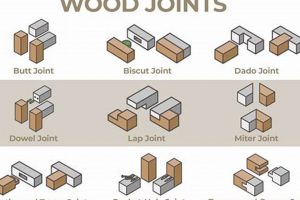
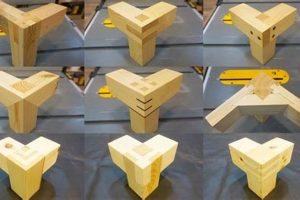
Interlocking wood joinery, often employed in creating strong and visually appealing corners, involves a series of pins and slots that mesh together to form a robust connection. This technique, typically seen in box construction, maximizes glue surface area, enhancing the joint’s overall strength and durability compared to simpler alternatives. The result is a mechanically sound and aesthetically pleasing corner, suitable for a wide range of woodworking projects.
The implementation of this particular type of joint offers several advantages. Its robust nature makes it ideal for applications requiring significant structural integrity. Moreover, the exposed end grain pattern creates an attractive visual element, lending a handcrafted quality to the finished piece. Historically, this method has been favored for its ability to withstand stress and resist racking, contributing to the longevity of furniture and other wooden articles. The method is a testament to combining functionality with aesthetic appeal.
The following sections will delve into the methods for creating this robust joinery, including the necessary tools and techniques, variations in design, and considerations for wood selection. Furthermore, we will explore the potential applications and finishing options available to enhance the visual appeal and protect the integrity of the finished product.
Expert Guidance on Interlocking Joinery
Achieving precision and strength in interlocking joinery requires careful planning and execution. The following tips provide guidance for optimizing the process and ensuring a high-quality result.
Tip 1: Material Selection: Prioritize hardwoods with straight grain for optimal strength and clean cuts. Avoid woods with excessive knots or irregularities, as these can compromise the integrity of the joint.
Tip 2: Accurate Measurements: Precise measurements are critical. Utilize a reliable marking gauge and ensure consistent pin and slot widths. Small errors can accumulate, leading to a poorly fitting and structurally weak joint.
Tip 3: Tooling Considerations: Employ sharp, high-quality blades or router bits specifically designed for creating clean, square edges. Dull tools can cause tear-out and uneven surfaces, affecting the joint’s appearance and strength.
Tip 4: Jig Construction: A well-constructed jig is essential for repetitive accuracy. Ensure the jig is securely mounted and that the workpiece is firmly held in place during the cutting process. Consider using clamps to prevent movement.
Tip 5: Test Cuts: Before committing to the final workpiece, perform test cuts on scrap material to verify jig settings and blade alignment. This allows for adjustments and prevents costly mistakes on the project materials.
Tip 6: Glue Application: Apply glue evenly and liberally to all mating surfaces. Ensure adequate clamping pressure to promote a strong bond. Wipe away excess glue immediately to prevent staining and simplify finishing.
Tip 7: Finishing Techniques: When sanding, take care to maintain the crisp edges of the joinery. Avoid rounding over the corners, as this can detract from the joint’s visual appeal. Consider using a clear finish to highlight the wood’s natural grain and the intricate pattern of the joint.
Implementing these recommendations will contribute to the creation of durable and visually appealing interlocking joints. Attention to detail and adherence to sound woodworking principles are paramount for achieving professional results.
The subsequent sections will address advanced techniques and troubleshooting strategies for refining the construction of this refined joinery. Further mastery awaits persistent, inquisitive learning.
1. Joint Strength
Joint strength is a primary attribute intrinsically linked to the design and execution of interlocking joinery. The configuration, characterized by numerous interlocking fingers, maximizes the surface area available for adhesive bonding. This increased surface area, when properly glued, translates directly into enhanced resistance against shear and tensile forces. The inherent mechanical interlock also contributes to its overall structural integrity, particularly in resisting racking or deformation under load. A poorly executed joint, however, compromises these benefits. Gaps due to inaccurate cuts reduce glue surface, diminishing strength. Improper wood selection can lead to joint failure, as softer woods may compress or split under stress. Thus, joint strength is not merely a byproduct of the joinery’s design, but rather a result of meticulously controlled parameters.
Consider, for instance, the construction of drawers for heavy-duty storage cabinets. The ability of the drawers to withstand repeated opening and closing, as well as the weight of their contents, depends heavily on the robustness of the corner joints. Interlocking joinery, in this context, provides a superior alternative to butt joints or simple rabbet joints, which are more susceptible to failure under similar conditions. Likewise, in the creation of speaker enclosures, where vibration and structural integrity are crucial, the employment of this robust joint is advantageous in preventing air leaks and maintaining the enclosure’s acoustic properties. The longevity and reliability of these products directly correlate with the strength of the corner connections, highlighting the practical application of this method.
In summation, joint strength is a fundamental component of successful interlocking joinery. The relationship is one of cause and effect: a well-executed box joint inherently provides superior strength due to its design and construction. However, achieving this strength requires meticulous attention to detail, precise execution, and appropriate material selection. Understanding and prioritizing joint strength is not merely a theoretical consideration, but a practical necessity for any woodworking project where structural integrity and durability are paramount. Ignoring this fundamental element results in compromised structural integrity and product failure.
2. Precise Cuts

The successful creation of interlocking finger joints is inextricably linked to the execution of precise cuts. This joinery’s design relies on the accurate meshing of individual fingers, demanding dimensional consistency across all components. Deviations in width or thickness, even minor, accumulate and result in a poorly fitting joint, compromising its structural integrity and aesthetic appeal. The accuracy of these cuts is not merely a matter of cosmetic concern; it directly influences the glue surface area and the overall strength of the assembled piece.
Consider the construction of a jewelry box. The tight tolerances required to create a seamless and visually appealing corner necessitate highly accurate cuts. Gaps or misalignments would not only detract from the box’s aesthetic value but also weaken the joint, rendering it susceptible to damage. Similarly, in constructing drawers for fine furniture, the smooth operation and durability of the drawer depend on the precise fit of the corner joints. Imprecise cuts will lead to drawers that are either too tight and difficult to open or too loose and prone to racking. The use of specialized tools, such as precision saws, router jigs, and digital measuring devices, is essential to consistently achieve the required level of accuracy.
In conclusion, precise cuts form the bedrock of interlocking finger joint construction. The relationship is causal: inaccurate cuts inevitably lead to a weakened joint and a diminished overall product. The ability to consistently produce accurate and repeatable cuts, therefore, is paramount. This necessitates an understanding of proper tool usage, precise measurement techniques, and a commitment to meticulous craftsmanship. Recognizing the central role of precise cuts is not merely an academic exercise but a prerequisite for achieving professional-grade woodworking results when employing this robust joint construction.
3. Accurate Jigs

The creation of precise interlocking finger joints frequently relies upon the use of jigs. These fixtures guide cutting tools, ensuring consistent and repeatable results. The accuracy of the jig directly influences the quality of the finished joint, making its construction and calibration critical components of the woodworking process.
- Indexing Precision
The primary function of a jig is to provide accurate indexing for each finger cut. The indexing mechanism must be robust and free of play to ensure uniform spacing. Any error in indexing will be compounded across the joint, resulting in misaligned fingers and a weakened structure. Inadequate indexing causes gaps and variations in the joint’s appearance.
- Tool Guidance
Jigs guide the cutting tool, maintaining consistent depth and angle of cut. Whether using a router or a saw, the jig must provide a stable platform that eliminates vibration and prevents the tool from deviating from the intended path. The absence of this guidance leads to uneven finger profiles and compromised fit. For instance, a poorly designed router jig may allow the bit to wander, producing rounded edges instead of square ones.
- Material Stability
The jig itself must be constructed from stable materials to prevent warping or distortion. Changes in temperature or humidity can affect the jig’s dimensions, leading to inaccuracies in the joint. Selecting materials such as Baltic birch plywood or aluminum is advantageous. Unstable jig materials, like softwood, tend to expand and contract.
- Clamping Security
Effective clamping mechanisms are essential to securely hold the workpiece during the cutting process. The workpiece must be firmly held against the jig to prevent movement or slippage. Inadequate clamping can result in inconsistent finger widths and depths. Toggle clamps or cam clamps are common fixtures that can secure the material.
The relationship between accurate jigs and robust interlocking finger joints is direct and causal. A well-constructed and properly calibrated jig is essential for achieving the precision required for strong, visually appealing joints. Conversely, a poorly designed or maintained jig will inevitably result in compromised joint quality. Therefore, investment in quality jig construction and careful attention to its setup and maintenance are paramount for successful woodworking projects using this specific type of joinery.
4. Wood Selection

The choice of wood significantly impacts the strength, durability, and aesthetic qualities of interlocking finger joints. Certain wood species possess characteristics that render them more suitable for this joinery method, influencing both the ease of construction and the longevity of the finished product. Appropriate wood selection is therefore a critical consideration.
- Hardness and Density
Hardwoods, characterized by their density and close grain structure, generally outperform softwoods in finger joint applications. Species such as maple, oak, and cherry provide superior resistance to wear and tear, crucial for joints subjected to stress. The hardness of the wood prevents crushing of the fingers under load, maintaining the joint’s integrity. Conversely, using softer woods like pine or fir may result in weakened joints that are prone to failure. For example, oak is well-suited for drawer boxes in heavily used dressers, while pine would be more appropriate for lightweight decorative boxes.
- Grain Orientation
Straight-grained wood is preferable to wood with irregular or swirling grain patterns. Straight grain facilitates clean, precise cuts, essential for achieving tight-fitting fingers. Wood with wild grain is prone to tear-out during machining, resulting in jagged edges and compromised joint strength. Careful consideration of grain orientation also minimizes the risk of warping or twisting, maintaining the joint’s alignment over time. When crafting a mitered box with finger joints, straight-grained hardwoods like maple are often selected to ensure uniformity and precision along all edges.
- Dimensional Stability
Woods with low shrinkage and expansion rates are ideal for applications where dimensional stability is paramount. Species like walnut and mahogany exhibit minimal movement in response to changes in humidity, reducing the risk of joint failure or distortion. Highly reactive woods, such as some types of pine, are more susceptible to swelling and shrinking, potentially compromising the joint’s integrity. Consequently, walnut is favored for constructing heirloom-quality boxes where maintaining consistent dimensions is crucial, ensuring a lasting and robust build.
- Gluing Properties
Certain wood species bond more readily with adhesives than others. Woods with high oil content, such as teak or rosewood, may require special preparation to ensure proper glue adhesion. Porous woods like poplar absorb glue readily, creating a strong bond. The wood’s cell structure and density influence glue penetration and mechanical interlocking. A close-grained wood species, properly prepared and paired with the appropriate adhesive, will generally result in a stronger and more durable joint. The choice of wood, therefore, must be considered alongside the selection of an appropriate adhesive.
In summary, the selection of wood is a crucial determinant in the success of interlocking finger joint construction. Considerations such as hardness, grain orientation, dimensional stability, and gluing properties directly impact the strength and longevity of the joint. Choosing the appropriate wood species, therefore, is not merely an aesthetic decision but a critical step in ensuring the structural integrity and durability of the woodworking project.
5. Glue Application
The efficacy of interlocking finger joints hinges critically on proper adhesive application. The inherent design, characterized by an extensive surface area, necessitates a uniform and sufficient layer of glue to ensure a strong and durable bond. Inadequate glue application translates directly into a weakened joint, negating the mechanical advantages of the interlocking structure. Conversely, excessive glue can impede proper clamping, leading to starved joints or unsightly squeeze-out. Achieving the correct balance is therefore paramount. For example, constructing a bookshelf using interlocking finger joints demands that each finger receives an even coating of adhesive. The strength of the shelf to withstand load depends upon the cohesive strength delivered by the glue layer between each finger connection.
The type of adhesive employed also impacts the overall performance of the joint. Wood glues, specifically polyvinyl acetate (PVA) adhesives, are commonly favored due to their strength, ease of use, and suitability for wood. However, specialized adhesives, such as epoxy or polyurethane glues, may be preferable for applications requiring water resistance or gap-filling properties. Surface preparation further influences the adhesive bond. Clean, dry surfaces are essential for optimal adhesion. Contaminants, such as dust or oil, impede the formation of a strong bond, leading to joint failure. Sanding or degreasing the surfaces before applying glue enhances adhesion and ensures long-term structural integrity. The proper cleaning and glue-up on an interlocking finger jointed box, intended for outdoor use, is essential for water to be kept out and the joint to maintain integrity.
In summary, adhesive application represents a cornerstone of successful interlocking finger joint construction. It is a pivotal component, ensuring the translation of mechanical advantage into actual structural integrity. The careful selection of appropriate glue, meticulous surface preparation, and precise application techniques are all essential for maximizing the joint’s strength and durability. Overlooking or underemphasizing adhesive application risks compromising the entire structure. It is a fundamental element, requiring the same degree of attention as material selection and cutting precision.
Frequently Asked Questions on Box Joints Woodworking
This section addresses common queries regarding interlocking finger joints, offering concise and authoritative answers to enhance understanding of this woodworking technique.
Question 1: What advantages does interlocking finger joints offer compared to simpler joints like butt joints?
Interlocking finger joints offer significantly enhanced strength due to the increased glue surface area and mechanical interlock. Butt joints rely solely on adhesive bonding at the end grain, which is inherently weaker.
Question 2: Is specialized equipment required to create interlocking finger joints?
While hand tools can be used, specialized equipment such as a table saw with a finger joint jig or a router with a dovetail jig facilitates faster, more accurate, and more consistent joint creation.
Question 3: What wood species are most suitable for interlocking finger joints?
Hardwoods, such as maple, oak, and cherry, are generally preferred due to their density and resistance to wear. Softwoods can be used for less demanding applications.
Question 4: How critical is precision when cutting the fingers for this type of joint?
Precision is paramount. Even minor deviations accumulate, leading to a poorly fitting joint that compromises strength and aesthetic appeal. Accurate measurements and consistent cutting are essential.
Question 5: What type of adhesive is recommended for interlocking finger joints?
Polyvinyl acetate (PVA) wood glues are commonly recommended for their strength and ease of use. Epoxy or polyurethane adhesives may be considered for applications requiring water resistance or gap-filling properties.
Question 6: How can joint failure be prevented?
Joint failure can be minimized by selecting appropriate wood species, ensuring precise cuts, using a well-constructed jig, applying adhesive properly, and providing adequate clamping pressure during the curing process.
In summary, interlocking finger joints provide a robust and visually appealing joinery solution when constructed with careful attention to detail and adherence to best practices.
The next section will explore advanced techniques and variations of interlocking finger joints, providing insights into further refinement of this woodworking skill.
Box Joints Woodworking
This exploration of box joints woodworking has illuminated the key factors contributing to the success of this robust joinery method. From wood selection and jig construction to precise cutting and adhesive application, each element plays a crucial role in achieving a strong and visually appealing joint. The discussion has emphasized the importance of precision, proper technique, and a thorough understanding of the materials involved.
Mastery of box joints woodworking offers significant advantages to woodworkers, providing a durable and aesthetically pleasing solution for a wide range of projects. Continued dedication to refining technique and exploring advanced methods will undoubtedly enhance the craftsperson’s capabilities and contribute to the creation of lasting, high-quality pieces. This expertise translates directly to superior craftsmanship and enduring structural integrity in woodworking endeavors.