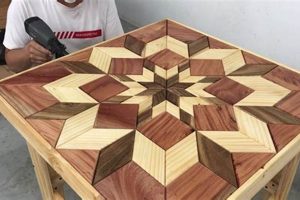
The application of a handheld or table-mounted power tool to shape wood, create joinery, or hollow out areas constitutes a significant subset of woodworking practices. This technique allows for the creation of decorative edges, precise grooves for joinery, and intricate surface patterns. For example, crafting a Roman ogee edge on a table top, cutting a dado for a shelf to fit into, or creating a sign with recessed lettering all exemplify this method.
The benefits of this woodworking technique are multifaceted. It offers precision and repeatability, allowing for identical cuts to be made across multiple workpieces. This is particularly crucial for projects requiring consistency, such as cabinet making or producing multiple copies of a product. Furthermore, the historical adoption of this technique reflects its ability to efficiently execute complex designs that would be time-consuming and difficult to achieve with hand tools alone. This efficiency translates to increased productivity and opens possibilities for more elaborate designs.
The subsequent discussion will explore a variety of applications, including edge profiling, joinery creation, template routing, and decorative carving. Each of these applications demonstrates the versatility of this woodworking approach and provides a foundation for woodworkers of all skill levels to expand their repertoire of techniques.
Guidance on Routing Techniques
Effective and safe routing requires adherence to best practices. These tips aim to improve the quality of work and enhance user safety when employing a router in woodworking.
Tip 1: Secure Workpiece Fixation: Ensure the workpiece is firmly clamped or held in a vise. Movement during the routing process can lead to inaccurate cuts and potential kickback.
Tip 2: Select Appropriate Cutter Speed: Consult the router bit manufacturer’s recommendations for optimal speed settings. Excessive speed can cause burning and premature bit wear; insufficient speed can lead to poor cut quality.
Tip 3: Implement Multiple Passes for Deep Cuts: Avoid attempting to remove excessive material in a single pass. Multiple shallow passes reduce stress on the router and bit, resulting in a smoother, cleaner cut.
Tip 4: Maintain Consistent Feed Rate: A uniform feed rate prevents burning and chatter. Avoid pausing during the cut, as this can leave marks on the wood.
Tip 5: Employ Dust Collection: Routing generates substantial amounts of dust. Utilizing a dust collection system improves visibility, promotes a healthier work environment, and reduces cleanup time.
Tip 6: Regularly Inspect Router Bits: Examine router bits for signs of wear, damage, or dullness before each use. Dull or damaged bits can produce poor results and increase the risk of kickback. Replace or sharpen bits as needed.
Tip 7: Use Push Sticks and Featherboards: When routing small or narrow pieces, utilize push sticks to keep hands safely away from the bit. Featherboards provide consistent pressure against the fence, ensuring accurate and safe cuts.
These guidelines, when consistently applied, contribute to safer and more precise woodworking using a router. By adhering to these practices, woodworkers can maximize the tool’s potential and minimize the risk of errors or injuries.
The subsequent section will address common mistakes in routing and provide strategies for their avoidance, further refining the skills necessary for effective routing applications.
1. Edge profile creation

Edge profile creation represents a fundamental application within the broader scope of techniques employing a router. The ability to shape the edges of wooden workpieces opens avenues for both aesthetic enhancement and functional refinement. The following discussion will examine critical facets of edge profiling, illustrating its integration with the capabilities of a router.
- Decorative Enhancement
Edge profiles significantly contribute to the visual appeal of furniture, cabinetry, and decorative items. Roundovers, chamfers, ogees, and coves transform plain edges into visually interesting features. A router, equipped with the appropriate bit, allows for the precise and repeatable creation of these profiles, ensuring consistency across multiple components of a project.
- Functional Improvement
Beyond aesthetics, edge profiles can enhance functionality. A rounded edge on a table or countertop eliminates sharp corners, improving comfort and safety. Similarly, a bullnose edge on a stair tread can increase its durability and resistance to wear. The versatility of a router allows for the creation of custom profiles tailored to specific functional requirements.
- Material Selection and Considerations
Successful edge profiling requires careful consideration of material properties. Hardwoods like maple and oak generally produce cleaner, sharper profiles than softwoods like pine. Grain direction also influences the outcome; routing against the grain can lead to tear-out, especially in softer woods. Appropriate bit selection and routing techniques are crucial to mitigating these challenges.
- Template and Guide Usage
For complex or repeated edge profiles, templates and guides offer increased precision and efficiency. A template, made from a durable material like plywood or acrylic, guides the router along a predetermined path, ensuring consistent results across multiple workpieces. This technique is particularly useful for creating curved or irregular edge profiles that would be difficult to achieve freehand.
In summary, edge profile creation with a router is a multifaceted process that combines technical skill with aesthetic awareness. By carefully considering material properties, bit selection, and appropriate techniques, woodworkers can leverage the capabilities of a router to create edges that are both visually appealing and functionally superior, furthering the overall quality and value of the finished piece.
2. Joinery Precision

Joinery precision, when intertwined with router-based techniques, significantly impacts the structural integrity and aesthetic quality of woodworking projects. The router’s capabilities, when applied judiciously, enable the creation of tight-fitting, durable joints, enhancing both the longevity and the visual appeal of the finished piece.
- Mortise and Tenon Joints
Routers facilitate the creation of accurate mortises and tenons, critical for strong and stable connections in furniture and frames. The use of jigs and templates, coupled with appropriate router bits, allows for the consistent production of mortises and tenons with precise dimensions. A properly executed mortise and tenon joint, achieved with router assistance, provides exceptional resistance to racking and tensile forces.
- Dovetail Joints
While often associated with hand-tool techniques, dovetail joints can be efficiently and accurately created with a router using specialized jigs. Dovetail joints, renowned for their mechanical strength and visual appeal, offer superior resistance to pull-out forces compared to other joint types. Router-cut dovetails, when properly executed, exhibit clean lines and tight fits, contributing to the overall quality of the piece.
- Rabbet and Dado Joints
Rabbet and dado joints, commonly used in cabinet construction and shelving, are readily and precisely cut with a router. The use of a straight bit and a fence or guide ensures consistent depth and width, resulting in joints that fit together snugly and squarely. These joints provide excellent support for shelves and panels, contributing to the structural stability of the assembly.
- Miter Joints
Routers, combined with a miter sled or a specialized miter joint router bit, facilitate the creation of precise miter joints for frames and boxes. Accurate miter joints, essential for achieving seamless corners, require precise angle cuts and tight fits. Router-assisted miter joints, when properly assembled, exhibit clean, crisp corners, enhancing the visual appeal of the finished product.
The strategic application of routers in joinery not only streamlines the construction process but also elevates the quality and durability of the final product. By leveraging the precision and repeatability of routers, woodworkers can consistently create robust and visually appealing joinery, contributing to the longevity and value of their projects. Router woodworking ideas enhance the capabilities of woodworkers to fabricate complex joints with a high degree of accuracy.
3. Template accuracy

The effectiveness of router-based woodworking is inextricably linked to template accuracy. A template serves as a precise guide, dictating the path of the router bit and, consequently, the shape and dimensions of the resulting workpiece. Inaccurate templates invariably translate to inaccurate cuts, rendering the finished product substandard. This cause-and-effect relationship underscores the critical importance of template accuracy as a foundational component of successful applications. For instance, crafting identical chair legs or replicating intricate molding profiles demands meticulous template construction to ensure uniformity and adherence to design specifications. The slightest deviation in the template is amplified in the final product, compromising the intended outcome.
The selection of materials for template creation, the precision of the template-making process, and the method of template attachment to the workpiece all contribute significantly to the final result. High-density materials, such as acrylic or MDF, provide a stable and consistent surface, minimizing the risk of warping or distortion. Precision cutting tools and techniques are essential for creating templates with accurate dimensions and smooth edges. Securely fastening the template to the workpiece prevents slippage during the routing process, ensuring that the router follows the intended path precisely. The use of double-sided tape or clamps, depending on the application, helps maintain stability and alignment.
In conclusion, template accuracy is not merely a desirable attribute but a fundamental requirement for achieving high-quality results in woodworking using a router. Its impact permeates every stage of the process, from initial design to final execution. Addressing the challenges associated with template creation and utilization, and understanding the implications of template inaccuracies, is crucial for realizing the full potential of router-based woodworking techniques. A precise template, therefore, forms the bedrock upon which successful outcomes are built.
4. Surface embellishment

Surface embellishment, when achieved through the application of router techniques, transforms utilitarian wooden surfaces into visually engaging and textured compositions. This transformation elevates the aesthetic value of woodworking projects, adding a layer of artistic expression and detail that distinguishes them from purely functional pieces. The router’s capacity for precise material removal enables the creation of a diverse range of decorative effects, enhancing the tactile and visual properties of the wood.
- Fluting and Reeding
Fluting, characterized by shallow, concave grooves, and reeding, its convex counterpart, represent classic forms of surface ornamentation achievable with a router. These linear patterns, often applied to columns, pilasters, and furniture legs, add visual rhythm and depth to otherwise plain surfaces. The consistent spacing and uniform depth of flutes and reeds, readily achieved with a router and appropriate jig, contribute to a sense of refined elegance.
- Decorative Carving
Routers, when equipped with carving bits and guided by templates, facilitate the creation of intricate surface carvings. These carvings can range from simple geometric patterns to complex relief sculptures, imbuing wooden surfaces with artistic expression and detail. The precision of the router allows for the faithful reproduction of intricate designs, adding a personal touch to woodworking projects.
- Texturing and Stippling
Texturing and stippling techniques, implemented with specialized router bits, create tactile surfaces that invite touch and enhance visual interest. These techniques involve the controlled removal of small amounts of material, resulting in a randomized pattern of depressions and elevations. Texturing and stippling can be used to add rustic charm to furniture, create non-slip surfaces, or simply enhance the aesthetic appeal of a wooden object.
- Lettering and Signage
Routers excel at creating precise lettering and signage on wooden surfaces. Using templates or CNC-controlled routers, woodworkers can accurately reproduce letters, numbers, and symbols, adding personalized messages or identifying marks to their creations. Router-cut lettering is commonly used for creating signs, plaques, and decorative labels, enhancing the functionality and aesthetic appeal of wooden items.
The versatility of the router in surface embellishment empowers woodworkers to transform ordinary wooden surfaces into captivating works of art. By combining technical skill with creative vision, woodworkers can leverage the precision and control of routers to add depth, texture, and personalized details to their projects, elevating the overall quality and aesthetic value of the finished product.
5. Material compatibility
The selection of wood species and its inherent properties profoundly impacts the outcome of router-based woodworking endeavors. Effective router application mandates a thorough understanding of wood density, grain orientation, and resin content. For instance, attempting to rout intricate details into a highly resinous softwood such as pine frequently results in tear-out, a phenomenon where wood fibers are pulled away from the surface, compromising the intended design. Conversely, dense hardwoods, like maple or oak, generally yield cleaner cuts but may require specialized router bits and slower feed rates to prevent burning or excessive bit wear. The success of many woodworking ideas depends heavily on this understanding of material characteristics.
Grain orientation exerts a significant influence on cut quality. Routing against the grain often leads to splintering and uneven surfaces, particularly in species with interlocked grain patterns. Therefore, careful planning and execution are essential to minimize the risk of tear-out. The choice of router bit geometry is another critical factor. Spiral upcut bits tend to lift wood fibers, making them suitable for mortise creation but potentially problematic for edge profiling. Downcut bits, conversely, compress the fibers, producing cleaner edges but potentially hindering chip evacuation in deep cuts. Adjusting router speed is also vital; higher speeds may be appropriate for hardwoods, while lower speeds can prevent burning in softwoods. Ignoring these variables causes subpar outcomes.
Ultimately, mastering material compatibility constitutes a cornerstone of proficient router woodworking. Woodworkers must acknowledge the interplay between wood characteristics, router settings, and bit selection to achieve optimal results. While the selection of creative router woodworking ideas is important, a lack of attention to material characteristics can render these ideas unrealizable. Careful consideration of these factors, often acquired through experience and experimentation, empowers woodworkers to navigate the challenges posed by diverse wood species and create projects that exhibit both aesthetic appeal and structural integrity. Therefore, a holistic understanding of material compatibility underpins successful router woodworking projects.
Frequently Asked Questions Regarding Router Woodworking Techniques
This section addresses common queries and misconceptions regarding the application of routers in woodworking, providing concise and informative answers to enhance understanding and promote safe and effective practices.
Question 1: What are the primary safety precautions necessary when operating a router?
Eye and ear protection are paramount. Secure workpiece fixation is essential to prevent movement during cutting. Understanding the direction of cut to avoid kickback is crucial. Routine inspection of router bits for sharpness and damage is mandatory prior to each use. Disconnecting the power source during bit changes or adjustments is imperative.
Question 2: What factors influence the selection of a router bit for a specific task?
The type of cut required (e.g., straight, curved, profiled), the material being worked (e.g., hardwood, softwood, composite), and the desired finish quality dictate bit selection. Bit geometry, cutting edge material (e.g., carbide, high-speed steel), and shank diameter must align with project requirements. Consult bit manufacturer specifications for optimal usage guidelines.
Question 3: How does router speed affect the quality of the cut and the lifespan of the bit?
Excessive router speed can lead to burning, chatter, and premature bit wear. Insufficient speed can result in rough cuts and increased stress on the router motor. Variable speed routers offer the ability to optimize speed for different materials and bit sizes. Consulting bit manufacturer recommendations for appropriate speed settings is advisable.
Question 4: What techniques minimize tear-out when routing against the grain?
Employing climb cutting (routing in the opposite direction of the bit’s rotation) can reduce tear-out, although it requires enhanced control due to the increased risk of kickback. Using a backer board to support the wood fibers can provide additional support. Shallow passes and sharp router bits are also beneficial. Selecting wood species with less interlocked grain minimizes the potential for tear-out.
Question 5: How can templates and jigs improve accuracy and repeatability in router woodworking?
Templates provide a physical guide for the router bit, ensuring consistent shape and dimensions across multiple workpieces. Jigs facilitate repetitive cuts, such as mortises or dadoes, with enhanced precision. Constructed from durable materials, templates and jigs minimize errors and improve efficiency, particularly in production environments.
Question 6: What are the advantages of using a table-mounted router versus a handheld router?
Table-mounted routers offer increased stability and control, particularly for smaller workpieces. They facilitate the use of fences and featherboards, enhancing accuracy and safety. Table-mounted routers are well-suited for edge profiling and joinery, whereas handheld routers provide greater versatility for tasks such as template routing and freehand shaping.
Effective router woodworking relies on a combination of technique, tool selection, and adherence to safety protocols. Understanding the principles outlined in these FAQs will contribute to improved outcomes and a safer working environment.
The subsequent section will address advanced applications and specialized techniques in router woodworking, further expanding the skill set required for complex projects.
Conclusion
This exposition has detailed the expansive realm of applications possible with “router woodworking ideas”. Key areas, encompassing edge profiling, joinery creation, template utilization, surface embellishment, and material compatibility, have been examined. The significance of technique, safety, and equipment maintenance has been underscored throughout this exploration.
The discussed techniques represent a foundation for woodworking endeavors. Continued experimentation, coupled with an unwavering commitment to safety and precision, remains paramount. The pursuit of mastery in this field necessitates ongoing learning and refinement, ensuring both the quality and longevity of crafted pieces.